


Photo Feature | Night of the goddess

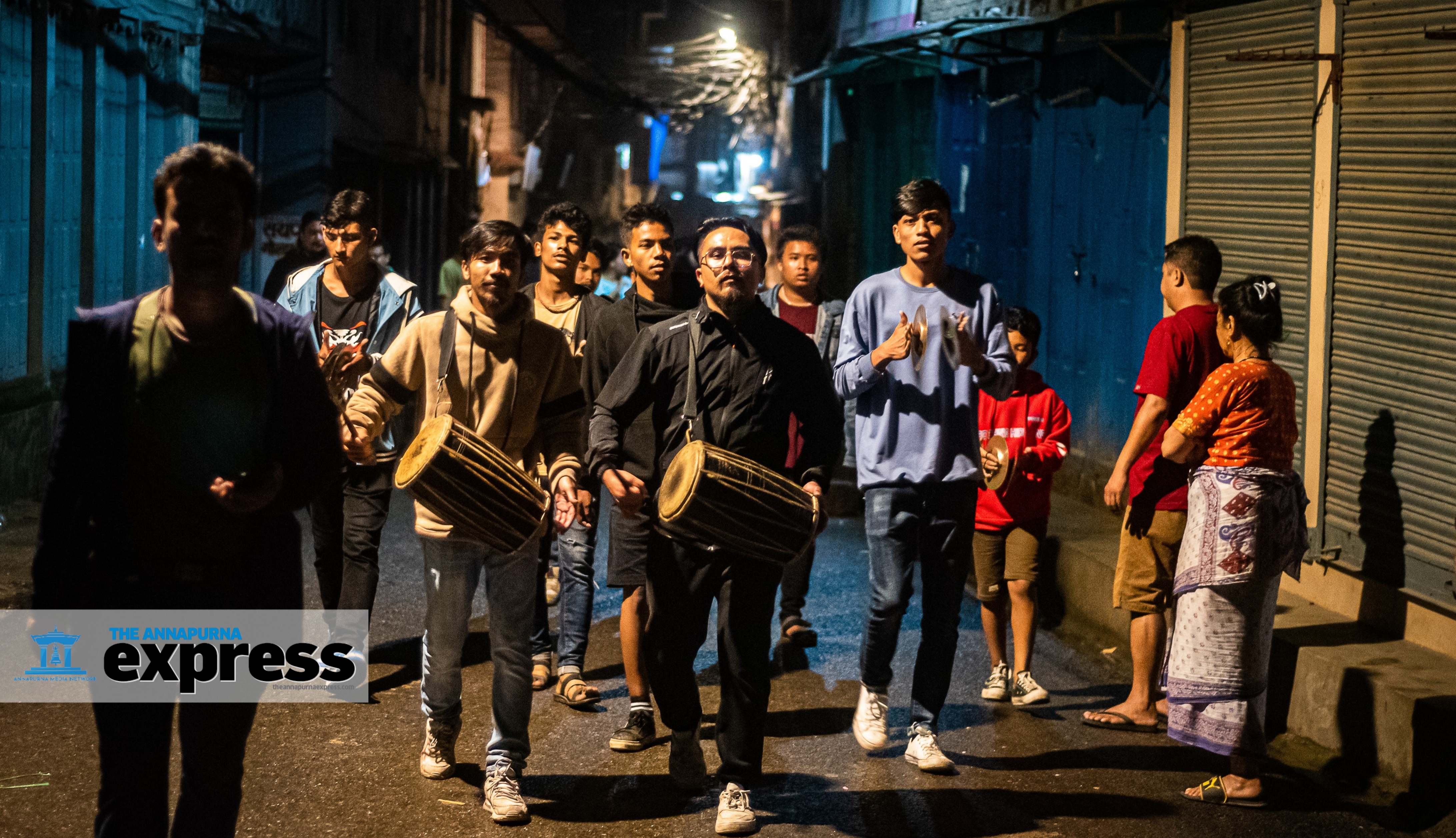
It’s three in the morning and the Teendhara Chowk in Banepa is teeming with people as though it was a busy afternoon. Folks of all age groups are here. Many of them are holding tiki torches in their hands; others are just there to witness the spectacle that is about to unfold. In the cards is a torch rally, part of the Chandreshwori Jatra, also considered the largest festival in Kavre district.

The three-day festival is held every year in honor of Chandreshwori, the avatar of Hindu goddess Parvati. It celebrities the triumph of good over evil. The torch rally, locally known as Ma-ta Puja, falls on the day of Buddha Purnima.

Again, it’s well before dawn, the sky at its darkest. On the ground, certain energy is building up. There is a small group of young men with Dhimeys (traditional Newari drums) and Bhusyahs (cymbals) getting ready for the procession. There are people preparing the plates laden with offerings.

Soon the torches are lit. The number of flames multiplies and there is a red glow all over. The rally is moving and so are the dancing flames. The movement of the fire-wielding procession resembles a rapidly spreading wildfire. I follow the march, which is set to conclude at the Chandreshwori Temple.
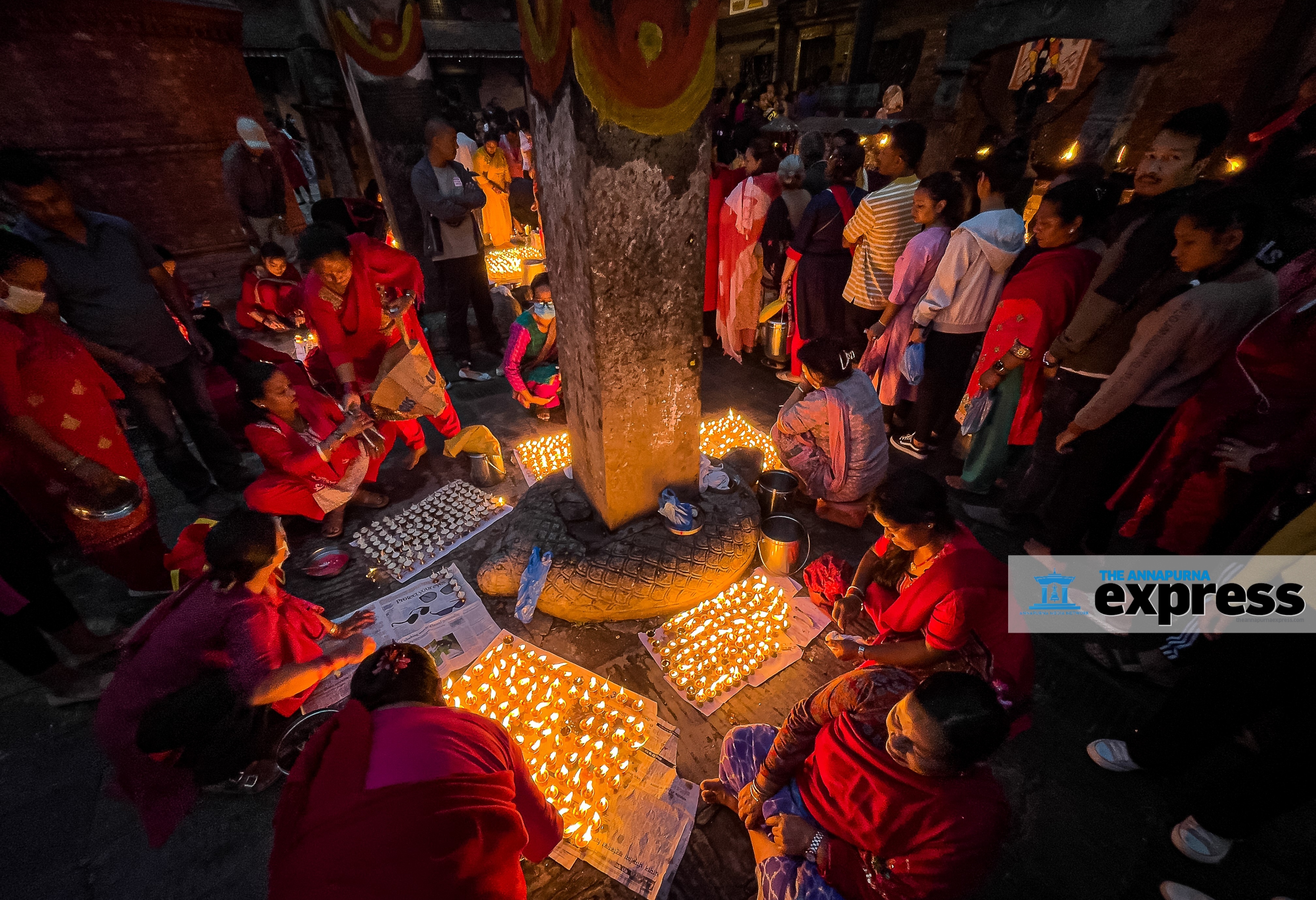
As we approach the shrine, a large idol of the goddess herself looms over the procession. The radiance of torches gives her a formidable presence. She commands reverence among her worshippers. The moment is hypnotizing.



Fulmaya Podeni: Sweeping her way to happiness
For the past 28 years, Fulmaya Podeni has devoted her life to sweeping the dusty streets of Kathmandu.
Born and raised in Makwanpur, she came to Kathmandu at the age of 20 to make a living in the city. With some help from her new peers, she was able to land a sweeper’s job.
Today, every morning, the 48-year-old travels from Swayambhu to Bhotahiti, where her work starts. She sweeps the main road leading from Bhotahiti to Bhadrakali.
Becoming a cleaner was not what Podeni had envisioned for herself. But without any education or other skill, she had few other options.
Even as a kid, she wanted to be educated but her family wouldn’t allow her to go to school.
“I was a girl so I was given the household responsibility while the boys in the family were sent to school,” she says.
Nevertheless, she was determined to one day make her own living. It was this determination, she says, that brought her to Kathmandu.
But life in the city was not what she had imagined it to be. And the job she took on was not just difficult, people also considered it undignified.
“They saw me as a filth rather than a working woman,” she says. Even her own friends and family looked down upon her for being a sweeper.
Podeni was 22 when she got married to a fresh army recruit. She became a mother a year later. As her husband was mostly away for work, it was her responsibility to raise the baby, a girl. At the time, she lived with her brother-in-law and his family.
“It was the most difficult time of my life,” she says.
With a newborn slung on her back, she used to walk to work every single day. “It was more a necessity than a choice,” she says with a tinge of sadness on her face.

“I had to keep my daughter with me even if my work meant exposing her to dust and dirt. There were no one to look after her,” she says.
Back in those days, she says, her work was much more demanding as there were so few sweepers.
“Working hours were long and besides the sweeping duty, we also had to load collected garbage onto trucks,” Podeni says.
What little she made during those days she had to hand it over to her brother-in-law in return for renting out his place.
“Yes, I had to struggle at work. But more than that I regretted not being able to look after my first child well, to bring her up in a healthy environment,” she says. Comparably, her second and third child had much better childhoods.
One thing Podeni is most proud of is sending all her three children to school. She takes joy in knowing that they will have a better life than hers.
“I was not allowed to go to school, and it felt terrible. I was thus determined to educate all my children,” she says.
Podeni has long moved out of her brother-in-law’s and rented her own place. She is at more peace today, she says.
She likes to think that her days of struggle are finally over.
Her husband has retired from the Nepal Army and works as a taxi driver.
Podeni still goes to work every morning, but the workload is much lighter. After the Covid-19 pandemic, she only has one long day a week.
“I finally get to spend some quality time with my family as I am no longer tired from working,” she says.
Podeni has also learned to accept her work. She doesn’t care about what others think of her so long as her children look up to her—and they do.
“Remembering the struggles I went through tears me up,” she says. “But then I look at my children and I cheer up instantly.”

‘The Vanishing Half’ book review: Enlightening and essential
I’d heard and read a lot about Brit Bennett’s debut novel ‘The Mothers’, a story about the consequences of an unplanned teenage pregnancy. Unfortunately, our local bookstores could never get the book. So I settled for her second novel published four years after The Mothers, ‘The Vanishing Half’, when I found it at Pilgrims Book House in Jhamsikhel.
Now, The Mothers was a smashing success. Often when there’s that pressure to come out with another equally good work, writers don’t deliver. But if The Mothers is even as half as good as The Vanishing Half, it’s going to be a phenomenal read: Bennett’s second novel is filled with intrigue, drama, and a rich, detailed setting that puts you, the reader, smack in the middle of all that is happening.
It’s a story about twin sisters Desiree and Stella Vignes who are born and live in Mallard, a fictional town in Louisiana, where the residents are mostly light-skinned blacks. Nobody marries dark in this town and over time the population becomes lighter and lighter, like ‘a cup of coffee steadily diluted with cream’. But being lighter than the average blacks doesn’t protect them in an era when prejudices and racism run deep.
The twin’s father is killed by a gang of white men and their mother works as a cleaner at a rich white lady’s house. Desiree and Stella know that if they continue to stay in Mallard, they won’t ever be safe or free despite their light skin tone and wavy locks. So they run away to New Orleans but after a year Stella leaves Desiree and the two end up leading entirely different lives: Stella passes off for white and Desiree marries the darkest man she can find.
A decade later, the twin’s teenage children, dark-skinned Jude and blonde Kennedy, meet at a cocktail party. Initially they don’t know they are cousins but they soon find out that their mothers are sisters and how their lives have been shaped by the lies they had nothing to do with, their fates sealed by their mother’s decisions. Largely a story about racism and identity, The Vanishing Half also explores the fragility of relationships and the constant effort you need to put in to build the life you always dreamt of.
Bennett seems to have a natural flair for writing and the story doesn’t drag on despite feeling a tad melodramatic at times. The Vanishing Half is a book of tremendous wisdom, forcing you to confront your hidden biases and misgivings about race, class, gender, and other societal constructs.
Three and half stars
Fiction
The Vanishing Half
Brit Bennett
Published: 2020
Publisher: Dialogue Books
Pages: 366, Paperback

‘Thar’ movie review: Parched of good writing and acting
India’s Thar Desert, with an area of 200,000 square km, is a massive expanse of land that covers the northwestern part of the Indian subcontinent. Sparsely populated and terribly parched, the desert is a grim setting for any movie. But Netflix’s latest “Thar” opens with shots of the Thar that redefine the aesthetics of the Great Indian Desert.
Director Raj Singh Chaudhary and his group of cinematographers create stunning visuals all through the Hindi-language action thriller. Set in 1985, the film is based in Munabao, a small village in Rajasthan near the India-Pakistan border that also happens to be a transit for cross-border opium trade.
Alongside the desert’s exquisite visuals, the film begins with the unmistakable voice of Anil Kapoor, who as Inspector Surekha Singh introduces the village and gives an idea of what’s transpiring there.
Munabao has been a sleepy village since Inspector Singh’s posting there. But then an unknown assailant is shot and brutally slaughtered in broad daylight; a family preparing for their daughter’s wedding is attacked and killed by merciless dacoits. Suddenly, Singh has his hands full, trying to find the culprits behind both the incidents and figuring out if the two events are connected.
The arrival of a new man in town—Siddharth Kumar (Harshvardhan Kapoor) —further complicates things for the inspector. Siddharth claims to be an antiques dealer and hires a local called Panna (Jitendra Joshi) to work for him. While Panna is away, he convinces his wife Chetna (Fatima Sana Shaikh) into keeping him in their house as a tenant.
Styled after the Western noir genre, Thar is a dark and gritty slow burner that features the classic story of crime, revenge and punishment. Think of any John Wayne or Gary Cooper movie, but in a much darker tone and customized for the Indian OTT audience.
I mention the OTT audience particularly because Thar is not something Bollywood would produce. If it did, the 2007 suspense thriller “Manorama Six Feet Under,” also based in Rajasthan with so similarities to this movie, would not have bombed at the box office despite so many good reviews.
The legendary actor Anil Kapoor’s son Harshvardhan has previously tried to enter the Bollywood film industry but was rejected by the audience and critics alike. Thar is the starlet’s attempt to enter the Indian OTT multiverse.
But here too he fails to show any good skills and his two or three facial expressions soon get boring to watch. Kapoor Jr. is terribly outshined by his father. The movie was an opportunity for Harshvardhan to redeem himself, but he does not seem to be trying much. In a movie based in a rural Rajasthani village in the 80s, Harshvardhan is still a 2022 Mumbai-boy.
The senior Kapoor, however, gets into character easily and shows us how he’s maintained a stellar reputation for himself in Bollywood and Hollywood for all these years. But the real show stealer is actor Fatima Sana Shaikh. I admit I am no expert in Rajasthani language, but Shaikh does seem to have nailed the accent and the attitude of a local Rajasthani woman.
In her rather limited role as Chetna, Shaikh gives her best and manages to come into the spotlight even when the filmmakers seemingly did not want her to. I can’t but imagine the actor’s impact had her character been given more thought while writing.
The writing in Thar is as mediocre as Harshvardhan’s acting. It takes inspiration from tried-and-tested movie stories but does not improvise much to create something of its own. A little bit of novelty could have given the film more substance than it now has.
Who should watch it?
Thar is a slow thriller with a good amount of violence and not much suspense. So it’s basically a straight-up thriller one can enjoy without giving much thought to the (predictable) storyline. But a regular Western noir audience would know how to judge better than that, right?
Rating: 2.5 stars
Director: Raj Singh Chaudhar
Actor: Anil Kapoor, Harshvardhan Kapoor, Fatima Sana Shaikh
Genre: Action thriller
Run time: 1hr 48mins


