


Nepal into cricket World Cup qualifiers

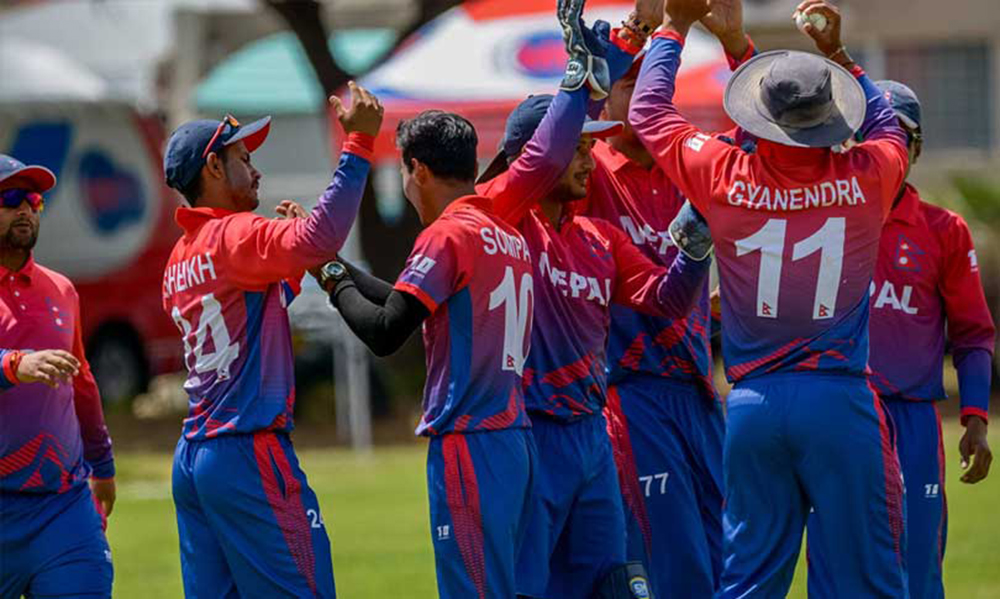 A quick-fire 42 runs in 31 balls by bowler Karan KC propelled Nepal into the qualifiers of the 2019 Cricket World Cup, as they beat Canada by one wicket on Wednesday, February 15. This represents the greatest victory for Nepal in the 50-over international cricket. Nepal will now be able to take part in the World Cup Qualifiers to be held in Zimbabwe in March later this year. Top two teams in the qualifiers will make it to the 2019 World Cup in England and Wales. In the final (must-win) match of the ICC World Cricket League Division-2 held at the Wanderers Cricket Ground in Windhoek, Namibia, Nepal sneaked through on the last ball, thanks to the heroics of KC, whose inning was studded with three fours and four sixes.
Earlier, deciding to bowl first, Nepal had restricted Canada to an average total of 194 runs, for eight wickets, in the stipulated 50 overs. Basant Regmi was the pick of the bowlers for Nepal, taking three wickets and giving away only 34 runs in 10 overs. Sandeep Lamichhane took two wickets while Karan KC and Sharad Veshwakar took one wicket each.
In reply, Nepal made a poor start losing opener Gyanendra Malla for just 9 runs and captain Paras Khadka for a first-ball duck. Sharad Veshwakar too was out early, scoring only 1 run in 5 balls.
Building on the 45 runs scored by wicket-keeper batsman Dilip Nath and 18 runs by Dipendra Singh Airee, Aarif Sheikh and Rohit Kumar took Nepal close to the victory target. However, Nepal kept losing wickets and were left with the last pair in the 42nd over with only 144 runs on the board.
However, Karan had other ideas and took away the match with a sensational innings, while Sandeep gave him company. Karan scored a single of the last ball to script a famous win for the country.
With the win, Nepal finished top of the points on the (six-team table) with 8 points from five matches.
(With inputs from RSS)

Changing lives in the mountains

I am a Himalayan American,” says Tsechu Dolma when asked about her nationality. At only 25, Dolma’s work and achievements are mountainously high, just like the terrains she loves to work in. A graduate of Columbia University School of International and Public Affairs, Dolma has been active in social work from a very early age. She has also co-founded women and girls economic and social empowerment component of ACHA Himalayan Sisterhood in New York and advised UNDP in Colombia on natural resource management and impact on indigenous and Afro-Colombian communities.
She runs indigenous honeybee farms, apple orchards, and greenhouses in the remote areas of the Nepali mountains. Ideally, the mountains are not considered the most lucrative terrains for agriculture and farming.
But with Dolma’s education, knowledge and persistence, she has been able to transform the areas she has worked in into profitable hubs of agro business, thus changing the lives of many farmers and their families especially women.
Her work as a social entrepreneur has been recognized by many organizations globally. She is a 2014 Brower Youth Award Winner, a 2013 Udall Scholar from the US Congress and 2017 Fulbright Hillary Clinton Fellow.
This young environmental scientist and anthropologist of Tibetan origin, who was born in Nepal and grew up in Kathmandu and Sindhupalchowk, is also the founder of the Mountain Resiliency Project which is working with communities in the rugged high mountains to build climate change resilience. Dolma was recently listed in the ‘Forbes 30 under 30: Social Entrepreneurs’, an achievement which is the first for a person from this region.
The Annapurna Express managed to briefly talk to Dolma who is currently based in Kathmandu. Excerpts from the rendezvous:
The beginning
My work on in remote mountains of Nepal started when I was 16 and studying in the US. From early childhood, my religion, culture and family always taught me that whatever you gain in life, you share with others. Because of these values, I felt it unfair to see how my childhood friends were living and how their lives were so different from mine, just because of the resources
available to us. Therefore, when my college provided resources for me to do summer projects, I chose to come back to Nepal do small agricultural projects in remote areas, like Mustang. This is how the concept for the Mountain Resiliency Project was developed.
Managing resources
After my first trip to Nepal’s mountainous regions, I started sharing everything I had seen with the people in the US. I started doing presentations and talking about food and water insecurities, climate change and identity politics. By sharing my ideas with people, I found donors and foundations who supported us.
Areas of work
The Mountain Resiliency Project is currently active in Mustang, Baglung, Sindhupalchowk, Gorkha, Rasuwa, Manang, Dolpa and Solukhumbu. We focus on developing the agriculture sector there. We work with local communities and farmers to connect them to value added market chains, to make farming more lucrative for remote areas.
Changes
In roughly nine years, we have managed to create a network of 15,000 farmers. In this time the average income of the farmers has increased by 800 percent. This has improved their standard of living and the children now have better access to education and health care. In our calculation, we have managed to generate a net benefit of $25 million in past nine years.
Challenges faced
As a young woman, whenever I go to district offices here in Nepal, I can never go forward and say I am the founder or CEO of an organization. I have to hide behind another man and pretend he is running the show. The problem of age and gender discrimination still exists in Nepal. There is also a gap between different ethnicities. The people of Tibetan-Buddhist origins are still treated with a certain amount of foreignness despite us co-existing with our neighbors here for generations. There is a lot of identity politics in Nepal.
The future
We are planning to reach a million farmers in the next three years. We would also like to scale up to 12 more districts in Nepal and expand to northern India, if possible. Also, we want to turn the net benefit of $25 million into $250 million within the next 10 years for the benefit of the communities we are working with.
Recognition
I would never feel comfortable introducing myself as a ‘Forbes 30 under 30’ person. In the past three or four years that I have been living in Nepal full time, I have spent 90 percent of my time up in the mountains instead of Kathmandu. It was never a priority for me to develop a network in Kathmandu. For me, being a part of the community, being there out on the ground, is so much more important than networking. All the awards, fellowships and recognitions I have received are based on the evaluation of my work.
Forbes 30 under 30
It has been such a blessing and privilege to be a part of this cohort. I have spent time with the other 29 participants and each of them has been equally inspiring. I think to be the first Nepali-Tibetan person to be on that prestigious list is inspiring to the other people in our community as well. To see someone just like you who comes from the same background reach this position based on her own hard work is relatable to the youth here.
Message
I truly believe that what I am today is because of the people I met in the past and the lessons I learnt from them. I believe in sharing my knowledge and experience with everyone, especially other young women. My message to the youth and people who want to work in this field is— always say yes to everything. You get so many opportunities in life but you can grab them only if you put yourself out there. Also, seek mentors. Getting training and guidance at an early age is very important.

Ride of hope: A cycle rally on Cancer Day
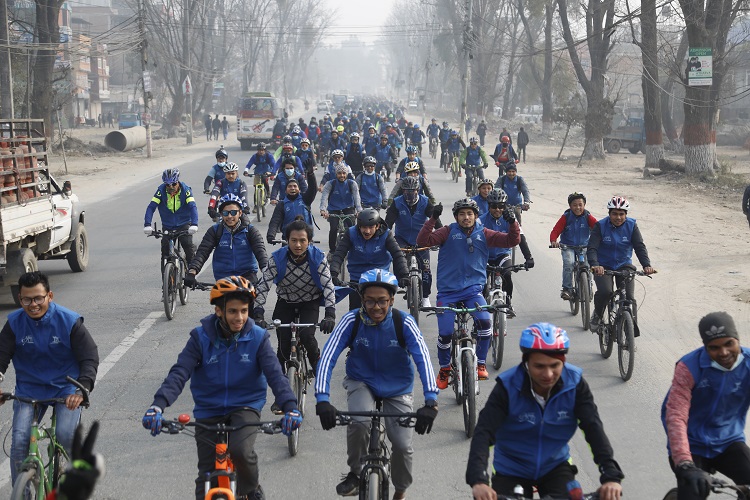
Around 30,000 new cancer diagnosis are made is Nepal every year—only a third of them get treated. According to the National Cancer Registry Program, the rest do not pursue treatment due to lack of finances, illiteracy and negligence. It is to get these untreated people to seek timely treatment, and to raise general awareness on the disease, that the Annapurna Media Network (AMN) has been organizing a yearly cycle rally, ‘Ride for Life’, on the World Cancer Day on February 4. Lung cancer is the most common cancer in Nepal while incidents of cervical, breast and abdomen cancers are also rising. A patient diagnosed with cancer in the first stage has 95 percent chance of cure; with cure rates plummeting to 50 percent with a third-stage diagnosis. In the fourth stage, cure is nearly impossible. Raising awareness on this was one of the goals of the cycle rally.
The Chief of Army staff Rajendra Chhetri kicked off the fourth edition of the Ride for Life from the AMN head office in Tinkune, Kathmandu. Hundreds of cyclists took part, as the rally passed through Gaushala, Chabahil, Maharajgung, Gongabu, Balaju, Sorakhutte, Lainchaur, Jamal, Ratnapark, Bhadrakali, Tripureshwor, Thapathali, Maitighar, Baneshwor, before converging at Tinkune again.
“We should all unite to fight cancer and to give the message that it can be prevented if we are self-aware,” says Sushil Pant, the Chairman of Nepal Cancer Foundation, who was also participating in the cycle rally.
The names of the participants of the cycle rally went into a lucky draw. The bumper award of a 43-inch television went to Samim Paudel. Similarly, Rajendra Chhetri got the first prize (a mountain bike) while Sanubabu Thapa and Ratman Gurung together got the second prize (each a two-way Simrik Airlines Kathmand-Pokhara ticket). Likewise, in third prize, seven lucky winners were given six-month subscription of Annapurna daily and Annapurna Sampurna magazine. APEX BUREAU

A young swimmer’s lament
.jpg )
When Gaurika Singh set eight national swimming records in the 2014 Galaxy Cup, young Nepali competitive swimmers like me were left flabbergasted. We would have been lucky to break one or two records—and here was this 13-year-old completely rewriting our record books. Singh is an inspiration for my generation. But in many ways comparing her achievement with the achievements of other young Nepali swimmers is also unfair. Singh lives in England, where she can train, morning and night, right through the year. Swimmers here in Nepal can barely train for six months a year, and even that training is sub-par. As a national level competitive swimmer, I have experienced these problems first-hand. And so have the rest of the 130 registered swimmers who take part in national games every year, along with countless others who never make it that far.
To compete internationally, we need to be able to train in an Olympic-sized (50m-long) swimming pool. But the only Olympic-sized pool in Kathmandu, the one at Satdobato (there is another one in Birgunj), we have to share with the public for three hours every day. Moreover, the pool is not heated in winters.
Invariably, our hard work goes down the drain during this long winter slough. National swimming head coach Ongden Lama likes to compare young Nepali swimmers to frogs in a well: “They learn to jump high, only to come crashing back”.
All heat
We don’t even get bare minimum facilities. For instance, the national team should have a gym workout before training in water. But the gym at the Satdobato pool is always under lock and key. Swimmers should also consume food within 30 minutes of training. But by the time we reach our homes from Satdobato, it is usually too late.
The National Swimming Association (NSA) started providing post-training diet to swimmers after the 2016 South Asian Games. But the little that is provided goes to the 10 swimmers who participate in the SAG, most of whom, in any case, can train on their own, in the Lincoln School’s heated pool (because they are students there) or abroad (because they live there). But the rest of us are barred from Lincoln, nor do we have the wherewithal to go abroad.
With the funds it gets from FINA, the global competitive swimming regulator, the NSA arranges for some star athletes to go abroad and train. But no one knows what happens to the association’s own funds, collected via private sponsors and parents of young swimmers. Even simple tasks, such as maintenance of the old pool, is being carried out by the Chinese government, which built the Satdobato complex in the first place.
Said one parent of a budding swimmer: “We had time and again contributed for the construction of a heated pool, to no avail”. The parent did not want to be named fearing that NSA officials, angry with her critical comment, would bar her child from future competitions.
When I asked him about the missing NSA funds, Ashok Bajracharya, the president of the association, hedged: “The private sector is only just starting to see swimming as a lucrative investment. This stands us in good stead for the future”.
Signs of hope
Thankfully, after years of pleading and pressure from parents as well as swimmers, the construction of the heated pool has finally begun, with 80 percent contribution coming from the government and 20 percent from the NSA. Why the abrupt change of heart? Because the country is again hosting the South Asian Games in March 2019. Moreover, the association needs to show FINA something tangible for all the funds it gets. Some old problems, such as leakage in the Satdobato pool, are suddenly being solved now.
Whether this is a mark of real change in the way competitive swimming is governed in Nepal or a blip on the NSA radar remains to be seen. Fingers crossed.


