


Shilpa Maskey: Dancing out her dream

Shy and introverted, Shilpa Maskey transforms into a confident and expressive version of herself every time she steps onto the stage to dance.
Maskey first found herself dancing as she watched her mother groove to the tunes on the radio. When she was five, she was already awing the audience with her performances.
Born in Biratnagar to a nurse and a development worker, Maskey traveled with her family to different parts of Nepal, wherever her father worked. Until she was eight, she had spent most of her time in Khandbari, Sankhuwasabha.
It was here that the now 30-year-old started dreaming of becoming a choreographer one day. “My mom always pushed me to take part in stage programs and festivals that were held in our village,” she shares. “I was known for my dancing in school and my love for it only grew with age.”
When she was around nine, her family moved to Kathmandu, where she completed her schooling. After holding herself back from her hobby for a while in the new environment, she started dancing and winning competitions again.
As an eighth-grader, Maskey already knew she wanted to become a classical dancer.
After her 10th grade, she again took a contemporary dance class while she was applying to study in the UK. But then she decided to pursue a career in chartered accounting. The demanding curricula meant her dancing got lost between college and working at a restaurant.

“I let go of my dream of becoming a choreographer for some time as I couldn’t afford dance classes,” she shares. “At least until I realized that studying CA didn’t make me happy”. She switched subjects and finished her three-year diploma in Business Management in the UK.
Later, she had to return to Nepal where she would continue with her studies. She started modeling and did her first cover shoot for a magazine. In 2016, she got an audition opportunity for a dancing role in the short movie ‘Shooting an Elephant’ , and she wasted no time in applying. She was over the moon when she got selected. Little did she know that this would be a life-changing experience.
“I hadn’t danced for four or five years at that point in my life,” she shares. “But the moves were always there with me, and with the sound of music, the magic just happened.” It was her first time on a film-set. The part of her that always held on to her love for dancing started falling for the world of films too.
While trying to juggle between dancing and films, she went back to the UK. There she auditioned for a Bollywood company called Bollyflex that recruited dancers for movies. When she got selected as one of the 25 dancers she enrolled in a six-month-long training. “Stepping into the industry among all the professional classical dancers, there were so many instances I felt low, like I was not good enough,” Maskey shares. “But the thought of being able to dance on such a big stage kept me going.”
Also read: Nimsdai: The man who went beyond the possible
Bigger doors opened for her and she got the chance to work on many films as a side character. Being able to experience the industry up close, she got to learn from many people, to familiarize herself with the technical side of filmmaking and to keep dreaming. Her life was transformed again when she got a small role in the Marvel movie Dr Strange (2016), and the once-timid Shilpa suddenly became more confident and outgoing.
She then joined an acting school. Maskey was learning Kathak and Odyssey dances on the side—all while working at a clothing store.
It was a hectic life and London never felt like home. She soon came back to Nepal and landed her first lead roles in ‘The Break up’ and ‘Kagaz Patra’, both of which came out in 2019. “Stepping into the world of acting helped me escape my comfort zone and discover an entirely new part that found beauty in vulnerability,” Maskey says. “It brought me closer to myself.”
Her latest projects are ‘Kathputali’ and ‘Devi’, two soon-to-be-released movies. ‘Love Sutra’, a romantic-comedy web series, is also in the offing.
Questioned about the roots of her versatility, Maskey answers: “My body is an instrument, I just need to feel it to play the strings.”

Nimsdai: The man who went beyond the possible

I am pretty sure that most of you have already watched ‘14 Peaks: Nothing is Impossible’—the Netflix documentary on Nirmal Purja (Nimsdai) about his record-breaking mountain expedition: Project Possible 14/7.
The documentary released on 26 November 2021 has become one of the most watched films of the week on Netflix. It is on the seventh position globally with over 12 million hours of watchtime and received an 8.2 rating on IMDb.
Born in Myagdi to a lower-middle-class family that moved to Chitwan, Purja was surrounded by Gurkha soldiers in the family. He also joined the Brigade of Gurkhas in 2003 and was accepted into the Royal Navy’s Special Boat Service (SBS) in 2009, becoming the first Gurkha to join the elite British unit. He further served in Special Boat Service as a cold-weather warfare specialist and Special Air Service (SAS) unit.
Purja first got into mountaineering in 2012 when he summited Lobuche (6,119m) and Dhaulagiri in 2014. He summited the highest peak in the world, Everest in 2016. Even at this point, he did not think of bidding adieu to the military.
In 2017, he completed the Everest-Lhotse-Makalu summit within five days. “I later realized I could have done it in three days, had I not rested,” he says on the idea of climbing all 14 peaks in the world above 8,000m in less than seven months. The previous record for the same feat was nearly eight years, but he did it in just six months and six days. “A lot of people didn’t believe me at the time when I shared my idea,” he adds.
Also read: Dr Garima Shrestha: A doctor treating social taboos
For Project Possible 14/7, Nimsdai was accompanied by Mingma David Sherpa, Lakpa Dendi, Geljen Sherpa, and Tensi Kasang, among other mountaineers. They started with Annapurna on 23 April 2019, and on 24 May 2019, they had completed climbing six of the mountains, completing phase I. This time, he broke his own world record by climbing Mt Everest, Lhotse, and Makalu in 2 days and 30 minutes.
The second phase of his project took him to Pakistan where he had to summit five peaks, including the deadly K2 and Nanga Parbat. Nimsdai and his team made another world record by climbing K2 on 24 July 2019—the first-ever winter ascent. Numerous climbers had failed to do so since the first attempt in 1987. Also, he was the only team member to the summit without the use of supplemental oxygen, becoming the first individual to do so in history.
Many other climbers suggested he should halt the project due to unfavorable weather conditions before phase I, but every time, his reply was “Giving up is not in the blood, sir. It’s not in the blood”—which later became a famous dialogue in his documentary.
The last phase started on 23 September 2019. This phase had some real hurdles due to permit issues from the Chinese side to climb Shishapangma, which lies in China. Due to the fall season, China had already closed the expedition for the year but with requests from all over the world, China granted Nimsdai and his team a special permit to scale the mountain on 1 October 2019. And on October 29, the Project Possible 14/7 was successfully completed.
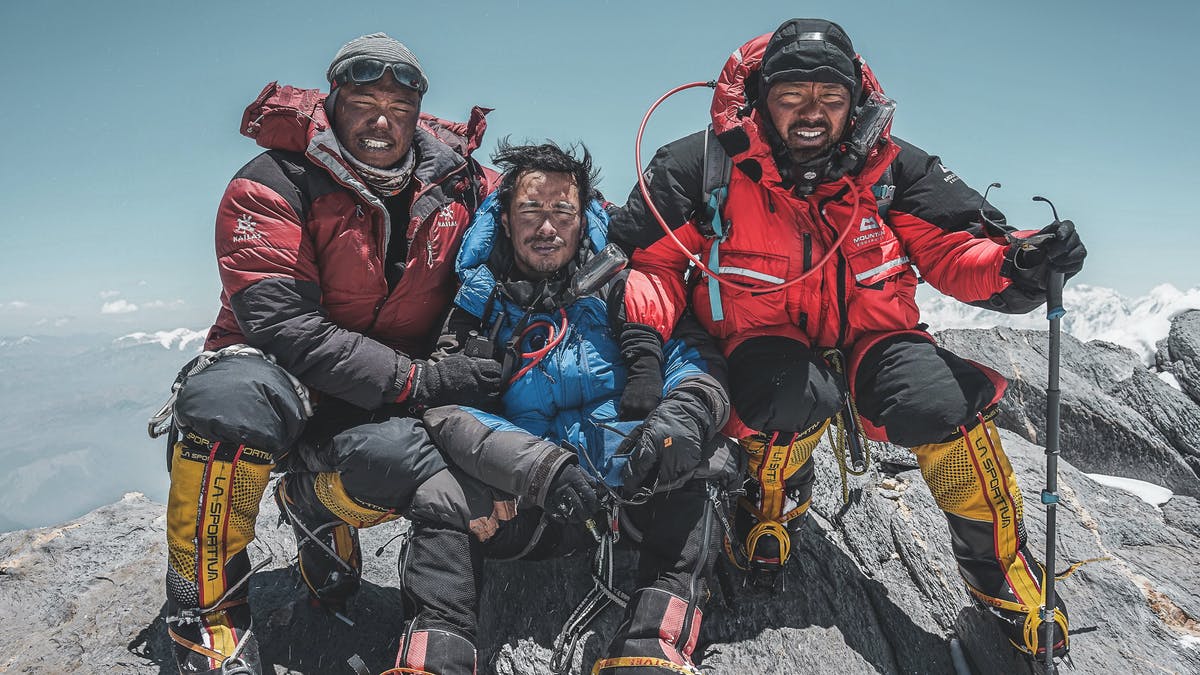
“The project was never about me individually or a race or a community. It was about the limits a human being can push to, and for that, I got support from all over the world,” he says.
Other than the major world record of the fastest ascent of the 14 tallest mountains in the world, Nimsdai broke these Guinness World Record: Most 8000m mountains (six) in the Spring season; most 8000m mountains (five) in the Summer season; the fastest summit of the three highest mountains in the world, Mt Everest, K2, and Kanchenjunga; the fastest summit of the five highest mountains in the world, Mt Everest, K2, Kanchenjunga, Lhotse, and Makalu; fastest bottom 8000m mountains, Gasherbrum I, II, and Broad Peak; fastest consecutive summits of Everest, Lhotse, and Makalu in 48 hours, beating his own previous record of five days.
Even before his legendary world records, Nimsdai was appointed as a Member of the Order of the British Empire (MBE) by Queen Elizabeth II for his outstanding work in high altitude mountaineering on 9 June 2018. This recognition was for his captaincy in the Gurkha Expedition ‘G200E’, which summited Mt. Everest together with 13 Gurkhas to commemorate 200 years of Gurkha service in the British Army on 15 May 2017.

Dr Garima Shrestha: A doctor treating social taboos
Dr Garima Shrestha, founder of She Nepal, a volunteer organization working for women’s health and empowerment, always knew her life would be different to the lives of most of her friends.
The 26-year-old, who has been fascinated by the human body ever since she was a child, spent many of her childhood days wondering how the human brain worked. Yet there was also a part of her that yearned to help other people.
“Whenever someone would ask me what I wanted to be when I grew up, I always said a doctor and social activist,” she says. “I didn’t know how, but I had to do both the things.”
As an introverted kid, she naturally focused on her studies to make her childhood dreams come true, inside her own little world filled with dedication. Years later, she found herself studying MBBS at Manipal College of Medical Studies in Pokhara.
She interned at the same hospital and got the chance to meet people from villages around the city who came there seeking treatment. She used to listen to their stories up close. It was there that she met a 16-year-old girl who was in labor with her second child. The girl shared her period stories from back home and how she was a victim of chhaupadi (“menstrual huts”).
Shrestha had now come face to face with the hard issues she had until then only read in textbooks. “I was heartbroken just listening to her,” she shares. “And, as a doctor, I came to realize that I needed to do a lot more than just treat my patients. I also needed to work on preventing suffering.”
After completing her MBBS, Shrestha returned home to Kathmandu to start an organization that would work to raise awareness about women and their reproductive health. Shrestha, with the support of her parents, started ‘She Nepal’. They started organizing campaigns in rural parts of the valley such as Panauti, Kavre, Jhor where the practice of chhaupadi persists.
Also read: Satyajit Pradhan: A worldly musician
Dedicated to fighting taboos around menstruation and women’s health, She Nepal also decided to provide them income-generating opportunities. They trained women on making reusable sanitary pads, and distributed the final product among women and menstruating individuals.
Shrestha then spread her work to Upper Dolpa, Accham, Pyuthan, and Taplejung. “We were trying to reach as many people as we could,” she says. Many women, after being introduced to reusable sanitary pads, even started making and selling pads on their own.
Moreover, She Nepal’s presence grew on social media and people started supporting the cause. With their help, around 10,000 reusable sanitary pads were distributed among quarantined menstruating individuals after the start of the covid pandemic.
After working with donors and sponsors in the beginning, She Nepal now works independently as it empowers women to make and sell bags and masks.
Shrestha is also currently doing her MD Residency at Army Hospital, Maharajgunj. She aims to become a medical microbiologist and then to continue working in both fields of her interest.
“Every day, the people I meet and the stories I hear help me create a vision of what I want to accomplish, and I want to keep working to give more to the people,” she shares. To achieve her awareness goals, she is planning to write a booklet on menstrual health awareness for children, hoping to make it a part of school curricula.
She also wants to open a diagnostic center of her own. With this income coupled with revenues generated via She Nepal, Shrestha will then help women with sexually transmitted infections (STIs).
“My goal is to normalize the conversation around menstruation and reproductive health and to make sanitary pads easily accessible, especially in rural Nepal,” she shares.

Satyajit Pradhan: A worldly musician
Satyajit Pradhan grew up strumming his guitar and singing along to the Beatles on the TV and Narayan Gopal on his parents’ old record player. Born in Lumbini, Nepal, he fell in love with the diversity of musical genres he discovered in different parts of the world.
Pradhan grew up in a musical family. His family moved to the Philippines when he was a toddler and lived there until he was 16. “My parents weren’t musicians, but they were always singing,” he shares. “I was raised in a Nepali household in a foreign country, singing Narayan Gopal and Kishor Kumar songs”.
His high-pitched voice had him singing in choirs as a kid. He discovered he was simply trying to mimic the singing styles of singers and bands he listened to, and in the process, he had learned to sing. Pradhan was introduced to classic Nepali bands at home, and outside, English rock bands fascinated him.
He used to sing with his friends and take part in different singing competitions, in and out of school. In the evenings after school, he found himself listening to the Beatles on the TV for hours. He spent his days daydreaming of one day performing on a concert stage to thousands of people. “I fell in love with the idea of being in a band and with it grew a deep yearning for composing and performing music with my own band someday,” Pradhan says.
Also read: Elena Don: Giving you a reason to smile
At the age of 13, Pradhan started to write his own songs, which were really odes to his overflowing teen emotions. He taught himself to play the guitar and formed his first band. They were a group of friends with a brotherly bond, hanging out, writing songs, and composing, dreaming to take it to bigger concert stages one day.
Soon, they started singing for the people around them. In no time, his music was being admired and appreciated and what started as fun became his passion. “At first, I loved the attention, especially from my girl classmates,” he laughs. “But it slowly grew into this sense of belonging to the stage”.
Pradhan gets the purest form of joy when a new genre of music finds him. In the Philippines, as a teenager, he got into hard rock with a heavy influence of bands like Pearl Jam, Nirvana, and Metallica.
He discovered an entirely new world of music when he moved to the US and started working on a record store called ‘Tower Records’. “As employees, we used to get free merchandise of bands and singers, and everyone rushed to grab the ones by the most popular singers,” he laughs. “I used to be left with the merch by not-so-popular bands”. But that became a blessing in disguise for Pradhan as it opened the doors to experience a whole new range of music.
He found out about local independent artists playing in bands and their incredible music. His journey then became a ride through different genres of music: Latin and Cuban rhythms, classical, jazz, African. “As an empath, every music found a way to move me in ways I couldn’t explain,” he says with joy. “It’s like music resonates with a different part of me and different parts of my life”.
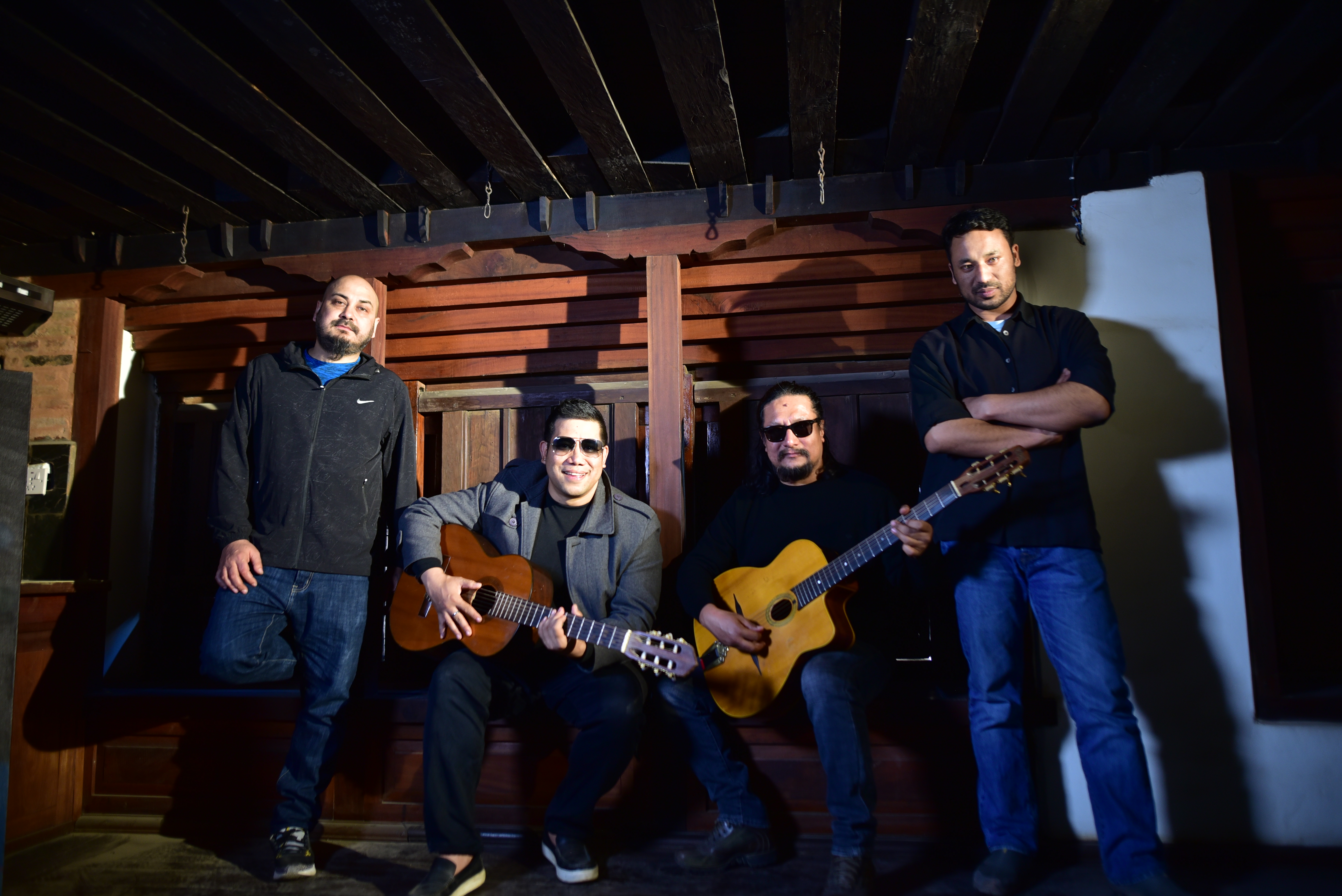
He came back to Nepal—after a spell in England—and met many great musicians and artists. Here, he would form yet another band, Products of Conception, in mid-2020. “We simply played different tunes and I would sing along, and just like magic, we’d be creating songs,” he shared. Products of Conception have so far brought out seven songs for their first album, with 13 more in the pipeline.
Even with a world of experience, Pradhan is a Nepali at heart. “Growing up in a Nepali home out there in the world, I spent so much of my life exploring music from many countries,” he shares. “In the end, I have decided to express myself and my Nepali identity through English songs of the genres I feel the closest to.”
He believes music is his way of communicating. “I often wonder how all of us are one vibration. While singing on stage, watching everyone move and dance to the same beats, banging their heads to the same rhythms, the moment is unreal. I can feel it through my bones and it never fails to bring me closer to the people around me and even closer to myself,” he shares.
These days, he plays music and brings out songs on the side. As a full-time job, he is the director of marketing, communication, evidence, and impact at Marie Stopes Nepal, a company that works on women’s reproductive health.
But he will not stop making music. “I want to tell a story, and I am hoping that my story will make sense to at least one person.”


