


The unflagging spirit of a young acid-attack survivor

When Jenny Khadka was 20 years old, her husband threw acid on her for refusing to go back home with him. He had brought the acid in a vodka bottle and had showed it to Jenny minutes before the incident.
Jenny had married a man 20 years her senior when she was 14. He said he loved her. For her, it wasn’t love, confesses Jenny, but fear of returning home and facing her father’s wrath after fleeing to Okhaldhunga on his motorbike that compelled her to marry this man. She later found out that he was already married and had an eight-year-old son.
“That evening when he dangled the vodka bottle in front of my face and asked me if I knew what it was, I confidently said that a drunkard would obviously carry alcohol with him,” says Jenny.
Suddenly, a cold splash fell on her. Jenny was just about to brush off the wetness when she felt her skin burn like plastic.
Two months in the hospital and nine surgeries later, Jenny, who had suffered 20 percent burn, mostly on her neck, chest and arms, was ready to put it all behind her. Four months after the incident, she, with the help of Astitwa Nepal, an organization that works to rehabilitate victims of violence, had secured a job at Sagun, an institute for social research and action.
“It wasn’t easy but I didn’t want that one incident to change my life. I have many dreams and responsibilities,” she says.
Up until the nationwide lockdown on March 24 to curb the spread of Covid-19, Jenny was actively engaged in conducting awareness campaigns through Sagun, under its Participatory Burn Prevention project. She has traveled to Janakpur and Hetauda and given training to as many as 500 women.
Sociologist Kamal Phuyal, who is the team leader of the said project, says he saw a lot of potential in Jenny when he first interviewed her for the job.
“As a victim of acid attack, she has been able to connect with rural women in a way others’ probably couldn’t have. But that wasn’t the reason we offered her a chance to work with us. It wasn’t because of sympathy either. She was very clear she didn’t want it to be that way,” says Phuyal, adding that he was impressed by the way she conducted herself and tried to rise above her situation.
“Jenny had that zeal to do something,” he says.
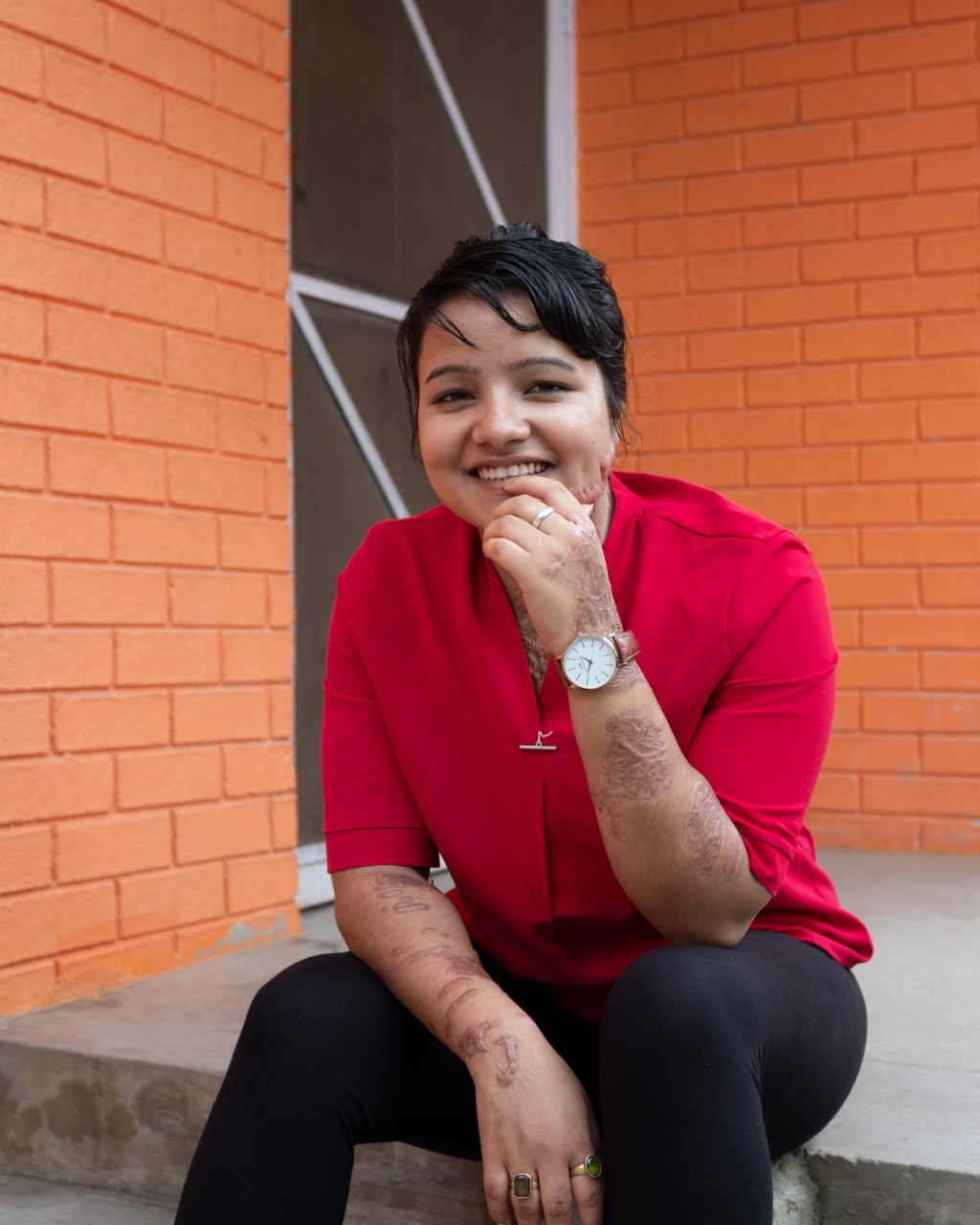
Phuyal took a chance on her and he hasn’t been disappointed. He says wherever she has gone for trainings and awareness campaigns, she has managed to impress people. Now, he has a lot of expectations from her. In the next 10 years, he expects her to have completed her masters. She has only finished her SEE. He believes, in the future, she can do well as a human rights activist.
“When I look at Jenny, I see a bold, courageous young woman who has what it takes to make a difference,” he says.
Rumi Rajbhandari, founder of Astitwa Nepal, calls Jenny one of the strongest acid attack survivors she has met till date. When Rajbhandari first saw her at Kirtipur Hospital, she thought Jenny wouldn’t make it as most of her injuries were on the neck area and there were many complications.
But Jenny pulled through—and how.
College, violin, German
However, there are moments of intense grief. She longs to see her five-year-old son. Sometimes, the scars make her cringe. It’s a stark reminder of the time when she ran screaming for help after the attack and not a single person came forward to help her. They just gawked and muttered.
Yet the sadness and overwhelming emotions, she says, only last a few minutes.
“My family and I have seen some terrible times but we don’t want that to drag us down. We can’t let it because then we will never see better days,” she says.
Just a little over a year after the incident, she has many plans that keep her mind off the unfortunate event. She wants to join college when educational establishments reopen. She will resume violin lessons that she had taken up right before the lockdown.
At home, besides reading and listening to music, she loves to cook and experiment with new dishes, makes paper crafts to decorate her room, and studies a little bit of German.
“I have many interests and hobbies, and they keep me sane,” says Jenny.
As normal as Jenny’s trying to be, her mother, Kamala Khadka, confesses that she is scared for her daughter even today. Constant threats from Jenny’s perpetrator aside, Kamala worries about her daughter’s health and her future.
“People look at you differently and they are a little disgusted by your wounds,” says Kamala.
She adds that she knows her daughter has the strength to power through the tough times ahead of her but that doesn’t console a mother.
Jenny, however, considers herself lucky. Things could have been worse, she says. Her face is unscarred, her right ear is partially damaged but the acid didn’t get to the eardrum so her hearing is intact, and most of her scars can be hidden with a scarf, though she prefers not to.
“Luck has always been on my side,” says Jenny.
She even talks about the time she was making a living selling cosmetics on a cart in Banepa—this was the first time she had run away from her possessive and abusive husband. With her 14-month-old son strapped to her back, she would easily make Rs 4,000 in day, with a profit margin of Rs 2,500.
“Other cosmetic sellers like me wouldn’t do that well,” she recalls with a laugh.
“You see why I consider myself destiny’s child. Things have somehow always worked in my favor,” she says.
This ability to look at the positive side of life has had a cathartic effect on her. The society’s censuring eyes don’t bother her but she hopes no one has to go through what she did. Acid attack condemns you to a life that’s possibly worse than death and she doesn’t wish that on her worst enemy.
So, Jenny wants to be able to work to empower and enable women to not be dependent on the men in their lives, be it their fathers, husbands, or sons. She feels financial independence is key to women leading stronger, better lives.
What’s done is done
According to Jenny, women often normalize abuse at home by laughing it off and hiding bruises under makeup. Women give multiple “second chances” to their violent husbands. The society too doesn’t intervene when they see couples fighting. There’s a popular saying in Nepali, Logne swashni ko jhagada paral ko aago (A husband and wife’s quarrels don’t last long), that governs people’s attitude towards marital discords.
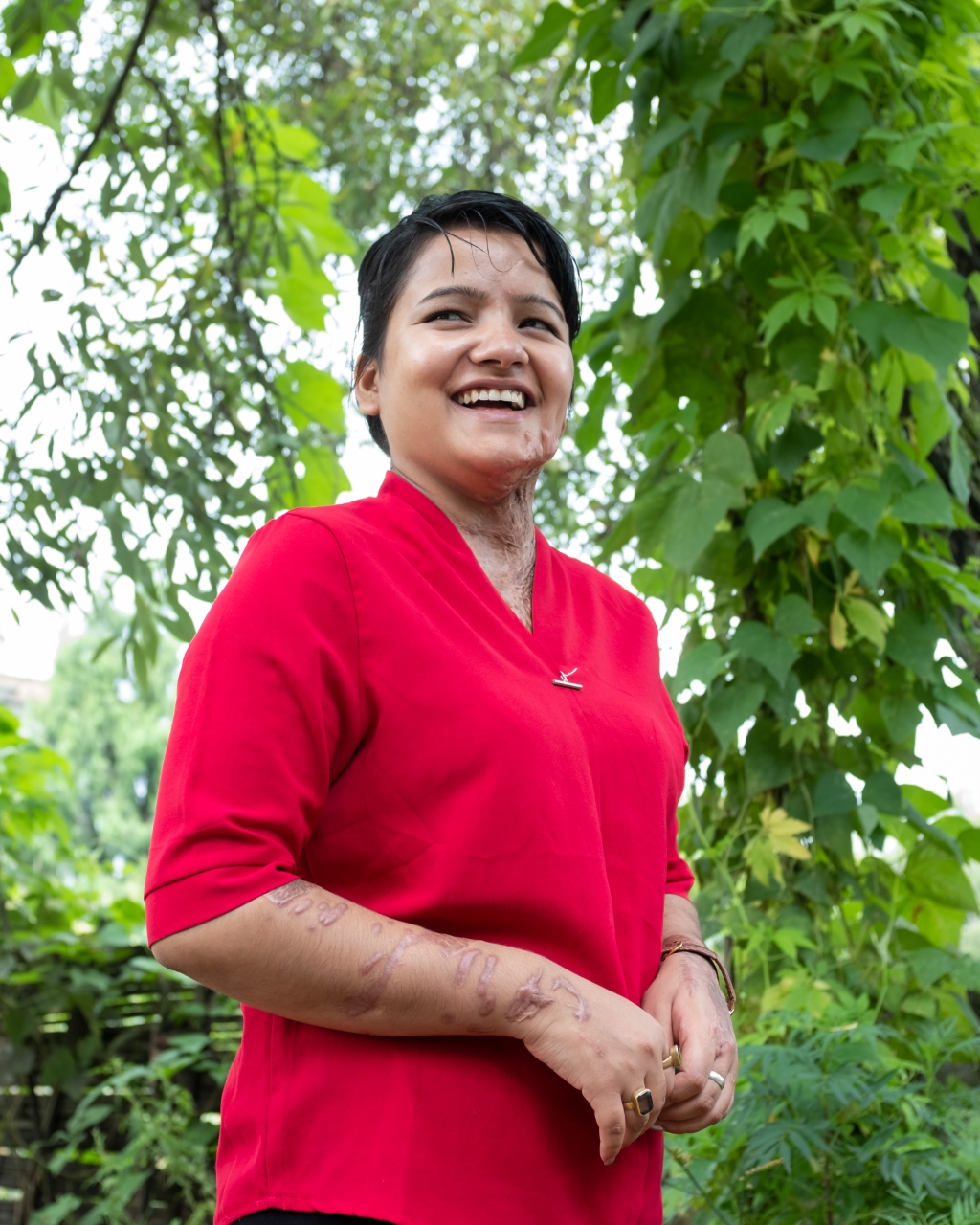
“If someone had spoken up on that night of the incident when he was shouting at me, maybe he wouldn’t have had the guts to do what he did,” says Jenny.
What’s done is done, she quickly adds, not being the kind to live in a world of maybe’s and fantasies. But she has learnt an invaluable lesson, she says, and today she finds herself stepping in and speaking up when she sees a man harass a woman or hears a couple arguing, and urges others to do the same.
“Sometimes a small intervention can avert a disaster,” she says.
Rajbhandari says she is happy to have seen Jenny evolve in the past year, from a timid girl to one who is able to voice her opinion.
“Many acid attack and burn survivors take years to come to terms with what has happened to them but it’s amazing how quickly Jenny has been able to move on,” she says.
Jenny smiles when she is told this and says, “I don’t want to be hung up on my past and spoil my future. That would be a bigger tragedy than what’s already happened.”

Menstrual huts: You demolish one, we’ll build another
When she started menstruating, her relatives did not allow her to stay home. As gods were supposedly angry, she was kept in a barn far from home. Tulsi Shahi, 19, of Lainchaur in Chamundabindra Saini of Dailekh district died in the cowshed, bitten by a snake while she was asleep. This happened in June 2017, after Shahi who forced into sleeping in a ‘menstruation hut’ by her own family.
In the same year, Lalsara BK, 24, also died in a menstruation hut. Forced to sleep in a shed far from her home, she was found dead in the morning, the cause of her death unknown. Around the same time, Nirmala Bartaula died of severe cold in another menstruation hut in Surkhet. There was also a report of a girl who was gang-raped in Barahatal village of Surkhet while sleeping in a menstruation hut built far from home.
According to INSEC, an NGO working in the field of human rights, 13 women and adolescents have lost their lives in such menstrual huts in the past 25 years in Dailekh district alone. But still, the practice continues in Dailekh as well as in other districts of the Karnali province. Women and adolescents are losing their lives pre-maturely as they are forced to sleep in menstruation huts, where they may be bitten by snakes, attacked by wild animals, suffocate, freeze, and even face physical assault and rape.
Most incidents of menstrual hut deaths are not reported, women rights activists say, as villagers tend to hide such cases.
After the death of many women in menstruation huts, the government last year started a campaign to demolish them. Thousands of these makeshift menstruation huts were destroyed in Karnali province. In Surkhet district alone, around 2,000 menstruation huts were demolished. But with the end of the campaign, menstruation huts have started resurfacing.
Women in these areas are still not allowed indoors during menstruation. After the demolition of the menstruation huts, they are made to stay in temporary sheds made of dried leaves and twigs for five days. This has made women and adolescents even more vulnerable. In Panchpuri municipality and Chowkune rural municipality of Surkhet, around 60 percent women are still forced out during their menstruation.
The locals are building more makeshift huts, farther away from their homes, in the fear of being hounded by the police. The women are now being made to sleep in animal sheds or even under the open sky during their menstruation.
Not only the three tiers of the government, even NGOs have been fighting against the practice of building menstruation huts, but to no avail.
Ghanshyam Bhandari, mayor of Dullu municipality, informs that preparations are underway to mobilize engineers through its Gender Equality and Social Inclusion Branch. “We realize our campaign to demolish menstruation huts last year was not enough. Now we are trying to come up with alternative plans,” he says.
Similarly, mayor of Panchpuri municipality, Upendra Bahadur Thapa, says the campaign is far from over. “We have deployed women’s groups and volunteers to spread awareness. We also organize roundtable meetings among local women,” he says. Thapa informs the municipality has withheld social security allowances and other municipal facilities for the offending families. Hinting at its success, Thapa says many women are now sleeping in different designated rooms within their own homes instead of somewhere outdoors.

Unemployment in Nepal worsens as government fumbles for a response
Any future projection of the Nepali economy has become increasingly difficult due to the highly uncertain course of the Covid-19 pandemic. Factoring in severe impacts on hotels, restaurants, domestic and international transport, and other areas, the Central Bureau of Statistics has projected national economic growth to shrink to 2.27 percent against the government’s aim of seven percent. But, again, this can only be a tentative estimate at best.
Accompanying this economic decline will be widespread joblessness across all sectors. Covid-19 is leading to dramatic job losses across the world and young people in particular are suffering a great deal. In our case, thousands of youths have already lost their jobs, while thousands more employed in Gulf countries are returning to Nepal after being relieved of their professional duties.
Dr. Anup Subedee, an infectious disease physician, says although it is hard to project the future trajectory of the virus, it could still be active in Nepal until April-May next year. “Perhaps if our labor destination countries can control the virus before we control it here in Nepal, our youths can go back to their jobs abroad after PCR testing.”
According to a National Planning Commission (NPC) report, around 700,000 Nepali migrant workers could return due to the Covid-19 crisis. Another 300,000 are expected to come back from India. They will add to the burden of joblessness. The Economic Survey of Nepal 2020/2021 says around half a million youths enter the country’s labor force each year.
The survey says, without giving any numbers, that there is a huge gap between job demand and job creation. There are also no official figures on the number of jobs created in Nepal every year. What can be said with more certainty is that till the fiscal 2019-2020, around five million Nepalis had gone abroad, excluding India, seeking employment opportunities.
Prolonged political instability contributed to an unstable economic climate for most of the past three decades. In the absence of jobs at home, youths sought the shores of the Gulf and other countries. On an institutional basis, Nepal issues labor permits to 110 countries, while permits on an individual basis are issued for 172 countries.

Pre-Covid days
The NPC’s third Nepal Labor Survey (2017-18) says working age population (15+) had a share of 71.5 percent (20.7 million) of the total population, of which 55.6 percent were females. Of approximately 20.7 million working-age people, 7.1 million were employed, while 908,000 were unemployed, translating into an unemployment rate of 11.4 percent. Moreover, females reported unemployment rate of 13.1 percent, 2.8 percentage points higher than males.
There were also geographical disparities. Bagmati province reported the lowest unemployment rate (seven percent) while Province 2 reported the highest (20.1 percent). Says the NPC survey: “One in every five people who had jobs in Nepal were employed in agriculture, the biggest employing industry. Trade-industry had the second largest share of employment (17.5 percent), followed by construction (13.8 percent). The informal sector had the biggest share of 62.2 percent.”
The hope was that the new government, with its two-thirds majority, would herald an era of stability and create many new jobs. But the expectation had proved misplaced, even before the onset of the Covid-19 pandemic.
During the pandemic
Public health experts say that even if the current wave of Covid-19 contagion is contained, there is always a chance of another wave as a vaccine is still uncertain. Since the start of the lockdown on March 24, economic activities are yet to fully resume, and things could get worse.
Data from the Nepal Rastra Bank (NRB) suggests that during the lockdown, which lasted a little over three months, four percent of industries were in full operation, 35 percent were partially operational, and 61 percent were closed. In this period, “there was a 22.4 percent layoff in industries and businesses. Two-thirds of manpower hired as temporary staff or on contract basis lost their jobs.” Hotels, restaurants, transport and education suffered the most, the NRB data show.
According to the Hotel Association of Nepal (HAN), around 700,000 people are employed in hotels. HAN President Shreejana Rana says hotels have no policy of expelling workers. “There has been an agreement that hotels will continue to pay some amount to their workers until the end of December,” she says, with the exact amount depending on the hotel’s profitability. Rana says there has been no forced layoffs, even though workers have the choice of voluntary retirement.
Another hard-hit area, according to the NRB survey, is transport. Saroj Sitaula, general secretary of the Federation of Nepali National Transport Entrepreneurs, says the sector employs a million people. During the lockdown, public transport was completely halted and workers were left in a lurch. Most workers in the sector don’t have formal appointment letters and as such, no social security as well. According to Sitaula, there is no record of how many people in transport have lost their jobs since the start of the lockdown.
“Some have returned to work with the resumption of transport, but entrepreneurs are still struggling to provide them with a timely salary,” he says.
Education has also been hit hard. Schools, colleges, and consultancy services are closed. Some colleges and universities are holding their classes online but, as guardians are reluctant to pay for this form of education, many teachers have not been paid.
Axe falls on the small
According to the UNDP-Nepal’s “Rapid Assessment of the Social and Economic Impacts of COVID-19”, both formal and informal micro, small and medium enterprises (MSMEs) with low cash-to-asset ratio have been affected. “We find that every three in five employees have lost their jobs in the micro and small businesses that were surveyed; [these businesses] have seen a fall of 95 percent in average monthly revenue,” the report says.
Says another survey undertaken by the International Labor Organization (ILO), “between 1.6 and 2.0 million jobs are likely to be disrupted in Nepal in the current crisis, either with complete job loss or reduced working hours and wages.”
The impact on labor differs by the nature of contract. Permanent workers get pay cuts or unpaid hiatus, backed by strong labor laws that discourage layoffs. Seasonal and informal workers, who represent 60 percent of the labor force, on the other hand, can be fired, according to the UNDP report. Temporary workers, internal migrants and day laborers are the most vulnerable. Nor can these workers find alternative work easily.
Approximately 5.7 million or 80.8 percent of workers in Nepal are a part of the informal economy. The majority of workers in all sectors are informally employed, including the sectors facing the highest degree of disruption: construction (97 percent informal employment), trade (74 percent) and manufacturing (84 percent), says the ILO survey.
Yet the chances of job-creation in the near future are dismal. Says economist Biswo Poudel, “The demand for bank loans is very low, including from the industries, which suggests our industries don’t want to spend and therefore, new jobs are not being created”.
According to him, the government has failed to come up with a policy of job-creating through the identification of growth areas. “The monetary and other policies are targeted at survival not job-creation. There is, for instance, great prospect of creating new jobs in the online business and yet, there is no incentive for those interested,” Poudel adds.
Areas of interest
An NPC panel formed to gauge the impact of Covid-19 on foreign employment and agriculture says 1.5 million jobs need to be created this fiscal. In the 2020-21 budget, the government had pledged 700,000 new jobs, less than half the number needed. But economists say some areas still hold promise.
Since the lockdown, ruling politicians as well as economists have agreed that agriculture is most suited to employ a large number. Partially as a result of young people seeking foreign employment over the past two decades, villages were empty and fertile lands were barren. Thus, returning migrant workers, particularly the youth, could be employed in farming.
Minister for Agriculture, Ghanashyam Bhushal, is hopeful of creating 150,000 new jobs in agriculture this fiscal. Speaking at an interaction a few days ago, Bhushal said jobs could be created by promoting farming in barren lands, riverbeds, and in designated plots.
The government has also launched the Prime Minister Employment Program. But critics say the youths are just not attracted to the program, which is to provide a minimum of 100 days of employment to unemployed youths.
Likewise, with the members of the marginalized community as its target, the government has come up with a program called Work for Food in the 2020-2021 budget. The goal here is to employ in various social works those who have returned from abroad or have lost their jobs. Similarly, the government has allocated budget for vocational training of unemployed youths, which, it claims, will create five million jobs in this fiscal. Subsidiary loans have also been pledged for starting new businesses. But economists reckon all these programs are inadequate to meet the enormous Covid-19-induced unemployment challenge.
Agriculture, again the answer
As senior economist Dr. Chandra Mani Adhikari puts it, with greater collaboration and cooperation between federal, provincial and local governments, plenty of jobs can be created in agriculture. “First, we should establish a multipurpose agriculture center in each province. This center will provide seeds, fertilizers, agriculture tools, training, anti-pesticides, cold storage, and other facilities that farmers need to sell their products,” suggests Adhikari.
According to Adhikari, farmers should then prioritize new types of fruits that are expensive and not easily available. “We are importing a lot of vegetables and masala from India and other countries, which we could otherwise have produced inside Nepal.” Another possible area of job creation could be services like plumbing, electrical work, and vehicle maintenance. Adhikari suggests organizing trainings for unemployed youths in these sectors.
Social and political costs
The government’s failure to create enough jobs could have grave political and social ramifications. Tika Ram Gautam, head of the Central Department of Sociology at Tribhuwan University, says the impact of Covid-19 won’t be limited to livelihood issues, as it can also create problems within families and societies. “There could be sudden changes in existing social norms and values. Greater unemployment could lead to more violence, social unrest, and other law and order problems,” Gautam says.
Rise of extremism is another possibility. In 1996, the Maoists had started their armed insurgency by recruiting a large number of unemployed youths from rural areas. Widespread unemployment today could similarly increase youth enthusiasm for extremism. For instance, the splinter Maoist group led by Netra Bikram Chand could more easily find recruits for its armed insurgency. One can only hope that the government works doubly hard from hereon to contain the Covid-19 crisis and create enough jobs for its growing workforce. The status quo is unsustainable.

Aneekarma: A young master of the art of social work
A young woman in Pokhara, who chooses not to reveal her real name, but prefers to be called Aneekarma, is gradually becoming well-known for her active engagement in social work and helping those in need.
When she was doing her +2, a massive earthquake shook Nepal to its core, leaving many suffering and in need. That is when Aneekarma, now 22, knew she had to get involved and do what she could to help. “I contacted a couple of my friends and we collected food and funds,” she remembers. They then visited villages in Rasuwa and Dhading to distribute the supplies they had collected.
After the earthquake, helping others became an important part of her life. When she can’t be directly involved, she works as a mediator. Since the earthquake, she has been continuously linking those in need with those who can help or donate to the cause.
Aneekarma has been doing the same now. With the country under the grips of the Covid-19 pandemic, she has been locating people who need her help through social media, friends, and sometimes even through phone calls that she gets from random folks who have heard of her and her work.
Aneekarma was a major helping hand in the case of Dambar Bahadur Shimkada, a poor man whose wife suffered from kidney failure. She managed to arrange Rs 150,000 for the wife’s treatment through crowd-sourcing. Aneekarma also rustled up Rs 50,000 for the family of Birenda Yadav, an India-returnee who had died while being stuck at the border during the lockdown.
Aneekarma has only just graduated with degrees in sociology and rural development from the Pokhara Multiple College. But she has been involved in different social initiatives like clean-up campaigns since her early childhood.
“During the current pandemic, I have played a role in helping people in over 15 cases,” she shares. “I believe we should all help those who are less fortunate than us. If you have the will, there’s always a way”.
Those involved in social work and helping others can often feel overwhelmed, as the work never stops. Because of this, it is important to maintain a healthy work-life balance. Aneekarma understands this. “I make sure I find some time for myself every day,” she says.
Despite her young age, she has already gained quite a bit of experience in social work, and in the challenges involved. “Sometimes, even when we collect help for someone, getting it to the needy can be difficult. In addition, raising funds while not being affiliated to an organization can be complicated,” she adds.
People with negative attitude are the main problem. “Maybe they’ve heard stories of how some people have disappeared with people’s money in the name of helping others,” she says. Most of the time, Aneekarma ignores her critics: “Why panic when my heart’s in the right place?”
Besides her social work, Aneekarma is also engaged in ‘What The Book Club’ in Pokhara that fosters a reading culture.
She also uses her voice to raise awareness on different social issues in her community. “I have been a part of many peaceful protests against caste-based discriminations and other social evils in Pokhara,” she explains.
She says it is not money but willingness that is needed to help those in need. “After all, there are many ways to help,” she adds.
Aneekarma believes many people in need are still “out of our sight”. Thus there is a need for constant vigilance “lest someone needs our urgent help.”


