


Nepal’s first music store closes in on a century of service

The ‘Harmonium Musicals and Sports’ store at Khichhapokhari, better known as Harmonium Musicals, is not an ordinary store selling all kinds of musical instruments. It’s a piece of history with a legacy that dates back almost a century.
Around 1925, Maila Tandukar, a local from Khichapokhari, opened a music store, then unnamed, which sold harmoniums, sitar, tabala, eshraj, and taanpura, among other Eastern classical and ethnic instruments. The family now claims that it was the first music store in Nepal, and there is probably no one to contest it.
At a time there was no music industry to speak of and the sales of musical instruments was not organized, Maila’s initiative brought him good business and recognition, including from the then royal palace and the Rana families. He was invited to the palace to repair and supply musical instruments, mainly the harmonium, which earned him the name of ‘Harmonium Maila’—a nickname which soon became a stuff legend among musicians of yesteryears.
When Maila handed over the business to his eldest son Ganesh Lal (GL) Tandukar in the early 1960s, the business took a different turn. “The Hippie Era had already begun when I took over and we started seeing many Western influences in fashion, art, music and the society back then,” 80-year-old GL recalls. “Western genres like pop, blues, jazz, and rock n’ roll were getting popular among the youth and that’s when I decided to try something new with the store.”

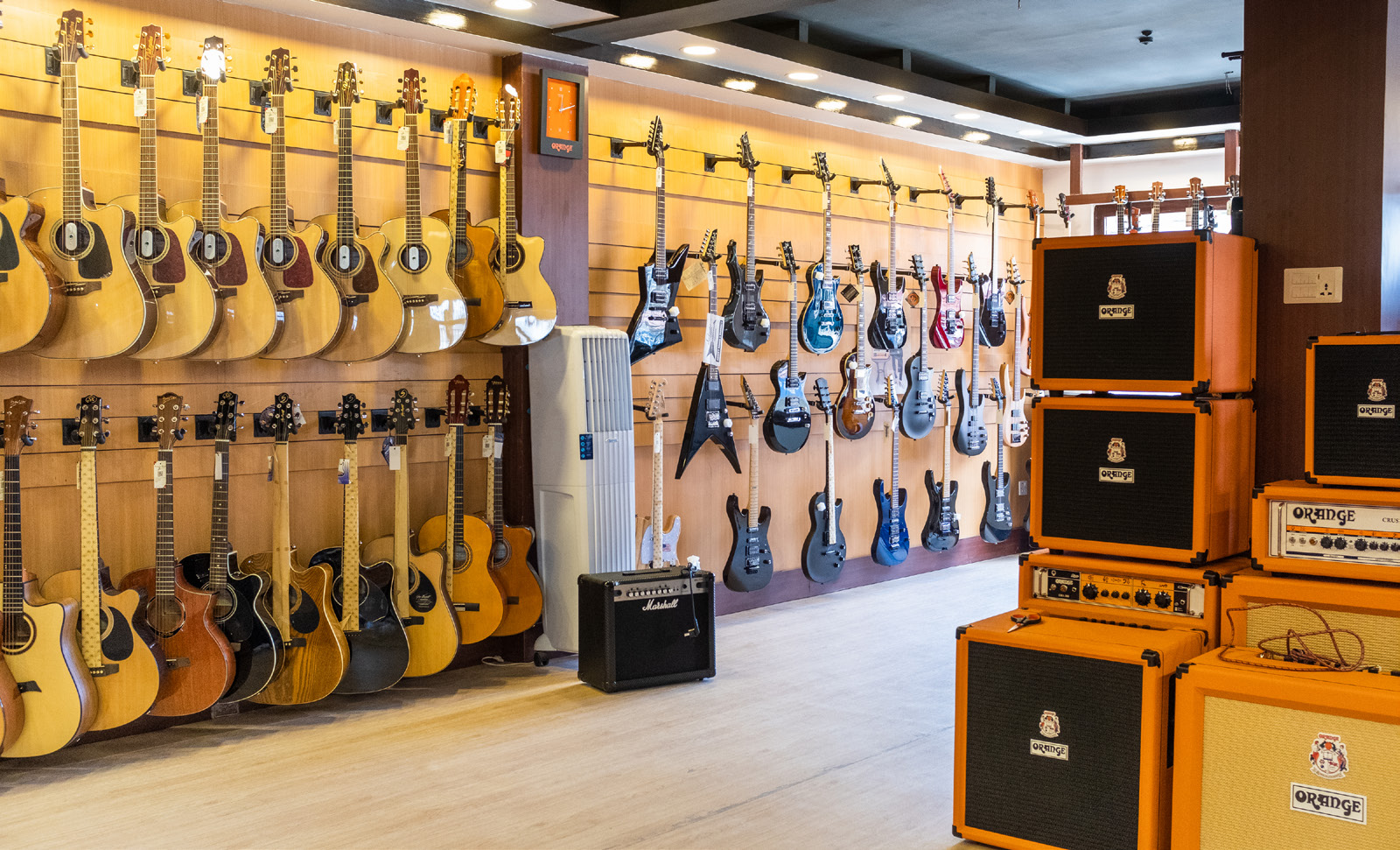
GL then officially established the ‘Harmonium Maila & Sons’ music store which would sell imported Western musical instruments “for the first time in Nepal”. Although import was next to impossible at the time, the Tandukar family’s reputation helped him import popular brands of musical instruments from as far away as Italy, Japan, UK, Germany, and Spain, among other countries. The store’s popularity catapulted among the youth of the time who had acquired a strong taste of Western music.
As Harmonium Musicals’ legacy got engraved into hundreds and hundreds of households that had bought musical instruments from them, a third generation of the Tandukar family prepared to inherit the store, making it inarguably the oldest running in the country. Mahesh Ranjan Tandukar (57) and Prajesh Raj Tandukar (38) took gradual steps into bequeathing the business from their father, starting in the 1990s. The store was again rebranded ‘Harmonium Musicals and Sports’. As the name suggests, it also started selling sports equipment, even though music was still their main business.
“Now we’ve not only taken over the business but are also trying to expand it in terms of import and availability,” Prajesh, the younger proprietor, says. “We have gained reputation for our quality products and services but the competition is high these days.” With increased competition, the family’s concern now is not just to maintain respectable existence but also to dominate the market as it did in the old days.
While the previous generations running Harmonium Musicals had been passively reaping the fruits of the pioneer venture, the new generation is aggressively reclaiming the portions of market it lost over time. To ensure quality and best prices, Harmonium Musicals has tied up with world famous international brands like Pearl Drums, Orange Amps, ESP Guitars, Sabian Cymbals, and Takamine Guitars. As exclusive authorized distributors for most brands that it imports, Harmonium offers genuine products at competitive prices and supportive after-sales services.
Also for the first time in its almost 100-year history, Harmonium Musicals has extended its service beyond its birthplace in Khichapokhari. The store has recently opened a branch in Jawlakhel, Patan (opposite Ekta Books) and has already had customers thanking it for the expansion, the owners say.
“This business of selling musical instruments is not as easy as it looks,” Prajesh says. “We need to understand the changing needs and demands of the customers and continuously stay updated.” He is thankful to the countless loyal customers who in turn have influenced the younger generations to visit the store.
With the Covid-19 outbreak that resulted in four months of lockdown, most of the marketing, promotion and sales plans were postponed, but according to the persistent owners, it is only a matter of time before things go back to normal. Of late, Harmonium Musicals has not only been selling music instruments but also supporting and sponsoring new us well as renowned musicians in the country.
“We will also be organizing workshops and seminars for musicians at our location when the situation normalizes,” Prajesh says. “And there’s plan to include more international brands in our portfolio.”

Resumption of taxi services fail to cheer up drivers
On July 9, government spokesperson Yubaraj Khatiwada had announced the Cabinet decision to resume the services of local public vehicles, including taxies, by adhering to health and safety protocols. According to new rules, apart from the driver, only two passengers and a child below the age of five, if from the same family, are to be allowed in the taxi. The same provision applies now that the odd-even number system is gone with the lifting of the Covid-19 lockdown.
Following the July 9 announcement, taxi services resumed. With most public busses still out of operation, the taxi drivers should have benefitted, but that was not the case. Taxis are still short of passengers.
Fasta Bahadur Magar, 34, from Bhaktapur who started his taxi service a couple days after the Cabinet decision, is despondent. “Before, I used to get 4-5 trips a day but now it is one or two trips,” he explains. “Many people prefer take to foot if their destination is within 30-40 minutes walking distance”.
Mohan Shrestha, 42, from Maitidevi, another taxi driver, had been waiting for six hours for his first passenger when APEX caught up with him. Shrestha does not expect things to drastically improve so long as the airport is not back in full operation and hotels restaurants don’t reopen.
Similarly, Rinjing Sherpa, 34, a taxi driver from Boudha, states, “Now, I am earning Rs 600-700 a day. Deducting petrol, maintenance, and owner’s share, I earn Rs 200 a day. How can I run my household on such a meager income?”
For his part, says New Buspark’s Dipak Bhattarai, 33, “Neither can we charge according to our will, nor do we get passengers. Things are difficult.” On the first day after the end of the nationwide lockdown, Bhattarai had made two trips till 2:30 pm, which was “a great improvement from the previous days yet hardly back to normal.”
As regards health and safety measures, all four taxi drivers keep hand sanitizer in their vehicles. They also claim to only allow passengers who are wearing masks, and request them to use sanitizer before entering their taxi. “When someone, in a rare case, comes without a mask I ask him/her to buy a medical mask, otherwise I refuse to go,” adds Shrestha.
They are also asking the government to revise fares. The old rates are outdated, they complain.
Both Sherpa and Magar say the taxi owners have been supportive. They have waived off the daily fixed charges drivers owe the owners. Whatever is left is shared on a 50-50 basis.
In the case of the drivers who own their taxis, loan installments are a headache. “Resumption of taxi services has given banks and house owners an excuse to collect their dues from us,” says Shrestha. He was unaware of the recent Nepal Rastra Bank monetary policy that plans on easing loan payments for those hit by Covid-19. When informed about the policy, he replied, “Our government is quick with plans, but always fails in implementation.”
Thousands of taxi drivers make—there are around 11,000 taxies in Kathmandu valley—depend on daily wages to earn their livelihood. Most of them are struggling to make their ends meet.

The communist movement in Nepal loses its father figure
A founding father of the communist movement in Nepal died on the morning of July 22. Burman Budhamagar died in a hospital in Kathmandu, a year after undergoing an operation for his colon cancer. One of the founders of the communist movement in Nepal back in 1950s, which would later coalesce into a broader nationwide Maoist movement, Budhamagar was noted for his principled and austere lifestyle, and was hence known as perhaps the only ‘true communist’ leader in the country.
In the words of the researcher of early Maoist movement in Nepal, Benoît Cailmail, “the leading and most charismatic figure of communism in the village of Thabang in Rolpa” in the early 1990s was also the “first of the villagers to fight against the local headmen’s authority and forms of abuse.”
Thabang, the cradle of Nepali Maoism, has been grief-stricken by the demise of 90-year-old Budhamgar from Thabang rural municipality in Rolpa district. Rishikesh Budhamgar “Sabin”, a relative of the dead ex-MP, expressed his shock. “People who have stayed true to their communist roots are dying while corrupt communists continue to rule the roost,” Sabin rues.
Budhamagar gets the credit for the birth of the communist movement in Thabang, which was already a Maoist stronghold when the then CPN (Maoist) started its armed rebellion in 1996. Even today, Thabang is considered a solid Maoist base area.
Budhamagar came into national limelight when he was elected an MP on behalf of the then ‘Janamorcha’ in the 1991 general election. He had a unique way of giving national recognition to his identity—he would go to the national parliament barefoot, clad in traditional Magar attire. One time, he was even stopped by the security guard in the parliament building for trying to enter barefoot. But that did not deter Budhamagar from dressing in his ‘attire of the people.’
Budhamagar’s political career formally began when he joined a farmers’ organization in Thabang in around 1957. Also around that time, he was active in the Maoist party led by Mohan Bikram Singh. Budhamagar, who was in contact with Singh during his imprisonment for subversive activities, had tried to avoid the ban on the party by opening a front that ostensibly served farmers. Later, Budhamagar also became the Pradhan Panch several times during the Panchayat period.
In the first general election of 1959, the people of Thabang had given all their votes to the radical communists, again largely thanks to Budhamagar’s influence in the area. Likewise, during the 1980 referendum, all the votes in Thabang were cast in favor of multi-party system. However, a year later, Budhamagar boycotted the national elections held under the Panchayat regime. For this ‘crime’, the national army even conducted a major operation in Thabang.
After the end of armed conflict on 20 March, 2006, Budhamagar remained close to communist politics, while working as an advisor to the mother Maoist party. Again thanks to Budhamgar’s influence, in the 2008 CA elections, 100 percent votes in Thabang went to the Maoist candidate Prachanda.
Owing to his tall political legacy, not only communist leaders, but also journalists and researchers who visited Thabang to understand its role in Nepal’s communist movement would not return without meeting Budhamagar.

They collect hair, craft wigs for cancer patients
We have all heard about blood and organ donations. But donate hair? Yep, whether you have heard about it or not, you can donate your hair right here in Nepal.
Earlier, cut hair that accumulated in salons and parlors in Kathmandu were disposed off as waste. This was until Koshish Nepal, an NGO, joined hands with Mayas Beauty Parlor to collect hair from willing donors and turn them into wigs for those who have lost hair for medical various reasons. “Koshish Nepal makes wigs for cancer patients or those suffering from hair loss for other medical reasons,” says Sujina Silpakar, the NGO’s president. The organization, established a year and half ago, is first-of-its-kind.
Lalitpur’s Manisha Dulal, 26 had donated her hair in December 2019 before going to Australia. “The concept was still very new back then. It was by pure chance that I found about Koshish online and decided to donate my hair.”
Another donor Anjita Pathak, 25, from Chitwan also donated her hair for the first time in August 2019. “I was wanted to donate but was struggling to find the right channel before a friend suggested Koshish Nepal,” she says, adding that she plans to donate again.
Namrata Pradhan, 25, also from Chitwan, has a similar story. She also donated her hair to Koshish Nepal through Mayas Beauty Parlor a year ago. “I have witnessed hair loss in cancer patients many times. I thought the least I could do for them is give them my hair,” she says.
Mayas Beauty Parlor and Koshish Nepal had also co-organized a hair donation campaign in 2019. “As far as I know, we’re the first and only salon facilitating hair donation in Nepal,” says Gita Giri of Mayas Beauty Parlor. According to Giri, Koshish Nepal has a team of doctors and nurses who oversee the health of potential hair recipients and determine if they are ready for the wigs.
Giri says Nepali women from as far afield as the US and Australia have been in contact, expressing their interest in hair donation. “The response has been overwhelming. Now even men can donate their hair,” she adds. The donors also get certificates.
“It’s a win-win: We do not charge for hair-cut and the needy patients get hair for free,” Giri says.
It’s not an easy process though. Hair from around 15-20 donors is needed just to make a single wig. Altogether, it takes 3-4 months to prepare. Six or seven people had been donating their hair on each event before the Covid-19 outbreak put a stop to it.
As the concept of hair donation is still new, people have many misconceptions about the process, Giri explains. Most people do not know about it and even when someone wants to donate, they are skeptical about whether their donation will reach the intended beneficiary.
“I initially had my doubts, but then Koshish Nepal was a credible organization. They even gave me a certificate,” Pathak, the donor, adds. Other donors also express their satisfaction and laud the transparency in the process.
To maintain such transparency, videos and photos of the donated hair are regularly posted on social media and the donors are informed. Lack of funding is the main crutch for the charity work. “There is a high demand of hair from cancer patients but with our limited funding and resources, we’re struggling to meet the demand,” she says.


