


Bus hit kills biker in Bhaktapur

A man died after a bus hit a bike in Bhaktapur on Friday.
The deceased has been identified as Ramesh Timilsina (36) of Sudan, Changunarayan Municipality-8.
The incident occurred when the bus (Ba 4 Kha 2001) heading towards Sallaghari from Radhe Radhe hit the bike (3-02-006 Pa 6114) yesterday, police said.
Critically injured in the incident, Timilsina breathed his last during the course of treatment, the Metropolitan Police Range, Bhaktapur said.
Police said that they are searching for the bus driver who fled the scene after the incident.

Nepal records 18 new Covid-19 cases on Friday
Nepal reported 18 new Covid-19 cases on Friday.
According to the Ministry of Health and Population, 2, 822 swab samples were tested in the RT-PCR method, of which 12 returned positive. Likewise, 1, 520 people underwent antigen tests, of which six were tested positive.
The Ministry said that no one died of virus in the last 24 hours. The Ministry said that 271 infected people recovered from the disease.
As of today, there are 1, 960 active cases in the country.

Man kills wife with sharp weapon in Budhanilkantha
A man killed his wife by attacking her with a sharp weapon in Chunikhel, Budhanilkantha Municipality-13 on Thursday.
SP Dinesh Raj Mainali of the Metropolitan Police Range, Kathmandu, said that Bhakta Bahadur Thapa (21) of Udayapur and currently residing in Chunikhel killed his wife Laxmi Tamang (24) by attacking her with the sharp weapon over a domestic dispute last night.
Critically injured in the incident, Tamang was rushed to a hospital but doctors pronounced her dead on arrival.
Police said that they have arrested Thapa and kept at the Metropolitan Police Circle, Budhanilkantha for investigation.

Fast track: Army veers off the environment track

The under-construction Kathmandu-Tarai fast track passes through 30km of agricultural land and 43km of forest cover. The project’s Environmental Impact Assessment (EIA), approved in 2015 foresees physical, biological, socio-economic, and cultural impacts from expressway construction. These impacts, the EIA estimated, would be particularly high in 38 villages that lie within 50-meter distance of the road development sites.
The EIA report also suggests measures to mitigate potential risks.
On its website, the Nepal Army, which is building the fast track, has put the EIA under the project’s ‘salient features’ category. It claims environmental concerns were fully addressed during the project’s planning, preliminary design and alignment phases. It also guarantees continuous monitoring of project sites and assures necessary steps will be taken for environment-protection and impact-mitigation.
Based on these commitments, the army, in late 2021, submitted a supplementary EIA report, which was later approved by the Ministry of Forests and Environment.
But the report clashes with ground realities.
During a recent ApEx field-reporting trip of the expressway, our team spotted several unaddressed EIA concerns.
Also read: Lack of fast track progress raises questions over Nepal Army’s credibility
As we reported on March 10, some Chinese workers had chopped down almost a dozen trees without any permit at Bandarekholchha of Makwanpurgadhi Rural Municipality in Makwanpur district. The army camp set up to liaise with the local community on fast track-related concerns had mostly ignored the villagers’ complaints.
In the same place, the army has cut off half of a hillside atop which sits a small village. This has exposed the village to landslide and erosion risks, once again suggesting the flouting of the EIA directives. But the army denies any oversight.
Brig. Gen. Bikash Pokharel, the fast track project chief, dismissed our findings and denied the EIA protocols were violated. He even refused to accept our photographic evidence.
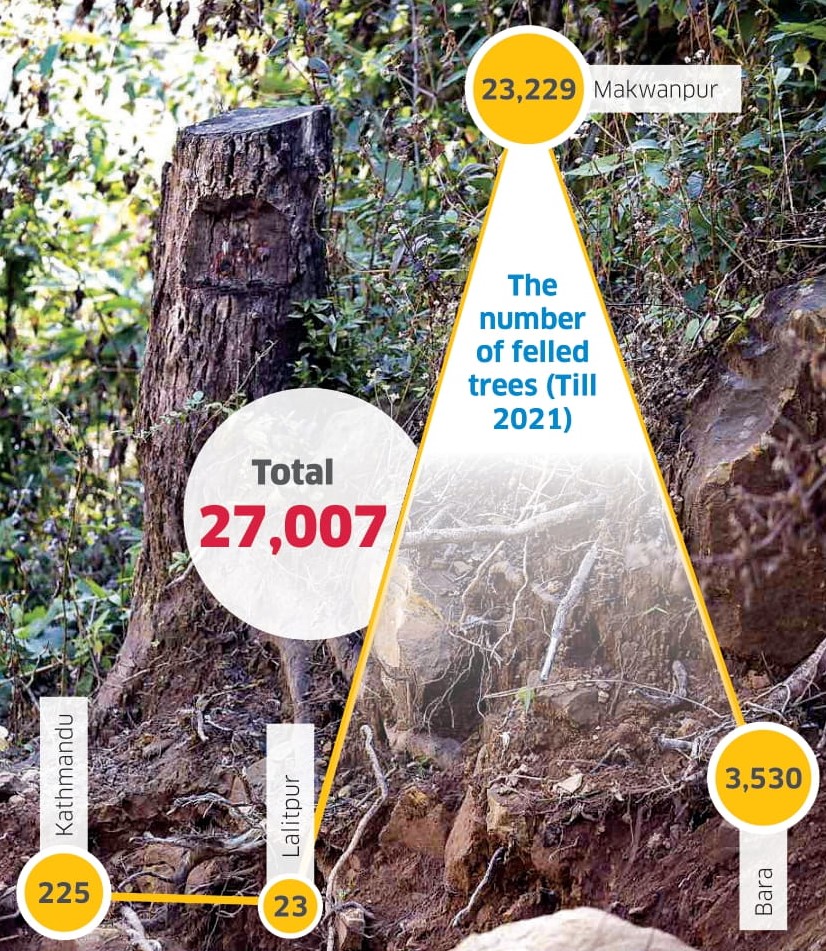
The army has felled over 27,000 trees while opening the expressway-track. There are 13 community forests and several other national forests in project areas.
As the expressway doesn’t cut through dense forest areas, there is unlikely to be much destruction of wildlife habitat. But, at the same time, the potential destruction of endangered species of natural flora cannot be disregarded.
Pollution is another environmental concern that seems to have gone unnoticed.
Residents living near fast track construction sites told ApEx that their earlier peaceful lives had been disrupted by the noise and vibration from earth-movers and other machines.
“We have to listen to this racket all the time. It’s unrelenting: construction happens day and night,” says Hikmat Tamang, a resident of Makwanpurgadhi Rural Municipality.
Residents close to the project sites also complain of deteriorating air quality. They say dust and dirt particles emanating from drilling, quarrying and blasting have polluted ambient air. Excessive dust particles have also harmed the crops of local farmers who rely on cash crops like pear, banana, maize, wheat and lapsi for their livelihood.
Also read: What if… the fast track project was completed on time?
Health experts say such constant noise and pollution could lead to physical and mental health problems.
“Continuous noise pollution could increase the risks of anxiety, psychological stress, depression, as well as high blood pressure, heart disease and stroke,” says Dr Rishav Koirala, a psychiatrist at Grande International Hospital.
But the army does not seem to have made any effort to rein in pollution at the project sites.
“You must water the construction sites twice a day to minimize the volume of dust in the air,” says environmentalist Aananda Bhandari.
Prohibiting open storage and spillage of loose soil, covering trucks carrying construction aggregate, and use of quality vehicle fuel and filtration systems could also help reduce air pollution.
Similarly, banning pressure horns, using noise barriers and silencers on vehicles and crushing plants, and limiting the use of explosives could minimize noise pollution. Planting of tree species such as the Ashoka is also useful in absorbing noise and air pollutants.
However, in many places, none of these mitigation measures seems to have been employed.
Bhandari thinks the expressway has been particularly egregious in neglecting environmental concerns compared to Nepal’s other mega projects.
“Apparently, as the fast track runs through small villages and only thin forest areas, perhaps the army does not think it will have much environmental impact,” he says. “But when it comes to preserving the environment, there should be no compromise. We should ask the army to strictly adhere to the EIA protocols.”
Also read: Fast track, off track
According to the EIA report, water quality at the project development sites was already poor, unsuitable for drinking or irrigation. The project has had relatively little impact on water resources. Still, the army has ignored the mandatory installation of wastewater treatment plants at project sites.
The only thing the army seems to be doing to protect the environment on a consistent basis is regularly disposing of the excavated waste.
Yet the army insists the fast track has not violated any EIA guidelines.
Officials at the Ministry of Forests and Environment also say there have been no reports of environmental concerns.
“We have not received any such complaints over the project on our regular inspections,” says Megh Nath Kafle, the ministry’s spokesperson.
When ApEx shared some examples of potential environmental breaches, he committed to unearthing the truth soon.


