Five-party alliance decides to focus on economic development

The ruling five-party alliance has decided to focus on ensuring people’s partnership for socioeconomic development of the country.
The five parties in their election manifesto stressed on practically reaching ‘Singha Durbar’, the centre of authority and power, to each village along with maximum mobilization of local levels.
As the government closed to the people, the local level’s empowerment is in the alliance’s priority.
The election manifestos made public by the parties have kept in centre the empowered and pro-people local level in a bid to ensure effective implementation of federalism.
Implementation of fundamental rights as citizen’s access to basic health service, free school education, food security, housing, employment, clean environment, regional and gender equality are reiterated as common issues by their manifestos.
In addition to the manifestos, the alliance has mobilized leaders and cadres of their parties for smooth coordination and collaboration in the elections.
The selection of election candidates in consensus is one of the significant features of the electoral alliance.
The leaders have informed that they were going to prepare common election manifestos in Kathmandu, Lalitpur, Bharatpur, Biratnagar and Biratnagar Metropolises.
Pokhara Metropolis and Ghorahi Sub Metropolis have prepared common manifestos of the alliance.
In this regard, Nepali Congress central member Krishna Kishor Ghimire said for the candidates fielded on behalf of alliance, there is joint mobilization of alliance parties.
Another NC leader and lawmaker Anita Devkota also informed that up to the ward level, NC, Maoist Centre and Janamorcha have forged electoral alliance, so there was no point in worrying about electoral performance.
Spokesperson of the CPN Maoist Centre, Krishna Bahadur Mahara said his party had given priority to socialism oriented prosperity via socio-economic transformation.
“It is local level government, so making manifesto based on the need of respective local levels is imperative. It will be focused,” he added.
Deputy mayoral candidate in Lalitpur Metropolis Baburaja Bajracharya also has the belief that the social justice-focused development model would be viable to pay heed to people’s need at present and ensure socialism in the country.

Former envoy to Nepal Kwatra takes charge as India’s new foreign secretary
Vinay Mohan Kwatra has taken charge as the new foreign secretary of India on Sunday.
The Ministry of External Affairs of India appointed Kwatra as the foreign secretary when he was the Indian Ambassador to Nepal.
He succeeded Harish Vardhan Shringla who retired from the service on Saturday.
"Shri Vinay Kwatra assumed charge as Foreign Secretary today morning. #TeamMEA wishes Foreign Secretary Kwatra a productive and successful tenure ahead," MEA Spokesperson Arindam Bagchi tweeted on Sunday.
Before his diplomatic posting to Nepal in 2020, he served as the Ambassador of India to France from August 2017 to February 2020.

Ukrainians plead for Mariupol rescue; Russian advance crawls
Ukrainian forces fought village by village Saturday to hold back a Russian advance through the country’s east, while the United Nations worked to broker a civilian evacuation from the last defensive stronghold in the bombed-out ruins of the port city of Mariupol, Associated Press reported.
An estimated 100,000 civilians remain in the city, and up to 1,000 are living beneath a sprawling Soviet-era steel plant, according to Ukrainian officials. Ukraine has not said how many fighters are also in the plant, the only part of Mariupol not occupied by Russian forces, but Russia put the number at about 2,000.
Russian state media outlets reported Saturday that 25 civilians had been evacuated from the Azovstal steelworks, though there was no confirmation from the UN Russia’s RIA Novosti news agency said 19 adults and six children were brought out, but gave no further details.
A top official with the Azov Regiment, the Ukrainian unit defending the plant, said 20 civilians were evacuated during a cease-fire, though it was not clear if he was referring to the same group as the Russian news reports.
“These are women and children,” Sviatoslav Palamar said in a video posted on the regiment’s Telegram channel. He also called for the evacuation of the wounded: “We don’t know why they are not taken away and their evacuation to the territory controlled by Ukraine is not being discussed.”
Video and images from inside the plant, shared with The Associated Press by two Ukrainian women who said their husbands are among the fighters refusing to surrender there, showed unidentified men with stained bandages; others had open wounds or amputated limbs, according to the Associated Press.
A skeleton medical staff was treating at least 600 wounded people, said the women, who identified their husbands as members of the Azov Regiment of Ukraine’s National Guard. Some of the wounds were rotting with gangrene, they said.
In the video the men said that they eat just once daily and share as little as 1.5 liters (50 ounces) of water a day among four people, and that supplies inside the besieged facility are depleted.
One shirtless man appeared to be in pain as he described his wounds: two broken ribs, a punctured lung and a dislocated arm that “was hanging on the flesh.”
“I want to tell everyone who sees this: If you will not stop this here, in Ukraine, it will go further, to Europe,” he said.
AP could not independently verify the date and location of the video, which the women said was taken in the last week in the maze of corridors and bunkers beneath the plant.
The women urged that Ukrainian fighters also be evacuated alongside civilians, warning they could be tortured and executed if captured. “The lives of soldiers matter too,” Yuliia Fedusiuk told AP in Rome, Associated Press reported.
In his nightly video address late Saturday, Ukrainian President Volodymyr Zelenskyy switched into Russian to urge Russian troops not to fight in Ukraine, saying even their generals expect that thousands more of them will die.
The president accused Moscow of recruiting new soldiers “with little motivation and little combat experience” so that units gutted early in the war can be thrown back into battle.
“Every Russian soldier can still save his own life,” Zelenskyy said. “It’s better for you to survive in Russia than to perish on our land.”

The May 13 vote at a glance

Preparations are in full swing for the May 13 local-level elections. Political parties and candidates are out barnstorming while the Election Commission is doing its part to conduct a free and fair vote.
For political parties, particularly those in the Nepali Congress-led ruling coalition, these past few weeks have been hectic. For days, the ruling parties were busy divvying up seats as they had decided to forge an electoral alliance against CPN-UML, the main opposition.
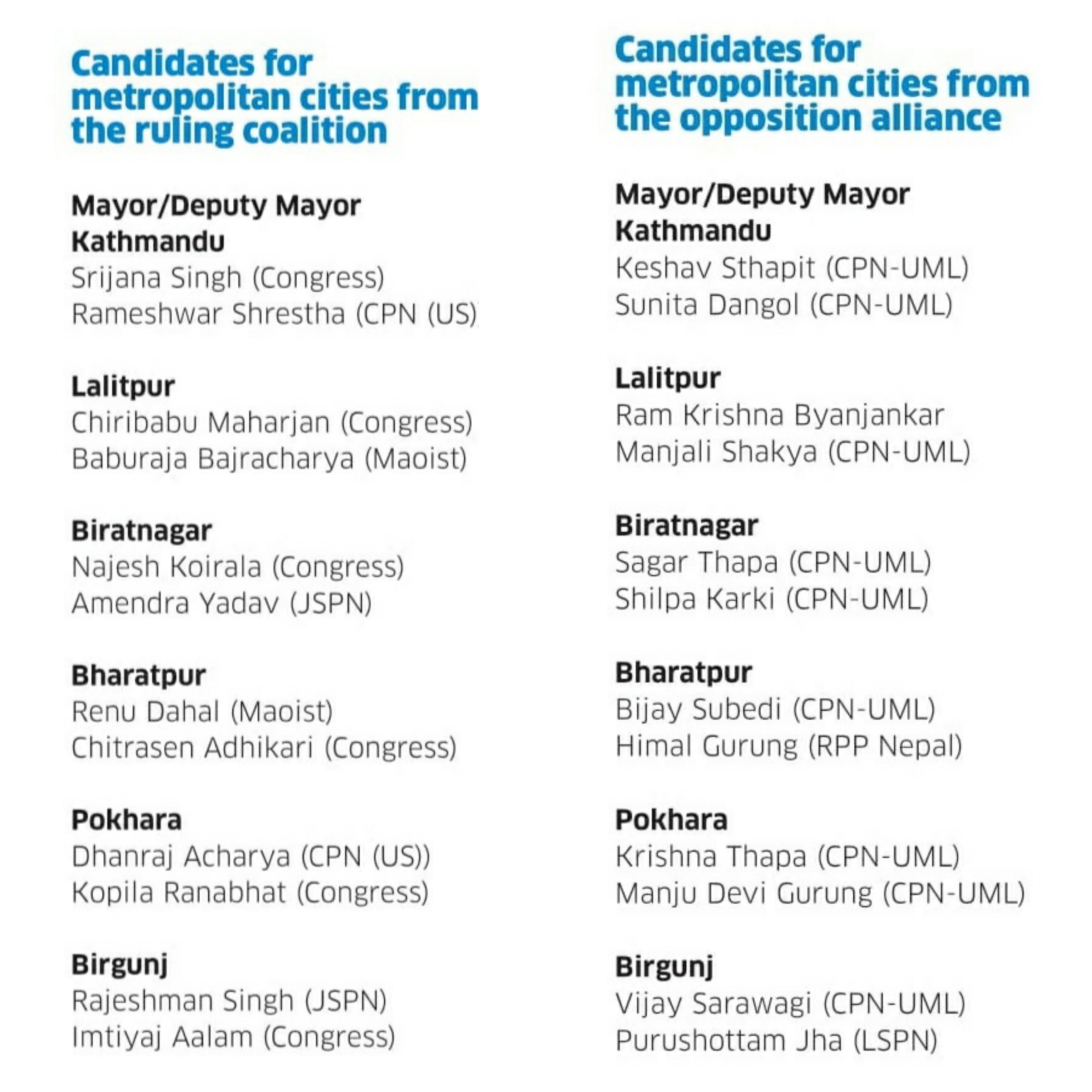
The ruling Congress, CPN (Maoist Center), CPN (Unified Socialist), and Janta Samajwadi Party have nominated common candidates in most local bodies and are competing individually only in a few places.
Similarly, UML, too, has cobbled alliances with small opposition parties like Loktantrik Samajwadi Party and Rastriya Prajatantra Party in many places. The main opposition, however, has called dibs on mayoral seats in almost every metropolis, sub-metropolis and municipality.
The electoral alliances have also led to resentment and dissatisfaction in some parties.
As a result, many local politicians have registered themselves as rebel candidates after being denied tickets from their parties. For instance, Jagannath Paudel of Congress has filed his candidacy against Renu Dahal of Maoist Center in Bharatpur Metropolitan City. Likewise, in Pokhara Metropolitan City, Nanda Tiwari and Hrishi Sapkota of Congress have stood against the Unified Socialist candidate, Dhanraj Acharya.
There are also several independent youth candidates this time. Rapper and structural engineer Balen Shah is running for the mayor of Kathmandu Metropolitan City. Similarly, Ganess Paudel has filed an independent candidacy for Pokhara Metropolitan City’s mayor. Young and independent candidates are also contesting at the municipal level.
Among the mayoral aspirants this time are also some provincial lawmakers. They have resigned as assembly members to contest the May 13 elections.
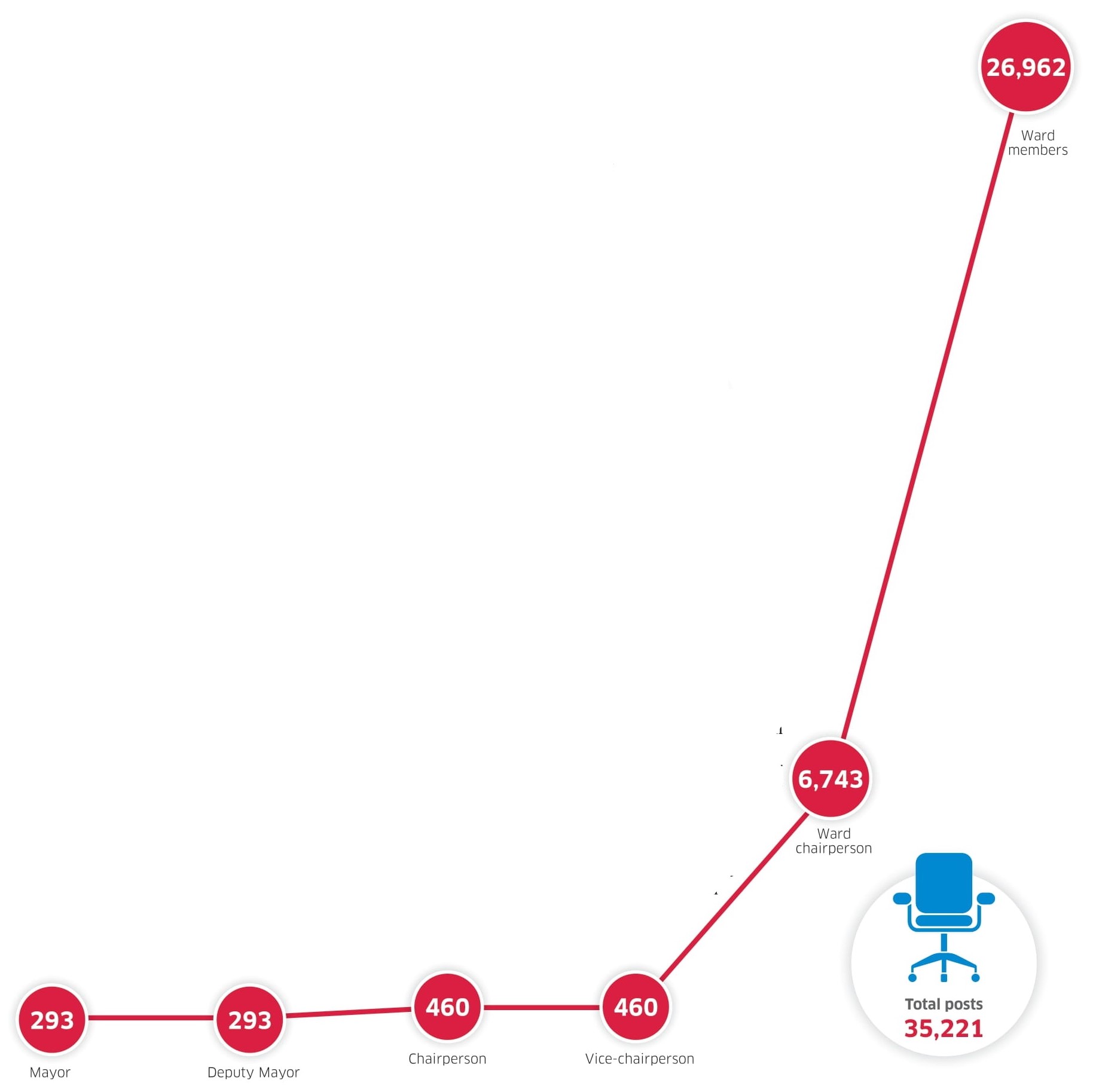
According to Saligram Sharma Paudel, spokesperson of the Election Commission, 137,043 people have filed their candidacies for 35,221 posts this time.
Of them, 3,276 are for mayor, 2,009 for deputy mayor, 3,264 for chairperson, 2,296 for vice-chairperson, and 32,217 for ward chairperson. Similarly, 23,521 candidacies have been filed for women members, 21,221 for Dalit women members, and 49,239 for ward members.
Kaike, Charkatangsong, and Shey Phoksundo rural municipalities of Dolpa district have already elected their chairs and vice-chairs unopposed after only Unified Socialist filed its candidacy.
There are over 10,000 polling stations all over Nepal. The Home Ministry has categorized around 3,000 of them as ‘very sensitive’ and 4,000 as ‘sensitive’ and is preparing to mobilize security personnel accordingly.
Nearly 100,000 temporary police have been hired to assist the 60,000-strong Nepal Police for election security. The Armed Police Force will also be deployed on patrol, and to secure election offices. Similarly, Nepal Army soldiers will also be involved in various poll security duties, including securing airports and prisons.
Around 2,000 officers of the National Investigation Department will be mobilized to collect vital security information and coordinate with the police forces.
‘Preparations are on track’
Dinesh Kumar Thapaliya
Chief Election Commissioner
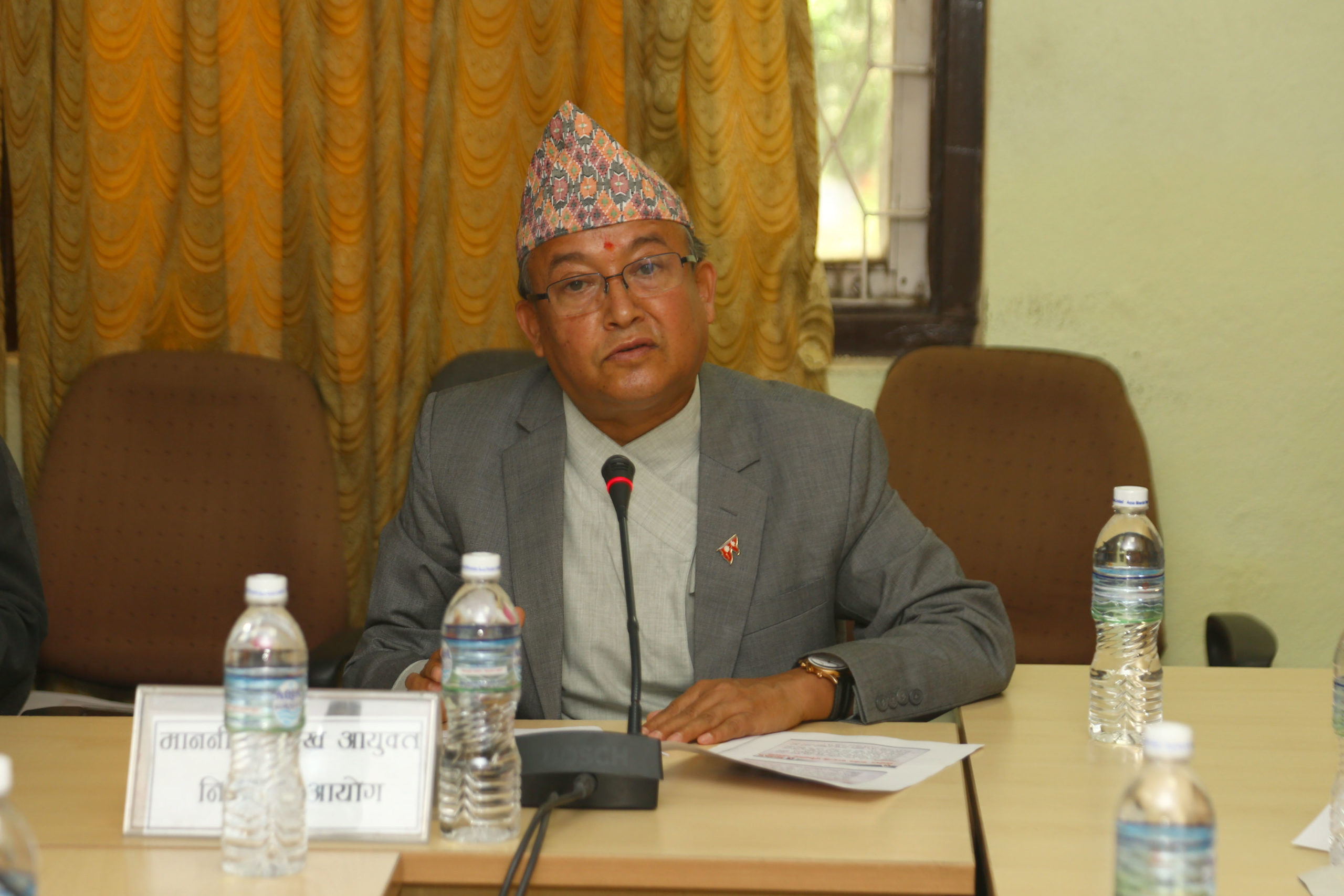
The commission is responsible for meeting almost every logistical election need. So we need to get many things right to conduct free and fair elections. Due to the many posts at the local level, managing ballot papers is a little tricky. Yet, we are on schedule and everything is on track.
We are in the process of finalizing candidates and giving them election symbols.
Ballot papers are also being printed, and other necessary materials are being sent to respective election offices. We are playing our part and I request other stakeholders to do the same, especially the political parties, whom I request to adhere to the election code of conduct.