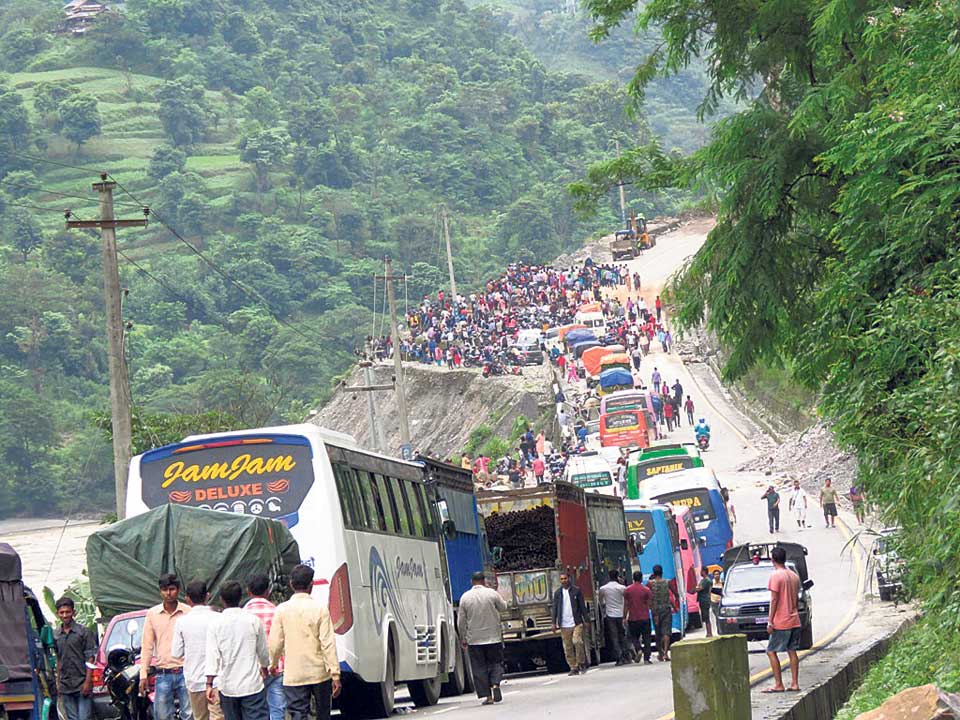
What did UML achieve from ‘Sankalpa Yatra’?

The CPN-UML has completed its 18-day long roadshow (Sankalpa Yatra) along the Mid-hill districts, which saw an active participation from its chairman, KP Sharma Oli. Starting from Jhulaghat in Baitadi district of far-western Nepal and culminating at Chiwa Bhanjyang of Panchthar district in the east, this journey weaved through 26 districts.
Over 200 central-level leaders and a sea of passionate cadres flooded the campaign trail. Oli formally ended the campaign by hoisting the national flag at Chiwa Bhanjyang—a settlement along the Nepal-India border and the eastern gateway of the Mid-Hill Highway.
On the occasion, Oli rallied the party faithful, urging them to gear up for a simple majority triumph in the 2027 elections. With the party positioned as the second-largest and best by numerous challenges, the stakes are high. “The Mid-Hill Highway will be the mainstay for the development of the mid-hill region of Nepal. We can develop Chiwa Bhanjyang as a transit point with India to gain financial benefits,” Oli declared.
He said the main objectives of the campaign were to transform people’s pessimism into optimism, to identify the developmental gaps in the mid-hill region, to develop a national vision, and to discourage anti-constitutional forces. The UML organized the campaign at a time when people’s frustration against the major political parties is at an all-time high and anti-constitution forces are intensifying their protests in the street.
Post last year’s national elections, the UML is the only party to launch a series of strategic campaigns to boost its organizational structure. Amid resistance from pro-identity activists, who staged strikes attempting to disrupt the campaign, the UML pressed on undeterred. Even in the face of sporadic incidents, the party proudly claims the campaign as a resounding success. Since 2008, identity-based federal structure advocates have painted UML as their adversary, a legacy rooted in the party's opposition to name the provinces based on ethnicity during the constitution drafting process. The party had taken the same position during the naming of the erstwhile Province 1. In Panchthar, obstacles were strategically placed on the road by pro-identity activists, yet these impediments failed to halt the UML’s march.
After last year’s national election, the UML has been on an organizational revitalization spree, with initiatives like the Mission Grassroots, which was aimed at addressing internal issues and wooing the youth. During the latest campaign, Oli informed the public about the party’s vision and criticized the misdeeds of the Dahal-led government.
But the UML itself faces internal strife and discontent, a challenge mirrored across major political entities in Nepal. As new political forces emerge and public frustration with established parties mounts, the UML sees the Sankalpa Yatra as a chance to intimately connect with the nation and resolve its internal quandaries. Party leaders emphasize that a comprehensive review of the campaign will guide future endeavors, signaling a commitment to adapt and evolve. The UML is preparing to fight the 2027 elections without forming any alliances.
While many have dubbed the latest UML campaign “Mission 2084,” the Nepali year when national elections will take place, Oli time and again has said that the party has to be ready for the midterm elections.
Among the major parties, the UML has the most strong and robust organizational structure at the local level. But this strength is weakening due to internal disputes and dissatisfaction. The emergence of new political forces and growing frustration against the major political parties among the masses is a wake up call for all major parties, not just the UML.
Leader Prithvi Subba Gurung underscores the campaign’s role in reinvigorating party leaders and cadres alike. The emergence of fresh political dynamics and the growing discontent with the political establishment pose formidable challenges for parties that have dominated the national political arena since the 1990s.
Another leader Deepak Prakash Bhatta says the campaign provided an opportunity for the leaders to see the plights of people residing in the Mid-Hill region and rebuild trust.
As the dust settles on this grand roadshow, only time will tell whether the UML’s campaign has succeeded in sustaining the people’s trust.

Burn injuries: Not a national priority
In 2006, Radha Shrestha and her mother suffered severe third-degree burns when a gas cylinder exploded in their one-bedroom home. Their treatment began only on the third day when they were shifted to Sushma Koirala Memorial Hospital (SKMH) in Sankhu. Shrestha’s mother passed away and she was discharged after 39 days.
Doctors attending to them said her mother’s death could have been prevented had she received immediate medical attention. Nearly two decades on, the situation remains much the same. Most hospitals in Nepal are still ill-equipped to handle burn cases, causing inevitable delays in case of emergencies.
Dr Binod Karn, associate professor of plastic surgery at Nepalgunj Medical College, says the government hasn’t given much attention to burn care. A few NGOs and INGOs conduct awareness and training programs and give medical assistance, and that’s about it.
Burns are the second most common injuries in Nepal. They are the most debilitating too. Treatment often lasts years, with victims requiring multiple surgeries. There are roughly 50,000 injuries and 21,000 deaths due to burns every year. Nepal is ranked number one in the list of countries with the highest rate of mortality by fire-related accidents.
Burn cases are mostly accidental and sometimes even homicidal and suicidal. In winter, most burn cases are 50-plus women who sit with their backs to the fire to keep themselves warm. In summer, electrical burns among metal workers are the most frequent cases. Suicidal and homicidal cases in Nepal are frequently related to dowry. Sometimes, women, frustrated by nagging and abuse, set themselves alight but usually, it’s the in-laws who burn them.
Most burn cases are referred to Kathmandu. Dr Karn says Nepalgunj Medical College can handle cases with 20 percent burn. Anything above that is either referred to Kirtipur Hospital or SKMH in the capital city. Many patients can’t afford the transport cost. Treatment is expensive. The survival rate, he says, is also low. A patient with a 20 to 30 percent burn has only a 20 to 30 percent chance of survival.
“Burn treatment is complex and most hospitals aren’t equipped for it,” says Dr Karn. There should be a separate hospital or at least a dedicated burn unit in each hospital. The medical staff also needs burn-focused training. He says every province should have at least one proper burn unit or hospital. “We can save many lives if there were at least three burn units in Nepal to begin with—one for provinces one and two; one for three and four; and one for provinces five, six, and seven,” he says.
Dr Santosh Bikram Bhandari, a burn, plastic, reconstructive, and cosmetic surgeon at SKMH, says the hospital handles over 100 burn cases every month. Though it has a separate burn ward and the government provides an allowance for free burn treatment, they are not enough to cater to all the needs of burn patients.
Experts say most burn cases emanate from the lower socio-economic strata. The families from these strata cannot afford expensive surgeries that follow an incident. There have been cases of families taking loans or selling their meager assets to fund treatment—driving them deeper into poverty.
Dr Bhandari says there is a lack of awareness on the management of burn injuries among the public as well as medical personnel. Poverty, he says, is the biggest strain. Many people simply don’t have access to alternatives to firewood. Saris catching fire while cooking is a common occurrence in rural areas.
“Lack of knowledge on fire safety as well as first aid is appalling. People have wrong concepts about what to do after a burn injury and that often makes it worse,” says Dr Bhandari.
The government remains oblivious to the sufferings of burn victims. After Nepali Congress leader Chandra Bhandari and his mother were injured in a gas cylinder explosion, burns became a much-discussed topic at ministerial meetings, says Dr Bhandari, with the authorities promising to give everything needed to establish a state-of-the-art burn care unit at SKMH. But the talks, he adds, soon fizzled out and nothing happened.
Dr Prakash Budathoki, spokesperson for the Ministry of Health and Population, says the government’s priority is communicable diseases and other ailments that regularly claim more lives. But burn cases are also on their radar. They have separated a budget for the burn ward at Bir Hospital. The ministry is also working on a plan to run awareness programs and training in all seven provinces.
Dr Bhandari, however, insists that the government isn’t serious about burns. Despite repeated lobbying for better policies to ease the load of burn treatment, the government has done little. “It’s not difficult to have a separate burn treatment fund if the government is willing,” he says.
Burns, in Nepal, are usually the result of gas explosions, petroleum-related incidents, and electrical malfunctions or accidents. The government can bring a policy where one rupee extra is charged per cylinder and fuel refill, and 0.1 percent of the total electrical bill is levied on each customer—and all of it goes to building a national burn treatment fund. “The government can easily make burn treatment accessible and save lives if it wants to,” says Dr Bhandari.
Archana Ranjit, a nursing officer at Tribhuvan University Teaching Hospital, has years of experience working with burn patients. She agrees with Dr Bhandari and says government involvement is crucial in tackling burn cases as they require extensive care and facilities. “When patients are forced to move from one hospital to the next due to the lack of all necessary facilities under one roof, there is a delay in treatment, which is sometimes fatal. In the case of burn injuries, the earlier the victim gets treated, the better the chances of survival and healing after surgery,” says Ranjit.

Some positives of content creation for Nepal
In today’s world, content creation involves more than just having a meaningful thing to say or a relevant issue to speak on. The formal, editing and designing aspect of the content is also important to creators. With more avenues for formal control, social media websites can expect to grow in user-base, and creative engagement with those websites might also take place for longer durations.
Popular apps like Snapchat and Tiktok (recently banned in Nepal) are examples where editing and designing videos is a user-centric process. Such a process allows users to feel more ‘in charge’ of their content, and thus motivates them to create more. A service which withheld such creative control would not prove as satisfying to users, even if it allowed wide dissemination of their content.
The uptake of such apps and services in the Nepali public can be attributed not only to the opportunity to raise voice but also to show one’s skills in communication and expression. Views, reactions and comments reward and recognize the ability to present in media in tandem with the words and ideas presented. In short, not just what you say but how you say it is more important than before.
It is in part due to the disabling of ‘expression’ (how one says something) and not just curtailment of content (or ‘speech’—what one says) that there has been an outcry over the loss of freedoms since the popular TikTok app got banned by the Nepal government. Freedom of expression is concerned with more than just publishing of the content. It is concerned with how proactively one arrived at that content. Users want the government to see that doing an investigation and/or processing available data in depth are instances of the meaningful work behind an act of expression published online.
Synthetic media
A technology which has been prevalent since the advent of computers, but which has grown significantly more sophisticated today, is ‘synthetic media.’ It is about to make content creation even more exciting. Synthetic media is any media (in visual, audio and/or text format) that has been made using computers. Of late, Artificial Intelligence has been used to create synthetic media. For example, in text-based synthetic media services (ChatGPT is an example), a textually articulated idea can be transformed into a news article or essay that the service produces by itself.
In the near future, creation of sophisticated synthetic media will be inexpensive and efficient. This bodes well for certain sections of Nepali society. Small-businesses can create advertisements for their products using synthetic media, thereby sidestepping a costly production process. In a different case, teachers can use synthetic media to present their ideas more clearly. For one, if preliminary ideas are acquired with relative ease due to the use of synthetic media in presenting, then the more technical and cutting-edge education can also be made part of the curriculum.
Extremely pertinently for Nepal’s case, synthetic media can help with public messaging on critical issues such as health and discrimination. Development organizations can create videos that are able to vividly represent the problems that they want to address. Effective communication of such societal problems would enable communities themselves to deliberate and enact solutions.
In all, a positive picture
With the use of synthetic media, Nepal’s media landscape is likely to be both representative of a diversity of voices and rich with meaningful expression. But, the potential to create meaningful content needs to be harnessed more strongly in our case. At the very least, there is a need to look carefully to see whether a rural-urban gap is developing in the production of content.
To gain a more organized outcome from a technological resource, the particular roles that it can play for particular groups needs to be explored clearly first. Thereafter, policies must be made with a clear goal of supporting positive outcomes for each of the groups using the technology.

Can hills of Nepal work as view towers?
Nepal, predominantly characterized by its hilly terrain, with hills covering 80.7 percent of the land, boasts numerous valleys and lakes, resembling natural view towers.
During my recent visit to Los Angeles, situated at the foothills of California, specifically Norwalk and Riverside, I marveled at the landscapes. Riverside, nestled at the base of hills, offers well-constructed trails that allow people to ascend and enjoy panoramic views of various cities. From atop one of these hills, I beheld the picturesque landscapes of Riverside, Moreno Valley, San Diego, Ontario, Los Angeles, and beyond. These cities, surrounded by hills on one side and the Pacific Ocean on the other, create a captivating spectacle.
Similarly, in Nepal, regions such as Kathmandu Valley, Pokhara, Surkhet, and Dang are embraced by hills, presenting a tremendous opportunity for the tourism industry. Nepal has the potential to develop trails providing access to these hills. By investing in road construction and cable cars, millions of visitors could be enticed to explore these elevated terrains. The breathtaking views of cities and the Himalayas from these natural view towers can be a significant attraction, much like the view towers of southern California. Constructing hiking trails on these hills can be achieved at a minimal cost, exemplified by the natural view towers in Pokhara, offering stunning vistas of the lake city.
However, the challenge lies in the lack of awareness and vision among Nepali rulers and decision-makers regarding how and where to allocate scarce resources. Random decision-making appears to be the norm, with little role for expert input. Political leaders often operate with self-interest, leading to decisions that benefit a select few. The absence of a coherent national agenda for development is evident, and questioning the actions of political parties seems futile.
Nepal can draw inspiration from iconic landmarks like the Hollywood Gate, which serves as a view tower for Los Angeles. Similarly, a hill in San Diego, housing an army camp, functions as a view tower offering stunning perspectives of the city and the Pacific Ocean.
Nepal is in a learning phase, acknowledging imperfections and seeking improvement. While mistakes are inevitable, the ability to learn from them is paramount. The prevailing egoism among rulers takes precedence over self-sacrifice, a fundamental quality for fostering a healthy and prosperous economy. Unfortunately, self-interest permeates Nepalese society, giving rise to nepotism, favoritism, and corruption. Policy decisions often legitimize these practices, hindering positive progress.
In contrast to constructing view towers, Nepal could invest in an eight-foot-wide road along the hills, facilitating trekking to hilltops. Redirecting resources from constructing towers to building footpaths around the hills of Kathmandu Valley could create a network of accessible viewpoints. Numerous spots could serve as small view towers, allowing people to appreciate the scenic beauty of the Kathmandu Valley hills. This strategic approach could offer a more sustainable and immersive experience for both locals and tourists.