



Celebrating Dashain in the shadow of corona

The pandemic-hit Nepal is on the verge of another Dashain, and the fear is that the greatest festival of Hindus may lose some of its charm this year.
Rikesh Acharya, 30, an accountant from Sunsari currently living in a rented house in Kathmandu, is in no mood to return to his hometown this Dashain. Even in the national capital, he plans on putting Tika only in one or two places. “Social distancing and other anti-corona safety measures will take away much fun,” he says.
Laxmi Subedi, 56, a social worker who runs an orphanage home in Kathmandu, also plans to stay put in her house. But she has a bigger worry. “Alas! There will be no shopping,” she rues.
Nabin Bhandari, a 21-year-old student in Kathmandu, is a native of Gulmi district. He does plan to go back to his ancestral village, yet he too feels jaded at the prospect of a Dashain without the regular Melas and Saraya Naach.
For Shantiraj Rai, 27, a Kathmandu-based journalist from Okhaldhunga, Dashain this time will be a simple affair. He plans to travel to Okhaldhunga on his own bike. “I surely won’t take a public vehicle this year,” he says.
A native of Bhaktapur, Ritu Shrestha, 22, a lab technician, is not travelling at all. Nor does she have any plans. “How can I plan anything when the number of Covid-positive cases are increasing by the day?” she asks.
Many Nepalis living abroad return home during Dashain. But not many are coming this year.
Manisha Dulal, 26, a student in Australia, says she feels for her parents who won’t get to bless their children this Dashain. “All my brothers and sisters are here in Australia. This is not going to be a happy occasion for my parents in Nepal,” she rues. Taking chartered flights is an option. But Dulal is against chartered flights, which she says are both uncertain and expensive.
For its part, the Department of Transportation Management hopes to open bookings for long-route buses starting mid-October. The department estimates only a fourth of the normal Dashain traffic will leave for their ancestral homes this year. In the previous years, over two million people did. Nor do people plan on travelling abroad for fun.
Saroj Baral, 53, a teacher from Inaruwa, Sunsari, says this time will be ‘an economic Dashain’ as he hasn’t gotten his salary for the past six months. “In previous years, my brothers and relatives used to come visit us on the day of Fulpati and we used to celebrate together. This time I have no such plans,” he adds. He suspects that unlike in the previous years when relatives expected others to come visit them, this year they may be hoping that no one comes to spread the virus.
Mathura Dhakal, 41, a housewife and shopkeeper in Kavre, does not think the pandemic will much alter Dashain celebration in her village. What she will miss though is travelling to Kathmandu for shopping.
Tanka Prasad Naral, a 44-year-old businessman, is relieved he has his own house in Kathmandu where he can celebrate instead of having to travel to his native Kavre. “When we travel, all family members travel together, which is risky during the pandemic,” he says. Meanwhile, drastic decrease in income will make this Dashain less expensive, he adds.

The case against capital punishment in Nepal
An APEX Facebook post asking what people thought about capital punishment for rape saw replies in its favor. One respondent was upset enough to inquire, “Are you kidding, a rapist is allowed to take everything from a woman and we are actually debating whether he deserves capital punishment?” A related poll had 84 percent respondents voting yes for death for rapists. Recently, many women parliamentarians formed a loose network to lobby for stricter rape laws, including the provision of death penalty.
According to Nepal Police data, 1,480 rape cases were recorded in the fiscal year 2017/18 while the number rose to 2,144 in 2019/20. A vast majority seems to believe that for a crime as heinous as rape, the only fit punishment is sentencing the culprit to death. Nothing less will do.
But people clamoring for capital punishment are being driven by their emotions, say those who are against death-penalty’s reinstatement. Those in its favor fail to see how it will not be an effective deterrent for rape. But it might as well be argued that the attitude of eye for an eye, which is essentially what sentencing someone to death is, will only negate the years of progress we have made as a democratic society.
Better implementation of laws
Sabitra Dhakal, a human rights activist, believes capital punishment will institutionalize violence. Besides being a gross rights violation, sentencing someone to death, however horrifying the crime, is a regressive approach for a society and its legal system.
_20201010114811.jpg)
According to her, capital punishment isn’t a solution also because it puts more power in the hands of those who are already powerful and victimizes those who don’t have the means to get a good legal representation.
“Rather than bringing another legislation, the laws we now have should be better implemented,” says Dhakal, adding that some women parliamentarians, by asking for capital punishment, are looking for an easy way out. The alternative, Dhakal says, which comprises of a societal and systemic overhaul, seemingly requires too much work.
Nepal is a signatory of the UN convention, the ICCPR, which ensures people’s civil and political rights. One of its protocols is the abolition of death penalty. That aside, our constitution prohibits it as well. The guiding thought here is that capital punishment is a barbaric act.
Anecdotal evidences suggest death penalty doesn’t stop crimes, or more specifically in this case, capital punishment won’t put an end to rapes—rather the opposite.
We don’t have to look far either.
On 14 September 2020, a 19-year-old Dalit woman was gang-raped by four men in Hathras district in Uttar Pradesh, India. The woman died two weeks later. This incident came mere six months after the four convicts in Nirbhaya gang rape-and-murder were hung to death in March 2020.
Counsellor Geeta Neupane of the Women’s Foundation of Nepal strongly opposes the death penalty, which, she says, is a systemic instigator of violence contributing to a chain reaction of revenge. Neupane reiterates Dhakal’s sentiments when she says the best way to tackle rape would be stronger implementation of existing laws.
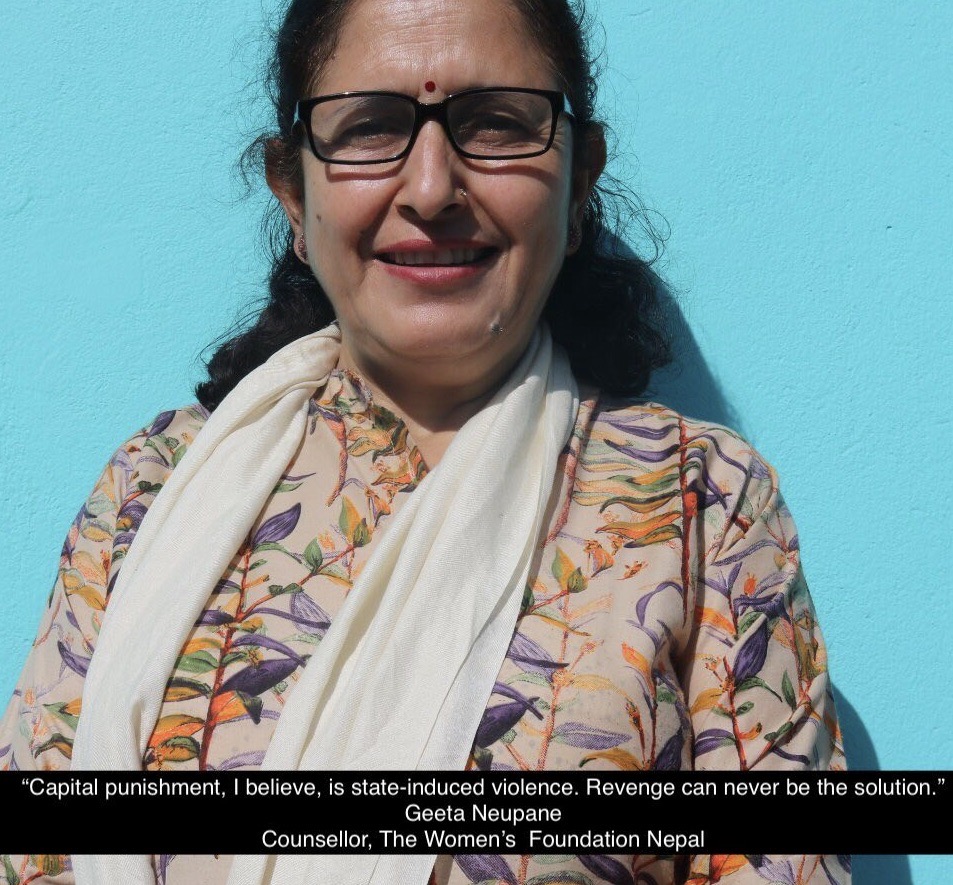
“We have stern laws for rapes and other atrocious offences. It’s just that there are many loopholes and corruption. Unfortunately, there is politics in everything,” says Neupane.
Efficient and effective legal system
Advocate Rahul Chapagain believes Nepal isn’t mature enough to handle capital punishment. If a country allows death penalty then all its other regulatory bodies—the investigative agencies, medical teams, and judiciary—need to be efficient and effective as well. Otherwise, it will be difficult to establish a crime and determine whether the accused is actually guilty.
_20201010114813.jpg)
“Rape cases are handled negligently in Nepal. There is no proper evidence collection and preservation, in terms of medical examination and photographs. What you usually have is a complaint and a writeup by the police stating the types of superficial wounds the victim had on her body,” says Chapagain.
This, he adds, makes it next to impossible for the justice system to ascertain that a crime has been committed and that the accused is the culprit beyond reasonable doubt.
According to advocate Ishan Raj Onta, media trials pose another grave challenge. Apart from having meticulous regulatory bodies, the media must also exercise control and be governed by a certain code of conduct. Sadly, that isn’t always the case.
_20201010114756.jpg)
“The media is quick to portray someone as guilty even in an ongoing investigation. This can cloud people’s judgement. How can capital punishment be a recourse in such a scenario?” he asks.
Another argument against reinstating capital punishment is that our justice system is retributive and reformative—operating under the principle that criminals too need to be given a second chance. The idea behind life imprisonment or a jail sentence in general is not only to punish someone but to make the prisoner realize his/her mistakes and change.
Raunaq Singh Adhikari, an advocate with Kantipur Law Associates, believes people—hardened criminals included—can change, given a chance. Besides, right to life is a fundamental right that no one can take away from you. Adhikari adds that fear of punishment, however harsh, cannot make someone think rationally and morally when impulse takes over.
_20201010114817.jpeg)
Punishment alone won’t stop rape
Activist Dhakal says capital punishment is reactive. What we should instead focus on are preventive measures if our goal is to cut back on and eventually stop the incidents of rapes and murders.
“It’s important to understand that punishment alone doesn’t address the root cause of crime,” says Onta. He adds that if the idea is to dish out maximum suffering to the perpetrator, as those lobbying for capital punishment claim, then death penalty actually doesn’t serve the purpose.
“Wouldn’t you rather have the culprit jailed for life? Capital punishment means his suffering will end in a few minutes,” he says.
However, Onta says that curbing rape isn’t something that should be dealt with in isolation. There many other factors to be kept in mind.
“Rape isn’t a new issue. It’s been there since the start of civilization. If we are to ever put an end to it, the reform must start from home and very early on,” he says.
Onta attributes rapes and gender-based violence to the society’s stringent gender roles. In our patriarchal society, it’s not uncommon for men to feel inherently superior.
Sanjita Timsina, a senior program coordinator at WOREC Nepal, says the way society looks at women—as the weaker sex—is largely the reason behind rapes. Raping someone shows you have no respect for that person. It’s a power play, she says. Chapagain agrees, claiming he has witnessed instances where the culprit seemed surprised to know he had committed a crime.
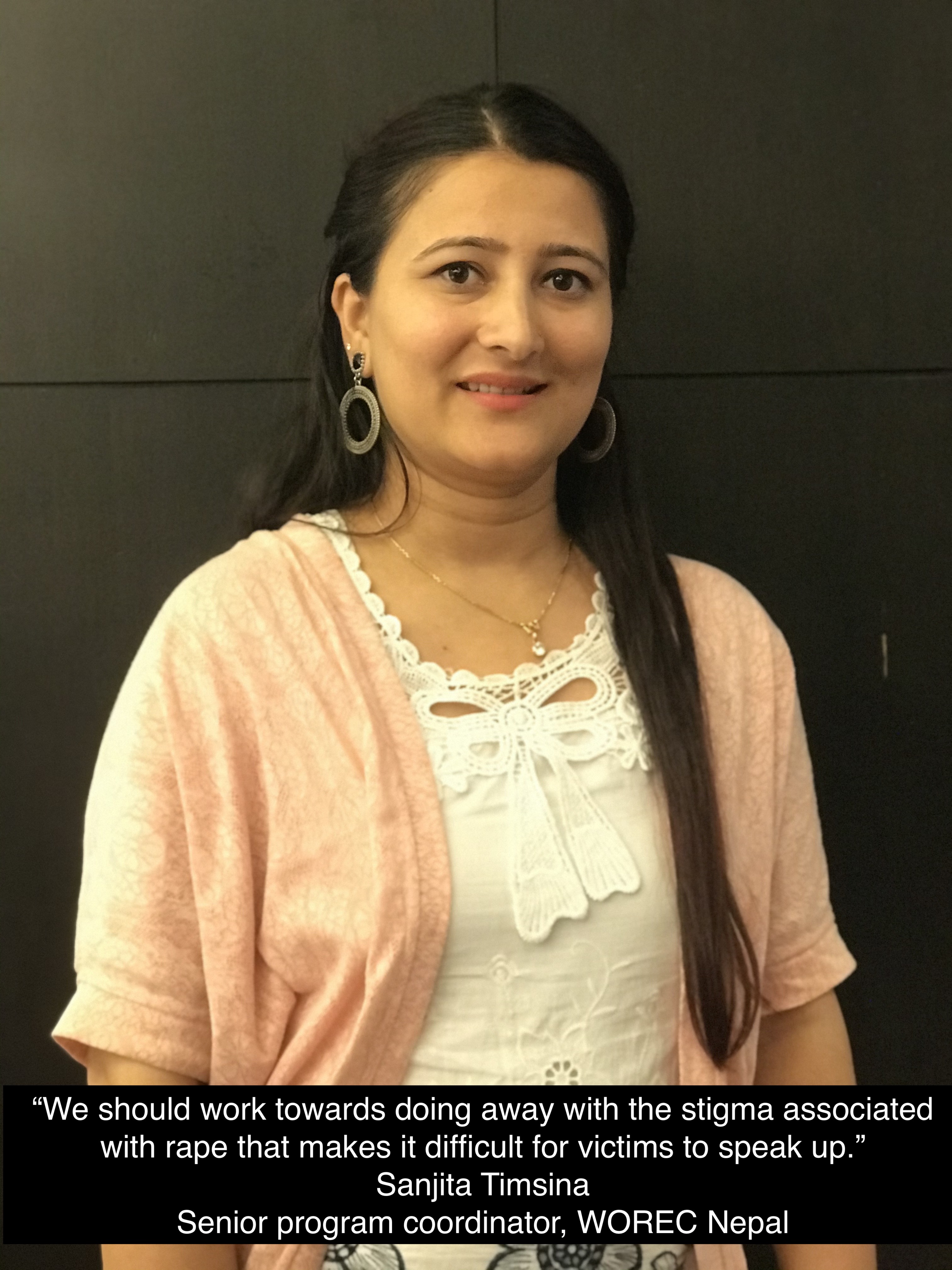
“It might sound strange but many men who rape seem to have no idea that it’s wrong to force yourself on someone. There’s simply no awareness. Many have the mindset that women need to comply with their wishes and demands, that they should be subservient,” he says.
To tackle this, boys and girls, Onta says, should be allowed to socialize and intermingle as early as possible without being made to behave a certain way because of their gender.
Neupane, the counsellor, adds it all boils down to raising your sons a little differently, telling them to respect the opposite sex, and teaching them the values of equality and acceptance in their formative years.
Certainty of punishment rather than severity
Apart from exploring long-term solutions, our legal system should also better protect women and rape victims.
It’s sad that victims often get blamed for the crimes—‘She must have said or done something to instigate violence’, ‘She shouldn’t have been out alone at that hour’, ‘And why wasn’t she “modestly” dressed?’ It’s this victim-blaming mindset that leads, first, to less reporting of the crime, and second, makes life after rape all the more miserable for the victim as well as her family. A fast track hearing process that doesn’t subject the victim to harassment and making the law more women-friendly could be the way out.
Advocate Aparmita Shakya says there will continue to be rapes so long as rapists don’t fear or hold the country’s law enforcement mechanism in high regard, and think they will get away with no more than a slap on their wrist.
_20201010115436.jpg)
“It’s not the severity of the sentence but the assurance that punishment will be meted out, and on time, that will deter rapes,” she says.
Manju Khatiwada, undersecretary, National Human Rights Commission, agrees with Shakya and reemphasizes the need for an unbiased legal system that guarantees punishment.
_20201010114806.jpg)
“Criminals often have a kind of ‘I-know-people-in-right-places’, and ‘I-can-get-away-with-this’ attitude, which are made worse by the fact that our legal system takes a long time to prosecute the guilty,” says Khatiwada.
She adds that she is against capital punishment not only because it violates basic human rights but also because there have been many cases, elsewhere in the world, where people have been wrongly punished.
“The loss of an innocent human life is irreparable,” she says. “Killing every person who rapes a woman isn’t the solution. For that will fuel hatred and create an unruly society.”
Take responsibility of our women
Pushpa Bhusal, a federal parliamentarian, says the country has to create a favorable environment for rape victims to report the crime and assure them justice. It’s unsettling to see how Nepal has failed its women, she says.
_20201010114813.jpg)
“We need better mechanisms because the ones we now have aren’t working,” she says, explaining the rationale behind forming a loose taskforce to look into laws on rapes and gender-based violence.
“One of our arguments is that if the victim is a minor then the rapist should get capital punishment. But it’s not a stand-alone argument. We are first urging the country to do everything in its power to ensure women’s safety. But if nothing can stop rapes, then reinstating the death penalty can be an alternative,” she says.
But Timsina of WOREC Nepal is sure we don’t have to go that far. “One thing we can do is throw out the 35-day limitation on lodging an FIR,” she says. What usually happens because of this limitation, Timsina says, is that there is a lot of mediation in that time. The victim is often put under pressure to keep quiet and given many assurances. Things get drastically worse for rape victims when the statute of limitation expires.
The solution, experts believe, lies not in increasing the harshness of punishment but in establishing a system where each department that looks into the crime does its job fairly, on time, and with unwavering focus. Another important aspect would be to create conditions where the rape victim isn’t stigmatized and justice is assured.
As Onta puts it, curbing rapes is a philosophical discourse with many social and legal aspects to it. There isn’t a one-size-fits-all solution.

Nepalis showing no interest in Dashain flight ticket bookings
Domestic flights in the country are still short of passengers. Nepali airline operators suspect prospective passengers might not be ready to travel in the middle of the Covid-19 pandemic. In previous years, Dashain bookings were done at least a month in advance but now there are only a few enquiries and not many passengers. There is the case with under two weeks to the start of the festival.
Regular domestic flights across the country only began on September 20 after six months of suspension. In the 15 days since daily flights resumed, there has been an occupancy rate of around 85 percent of capacity. Right now, only a quarter of all regular flights have resumed. Occupancy is said to be increasing on the trunk routes (flight to the lowlands) rather than the stall routes (high altitude areas). There are more cargo than passenger flights on stall routes.
The Civil Aviation Authority of Nepal currently allows about 80 daily flights from airlines such as Buddha, Yeti, Simrik, Shree, Sita, Tara, Summit, and Nepal Airlines. Buddha and Yeti Airlines have been flying on the trunk routes while Sita, Tara, Summit and Nepal Airlines have been plying the stall routes. Simrik Airlines informs that it will start two daily flights to Pokhara alone from October 15.
According to CAAN’s flight schedule, Buddha Air gets to fly 30 flights a day. At present, it has around 85 percent flight occupancy, spokesperson and marketing manager for the airlines Rupesh Joshi informs.
Even now, bookings are made only one day before the flight, Joshi informs, adding that nothing can be said for Dashain yet. “There may be some excitement in passengers from Ghatasthapana [October 17]. If passenger pressure decreases, airfares may reduce, but if the pressure increases, the current fares remain. But we have no plans targeting Dashain yet,” says Joshi.
The occupancy of Yeti Airlines is currently around 90 percent, informs Sudarshan Bartaula, flight safety chief and spokesperson. Yeti Airlines, which is flying about 18 flights a day on trunk routes, has not started bookings for Dashain. “We have not introduced cheap fares for Dashain as yet. We are in a wait-and-see mode. It is impossible to foresee passenger pressure in Dashain,” says Bartaula.
Bartaula attributes lack of booking to the common mentality that seats will be easily available till the last moment. Stating that flights are currently being operated at cheaper rates, Bartaula adds the airlines are struggling to raise operating expenses. He adds that there is no possibility of further reducing fares. Even though there are no advance bookings, Yeti Airlines hopes daily flights will be filled by Dashain.

Nepalis into TikTok for fun—and education
If you are a regular on TikTok, you probably know it is by and large a medium for entertainment. But you would also have come across a few educational and instructional posts. Indeed, as the social media platform matures, it is increasingly seen as an eclectic mix of education and entertainment.
Saunak Bhatta, 29, a motivational speaker from Kathmandu, uploads motivational videos and even talks on contemporary social issues on his TikTok account (@saunakbhatta). He has 144.5k followers.
“As TikTok became popular, I started uploading videos by cutting and pasting images and clips from other platforms like YouTube, Facebook, and Instagram. After the lockdown, I started making videos exclusively for this platform,” he claims. Soon, viewership surged.
Bhatta finds TikTok a challenging platform. “I am more used to motivational speeches spanning 2-3 hours. So it was a challenge to cram everything into a minute-long video. That, I think, made me more creative,” he adds. For some videos, he claims, he took around 60 takes just to fit within the given timeframe. TikTok, Bhatta says, taught him to be courageous, creative, and share his knowledge.
Another user thinking out of the box and using the platform to share skills, knowledge, and ideas is Lila Nath Ghimire, an advocate and freelancer from Sindhuli. He opened a TikTok account (@advocate_ln) back in August during the lockdown. He did so to share his knowledge on law, and he is happy with the response.
“I started giving legal advice through TikTok, and in no time gained 20.8k followers,” he says. His basic premise was that everyone should be acquainted with law.
Similarly, Mamta Shiwakoti, 24, from Kathmandu, also disseminates legal information through her account (@lawwithmamta). She has 45.7k followers.
When Shiwakoti was randomly scrolling TikTok earlier this year she came across a video in which a doctor was giving health advice. That in turn motivated her to do something similar. At the end of June, she too started making videos on law.
“I find TikTok is a good medium to share knowledge,” she says. She claims she is getting positive feedback and feels proud to be helping people. “I seem to inspire many people, females especially, to take up law, which is highly motivating,” she says.
Likewise, Dinesh Bajgain, 25, a teacher from Kailali, uploads videos with math and GK tricks on his Tiktok account (@dineshbajgain1) that has 122.8k followers. He joined TikTok around two years ago but started making educational trick videos only after the lockdown. “At first, I used to upload comedy videos. But then, my friends started mocking me for my frivolity even though I was a teacher,” he recalls. He then changed his course.
Another TikTok user Jyotish Sudeep Dhakal, 29, who is an astrologer from Bara, has 39.4k followers (@astrologer_sudeep_dhakal). He says he started making videos back in April when he says the paucity of astrological services online. “You would be surprised how many TikTok users are curious to know more about their future,” he says.
He says the “direct and immediate” feedback he gets has been the most helpful. Inspired by his TikTok videos, some even call him for astrological services.
Subash KC, 34, an English language instructor in Kathmandu, teaches English language through his account (@mercy_education) that has 133.6k followers. He joined TikTok three months ago. “After the lockdown started, students started approaching me to make TikTok videos to help them fill the education void. It was a hit right from the start.”
Even TikTok messaged him a short time after he opened the account with a request to display ads in his fast-growing account. “This motivated me even more to tailor my content to audience taste,” he says.
He claims to have worldwide audience and says regularly updating videos encourages him to keep himself updated and learn more.
Sushma Karki, 25, a make-up artist from Kathmandu, started using TikTok two years ago. She shares make-up and beauty tips via her account @ksuskalology that has 16.6k followers.
Karki points out some loopholes in TikTok even though it is by and large a great platform. “I think a minute is too short a time and I also feel that there could be a bit more monitoring of the content,” she says.
As most users like to watch entertaining videos on TikTok, adds Bhatta, the motivational speaker: “Whatever we make, it should be creative and entertaining.” He says if a trend of educating people with entertaining videos can be established, it could even revolutionize the traditional teaching-learning process.


