


Fostering a reading culture in Nepal

The lockdowns amidst Covid-19 pandemic had the world hoarding toilet paper. Many families now probably have enough to last at least a couple of years, if not a decade. Apparently, quite a few avid readers in Nepal bought books just as frantically. Those in the book business say many Nepalis seem more inclined to read today than ever before.
“There was a time when only tourists would buy books. Bookstores didn’t appeal or cater to Nepalis,” says Daya Ram Dangol, owner of Book Paradise in Jamal, Kathmandu.
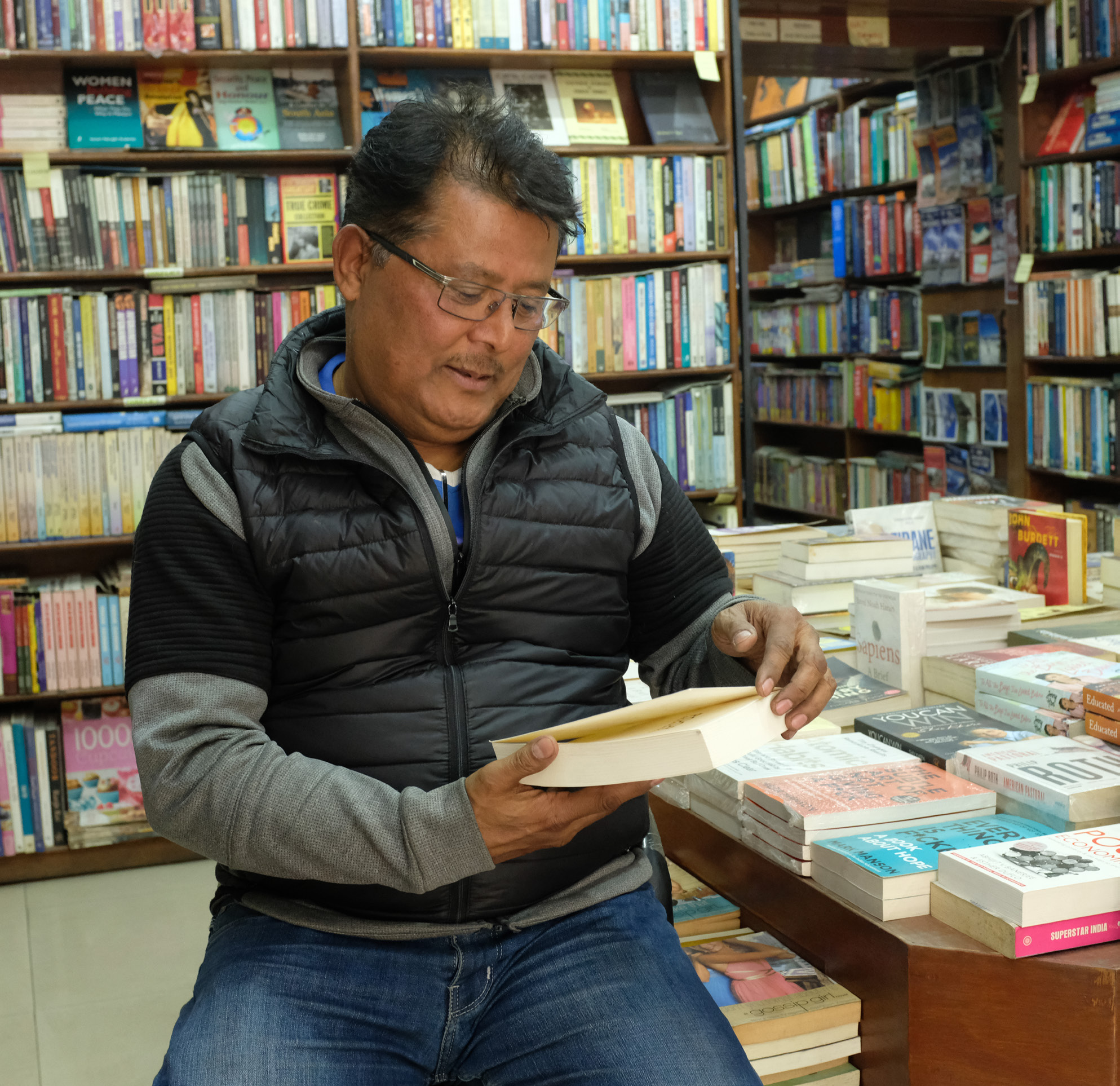 Daya Ram Dangol, owner of Book Paradise in Jamal, Kathmandu
Dangol has been in the book business for over 45 years. When he started, he says, the bookstore he worked at only sold travel books—mostly on Tibet, Bhutan, India—photo books, and a select few coffee-table books.
Things, he says, have definitely come a long way with over 95 percent of his customers today being young Nepalis who, according to Dangol, have varied interests.
“I rarely get foreign customers today. There was a time when the entire business depended on them,” he adds.
He feels this change in the reading scene in Nepal can, to a large extent, be credited to the internet. People these days know about new releases in the market. It isn’t like before when you would have to go to a bookstore to find out what was available.
Siddhartha Maharjan, manager at Mandala Book Point in Kantipath, Kathmandu, highlights the media’s role in making books popular and reading trendy in recent times.
“A lot is being written in the print media about literature these days and that gives books and authors the visibility they deserve,” he says.
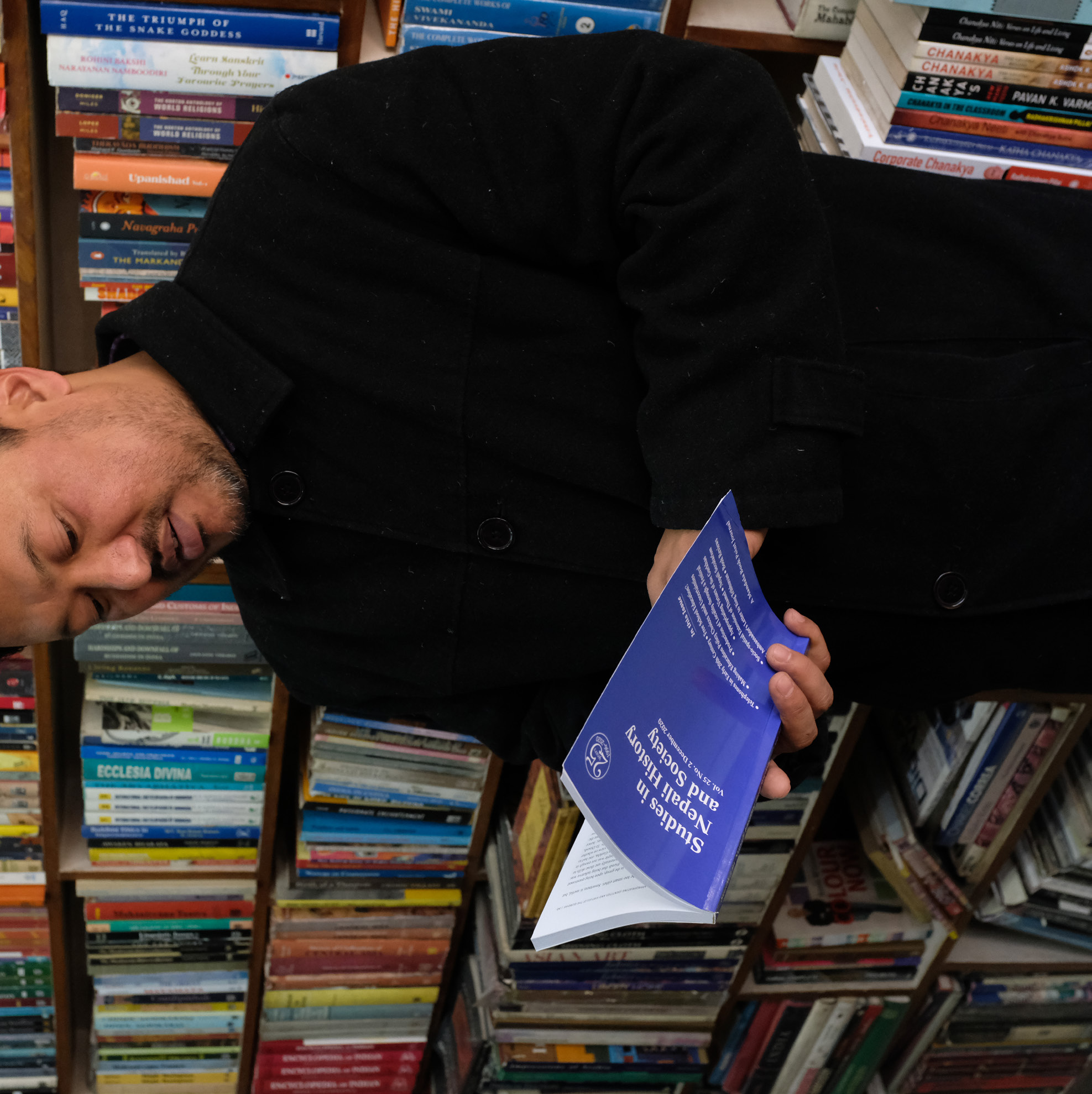 Siddhartha Maharjan, manager of Mandala Book Point, Kantipath, Kathmandu
Maharjan, however, says that Nepal doesn’t have a thriving reading culture—not yet. Most people, he says, read just the bestsellers or books that come highly recommended, be it by friends or on social media.
Like most good habits, a reading habit isn’t something that can be cultivated overnight. And like most habits, the earlier you start reading the better, says Maharjan.
In this regard, schools can and have been playing an important role by giving children reading assignments. But most parents themselves buy the prescribed books for their children—on their way to work or back home. According to Maharjan, there aren’t many parents who actually bring their children to the bookstore and let them pick books.
“This concept of letting kids explore a bookstore is missing here in Nepal and that is what is hindering the development of a reading culture,” he says. Only when children go to bookstores to find a particular book and then come across something else they like, Maharjan adds, will they eventually start reading on their own—not because they have to, but because they want to.
Radha Sharma Rai, senior sales manager at Ekta Books, says they have a rather large children’s section with a kid-friendly setting at their bookstore in Thapathali, Kathmandu. The intent is to get parents to let their kids roam around and discover books. She says she sees many people, who themselves grew up reading, bringing their children and letting them choose books on their own.
Besides cultivating a lifelong reading habit, bookstore owners APEX talked to said that Nepalis, in general, are definitely reading more than ever before—even if it’s a one-off popular book or pop-fiction by Paolo Coelho, Nicholas Sparks, and Chetan Bhagat.
While the older generation seems to prefer books on politics and economy, young Nepalis, they say, are mostly reading about personal development, businesses and startups, and spirituality. But the one genre that apparently sells across ages and interests is biography. With every other celebrity and politician talking about their lives, there is always some book selling like hotcakes.
The Covid-19 pandemic didn’t harm the book business. Rather, as bookstores took to Instagram and other social media platforms to showcase what they had in stock, their businesses actually did quite well. Granted, they had to tweak their business modules a bit but things have pretty much worked to their advantage.
“People these days want to know things. They want to be better versions of themselves. They want to develop new skills. And they realize reading books on topics they are interested in is a great way to do all that,” says Dhan Bahadur Lamsal, proprietor of Fewa Book Shop in Lakeside, Pokhara.
Pratima Sharma, who looks after online sales and marketing at Nepal Mandala Book Shop, also in Lakeside, says people turn to books looking for solutions to issues they might have. And it helps that we now have access to a variety of books, she says.
 Pratima Sharma, online sales and marketing officer, Nepal Mandala Book Shop, Lakeside, Pokhara
“I see a lot of people gravitate towards recent releases, poetry, and self-help,” says Sharma, adding that there seems to be a keener interest in books today as compared to, say, even five years ago.
But ours isn’t a conducive environment for promoting a reading culture, she laments. Books, she says, don’t come cheap. An avid reader herself, she confesses she probably wouldn’t have had access to or been able to afford many books if her parents didn’t own a bookstore.
Nor do we have good libraries in Nepal. This, Sharma says, not only increases piracy but also makes people search for other, cheaper or free, means of information and entertainment.
“The few libraries that we do have, have old books that are usually falling apart. Unlike in other countries where libraries get plenty of copies of new releases, libraries here run mostly on donated books,” she says.
If every Nepali city were to have at least one well-equipped library then that would mean even those without the means to buy books could take to reading. Sharma thinks the government should look into this. After all, in the long run, a robust reading culture helps create a society of smart individuals which could in turn foster prosperity and development.
There is also no concept of sharing books among readers in the community in Nepal. In many parts of the world, Little Free Library, a non-profit based in the United States, promotes neighborhood book exchanges. The aim is to increase access to books for readers of all ages and backgrounds. Communities here could also work upon a similar idea to get more people reading.
For now, Dangol at Book Paradise thinks easing the import process and not levying heavy taxes on books could help in making books accessible to all. Lamsal of Fewa Book Shop agrees. These days our education system supports free thinking and forming opinions from early on. This, he says, naturally has people wanting to read more. Hence, the only caveat to fostering a reading culture is making sure people who want to read have the resources to do so.

Conflict-time campaign resurrected to revive Pokhara
Under normal circumstances, the occupancy rate of hotels in Pokhara used to be around 75 to 80 percent in October-November. As the Annapurna trekking area starts getting cold after that, the number of foreign tourists coming for trekking gradually decreases from that time, and occupancy drops to 50-60 percent.
Of 80 percent occupancy, domestic tourists made up 30 percent and foreign tourists 50 percent, informs Bikal Tulachan, hotelier, and president of Paschimanchal Hotel Association Pokhara (PHAP). During the three days of Restaurant and Bar Association Nepal Pokhara’s annual Lakeside Road Festival starting on the first day of the English New Year, hotels in Pokhara were over 90 percent full.
That was before the Covid-19 pandemic hit Nepal. When the lockdowns started, Nepal's tourism hit its nadir in April 2020. Now, even as trade and commerce slowly resume, the tourism industry has not been able to hit its stride. The reason? There are currently next to no foreign tourists in Nepal right now.
The arrival of foreign tourists has not resumed even after the resumption of international and domestic flights, even as the Indian border remains closed for tourists who want to enter the country by land. Thus, with the intent of attracting domestic tourists to Pokhara, PHAP is conducting a campaign under the slogan “Jaaun Hai Pokhara” (Lets go to Pokhara) in major Tarai cities including Parsa, Birgunj, Janakpur, Biratnagar and Chitwan.
According to Bharat Parajuli, the coordinator of the team currently travelling to various cities on promotion activities, they have interacted with provincial governments, media and tourism professionals with the goal of promoting tourism in Pokhara. Association president Tulachan informs that hotels in Pokhara have been giving up to 50 percent discount to attract tourists. There is also a 50 percent discount on paragliding.
There are over 750 hotels of different sizes in Pokhara, of which around 400 are affiliated to the hotel association. These hotels have around 30,000 well-kept beds, with total investment in hotels crossing Rs 200 billion. Similarly, there has been massive investments in restaurants, adventure sports, paragliding, ultralight bungee jumping, zipline, tourist buses and other fun-filled activities in tourist areas.
Biplav Poudel, former president of the Jaaun Hai Pokhara Campaign and executive member of NTB informs of how the campaign that started 18 years ago at the height of the Maoist conflict is now being resurrected with the goal of mitigating the damages caused by the pandemic and ensuing lockdowns.
In a program hosted this week in Birgunj as part of the campaign, Province No. 2 Minister of State for Industry, Tourism, Forests and Environment Suresh Kumar Mandal expressed his full support for the campaign and said he would play his part to make it a success.

Climate activism came early for this Nepali teenager
“It is on today’s youths to protect the environment,” says Tanuja Pandey, a 19-year-old law student from Kathmandu who has also been leading a youth environment protection movement for the past two years.
In her childhood, Pandey was fascinated by the eco-friendly cultures of indigenous communities of Kailali district (where she was born) and Jhapa district (where her family later migrated). “That impression stayed with me and I fell in deep love with nature,” she recalls.
Pandey grew up witnessing excessive extraction of riverbed materials, deforestation, and random road building in the otherwise environmentally rich Chure hills of Jhapa. She used to question herself time and again: What if our mountains melt? What if the Tarai gets converted into a desert? What if we become climate refugees? “The quest to find answers to these questions ultimately turned me into a climate activist,” she says.
Pandey founded Harin Nepal, on 14 April 2018, which is “still a loose youth alliance but more organized than during the starting days.” The inspiration was the ‘Fridays for Future’, an international movement of school students. When she saw that even children were acting as climate activists, she asked herself, “Why can’t I?” Thus Harin Nepal was born.
It is an alliance of environment-loving youths, with the objective of uniting the voices of Nepali youths in favor of climate justice. It also campaigns for greater environmental awareness and advocates sustainable development. And older folks are included too. “Though it is a youth-led organization, we have allowed older, intellectual people whose experience and knowledge help guide us on the right path,” says Pandey.
“Our core team has five members,” she adds, but any willing soul may join Harin Nepal that now is active on Facebook, Twitter, Instagram, and YouTube.
From the start, the organization focused on climate strikes and discussions on climate change. Climate strike is similar to Friday for Future. “It is like a call for action. Every Friday, we take to streets or knock on the doors of politicians and policymakers to give voice to our demands,” she explains.
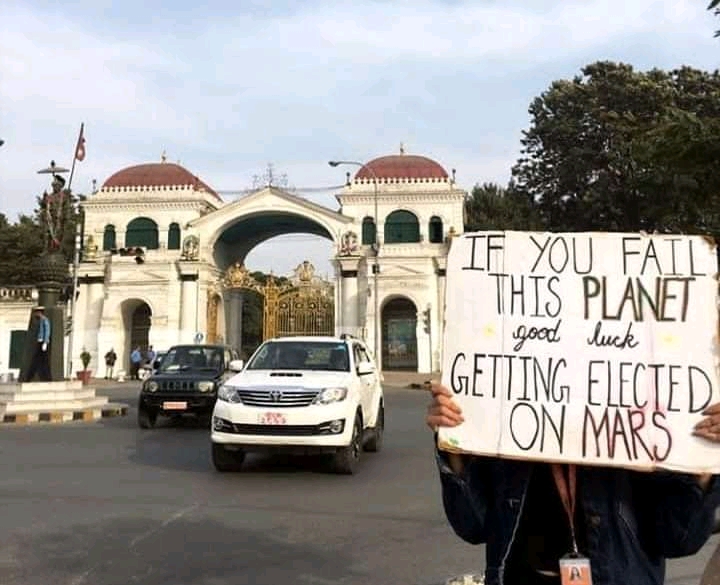
These demands include declaration of climate emergency along with quick action against the contributors to climate change. In addition, the group defends the rights of indigenous groups and farmers who are on the front-line of the fight against climate change.
“We have also urged the government to rethink the Nijgadh airport project, which is lethal for the local environment,” Pandey says. “Our government cannot close its eyes and pretend everything is fine.”
According to Pandey, Harin Nepal conducts discussions on climate change among affected people, concerned authorities, and experts. Before the pandemic, schools and colleges were its preferred venues. “Now, we conduct our climate strikes and discussion programs digitally.”
Group members travel to different places spreading awareness. Recently, they visited Sindhupalchowk, a landslide-prone district in Bagmati Province. “We were there to suggest ways to minimize natural calamities by protecting the environment,” she says.
Pandey cites shortage of funds as a major issue. “Right now, we pitch in from our own pockets. Sometimes our friends abroad help as well,” she adds. It’s a tricky balance, as the organization does not want to be accused of working for vested interests.
As it is, she adds, her climate-warriors get plenty of threats and discouragement, mostly from politicians and businessmen. The environment activists fighting the unmanaged crusher industry even get death threat. Pandey recalls how the 24-year-old Dilip Kumar Mahato of Danusha district was killed on January 10 when he protested against the illegal mining of construction materials. “Can you believe to date no one has been punished for such a heinous crime?” she asks.
Similarly, she says many politicians, including a government minister, blame Nijgadh campaigners for having a hidden agenda, being foreign agents, and hindering development. “We are ready to have a public debate on this,” she adds.
Pandey does not deny the importance of development. “We are not against development per se. We are only saying that our development process should be sustainable and climate-friendly. And our development certainly should not invite disasters,” she says.
Nepal is a disaster-prone country where floods and landslides have wreaked havoc in recent years. “The worst is yet to come if unsustainable exploitation of our nature continues unabated,” Pandey warns.
Pandey says her parents fear for her well-being as activism can sometimes be risky, as the case of Mahato suggests. Another challenge is more personal: having to juggle activism and study. “But I think I have enough willpower to pursue both simultaneously,” she adds.

Thamel wants to open up, ‘too early’ say health experts
When Thamel’s LOD (Lord of the Drinks)—probably the biggest nightclub in the country at the moment—opened last week after almost nine months, massive criticism came its way. Images and videos of youngsters dancing in the club circulated in social media and people could not stop talking about how unsafe these clubs are. Is it wise to open them, they asked, at a time the threat of Covid-19 is still so imminent?
Despite the all-round criticism, the club decided to open through the week, also featuring live music sessions even on weekends. Following suit, a number of other clubs in Kathmandu, mainly in Thamel, announced the resumption of their services, adding fuel to the debate on the right time to open Kathmandu’s nightlife and entertainment outlets.
While the majority of people and even medical professionals are against opening bars, pubs and nightclubs in the capital city, the arguments in favor have not been given much space in public forums. People are concerned that late-night clubs could be hotspots for virus transmission as they are unventilated and crowded closed spaces.
The stakeholders of night entertainment businesses say they are as safe as any other business that has opened. In fact, they claim, their outlets follow more stringent safety protocols than most other private and public enterprises.

During the Covid-19 pandemic, night businesses in Nepal, especially Kathmandu, were the first to take a hit. The police were already enforcing an early shutdown weeks before Nepal went into its first lockdown in mid-March. Even now, when most other businesses and industries are allowed to operate freely, the government’s iron rules on night entertainment have irked the business community and related stakeholders alike. The once throbbing Thamel still wears a deserted look even on weekends, with no tourists and few locals visiting.
The police have been imposing a curfew on businesses around Thamel—Kathmandu’s nightlife hub—with no clear explanation on where the instructions are coming from. We are told that earlier, the curfew was 8 pm for restaurants, bars, pubs or clubs operating in the Thamel area. Following protests from local businesses, the deadline was pushed back to 10 pm, which is still not viable for their businesses, say entrepreneurs.
Why only Thamel?
Under the umbrella of the Night Entertainment Business Association of Nepal (NEBAN), entrepreneurs and stakeholders of Thamel have been staging protests against the restrictive measures. Without any relief package from the government, Thamel’s businesses, which otherwise pay high taxes, are on the verge of bankruptcy. Many of them have closed forever and the remaining ones are on the verge of collapse if the strict covid-19 measures continue. “Does corona spread only in Thamel?” “And does it spread only at night?” These were some of the questions the protestors were asking.
“Why is Thamel still under such a strict rule when everything else in the country is open?” questions Biru Man Prajapati, a DJ and entertainment business entrepreneur. “This is an entertainment zone. With all that they have been through in recent times, people need some quality down-time to refresh their minds,” the Thamel resident says.
“Wedding receptions are taking place unhindered and yet people criticize when bars and pubs open. How is that fair?” asks Nikesh Manandhar, drummer of the band AudioSquad which performs in venues around Thamel. Before the lockdown, Manandhar’s band was getting just about enough weekly shows to sustain its five-member team. Now, again, as LOD opened, so did the opportunity for them to earn decently. AudioSquad has resumed its position as a house band at LOD, playing on weekdays, albeit for around 30 percent less payment compared to pre-covid days.
“We have no complaints as long as we get to play live music,” Manandhar says. “The management has promised to start paying us more as soon as business gets back to normal.” A number of other bands have started performing in Thamel, even though they are often forced to end their sets by 9 pm or even earlier.

“Our protest is not only on behalf of business owners but also countless other stakeholders in Thamel’s night entertainment industry,” says Dinesh Shrestha, vice-president of NEBAN and member of Thamel Tourism Board. Also the owner of the Thamel-based Ozzie Lounge, Shrestha complains of the government apathy to the high-tax paying Thamel businesses as well as of people’s prejudiced perception of what happens in Thamel.
Jobs at stake
“If you look at areas around Thamel, like Chhetrapati, Ason, New Road, you’ll see that they are crowded all through the day. But when we open for a few hours at night, we are treated like we’re the only super-spreaders,” Shrestha complains, adding that the government has done a huge injustice to the night entertainment industry that creates thousands of jobs.
It’s a vicious cycle, adds Shrestha, where daily wage workers, salaried employees, independent contractors, musicians, singers, dancers, landlords and even banks are suffering. Night life brings people to Thamel, sustaining many other non-entertainment related businesses as well.
Also, Shrestha claims that all the businesses that have resumed or planned to resume are fully aware of the Covid precautions. He again gives the example of LOD which checks the temperature of each guest before letting them in through a sanitization booth. It is operating at half of its capacity and the staff have to mandatorily wear masks at all times.

“Profit is not our motive at the moment. We just want to minimize our losses and sustain our businesses till everything goes back to normal,” Shrestha says. “Some business owners had taken out millions in loans, anticipating a successful tourism year 2020. Now they can’t even pay their interest. And then there’s rent and staff salary that needs to be paid whether we operate or not.”
In these conditions, operating in half capacity would be just about enough to retain the staff and pay rents, say stakeholders.
Ashok Thapa, owner of the famous Reggae Bar in Thamel that has been in operation since 2005, seconds Shrestha. Also an executive member of Thamel Tourism Development Council, Thapa informs that it has only been a month since Reggae restarted with live music but the bar is yet to even make break-even revenues. “Despite financial losses, closing down forever is not an option,” Thapa says. “We are maintaining safety protocols and running half capacity just to stay alive as a business.”
Life and death
But Dr. Anup Bastola, chief consultant for Tropical Medicine at the Ministry of Health and Population, advises caution. The crowds in open places like New Road and Ason are not the same as crowds in crowded nightclubs and pubs where people come into contact with one another for longer periods, he says. Bastola also fears that once people get a little drunk, safety measures might take a backseat.
“There are reports of clubs becoming super-spreaders in Europe too. So I think people should be aware that once they enter covered and crowded places, their vulnerability to contracting covid-19 will greatly increase,” Bastola says. Aware of the economic impact of the closure of night entertainment businesses, he emphasizes the need to maintain strict health protocols even if the clubs are to open and requests both patrons and management to consider their own safety.
Khyam Raj Tiwari, ward president of Kathmandu Metropolitan City-26 that includes most of Thamel, informs that his office has already sent letters to the Chief District Office, Tourism Ministry and Home Ministry requesting full resumption of night entertainment businesses in Thamel. “[If we open up] some people may get the coronavirus, and a few could even die. As it is, thousands of people are suffering from financial, social and mental problems,” Tiwari says. “We fear that if the strict restrictions continue, many more could die from these restrictions than from the dreaded virus.”


