


Rupandehi bus accident: Six among nine deceased identified

Six of the nine people killed in a bus accident in Rupandehi have been identified.
The deceased have been identified as Bishnu Paudel (56) of Yogikuti, Butwal, Krishna Prasad Basyal of Kalikanagar, Butwal-11, Rajendra Prasad Pandey of Matariya, Omsatiya Rural Municipality-4, Dinesh Das (20) of Rautahat, Tulsi Basyal (37) of Tilottama Municipality-8, Rupandehi and Arbindra Sharma (40) of Janakpurgram, India.
Also read: 9 killed, 24 injured as bus falls off bridge in Rupandehi
Police said that 24 persons were injured in the incident. Among them, 16 are in critical condition.
There were 33 persons on board the ill-fated bus when the incident occurred.

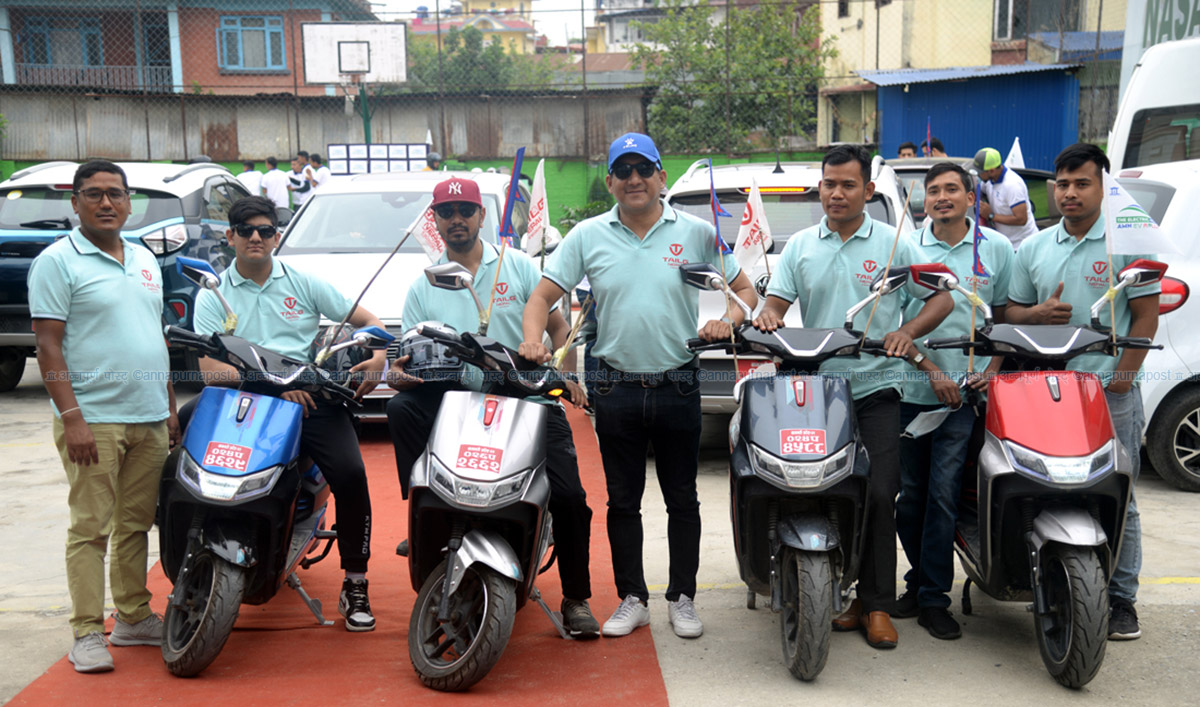
AMN organizes electric vehicle rally to mark World Environment Day (With photos)
Annapurna Media Network (AMN) in association with Alternative Energy Promotion Center (AEPC) organized an electric vehicle rally in Kathmandu on the occasion of World Environment Day on Sunday.
The rally which started from corporate office of Annapurna Media Network in Tinkune this morning passed through Gaushala, Chabahil, Mahargunj, Balaju, Sorakhutte, Lainchaur, Kesarmahal, Jamal, Durbarmarg, Gyaneshwor, Ratopul, Gaushala and culminated at Tinkune ground.
Before the commencement of the rally, Annapurna Media Network Chairman Rameshwar Thapa said that the people should contribute to the protection of the environment from today itself for the next generation.
He stressed on the need for national and international organizations, government and private sector to work hand in hand for the protection of the environment.
Saying that human activities are degrading the environment, Dr Madhusudhan Adhikari, Executive Director of the Alternative Energy Promotion Center, said that human activities should be environment friendly.
He stressed on the need for promoting electric vehicles to protect the environment.
World Environment Day was observed on June 5 in Nepal and across the world.



9 killed, 24 injured as bus falls off bridge in Rupandehi
At least nine persons died and 26 others were injured when a commuter bus met with an accident in Rupandehi on Sunday.
The identities of the deceased are yet to be ascertained.
Among the injured, 16 are said to be in critical condition.
DSP Nawaratna Paudel, spokesperson at the District Police Office, Rupandehi, the incident occurred when the bus (Lu 2 Kha 3841) heading towards Bhairahawa from Janakpur plunged off a bridge into the Rohini River at the border of Rohini Rural Municipality-3 and Omsatiya Rural Municipality-4 along the Bhairahawa-Parasi road section at around 4 am today.
Police said that the injured have been taken to the Bhairahawa-based Bhim Hospital and Universal Medical College for treatment.

North Korea Fires Volley of Missiles After US, South Korea Stage Drills
North Korea fired eight short-range ballistic missiles towards the sea off its east coast on Sunday, a day after South Korea and the United States wrapped up their first combined military exercises involving an American aircraft carrier in more than four years, Reuters reported.
The missiles were fired from the Sunan area of the North Korean capital Pyongyang, South Korea's Joint Chiefs of Staff said.
Japan's Kyodo news agency, citing a government source, also said the North had launched multiple missiles.
The launch also followed a visit to Seoul by the US point man on North Korean affairs, US Special Representative Sung Kim, who departed on Saturday.
He met his South Korean and Japanese counterparts, Kim Gunn and Takehiro Funakoshi, on Friday to prepare for "all contingencies" amid signs North Korea was preparing to conduct a nuclear test for the first time since 2017.
Washington has made very clear directly to Pyongyang that it is open to diplomacy, Kim said during the visit, which wrapped up on Sunday, noting that he was willing to discuss items of interest to Pyongyang, such as sanctions relief, according to Reuters.
Last week, the United States called for more UN sanctions on North Korea over its ballistic missile launches, but China and Russia vetoed the suggestion, publicly splitting the UN Security Council on North Korea for the first time since it started punishing it in 2006, when North Korea conducted its first nuclear test.
In recent weeks, North Korea has test-fired a range of missiles, including its largest intercontinental ballistic missile (ICBM).
North Korea's last tests were on May 25, when it launched three missiles after US President Joe Biden ended an Asia trip where he agreed to new measures to deter the nuclear-armed state.
The first missile appeared to be the North's largest ICBM, the Hwasong-17, while a second unspecified missile appeared to have failed mid-flight, South Korean officials said at the time. The third missile was a short-range ballistic missile (SRBM), Reuters reported.
On Saturday, South Korean and American ships concluded three days of drills in international waters off the Japanese island of Okinawa, including air defence, anti-ship, anti-submarine, and maritime interdiction operations, South Korea's Joint Chiefs of Staff said.
The exercises included the USS Ronald Reagan, a 100,000-ton nuclear-powered aircraft carrier, among other major warships.
South Korean President Yoon Suk-yeol, who took office on May 10, had agreed with Biden to increase bilateral military drills to deter North Korea.
North Korea has criticized previous joint drills as an example of Washington's continued "hostile policies" toward Pyongyang, despite its talk of diplomacy, according to Reuters.


