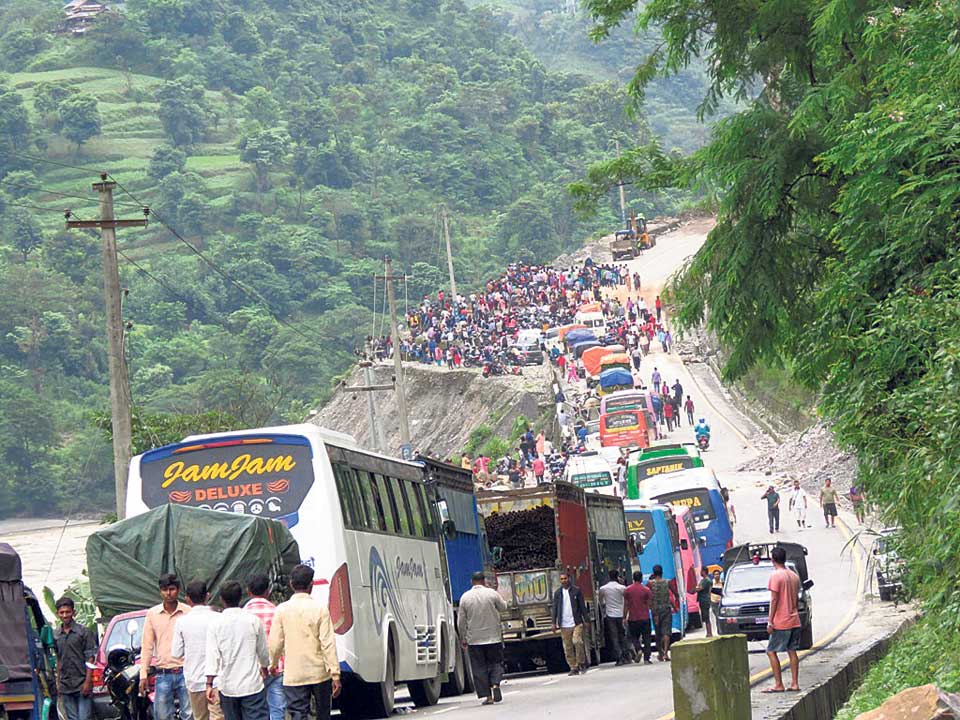
Three children swept away by flooded stream found buried in Rukum Paschim

Three children swept away by a flooded stream have been found buried, while a person went missing.
The flooded Jhinchaur rivulet swept away some houses at Athbiskot Municipality-12 in Rukum Paschim district last night.
Those washed away by the flood were Hit Maya Pun (8), Dhanisha Pun (5) and Manisha Sarki (4). Similarly, 40-year-old Dilli Bahadur Budhathoki has gone missing, according to Rabi KC, Mayor of Athbiskot municipality.
Moreover, Bijay Sarki (10), Anisha Pun (22), Janak Khatri (29), Mansari Pun (65), Mexan Pun (4), Dhan Maya Pun (20) and Kalpana Kami (65) were injured in the flooding.
Mayor KC further informed that as three children were found buried, it was difficult to pull them out from the mudslide.
Efforts are on to take the injured ones to the municipal hospital at Radi.
Police personnel and locals are carrying out rescue operations.

Campaigners capacitated for effective CFLG implementation
The National Child Friendly Local Governance Forum (NCFLGF), in collaboration with Jagriti Child and Youth Concern Nepal (JCYCN), successfully concluded a four-day training of trainers on Child Friendly Local Governance (CFLG) and Nutrition Friendly Local Governance (NFLG). The training, held from July 8-11, aimed to enhance the competencies of CFLG campaigners from various parts of the country, providing them with the latest knowledge and skills in child-friendly and nutrition-friendly governance.
Inaugurating the training, Joint Secretary of the Ministry of Federal Affairs and General Administration (MOFAGA) said, “Our goal is to capacitate our partners and campaigners to drive real change in their communities.” He further said, “This training is a crucial step towards ensuring that child-friendly and nutrition-friendly governance becomes a reality at the local level.”
In his welcome speech, Tilottam Paudel, Strategic Advisor to the National CFLG Forum, emphasized the need to advance these campaigns and the importance of training like this in empowering campaigners. “Identifying and engaging with key stakeholders is crucial for the successful implementation of CFLG and NFLG initiatives,” he noted.
Uma Magar from World Vision International Nepal highlighted World Vision’s commitment to child welfare and their alignment with the CFLG initiative. She also showcased some successful projects and interventions supporting child development and protection.
Shiva Ranjan Poudyal from the National Planning Commission presented the context on MSNP and its linkages with SDG goals.
Lila Bikram Thapa, Head of the Nutrition Department at the Ministry of Health, delivered the presentation on fundamental nutrition, emphasizing the role of nutrition specialists and the integration of nutrition-focused practices into health institutions. Resham Kandel, Under Secretary of MoFAGA, presented on the steps and institutional structure of CFLG and NFLG. He highlighted the interconnectedness of these governance models and the importance of a coordinated approach. “Understanding the link between CFLG and NFLG is essential for maximizing our efforts and achieving sustainable outcomes,” Kandel mentioned.
Sujan Adhikari from Bhaktapur shared, “The training was crucial for empowering local levels, providing essential knowledge and skills for effective governance.”
Pooja Pokhrel added, “We’ve been actively involved in nutrition and CFLG, but merging these two is a new challenge. This training has given me deeper insights and tools to address this effectively.”
Namaraj Thapa from Dailekh emphasized, “We need to integrate these campaigns to ensure nutrition and impact reach every child, especially those in the Karnali region.” Participants were actively involved in group discussions, exploring the indicators of CFLG and NFLG, identifying necessary activities, and outlining collaboration strategies with various stakeholders.
During the training, Ashok Khanal, Coordinator of NCFLG Forum, facilitated sessions on Bal Bhela (child gatherings) using various interactive instruments designed to engage children. These tools included games, storytelling, and participatory activities aimed at making children feel involved and heard in governance processes.
Rasila Dhamala, Program Coordinator of the NCFLG Forum, noted that the NCFLG Forum was established in 2017 by former members of Child Clubs to promote Child Friendly Local Governance.
A total of 30 participants representing various working areas of WVIN, CFLG campaigners, and NCFLGF members attended the training conducted with the assistance of World Vision International Nepal (WVIN).

No sewerage, waste management system in Rampur
Rampur Municipality in Palpa district of Lumbini province sounds good in terms of vocalizing the slogan of a city without sewerage system. However, the sewerage and waste management in the municipality remains awful about performance in the sanitation sector.
Mayor Raman Bahadur Thapa boasts of announcing the municipality as a sewage pipes free town and its beauty. Thapa frequently announced in public forums and programs that the dignity of town was being it as a sewerage pipes free and clean city .
Contrary to the mayor’s claims, the waste management and environment perspectives are very pathetic in the city, said the local denizens. “Our elected representatives are jokers,” said Lok Nath Dhakal, resident of Rampur-6. “Their words and actions many times go just opposite, “ he added.
The waste generated from toilets and safety tanks are connecting to streams and rivers merging to cultural and holy Kaligandaki River, said locals of densely populated Ward 5 and 6.
According to the municipal authority, the municipality has some 42,000 people with 7,500 households in all of its 10 wards. The municipality owns seven vehicles in order to manage waste in the city.
The municipality allocates Rs 4m to Rs 5m for environment programs. Additionally, a similar amount of budget is allocated for the environment sector through ward programs.
The local body purchased 19 ropanis of land to develop a landfill site to dump waste at Ward 4. But the locals protested against it and the civil body could not manage it. Now, it is dumping waste at different places in Ward 6. The local people are also opposing it due to the waste hazard and bad smells.
However, the local government has failed to segregate waste nor did it restrict throwing plastic waste in open places, farm lands, rivers, forests and streams. “The municipality doesn’t care about serious issues but misuse of funds and natural resources,” said Tulasi Ram Pokharel, resident of Ward 5.
The municipality even has not maintained to place dust bins in the public places, busy corners and crossroads. “A few schools have themselves managed to put trash bins,” said Krishna Thapa, chief of Forest, Environment and Natural Disaster Management Section of Rampur Municipality.
Thapa further said that they have not placed a single trash bin in the city. “We distribute fruits and other trees to protect the environment in the town,“ he added. “We have not done anything special in this sector though throwing wastes to water resources is a crime,” he admitted.

Provide stipend for resident doctors in AIIMS, resident docs say
Resident doctors working in All India Institute of Medical Sciences, Delhi, have asked AIIMS director Dr M Srinivas to provide the status of stipend of the foreign national residents in AIIMS.
In a letter signed by Dr Indra Shekhar Prasad, the president of the association, and Dr Raghunandan Dixit, general secretary, on behalf of all the resident doctors in AIIMS raising their concern regarding the non-payment of stipends of the foreign national residents at AIIMS, have asked for an urgent initiation of the disbursement of stipends to the resident doctors without further delay.
“This long-standing grievance demands immediate redressal and decisive intervention,” said Dr Prasad, in an interview with ApEx.
The resident doctors have been lamenting that they have to perform usual clinical/hospital duties as part of their courses without remuneration, while their Indian counterparts get more than InRs 100,000 for the same job.
At least 60 foreign students enrolled in MD, MS, MDS, DM and MCH courses are working as resident doctors in one of India’s top medical colleges of which most of them are Nepalis. They log 12 hours on a normal shift and have to put in 48 hours extra during emergencies, without getting paid.
“They are working in different departments and have their jobs duty hours scheduled as per the need and emergency. But they have not been provided the stipend till now,” said Dr Prasad.
As their long-pressed demand for stipend has gone unheard, resident doctors at AIIMS had earlier requested the government of Nepal to take up the matter with India. The issue however has not been resolved.
“We have asked for a stipend with the AIIMS administration on humanitarian grounds. No one should be barred from the stipend regarding their nationality and geographical location,” Dr Pradad said.
“Denial of their stipends not only undermines their morale but also tarnishes AIIMS's reputation as a beacon of medical education and equality.”
Unlike at AIIMS, Nepali students in Post-Graduate Institute of Medical Education and Research (PGIMER), Chandigarh and Jawaharlal Institute of Postgraduate Medical Education and Research (JIPMER), Puducherry have been getting the stipend for their service.
These institutions started paying the Nepali students after Prime Minister KP Sharma Oli raised the issue during his visit to India in 2020.