


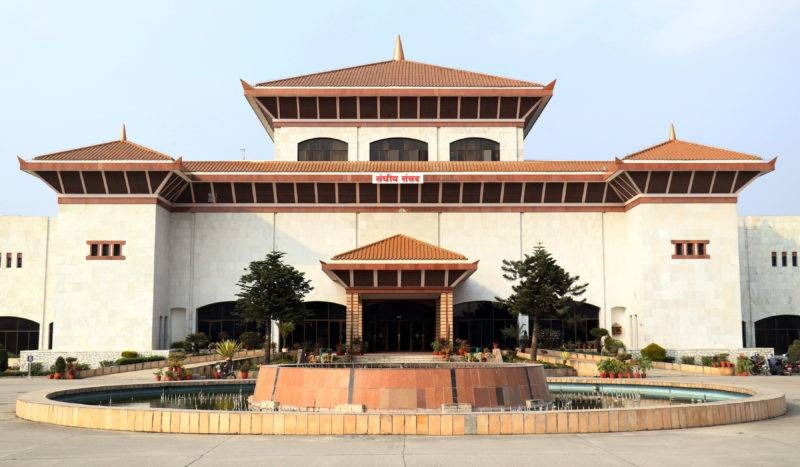

EC calls all-party meeting

The Election Commission has summoned an all-party meeting on Friday. The poll body called the political parties to discuss the government’s decision to scrap the district election offices. The EC spokesperson Shaligram Sharma Paudel said that the meeting has been called for 11 am today. He said that various five issues including the government’s decision to scrap the district election offices will be discussed in the meeting. Through the annual budget for the fiscal year 2023/24, the government announced to scrap all the 77 district election offices and put them under the jurisdiction of district administration offices. Earlier, the EC had urged Deputy Prime Minister and Home Minister Narayankaji Shrestha to roll back the government’s decision to scrap the district election offices. At Wednesday's Parliament meeting, Nepali Congress leader Gagan Thapa had raised a question over the government’s decision to scrap the district election offices. He had demanded that the government take back its decision immediately.

Nepal elected UN ECOSOC member for two years
Nepal has been elected as a member of the United Nations (UN) Economic and Social Council (ECOSOC) for the term 2024-2026. The Permanent Mission of Nepal to the UN in New York stated that Nepal has been elected the United Nations ECOSOC member with the highest number of 145 votes from the Asia-Pacific Group from the elections held on June 8 in New York. "With 145 votes, Nepal has been elected as a member of the UN ECOSOC for the term 2024-2026. We thank Member States for electing us. We look forward to working closely with all to achieve the 2030 agenda," the Permanent Mission of Nepal to the UN tweeted.

Private sector's collaboration crucial for advancing towards prosperity: PM Dahal
Prime Minister Pushpa Kamal Dahal said the country's prosperity is not achievable without the involvement and collaboration of the private sector. He said the government is ready to facilitate the private sector to resolve the problems it has been facing, commending the role of the private sector to the economy. Inaugurating the Lumbini cable car promoted by the Butwal Hills here today, the head of the government said he wished to take the private sector together in a journey towards nation's development and prosperity. "The government is in favor of collaborating with the private sector in efforts to unlock investment opportunities," underlining the urgency of an economic revolution to revive post-Covid- 19 economy. He said the government earlier brought various economic packages for the cause of private sector. Commenting over the launching of a cable car in Lumbini, he said the operation of service in Lumbini, the birth of Gautam Buddha, would have its contribution not only to the local economy but also to the national level. The Prime Minister vowed to adopt necessary policy to regularize flights at Bhairahawa and Pokhara-based international airports, promote hotel and tourism infrastructures there, improve security arrangements and lengthen the duration of visitors' stay for what he said was a multidimensional development of the tourism sector. Underlining the need of reconsidering the country's development model, he said despite noticeable achievements in physical infrastructure, education, health, gender parity, and inclusion, expected achievements in production and employment creation were still awaited. Prime Minister Dahal clarified that there would be quality improvement in development and prosperity only if there is common determination. Saying an environment of investment is being created in Nepal, the Prime Minister said he in the course of his recent India visit called on Indian industrialists and entrepreneurs to invest in Nepal. Similarly, Province Chief of Lumbini province Amik Sherchan expressed his belief that the Lumbini cable car constructed connecting Butwal and Palpa would make a significant contribution in tourism promotion of the province. Chief Minister of Lumbini Province Dilli Bahadur Chaudhary mentioned that although there are immense potentials for tourism development in Lumbini Province, attention has not been paid in its promotion. He expressed his belief that construction of such types of infrastructures would make a significant contribution to the development of the tourism sector. Likewise, former Finance Minister Bishnu Prasad Poudel mentioned that Lumbini, the birthplace of Gautam Buddha, is an important heritage for the tourism development of the area and drew the attention of the government to fulfill its master plan. Regular operation of Gautam Buddha International Airport, expansion of Butwal-Gaindakot road, construction of Siddhababa tunnel route, construction of International-standard City Hall as well as other physical infrastructures constructed from private sector would become supportive for development and prosperity of Lumbini. Similarly, former Chief Minister of Uttar Pradesh, India, Jagdambika Pal, said Lumbini has become a better tourism destination to the citizens of Uttar Pradesh as Lumbini is located near Nepal-India border area. Chairperson of Tinau Rural Municipality, Prem Shrestha, shared that the operation of cable car service would make a great contribution in the development of rural municipalities. Lumbini President of Federation of Nepalese Chambers of Commerce and Industry, Krishna Prasad Sharma, expected that the operation of cable car at Basantapur, the hill station of Palpa from Butwal would make improvement in business and trade of Rupandehi. The cable car is around three kilometers long and it is operated from Golpark Bamghat of Butwal sub-metropolitan city-3 to Basantapur of Tinau rural municipality-3 in Palpa district. It is the first cable car in Lumbini Province.

Lawmakers air mixed opinions over budget in National Assembly
Lawmakers aired mixed opinions over the budget for the fiscal year 2023/24. Speaking at the meeting of the National Assembly on Wednesday, members representing the ruling parties welcomed the government estimates for income and expenditures for the next year while the opposition criticized it. Jag Prasad Sharma said the budget was realistic and the priorities to increase capital expenditures were a positive aspect of it. Objective assessment of the problems, priorities to control revenue leakage, promote export timber production, promote trade and further strengthen the relations with two close neighbors were the positive aspects of the budget that adopted a policy to control general expenditures and this approach was noteworthy. He commended the deadline to spend the budget, announcements to improve the financial system and laws and regulations and to scrap 20 government entities and the assurance for its implementation. "The budget has attempted to create five bases for economic revolution and prosperity and it is realistic," he said, adding that however the announcement to revive the 'Parliament development fund' was wrong. "It has devalued the MP's post, treating the lawmaker as a ward chair." He drew the attention of the finance minister towards lack of sufficient budget allocations to health and education sectors. Uday Bahadur Bohara said the budget presented a clear picture about the issues in the nation and its implementation should be for resolving them. Shekhar Kumar Singh applauded the government for incorporating timely relevant issues in the budget. "Though some human errors are noticed and they could be corrected," he said, focusing on the effective implementation of the budget. Ramesh Jung Rayamajhi expressed his concern over the comment that the budget was like a good essay and argued that it accorded priority to the economic development of the nation. "To protest for the sake of protest is absolutely wrong." Indu Kadariya said the budget was not centered on finding solutions to the existing problems, adding that "budget without source will not serve the goals and meet the people's aspirations." Dr Bimala Rai Paudyal said the economic situation in the current fiscal year suggested that the country was likely to face an economic crisis, but the new budget failed to assess it and catch up the pace for minimizing such risk. "The budget has failed to set a destination, present substantive plans for addressing potential risks for economic crisis. Its size is big and is beyond the reality," said Ramchandra Rai. Prakash Panth echoed the need of discouraging public expenditures, encouraging capital expenditures, preventing corruption and paying special attention to the promotion of good governance. "The budget implementation should be effective." As he said, the government has failed to focus on the implementation of federalism through the budget. Mohammed Khalid was of the view that the budget failed to address the issues of inclusion and proportional system justifiably. He was against the announcement to scrap the Dairy Development Board.


