


How the pandemic wrecked the national economy

The economy fared impressively for three consecutive years following the earthquake and Indian blockade in 2015-16, with around seven percent growth rates.
The spurt was the result of different factors, some of them natural, others related to long-needed reforms. Electricity supply had improved, and construction-related industries were flooded with demand as well as investment in post-earthquake reconstruction. Plus, a stable investment climate had been created after the communist coalition’s near two-thirds majority in the 2017 elections.
The newly elected local governments received a significant chunk of the budget from the federal government and the money they spent had an impact across the country.
In the fiscal year 2018-19, a robust harvest was recorded owing to a favorable monsoon, and agriculture output grew by a record 5.16 percent. The construction sector grew by 7.8 percent. Improvements in service delivery at local level and more foreign investment sustained growth.
Buoyed by the overall positive outlook, then Finance Minister Yubaraj Khatiwada set an 8 percent growth target for 2019-20. His target was also attributed to the likely completion of two mega projects—the Upper Tamakoshi hydropower project and the Melamchi Drinking Water Project—announced in that year’s budget.
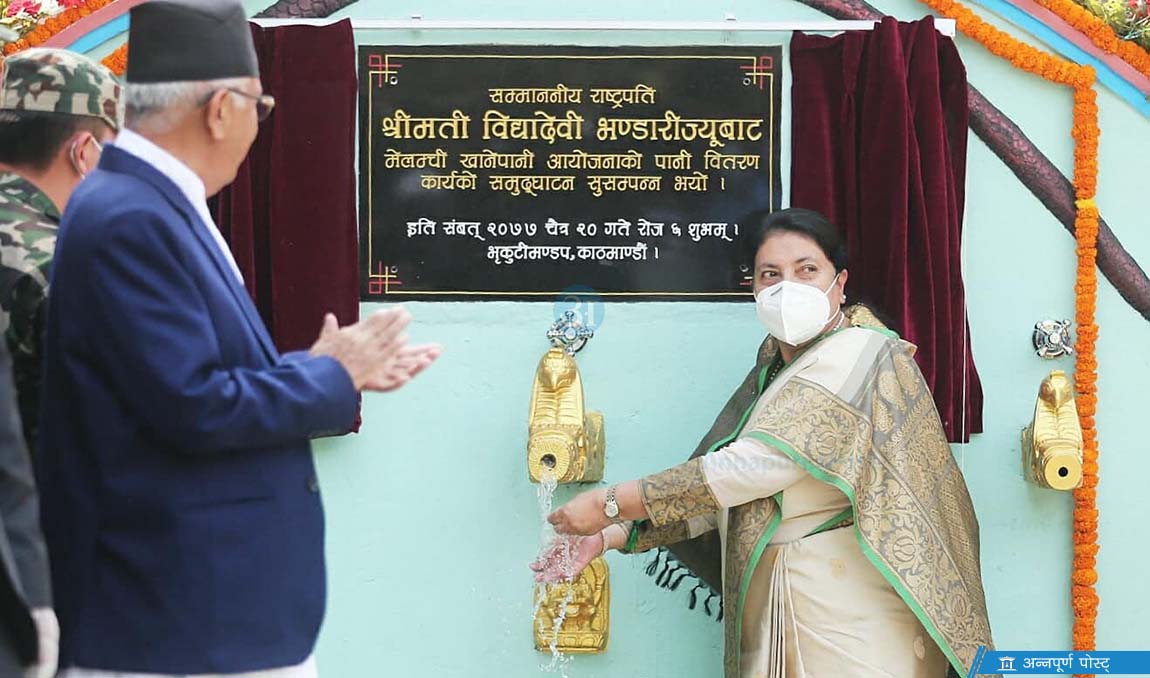 President Bidhya Devi Bhandari inaugurating the distribution of Melamchi Drinking Water project at Bhrikutimandap | Sunita Dangol
In February 2020, the mid-term budget evaluation projected agriculture output growth of 2.23 percent—lower than the previous year’s. The two game-changer projects were also not ready by the year-end. Bilateral development partners such as the World Bank and IMF and ABD now projected Nepal’s growth to hover around five percent.
The projections came as the government's capital spending, which drives private sector investments, and foreign investment inflow, also slowed. But Minister Khatiwada was steadfast on his projection.
The government needed a strong base for economic growth and important projects such as Melamchi and Upper Tamakoshi had to come online for this, says economist Chandramani Adhikari. “But none of the projects that could help sustain high growth were ready,” he says.
Then came covid
This was the country’s economic scenario when Covid-19 hit in March 2020. The government’s overall spending, heavily concentrated between March and mid-July, was yet to gain speed. “The government’s slow spending till mid-July also contributed to the economy’s shrinkage,” adds Adhikari.
A nationwide Covid-19 lockdown stopped the economy in its tracks. International borders were sealed and trade froze. Tens of thousands of migrant workers, who walked hundreds of kilometers from Indian cities to get home, were stopped at the border. With a ban on international flights, the mega-program of bringing two million tourists in 2020 was shelved.
“The government neither worked on keeping feasible industries open nor did it do much to check the inflow of infections from migrant workers in India,” Adhikari says.
The government diverted Rs 136 billion from its budget to fight Covid-19. Some industries opened with the lockdown’s relaxation in June, but limited testing hindered economic activities. Those with limited means such as daily wage earners were left to fend for themselves. The economy shrank by 2.01 percent.
In mid-May last year, then Finance Minister Yubaraj Khatiwada had tabled a Rs 1.47 trillion budget focusing on health facilities and Covid-19 response. A financial package worth Rs 150 billion (around 4 percent of GDP) was set aside to offset the negative impact of Covid-19 and subsequent lockdowns.
Minister Khatiwada vowed that new jobs would be created as thousands of returning migrant workers were expected to take to agriculture. Also, “food-for-work programs in infrastructure projects will help create jobs,” he had said.
The government, however, did not even assess the damage Covid-19 wreaked “on hundreds of new enterprises set up by the young generation”, says Pashupati Murarka, ex-president of Federation of Nepalese Chambers of Commerce and Industry. Nonetheless, a purse of Rs 83 billion for refinancing at 5 percent interest was available for enterprises that had borrowed from the banks.
But losses in tourism, recreation, aviation, transport, and service industries were huge and the government response was paltry, according to economists and members of the business community.
“It didn’t even offer relief materials for the most vulnerable wage-earners and also ignored protests by youths demanding PCR tests and health services,” says economist Keshav Acharya.
Remittance cushion
Despite the announcement of plans by all three tiers of the government to provide jobs to returnees and engage them in agriculture, migrant returnees, still jobless, started going back in hordes to India in October.
The government could only rescue a few hundred migrant workers who had lost their jobs due to the Covid outbreak in the Middle East and Malaysia. Economists feared a reduction in remittance inflow; instead it has steadily grown since last June. Economies in Malaysia and the Middle East bounced back quicker than expected and the migrant workers this time chose to send money via formal channels, according to the World Bank. The government was cushioned by foreign currency received via remittances even when tourism collapsed.
The health sector nearly collapsed. Wrote another economist Chandan Sapkota in an article for The Kathmandu Post, “This time, in addition to weak economic fundamentals and unrealized political and peace dividends, the inadequate infrastructure provision and a collapsed healthcare sector have laid bare economic and social vulnerabilities.”
Poor implementation of the health budget crippled the health sector. But after five months of the fiscal, the government went on a nationwide foundation-stone laying spree for 5-15 bed hospitals at the local level. But real work on them was yet to begin at April-end, when the second lockdown began. A total of Rs 115.06 billion (7 percent of total budget) was allotted for the health sector, according to budget documents.
But information provided by the Financial Comptroller General Office to ApEx shows that such allocation was only Rs 66.03 billion, including Rs 7 billion given to different ministries to fight the pandemic. Only Rs 26.98 billion (about 40 percent) of the budget was spent by mid-May.
Observers are worried the remaining 60 percent of the budget may remain unspent by the end of fiscal (mid-July) even as people struggle to access health services in remote areas. Death rates have spiked alarmingly in the second and third weeks of May due to shortage of oxygen cylinders and hospital beds.
Farmers faced an acute shortage of chemical fertilizers during the paddy and wheat seasons, from June to November. Owing to the shortage, the projected 2.64 percent agriculture growth by the Central Bureau of Statistics will most likely be missed. So growth this year will be more or less the same as last year, economists reckon.
Beware another wave
Now most of the country is under a second set of lockdowns and there is no indication of the economy’s reopening. No one knows when a significant proportion of the population will be vaccinated and allowed to return to work.
In his budget speech for the new fiscal, Finance Minister Bishnu Prasad Paudel acknowledged that achieving 4.01 percent project growth for this fiscal would be challenging in the middle of the pandemic.
Even in this bleak scenario, Nepal Stock Exchange has been on a bullish run, climbing to a new record of 2,800 points this June. Economists say the market’s trend does not mirror the reality of Covid economy and needs to be monitored properly.
When covid cases declined in January, interested foreign mountaineers flew to Nepal and headed to the base camp to scale Mt Everest. The relaunch of mountaineering had rekindled the hope of a bounce-back in tourism, but the hope was short-lived.
There is also fear of another wave. On May 25, Dr Sudhamshu KC of Bir Hospital tweeted, “We could not save lives because of mismanagement, we need to be better prepared for a possible third wave of Covid 19.” But the prime minister’s address to the nation and the finance minister’s subsequent budget speech were both silent on the third wave.
Budget goodies
On May 29, Finance Minister Bishnu Prasad Paudel presented a budget of Rs 1.647 trillion for the next fiscal aiming for 6.5 percent growth. The budget focuses on health, with an allotment of Rs 122.77 billion for the Ministry of Health and various schemes to help the economy recover from the pandemic. The government expects the economy to bounce back soon after the majority of the people are vaccinated. Rs 26.75 billion have been allotted for vaccines in the next year’s budget while another Rs 37.5 billion will be spent on Covid tests and treatment.
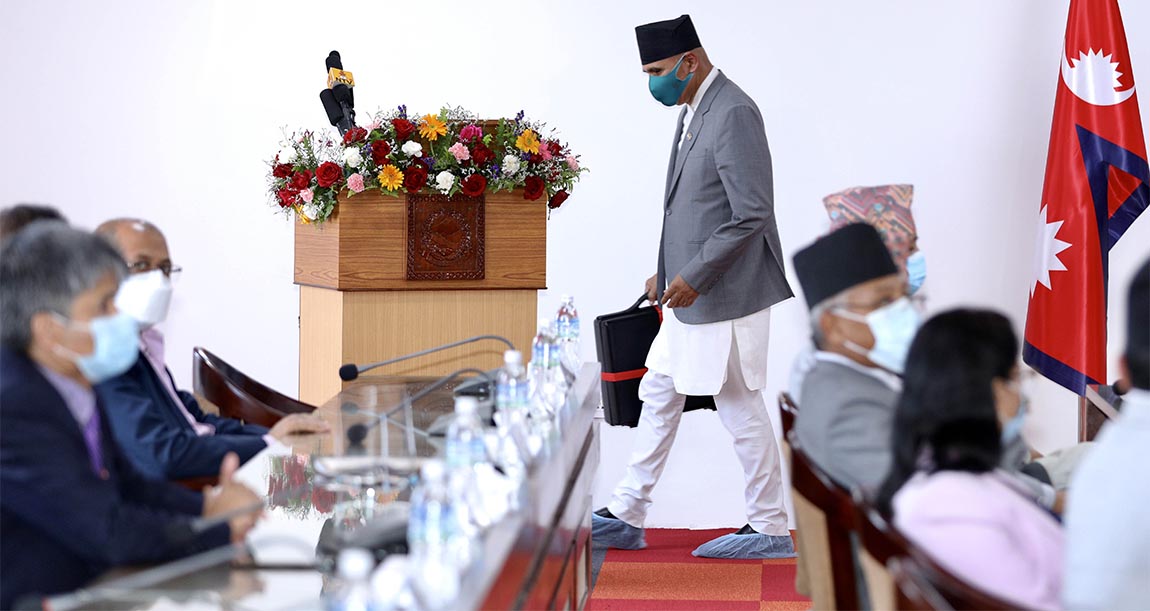 Finance Minister Bishnu Prasad Paudel walking towards the rostrum to deliver budget speech of fiscal year 2021/22
The budget waived 90 percent income tax of firms with annual transactions worth under Rs 2 million; and it waived 75 percent and 50 percent for firms with transactions ranging from Rs 2 to 5 million and Rs 5 to 10 million respectively.
Likewise, income tax for hotel, travel, trekking, transportation, aviation, film industry and media has been lowered to 1 percent and these industries also can carry forward Covid-time losses for next ten years for taxation purposes. The private sector has welcomed these packages to revive the ailing economy.
The budget also provides concessions for startups. They will get a loan of up to Rs 2.5 million as seed money at one percent interest and income tax waiver for five years.
Lease fees for industries based in Special Economic Zones have been lowered while they, mainly established for exports, will also be allowed to sell 40 percent of their products in local markets for the next three years. The government will reimburse 75 percent of the cost of building access roads and transmission lines for new star hotels as well as cement and iron factories if the industries build them on their own.
But the private sector is also concerned about the government’s slow progress in vaccine import. “Vaccinating people from the private sector is important to bring them back to work, helping achieve the growth target for the next fiscal year,” FNCCI said in a post-budget statement.
Cost of jabs
Vaccination for eligible people should be the top priority to stem daily economic losses worth billions of rupees, say both doctors and economists. “If we want to bring the economy back on track, we first need to bring people out of their homes. This will only be possible when we vaccinate the eligible population,” says Dr KC.
But the government plan of purchasing five million doses of the Covishield vaccine from Serum Institute India has failed and the whole episode was riddled with corruption.
ApEx calculates the cost of importing the required 40 million jabs at around US $220 million (nearly Rs 25 billion), going by the $5.5 per dose price quoted by the Serum Institute.
“People from developed countries may soon be interested in travelling to Nepal as tourists. But they won’t come if we have not vaccinated our people,” says Dr Sushil Koirala, chairman of the National Dental Hospital. Travel and tourism contributes 7.9 percent to the GDP and provides jobs to over a million people directly or indirectly.
Economist Keshav Acharya agrees with Dr KC and says that the government should keep its citizens first. Acharya says, “Investing a few billions on vaccination would be wise, even if we have to pay a little more for it. This investment could eventually save tens of billions of rupees for the economy.”

How Covid-19 is robbing us of dignified mourning
My first experience with the death of a close relative was the sudden demise of my grandfather a few years ago. As is with all humans, that safe bubble of denial of death, in which I had erstwhile lived, had inevitably burst. What followed was the harrowing aftermath—the dealing with and facing of the last rite of passage. A grief and sadness that I had never known crept upon me, first as a shock and then as a hesitant realization of the departure of someone I loved.
While each individual confronts this inescapable tragedy in their own unique way, the universality of death makes the feelings I have described resonate with most humans. It is, then, curious to note how our ancestors practiced certain rituals that demanded a more inclusive grieving. Most cultures and communities, all over the world, have their own specific ways of grieving for the dead. From cremation in Hindu and Buddhist religions to burial in Muslim and Christian religious practices, a specific mourning protocol has been observed for centuries. While they may differ in their funeral and mourning processes, a common thread runs through all religions: collective mourning.
Be it during the burial and cremation itself or the wake afterwards, for centuries communities have shared the unimaginable grief that death leaves behind. It is essential that the burning on the pyre be observed by friends and family of the deceased or the burial be reverberated by the chanting of prayers by community members. Even the “Ram Naam Satya hai,” a phrase repeated while transporting the body to the cremation ground, is a collective shout by the members of the community who usually accompany the relatives of the deceased.
This shared grief, the burden of death that is distributed, if not evenly then disparately, speaks of the communal companionship our society is founded on. This communal grieving is apparently different in different cultures: from the “death wails” of the ancient Celts from Central Europe who allowed for public mourning to the Oppari singers of Tamil Nadu who are professional funeral mourners. Different they may be, the common thread of communal grieving attest to the importance our ancestors awarded to such group rituals.
With such immersive mourning rituals embedded in the very matrix of our society, Covid-19 seems to have shaken the very fundamentals of grief we operate on. The highly contagious nature of the virus has forced authorities to put a stop on funerals due to the huge groups it gathers. Crematoriums in Kathmandu have reached maximum capacity and people are being forced to cremate out in the open. Moreover, for the ones who have died due to the virus itself, the matter becomes all the more complicated with many not even getting a proper funeral that follows religious decree. While it is grudgingly acknowledged that such measures are important in order to keep the virus from spreading, it is safe to say that the pandemic has caused more damage than is visible.
Covid-19 restrictions have robbed us of an experience of communal grieving that would have otherwise helped cope with the unimaginable distress that death results in. This experience, one that we took for granted, is essential to a “sound” grieving process. Having been robbed of the opportunity to formally say goodbye to a loved one, to carry out proper funerary practices, to gather in a group to lament the departed and to share grief through food and drinks, we seem to have lost an appropriate channel for our grief.
Further, the sheer inability to change the circumstance invokes an emotional hopelessness. We are constantly gagged by grief, with Instagram and Facebook obituaries continuously reminding us of losses incurred, yet it seems impossible to scream out loud. Thus when news of a covid positive family unable to cremate their relative who had been pronounced dead three days prior reaches our ears, we are forced to come face to face with a horror we are unprepared for.
Last month, a New York Times article discussing mental health problems during the pandemic went viral. The principal take away was the word “languishing” which, Adam Grant writes, is a sense of stagnation and emptiness. It is the “void between depression and flourishing—the absence of well-being.” The rising number of cases along with an ineffectual vaccine rollout process resulted in another national lockdown.
However, as compared to the last national lockdown, the gravity of the situation in Nepal currently simply cannot be disregarded. The mental toll that the pandemic has taken on our lives needs to be recognized. In these unprecedented times, we are “languishing,” unaware of how to deal with the ever-increasing encounter with deaths of someone or someone’s someone, all of them gradually being reduced to mere statistics. The lack of a proper channel is only adding to our distress and while the bittersweet experience of collective mourning is far from us, alternatives need to be discerned.
Dorothy P. Hollinger, the author of “The Anatomy of Grief,” says that art helps us express our sorrow. She says it is important not only to contextualize our pain but also to honor the victims. It is important, for the sake of our collective catharsis, to not let the victims be reduced to a mere statistical fact.
Normalcy, if such a thing still exists, is still a long way off. It is difficult to try and assuage the grief that we are experiencing when we are so bombarded with news of death. To avoid facing the situation would be a serious mishap. A good first step would be the acknowledgement of the unfavorable turn our lives have taken. While some may prescribe “staying positive”, studies show that toxic positivity or “tragic optimism” only causes more harm.
Still, no measure is failsafe and the mental damage this pandemic has unleashed on us cannot be reversed. We need to urge the government to provide faster vaccinations in order to gain some respite from the fear that has been plaguing us. Perhaps, for now, collectively chanting “No Khop, No Vote” may be useful to channel our grief.
The author, a native of Dharan, is pursuing her Masters in Comparative Literature from SOAS University of London. Her interests lie in a keen observation of culture, politics, art and their shaping of the society

Ujwal Thapa: Hope can move mountains
Probably for the first time in Nepal's history millions of people were praying for a politician's recovery from illness—in solidarity. Unfortunately, their prayer went unanswered as Ujwal succumbed to Covid-19 on June 1, after valiantly fighting it for nearly a month.
He was not a humongously famous big leader of a big political party. The Bibeksheel Sajha Party has only three members elected from proportional representation votes in the Bagmati provincial assembly. It’s a small party by all measures. But when the news that he had to be supported with the very expensive Extracorporeal Membrane Oxygenation (ECMO) became public, a spontaneous fund-raising campaign was initiated by some youths, which exceeded the target within 24 hours. Almost Rs 5 million was raised spontaneously, and enquiries were still pouring in. The exuberance exhibited by Nepalis from all over Nepal and abroad was insightful. It’s evident that Ujwal was the rare politician of our time who had earned genuine public respect through his virtues.
Ashutosh Tiwari, a fellow party member and a friend of Ujwal, wrote on social media, “There are people who have authority and power. And there are people like Ujwal who have courage and influence. I see the enormous heartfelt outpouring of public support, affection, love and concerns for him in this light.”
Ujwal, who was known to be a miser with words in conversations, had many firsts to his name. At a time youths of this country were frustrated with the never-ending political crisis, Ujwal dared to lead the change. With many patriotic slogans as the basis of his messaging—‘Nepal is open’ in response to the culture of closures that were employed by all political parties, and ‘Nepal is our home, not a rented room’ to invigorate a feeling of commitment towards public matters from the youth—Ujwal had always been a maverick, the daring one.
There was clear evidence of some level of support for Ujwal Thapa and for his brand of alternative politics since the beginning. It was manifest in the followership, the votes that some of the candidates received and on social media. That this support hasn't been enough to sweep the old forces away or to triumph over other parties has been one of the most perplexing dichotomies and disappointments of present-day Nepal. In that context, the spontaneous outpouring of support for him was a happy surprise.
In fact, Rabindra Mishra, the current president of Sajha Bibeksheel Party, which was formed by merging the Sajha Party he founded with the Bibeksheel Nepali Dal that Ujwal co-founded, wrote in social media in the sense that 'had the kind of support and concern that's pouring in at the moment been shown by voters in the two elections that Ujwal faced, the situation would have been much different'. He later withdrew the statement as it drew a lot of flak for being insensitive.
Although it was inappropriate and tactless of him to say such a thing when Ujwal was fighting for every breath, it had some truth to it. And Mishra himself had lost the election to the Congress stalwart Prakash Man Singh by a close margin in Kathmandu 1 constituency; and it is an open secret that the Congress had collaborated with the UML at that time to defeat the most probable winner of the alternative party. Mishra has all the reasons for bitterness as the movement to build an alternative political force in Nepal hasn't gathered enough momentum; and when compared with the movement that Arvind Kejriwal led in Delhi, the Sajha Bibeksheel Party stands nowhere.
Reading too much into the response Thapa's critical health condition had created will be unwise. The reality is that the criminal-political nexus that is hardwired into Nepali society will fight tooth and nail not to let any alternative emerge; and combined with the flock of disinterested youths and degraded moral values and inefficient work culture in the society, the nexus grows ever stronger. There is a lot that the dark forces can feed on, and the rare ray of hope that virtuous leaders like Ujwal Thapa bring is the only weapon against them. The fight is steep, and the youths have to buckle up, learn fast from the failures and fight it hard. At a dark time when politics has failed the people miserably, Ujwal has brought hope in the injured conscience of the society, and hope can move mountains. And that will be his enduring legacy.

Opinion | Decoding Chinese signals in Nepal
A defining feature of Chinese diplomacy is that it sends signals to the intended country that signify a major change in its attitude to that country. The most famous one being inviting Edgar Snow, the Mao-loving American journalist, to attend the annual military parade to mark the anniversary of the founding of the People’s Republic in 1970. The Chinese released a photo of Snow standing alongside chairman Mao. They saw Snow as an important figure in America and hoped that the picture would signal to the Americans that China was not only willing to establish diplomatic relations with the US, but also to welcome a high-level US delegation.
But Snow was not an important figure in the US and as Henry Kissinger later wrote, at first nobody in the US understood what the Chinese were trying to signal with the photo and they (the Americans) understood its message fairly late. And there are numerous other instances of China’s signal diplomacy. (If you are particularly interested in China's signal diplomacy vis-à-vis Nepal, you can read about them here.)
China is signaling something to us and we got to understand it. After all, it’s an important neighbor and as things now stand, our only hope of getting corona vaccines quickly.
(A disclaimer first: Look, like many in Nepal, I too am clueless about what really happens in the halls of Baluwatar and Shital Niwas, and like many who write, I also write based on what I think really transpired, and like them, I too could be very wrong.)
It’s hard to believe that the telephone conversation between our President Bidhya Bhandari and President Xi Jinping was not preplanned. Many days and weeks were probably spent by our diplomats in Beijing and by Chinese diplomats in Kathmandu (or given the way we conduct our foreign policy these days, I wouldn't be surprised if it were the Chinese diplomats who did all the work.) This suspicion has some grounds. Think of it, otherwise, why would President Bhandari send a letter to her Indian counterpart requesting speedy delivery of vaccines just a day before the phone conversation with her Chinese counterpart? Maybe it was to signal to India that Nepali government was not going to switch sides. Or, by making her appear really concerned about the people, it was an attempt to improve her public image in Nepal where her popularity is at an all-time low.
Now the million-dollar question: why would the most powerful man in the world be willing to talk to our president when almost all reports point to PM Oli snubbing China's requests to do his most, even resign as either party president or prime minister, to save the unity of the party China invested heavily on?
Without a doubt, China is signaling something.
The most likely one being that despite what happened in Nepal, China is willing to work with the Oli government. Maybe China realized it is futile to get involved in Nepal's internal politics and no Nepali government, even one supported by India, would dare work against its legitimate interests in Nepal. Further, given India’s support for Oli, as suggested by India’s suspicious silence on Nepal’s recent political developments, the Chinese must have rightly calculated that he is going to call the shots for some time. And it is in their interest to engage with him. Could it be that China is signaling that from now on, it will follow its earlier hands-off approach in Nepal?
The second most likely scenario is that China wants to help Nepal deal with the covid pandemic by supplying us with the much-needed vaccines. But as a major global power, it wants Nepal to make an official request and let the world know about it. That would serve three purposes: Prove there are many countries that trust Chinese vaccines, and let others know that if you request from us, we would give you vaccines. Third, and most important, using Nepal as a successful model of Chinese vaccines would make India realize it’s limits in dealing with the pandemic and force it to rethink its opposition to Chinese vaccines. That would boost China’s international standing and soft power by many folds and force India to accept that its regional ambitions are unrealistic and misplaced as of now.
And my twisted skeptic brain has yet another theory. It is most likely but like I said, we can only make intelligent guesses and this too should not be overlooked.
China is giving us a million vaccines this time. Earlier it gave 800,000. That’s a total of 1.8 million doses. While it’s better than nothing and like all Nepalis, I am grateful to China for this kind gesture, the volumes are awfully low given our 30 million-plus people. Maybe the Chinese are signaling that more vaccines will follow only after the ouster of PM Oli, and it is their way of punishing him—or, the way Chinese like to put it, teaching him a lesson—for snubbing Chinese requests to step down. Maybe it signals a more hands-on approach on Nepal.
We don't need to wait long to decipher the Chinese signal. What the Chinese do and don't do would make us understand what they want in Nepal and their Nepal policy for at least 10 years to come.


