


The perks and perils of working from home

You have two minutes to feed your dog before the host lets you in on that Zoom meeting. You have mastered the art of muting your microphone in sync with the pressure cooker whistle, and lunch often happens with at least 10 people peering at you from your laptop screen.
Some days you find yourself binging on Netflix dramas in the afternoon. Naps are non-negotiable. There’s no such thing as a late submission, only internet issues.
But as liberating as working from home might feel, it’s difficult to get work done when there are countless distractions and “better things to do” than draft a research proposal.
For Swasti Gautam, an intern working in the development sector, rolling out of bed at 10:00 am for a meeting at 10:15 am was one of the biggest perks of working from home at the start of the lockdown in March this year.

She liked not having to change into office attire. Best of all, no more traffic jams. She could use the extra time to work out and pick up new skills. And she did.
Fast forward five months and working from home is making her feel less creative and a bit sullen.
She isn’t alone.
Most people APEX talked to claimed that working from home is challenging once the novelty wears off. It’s either tough to be disciplined and get things done or you tend to put in longer hours than you would have at office as the line between home and work life blurs.
If he had a choice, Swarup Acharya, health reporter for Kantipur Daily and eKantipur, would go to office. Besides the home environment not being conducive to working, there are no discussions and conversations, which are highly valued in his line of work.
“It’s a one-way street. You do your work and submit it. There is no feedback,” he says.
But working from home isn’t a choice or a luxury now. It’s a compulsion. So, you are forced to navigate your life between attending Zoom meetings and doing the laundry. Tackling dirty dishes in the kitchen and overseeing your kid’s homework are as important as working on that presentation.
Is there a way you can stay on top of work while lounging in your pajamas? And is it possible to disconnect from work—in bed, at the dinner table or when your mom is talking to you?
Getting around
The best way to ensure you are productive and get work done, says Swasti, is to exercise regularly and sit at a desk and not the sofa or bed. Trying to work within office hours also helps—pretend you are at the office and thereby trick your mind and body.
For Pankaj Thapa, communication strategist at Think Ideas and Solutions, setting up a routine has helped him survive this work from home situation. Listing out a realistic number of things that he wants to complete in a day comes a close second.
Eta Shrestha, CEO, Mantra Spa & Wellness and founder, Tissah Pvt. Ltd., swears by the effectiveness of a work schedule. Setting manageable goals helps too.
Eta uses Trello, a project management app, to organize her tasks and finds it really helps with productivity.
Pankaj says working from home is a relatively new concept for Nepalis and it’s going to take a lot more getting used to. Poor infrastructure, in terms of electricity and internet, makes an already difficult situation all the more strenuous.
“The main thing, for me, is to take care of my mental health so I try to communicate well with my team members and set realistic goals,” he says, adding that it’s important to set aside time for your family and hobbies.
Eta has a simple solution for that. She and her husband both work from home and they have a cut off time, after which they try not to work. Also, they keep evenings and weekends relatively free.
But Eta misses meeting people—real time interactions with her team and peers. Pre-Covid-19, she worked with team members and partners; sharing ideas and building collaborations.
“A lot can be done remotely with Zoom meetings and Whatsapp/Viber calls but in-person human interactions cannot be replaced,” she adds.
That is indeed true, says Richa Bhattarai, external affairs associate, World Bank Group. Richa too misses face-to-face interactions that made for a fun and productive work environment.
What’s worse, Richa adds, is that simple conversations now require elaborate mails and calls which take up a lot of time and contribute to screen fatigue. There’s also the pressure of constantly being online and available.
Separate space and to-do lists
But the main challenge of working from home, for most, it seems, is the merging of home- and professional-life.
Sometimes, co-working with your partners can also get a little chaotic. You might have always wanted to spend more time together but a pandemic lockdown wasn’t exactly what you had in mind.
“My husband and I co-work in a tiny apartment and it’s tricky when we have meetings at the same time,” says Richa. Her husband, however, communicates about his potential calls, and if it’s not possible to join meetings in different rooms, they reschedule their appointments so as not to clash with each other.
Some have taken things several notches up.
The first thing Prasanna KC, executive director, KPMG, did when he realized he and his wife were going to be working from home for a while, was build a new study. That way each of them could have their own space and work undisturbed.
Interestingly, everyone APEX talked to also engage in some form of physical activity—be it running, cycling, or YouTube-guided workouts. Some have taken up yoga and pilates. It keeps them mentally agile and gives them an endorphin high—which is of paramount importance in these stressful times.
Working from home, which comes with its fair share of challenges, is a whole different ball game when you have children.
At 2:00 pm this past Monday, Sangharsha Bhattarai, ICT specialist working in the development sector, was putting his youngest son to sleep. His wife, Avinashi Paudel, also works from home and Sangharsha says time management is a huge issue.
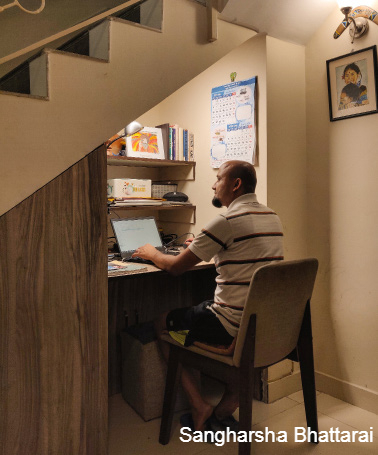
“My wife and I have designated our work hours to ensure they don’t overlap. One parent is always minding the kids,” he says.
Prasanna, who has an eight-year-old son, says parenting is a full-time job. For two people.
“Be reasonable and know your limits in terms of what you can do with a kid in the house,” says Prasanna.
But working from home, with or without kids, doesn’t have to be such a daunting task if you follow a system, according to those who have been operating from the home base before the lockdown made it mandatory.
Sneha Koirala, founder of the lifestyle brand Studio Sarcastic, recommends making notes to keep yourself on track.
“Don’t underestimate the power of a to-do list,” says Sneha who is a sucker for making daily agendas. That is how she stays on top of things.
Ayushma Rana, founder of ST Group which deals in luxury gift packaging and event management, on the other hand, suggests you first calm down and then figure out what works for you. Ayushma, a mother of two, prefers to work in the nighttime when everything is quiet and there aren’t 10 things that need her attention.
“I’m not saying everyone has to become a night-owl but working from home becomes a whole lot easier when you know what works for you,” she says.
Most people vouch for the power of a disciplined lifestyle when it comes to juggling work and home responsibilities while working from home. Those with years of practice know that’s true. Both Sneha and Ayushma agree that the best way to be productive while working from home is to define how, when, and where you are going to work, and stick to the plan.

Sunrise over Lazimpat
Shopping only allowed between 5am and 7am, they say. Nah, I reply. There must be time to shop in the evening too. Who the heck is up and out at 5am?
Pre-Asia, I worked for an exhibition organiser. The company, and I, were based in Edinburgh but our exhibitions were held in Glasgow. For each exhibition there would be a team of around six of us from the Edinburgh office on-site in Glasgow every day for approximately 10 days. Those higher paid sales personnel and management would stay in a hotel in Glasgow, while us lowly secretaries would take advantage of the great daily expenses rate. And rather than spend it on a hotel room, would travel in every day. I would be up at 4am to get the 5.15am bus to the train station in time to catch the 6am train, arriving in Glasgow around 7am. Then a short taxi ride would get us on-site before 8am when the doors opened for exhibitors. A 5am walk through the dark to the bus stop.
Around about the same time I took a coach, along with a friend, from Edinburgh to Calais, France for the day. At that time many people crossed over the Channel into France to take advantage of the cheaper wine and other items. An organised ‘bus tour’ was common. And pretty exciting back then! We left on a Friday evening in time to catch an early morning ferry over to France. As we were not interested in the mega hypermarkets, on arrival in Calais, which is mainly a port town, we took a train to Bologna, which is much more ‘authentically’ French. We slept back in Calais with the rest of the group in some ship’s bow shaped hotel. Extremely thankful to finally lie in a bed that was not moving before being up and out around 5am for the ferry again and long Sunday drive back to Scotland. Two 5am ferry boardings.
Fast forward a decade to Bardia National Park where I was partner in a safari lodge. Getting up at 4am was a regular thing to ensure breakfast would be ready for the guests at 5am so they could be at the park gate for the 6am opening. Foggy and cold in the winter, steamy and hot in the summer, those 4am starts were hard work.
That brings me up to Kathmandu. I wish I could talk about being energized by sunrises over the Himalayas but in general those early morning sunrises in the hills, gazing at mountains, were mainly followed closely by going back to bed. No, from Kathmandu most of my early morning forays have been when travelling back to Scotland, for I would rather go on an early flight, and trips to more tropical places.
I think the last pre-5am out and about was in Bangkok for an early morning flight to Koh Lipe. I remember that in the airport’s domestic terminal, nothing was open that early. At the other end of the flight, there was a bit of a wait before the first taxi van heading to the docks for the first ferry to the island. Another early morning fly-drive-ferry ride.
But probably the most memorable 5am wanderings have been to watch sunrise over Ankor Wat in Cambodia. I have done this twice although have been to the Ankor complex a good few times. Perhaps I have been in the Himalayas too long to fully appreciate the majesty of the mountains in the morning. But an early morning tuk-tuk ride to see sunrise over Ankor has tourist me gawking in awe the same way tourists to Nepal gaze at the mountains.
So yes, there have been a handful of times I have been out and about with a purpose at 5am (and we won’t mention arriving home at 5am after an Edinburgh night out). But I’m not yet, at the time of writing anyway, ready to experience sunrise over Lazimpat while waiting in line at the veggie shop.


Is the singers’ freedom of expression absolute?
Singer Sophia Thapa was hounded online, mostly by Hindu extremists, after she came out with her new Teej song that discourages women from fasting for their hubbies. At the other extreme, male singer Durgesh Thapa has been in controversy for supposedly mocking women who are celebrating Teej. Before that it was the turn of veteran signer Komal Oli, who had landed in hot soup for own Teej song that said women should have the right to elope.
Should there be limits on what singers can say in their songs, or should this freedom of expression be absolute? APEX asked 10 folks from different walks of life.
Prapti Dahal, 24, housewife

I believe there should be no limits on musical expression, so long as our cultures and traditions are being respected. Singers have an obligation to represent societal norms and values; they should not try to exploit them. Moreover, songs need to have appropriate lyrics so that we can listen to them with family members without feeling uncomfortable.
Raj Dhakal, 27, education consultant

When there are controversies over singers and their lyrics, many people argue that it is their right to freedom of speech or expression. Although I somewhat agree, and believe singers and songwriters should represent the unheard voices of those against outdated traditions, it must be done in a way that does not misuse their artistic freedoms.
Shristi Subedi, 16, college student

In my opinion, there should be limits to what singers are allowed to say, especially when it comes to cultural beliefs and customs. Something that I cannot tolerate is when singers’ lyrics undermines the significance of our festivals and traditions by using foul language and negativity to describe them. To prevent this, there should be curbs on what singers can sing about.
Sitaram Dahal, 25, businessman

Singers have the right to choose their lyrics and channel their performance as a creative outlet. Yet they must not forget they are role models for many. As singers are so influential, it is important that their songs carry positive messages. Therefore, I think having a censorship board to screen songs’ messages would be a good idea.
Ashirbad Adhikari, 25, aircraft technician

If singers, by any means, have negative impact on society, it is wise to ban them. Freedom of speech/creativity is a basic right, but some are misusing that right. Especially in the case of rap lyrics, which I find vulgar and crass. I think every song should be passed through a censorship board before its release. Only then can we minimize their negative social impact.
Dipak Acharya, 30, accountant

Songs have the ability to reach and be heard by thousands of listeners, including children. If the song is vulgar or uses profanity, it can negatively impact children. Because of this, people should discourage the popularity of songs that spread negativity about our religion, culture, or traditions. For me, it would be best to start a censorship board to monitor and check all songs before they are released.
Shova Magar, 28, social activist

While creating songs, it is important that singers choose their words carefully. The use of vulgar or unrefined phrases is not necessary when writing lyrics. I believe songs can have long term impact on listeners, especially children who do not know better, so it is vital to create suitable lyrics that obey certain societal norms.
Nerajan KC, 21, computer programmer

Nepal is a democratic country, where freedom of speech and expression is a right. This applies to singers and the songs they create. There should thus be no limits on the actual act of singing. But I do think singers should be aware of their content and make sure it does not disrespect any one’s culture or way of life.
Shiva Pariyar, singer

Music has no boundary. However, singers should be careful about the impact they have on their audiences and do their best not to disturb social norms. Limits on singing can be determined by the people themselves, as they are the ones who decide whether or not a song will be a hit. People simply need to ignore a song and discourage others to listen to it if it contains a socially troubling message.
Prabisha Adhikari, singer

Of course I think there should be limits on the choice of words for songs. In my opinion, if they do not abide by our societal norms and values, such songs should not be allowed to become public.


