


Panorama | Final farewell
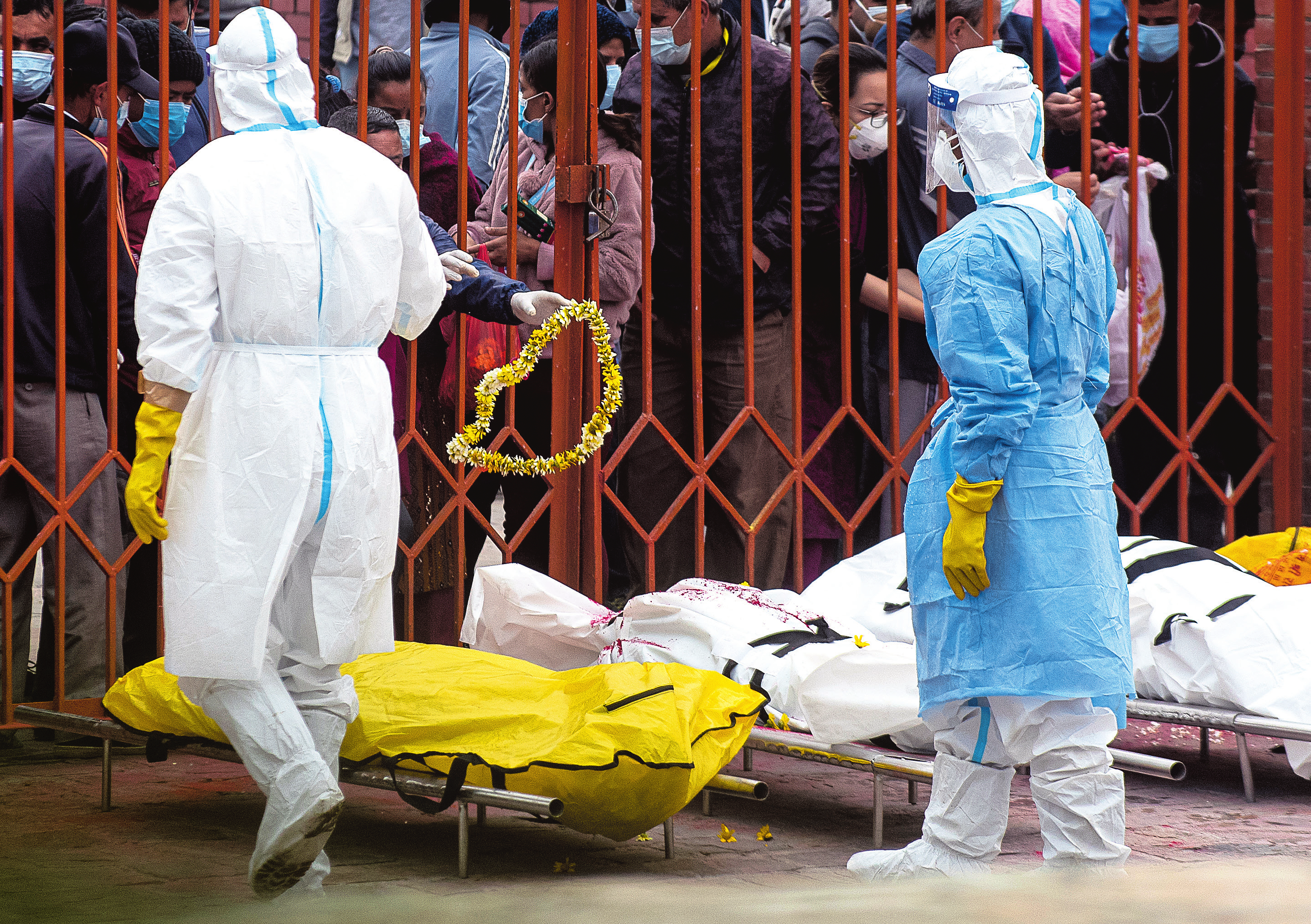
Final farewell: A relative tosses a garland at the body of his loved one who died from Covid-19 as health workers look on, outside the gates of the electric crematory at Pashupatinath, Kathmandu, on May 2. As of May 5, almost 3,500 people had lost their lives to the contagion in Nepal | Pratik Rayamajhi

ApEx salutes Covid heroes
Doctors and nurses nodding off on their feet from sheer exhaustion. Police personnel, half-asleep, running to enforce restrictions at the crack of dawn. Sanitary workers going door to door to college garbage. Bank workers facilitating the payment of our medical and food bills. Journalists reporting from hospitals and health centers around the country. They and countless others who are doing their duties in these difficult times, often at great risk to their lives, are our heroes.
Yet even among them, the work of medical and police personnel are tricky. Doctors and nurses cannot work from home nor do they have the option of reducing their contact points. Given their shortage in Nepal, many are working 12- to 16-hour days, testing, tending to the ill, responding to emergencies. The police personnel deployed to enforce the Covid-19 restrictive measures are as overworked, reporting to duty at 4.45 am every day and working non-stop for the next 16-18 hours. In return, instead of a sincere ‘thank you’, those defying prohibitory orders often bombard them with abuses.
ApEx would like to thank each one of the frontline workers who are involved in saving lives or in facilitating, each in their own way, our daily, cooped-up existence. Our lives would be so much more difficult without you. Heck, we might not even be alive.

Obituary | Ganesh Bhakta Saakha: Architect of one of Nepal’s leading business houses
Birth: 17 December 1929, Bhaktapur
Death: 17 April 2021, Thapathali
Trade and commerce have never been easy for Nepal, a landlocked country. Nepal these days imports and exports commodities from different parts of the world. But during the 1950s, it was solely dependent on India.
When Ram Bhakta Saakha, a reputable businessman from Nepal, decided to travel to Bombay to sign a new business deal, accompanying him was his 18-year-old son Ganesh Bhakta, who had already been assisting him in business.
In Bombay, the junior Saakha was surprised when his father told him to stay in the city and study. The arrangement had not been discussed earlier but Ganesh Bhakta couldn’t say no to his father. He lived in India for five years and returned home after completing his diploma in commerce.
Ganesh Bhakta came home with a lot of energy and the desire to do expand his family business. He first assisted his father, but gradually worked on expanding the business. In 1974, he established his first factory, Unisha Polychem, in Bhaktapur. It was followed by Nepal Paints and Saakha Steels, both of which these days belong to the Saakha Group.
In 1997, Saakha was nominated member of a government research team on the implementation of the VAT system in Nepal. But the same issue of VAT would compel his company to pay almost Rs. 7.3 million in fines to the government in 2012. After the commencement of the VAT system, all sales tax was merged with VAT. But the group accountants had not been complying with new norms.
From his early days, Saakha was interested in politics. He contested the election for the post of ward chairperson in the 1957 municipal elections. Despite not winning, he became an active member of the Bhaktapur District Committee of the Nepali Congress and also served as district treasurer.
Saakha played a key role in establishing the Bhaktapur branch of FNCCI. He continued to be involved in his family business in his old age, before passing away at 91, without any major health complications.
He is survived by four sons—Kiran Prakash, Tej Prakash, Biswo Prakash, and Jyoti Prakash; and three daughters—Usha Kiran, Kalpana Kiran, and Komal Kiran.

Business | Nepali banks failing their country
“In nine months (of the current fiscal year) the 27 commercial banks of Nepal made a net profit of Rs 50.74 billion… Let these banks help establish isolation centers—1,000 bed each,” tweeted journalist Subina Shrestha on April 29. (The Nepali bits in this tweet and the tweets discussed below have been translated into English.)
The respondents to Shrestha’s tweet were mostly pessimistic. “I don't think they are rich enough for this type of greater good for larger public,” replied Roshan Regmi. “Is the banks’ social responsibility limited to making money?” asked Sita Mademba. “Seems you misunderstood it,” Ajay Das chimed in. “Nepali banks do nothing except make profits. The social responsibility of their operators is limited to establishing prizes in the names of their mothers and fathers.”
Indeed, even amid a raging pandemic, it was a bumper year for most Nepali commercial banks. Compared to the same period last fiscal, the 27 banks’ net profits increased by Rs 6.07 billion, a 13.5 percent increase.
Take the case of Nepal’s biggest commercial bank by paid-up capital, Global IME Bank. It made a net profit of Rs 3.59 billion in the first nine months of the current fiscal. Interestingly, even during the pandemic, the bank increased its net profit by a whopping 32.40 percent. Yet the bank has done precious little to help the country combat Covid-19. (Our repeated attempts to contact bank authorities for comments were unsuccessful.)
Global IME’s Chairperson Chandra Prakash Dhakal is a shadowy figure. In its 2019 report, the Center for Investigative Journalism, Nepal (CIJ Nepal) named Dhakal among 55 Nepali nationals with illegal properties abroad. “Chandra Prasad Dhakal is found to have purchased the Sunbird Computer Consultants Limited on August 9, 2002,” says the report. “According to the documents received by the CIJ Nepal… he had rechristened the company as International Money Express (IME) UK Limited.”
Rather than invest in their country or help it overcome a crippling pandemic, top bankers like Dhakal are busy stashing their wealth abroad and cheating Nepali tax authorities.
This is not to single out the IME group and Dhakal. In the first nine months of the current fiscal, only one bank has made more profit than Global IME: Nabil Bank. Compared to its sheer heft, its contribution to the country’s anti-corona efforts has been puny. Incidentally, the same CIJ Nepal reports implicates the family behind the Chaudhary Group—who are also Nabil’s operators—in building wealth abroad.
“Every Nepali citizen and organization is constitutionally obliged to help the country in times of crisis as per their capacity. It’s also a moral duty,” says Uma Shankar Prasad, associate professor of economics at Tribhuvan University. Rather than our own organizations, he rues, outside agencies are doing more to help combat Covid-19 in Nepal. “There can be no question that the banks that have made so much money in this country should help it during a crisis like this.”
Even in India, adds Prasad, you have SBI as well as other commercial banks investing a lot in the betterment of their society. Nepali banks also spend on social causes but on a much smaller scale compared to their size.
“Why can’t Nepal’s profitable banks build isolation or quarantine centers? How about a subsidized hotel where the Covid-19 can be kept and treated?” Prasad asks.

Society | Ventilators out of use despite rising Covid-19 cases
A few days ago, a 38-year-old woman from Galyang died on the way to Pokhara where she was being rushed for treatment. The woman, who was infected with corona virus, died due to lack of oxygen.
Similarly, three others have died due to Covid-19 in Syangja so far since the beginning of the Nepali new year. As the second wave of corona virus infections is on the rise in the country, many hospitals are facing shortages of ventilators. However, the four ventilators available at Syangja Hospital are kept in the storeroom.
Medical Superintendent of the hospital Dr Ramesh Acharya said the ventilator had to be kept in the store as they were useless without skilled human resources to operate them. He said, “Anesthesiologists and trained nurses are needed to operate the ventilator.”
"As the condition of patients who need ventilator support is always critical, the work of a technician operating a ventilator is extremely sensitive," he said.
Chief District Officer Deepak Raj Nepal informed that the District Crisis Management Committee has decided to set up a 10-bed isolation ward in the hospital. The hospital administration stated that an isolation room is being prepared at the hospital accordingly.
The Gandaki state government provided the ventilators to the district hospital located in Putlibazar Municipality-3. An isolation center was also set up at the hospital during the first wave of corona infections.
The number of coronavirus infections in Syangja is increasing day by day. As of Tuesday, the number of infected people has exceeded 216. Of those infected, 186 are being treated at home, 25 in various health facilities and five in quarantine centers.
Bishnu Prasad Subedi, chief of the health office in Syangja, said none of the 10 hospitals in the district has ICU and ventilator facilities despite having a capacity of 210 beds.

Editorial: Vaccines and commissions
Nepal is on the cusp of a Covid-19 catastrophe. As of this writing, daily reported new infections have climbed to 7,500, with nearly 3,500 total deaths. The actual numbers, on both counts, could be much higher. This is the time for every conscionable Nepali citizen and organization to help the country tackle the deadly virus and prevent unnecessary loss of lives and livelihoods. The private sector, in this regard, has failed its duty. A part of it may also have been involved in a criminal act of disrupting vital vaccination supplies.
Asked about the delay in import of Indian vaccines, Health Minister Hridesh Tripathi had replied some time ago that at least a million more doses of the Covishield would already have been imported if not for some meddlesome ‘middlemen’. These people were using their clout, both in India and Nepal, to disrupt supplies. They wanted to import the vaccines at a 10 percent mark-up, an offer the ministry declined. So, a bunch of selfish businessmen has been denying life-saving vaccines to hundreds of thousands of Nepalis.
If so, these unconscionable middlemen who wanted to profit from the misery of their brethren must be brought to book and barred from all future government-related contracts. A dangerous precedent could be set if no action is taken against such blatant disregard of people’s health and wellbeing. That said, Minister Tripathi’s admission also suggested the weakness, if not collusion, of our state mechanisms. The reality is that the federal government has failed in Covid management right from the start of the contagion in Nepal back in March 2020.
Prime Minister KP Oli must clear the bottlenecks in the import of vaccines and save further embarrassment to his government. It is upon him to back his thoughtful speech to the country on April 29 on corona-control with urgent action. On the line is not just his political legacy, but also the lives of millions of Nepalis.

Society | Nepal’s civil society members miffed at government Covid-19 inaction
Eighty-nine members of the civil society have expressed their disappointment over the government’s lack of proactive approach to controlling the Covid-19 pandemic. They have chastised the government for supposedly washing its hands of the responsibility to take care of the health and wellbeing of its citizens. The full text of the appeal is given below:
Citizen Appeal
The second wave of coronavirus along with its various variants has hit Nepal resulting in a sharp spike in the numbers of the infected as well as deaths. The daily increase in the infected indicate that we will require oxygen and ICU facilities in greater numbers in the immediate future. In this context, the latest statement from the Ministry of Health and Population (MoHP) citing “inability to provide hospital beds” has angered as well as worried the general public.
In this regard, on behalf of the general public, we would like to draw the attention of the Nepal government and the respective authorities to the following:
- We express grave disappointment at the lack of government’s proactive action to control and manage the COVID situation during easier times and the defaulting into lockdown as the last resort.
- The government’s statement- “treatment will be scarce with the rise in infection”—is in direct opposition to its constitutional responsibility of ensuring the health of its citizenry through the use of all available means. Such stance from the government has saddened and frightened the citizens.
- We demand that protocols such as the mandatory use of masks and maintenance of physical distancing to control the spread of COVID-19 be strictly enforced. Furthermore, ordinary citizens who do not adhere to the rules need to be made aware of the importance of following these protocols and those in high and responsible positions of the state who flout such protocols need to be fined.
- Provisions need to be made to utilize the health equipment and human resources available in the private and community hospitals for the services to those affected by the virus.
- The increase in the infection rates have spiked up the use of ICU facilities. We demand for additional management of the ICU facilities across the country.
- We request the government to seek help from friendly countries and donor agencies for the immediate arrangement of essential health equipment and materials.
- We ask the government to initiate collaborative efforts to mobilize and encourage the citizenry, organizations, businesses and volunteer organizations in controlling the pandemic.
- We request the local governments to replicate their earlier efforts and proactively conduct activities to diminish the rate of infection. Similarly, we also ask the utilization of local health institutions and the support for those that are negatively impacted by the lockdown.
- We demand the identification and punishing of those who are taking advantage of the crisis to create black markets on health, food and other essential items.
- In this hour or crisis, we call on the National Assembly, the Federal and Provincial House of Representatives, local assemblies and all elected representatives to raise the concerns of the public, demand for proactive government and make the government accountable to its citizens.
- We demand that provisions for PCR tests and at least a week long quarantine facility be made for those arriving at the various border points.
- We demand for relief programs and budget management for the laborers, the poor, marginalized communities and affected businesses that are severely impacted by the lockdown.
- We ask that quarantine facilities and isolation centers be made disabled and gender friendly and that infected women, pregnant women, single women, children, persons with disabilities, chronic patients, senior citizens, sexual minorities (LGBTQIA) be prioritized in treatment.
- We demand that all of the expenditures made for COVID prevention and control by all three tiers of the government be made publicly available and transparent.
- We call upon all citizens to be patient during these difficult times and stay home. Furthermore, we ask to follow all of the precautionary protocols while out in public.
On behalf of the general public
- Prof. Dr. Hemraj Pant, Educationist
- Jagannath Lamichhane, Activist
- Prem Sapkota, Activist
- Ganesh B.K, General Secretary, FOPHUR, Bajhang
- Manomohan Swar, Journalist, Kailali
- Senior Advocate Ramesh Deb Bhatt, Kanchanpur
- Basanti Chaudhary, Rights Activist, Kailali
- Advocate Ajay Shankar Jha, Kathmandu.
- Pradip Pariyar, Executive Director, Samata Foundation.
- Bhakta Bishwakarma, National Activing President, DNF
- Suman Adhikari, Executive Director, National Federation of Deaf,Nepal
- Rem B.K, Executive Director, Jagaran Media
- Sanju Sah, Chairperson, Women, Peace and Development Center, Morang
- Pramesh Mandal, Safe Nepal, Siraha
- Dr. Birendra Raj Pokhrel, Disability and Human Rights Activist, Kathmandu
- Yamlal Lohoni, President, Rupendehi Trade Association
- Deepajyoti Shrestha, Youth Activist, Nuwakot
- Janaki Ghimire Aryal, Lumbini State President, Single Women's Group for Human Rights
- Ravi Thakur, President, Madhesh Human Rights House
- Jog Bahadur Khatri, Chairman High Court Bar, Butwal
- Sikendra Paswan, Rights Activist, Bara
- Shyam Kumari Sah, Women Rights Activist, Siraha
- Fulmohammad Miya, Activists, Parsa
- Rajesh Karn, Journalist, Janakpurdham
- Lakshmi Shrestha, Human Rights Activist, Kapilbastu
- Sharda Chand, Social Activist, Kanchanpur
- Ramesh Rai, CPN-UML, District Committee Secretariat Member, Ilam
- Chakraraj Dahal, Associate Professor, Mahendra Multiple Campus, Dharan
- Govindaraj Gautam, Vice President, National Consumer Forum, Baglung
- Tuk Bahadur Thapa, Advocate, Kapilbastu District Bar Unit, Taulihawa
- Bina Silwal, NGO Federation, Gandaki Province
- Renu Sijapati, General Secretary, Feminist Dalit Organizations (FEDO), Kathmandu
- Girdhari Subedi, Sayapatri Samaj, Pokhara
- Than Bahadur Chhetri, Associate Professor, Tribhuvan University
- Nir Shrestha, Disability Rights Activist
- Lokendra Sitaula, Associate Professor, Tehrathum Multiple Campus, Tehrathum
- Dr. Arjun Aayadi, Associate Professor, Midwestern University, Surkhet
- Amrit Kumar Bhandari, Syangja
- Bhrikuti Rai, Co-Producer Bojubjai Podcast, Kathmandu
- Itisha Giri, Writer / Podcaster, Kathmandu
- Vidya Chapagain, Journalist, Kathmandu
- Shubh Kayastha, Civic Activist, Bhaktapur
- Rukmani Maharjan, Advocate, Kathmandu
- Santosh Sigdel, Civic Activist, Kathmandu
- Umid Bagchand, Journalist, Kailali
- Amuda Mishra, Human Rights Activist, Kathmandu
- Avasna Pandey, Journalist, Kathmandu
- Dr. Buddha Bahadur Thapa, Chairman, Nepal Professors Association Central Committee
- Bhavani Prasad Pandey, Journalist, Rupandehi
- Gunja Rai, Women's Rights Activist, Janakpur
- Kailash Dash, State President, Nepal National Dalit Journalists Association, Janakpur
- Jayakant Goit, Former Teacher, Saptari
- Bhola Paswan, Rights Activist, Saptari
- Swagat Raj Pandey, Civic Activist, Kathmandu
- Khagendra Lamichhane, Writer / Actor
- Prakriti Bhattarai Basnet, Activist
- Samson Karki, Filmmaker
- Pravin KC, student
- Deepak Acharya, Businessman
- Som Niraula, Human Rights Activist, Kathmandu
- Shivnath Yadav, Youth Activist, Birganj
- Dawa Lhamu Sherpa, Young Mental Health Activist
- Suraj Ray, Student / Activist
- Richa Palikhe, Activist / Businessman
- Annie, Activist
- Niraj Bhari, Publisher
- Saugat Wagle, Disability Rights Activist
- Ananda Mishra, Environment Activist
- Parina Chaudhary, Sexual Minority Rights Activist, Banke
- Savitra Ghimire, Women's Rights Activist, Kailali
- Nirmala Bagchand, Women Rights Activists, Kailali
- Tika Dahal, President, Nepal Disable Women's Association, Kathmandu
- Shehnaz Banu, Civic Activist, Kathmandu
- Devidatta Acharya, DEC Nepal, Banke
- Prabhakar Bagchand, Rights Activist, Kathmandu
- Indu Tuladhar, Advocate, Kathmandu
- Yograj Sapkota, Human Rights Activist, Ilam
- Sushma Barali, Journalist
- Sangam Sherpa, Businessman
- Govind Pariyar, Journalist
- Basanta Chippa, Activist
- Bhuvan KC, Businessman
- Nirmal Upreti, Advocate, Kathmandu
- Khima BK, Rights Activist, Bardia
- Neetu Pokharel, Women Rights Activist
- Sita Subedi, Disability Women's Rights Activist, Jhapa
- Nabin Silwal, Activist, Dhading
- Ajit Acharya, Human Rights Activists, Kathmandu
- Sujit Saksena, Human Rights Activists, Janakpur

Panorama | Still-Moving

Still-Moving: A man on a bicycle and some cattle are silhouetted with the setting sun in the background at Itahari, Province 1 | Photo: Pratik Rayamajhi


