


NIC Asia Bank tightens the screw on Covid-hit customers
Top Nepal banks have been reaping bumper profits even in the middle of a raging pandemic. But they have been reluctant to open their pursue strings for Covid-19 relief and help their country and communities. Instead, some are adding to the burdens of Covid-hit customers.
NIC Asia Bank, one of the country’s top banks, has landed in trouble with the central bank after it was found to be charging exorbitant interest rates on loans to consumers.
According to bank documents published by various online news websites, the bank recently hiked interest rates for consumers availing home and car loans. The consumers, who were paying 9-10 percent interest on their loans, have now been told to pay up to 15.7 percent, the documents reveal.
In its letter to one of the consumers, the bank has reduced its base rate but hiked the premium on the base rate to jack up the effective interest rate. Experts say that it is unusual for the bank to quote a premium of over 7 percent when the base rate stands at 6.77 percent. Most banks usually quote a premium of around 2 percent.
Following complaints from the public, the Nepal Rastra Bank has written to the bank seeking clarification on the issue. The NRB said it would decide future course of action based on the bank’s clarification.

Panorama | Any space better than no space
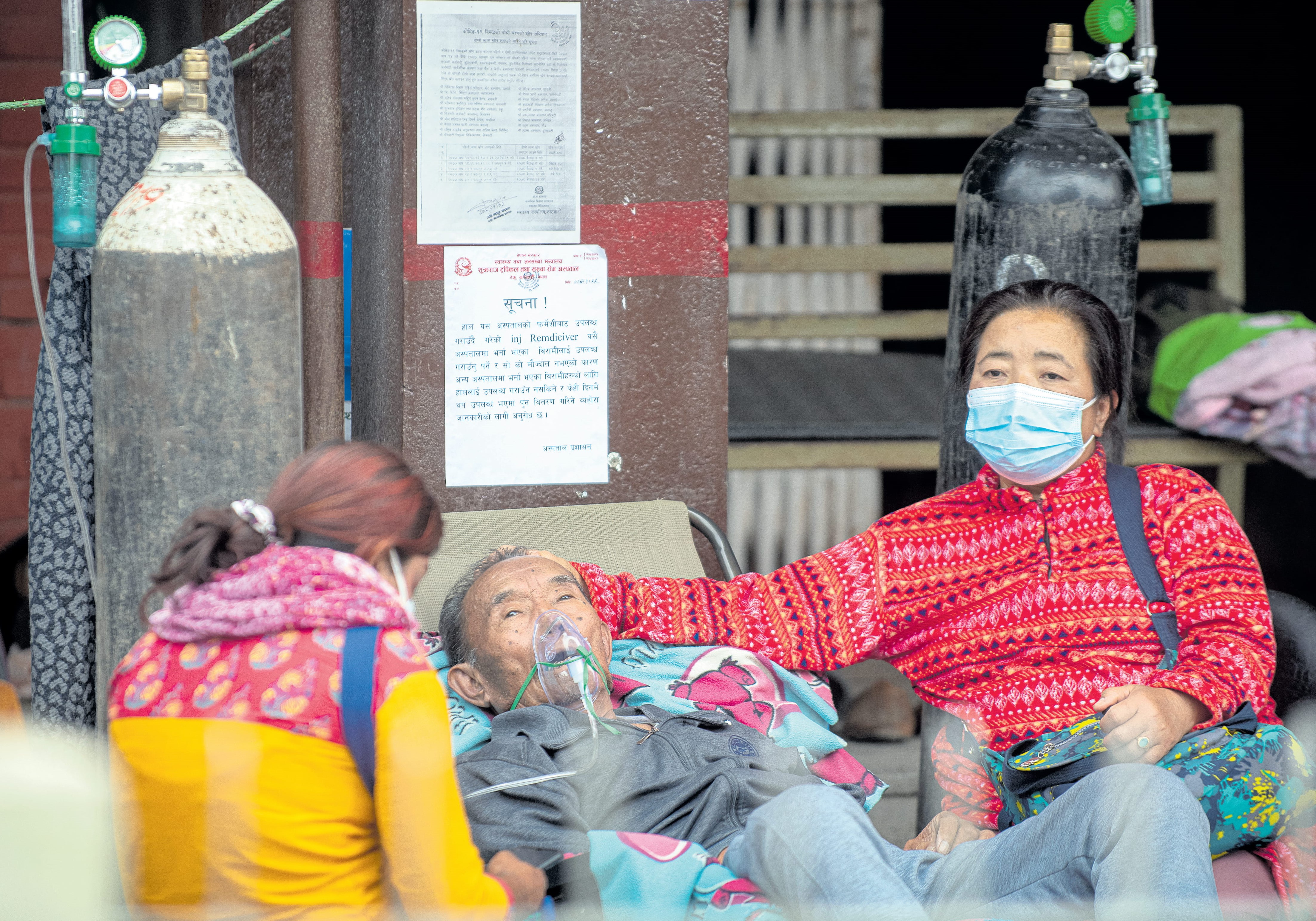
Any space better than no space: A 75-year-old Covid-19 patient being treated in the open space outside the Sukraraj Tropical and Infectious Disease Hospital at Teku, Kathmandu, on May 11. With the number of covid cases rising rapidly, health-care facilities around the country have been overwhelmed. The hospitals also face acute shortages of oxygen, vital medicines and manpower | Pratik Rayamajhi

Society | Nepal’s civil society appeals to China for vaccines and oxygen plants
Eighty-three members of the civil society in Nepal have made an appeal to China, asking the northern neighbor for more vaccines, oxygen supplies as well as other Covid-19 related material and medicines. This is perhaps the first instance of the Nepali civil society making such an appeal with China, even as there have been many instances of similar appeals to various western countries.
Below is the full text of the appeal.
Citizen Appeal to The People’s Republic of China (Date: May 12, 2021)
Covid-19 cases in Nepal have increased by 1200 percent in the last few weeks. The positivity rate of tests conducted stands consistently over fifty percent. The country’s health infrastructure has been pushed to the brink with health professionals and frontline workers stretched thin across the country. We are witnessing the fastest spread of COVID-19 globally and the coming months are certain to be an uphill battle. In this context, it is becoming increasingly clear that Nepal will require the help of our neighbors to mitigate the unfolding humanitarian disaster.
China is not only a neighbor but a good friend to Nepal, a relationship attested particularly in times of crisis. The unwavering support China provided when Nepal was at its most vulnerable, in the aftermath of the earthquakes in 2015 and the blockade that followed, remains fresh in the hearts and minds of all Nepalis. Our gratitude for this support knows no bounds.
While diplomatic relations between Nepal and People’s Republic of China date back to 1955, human relationships have lasted much longer and continue to be strong. It is during these unprecedented times, on behalf of the citizens of Nepal, we would like to appeal—once again—to the government and people of the People’s Republic of China to extend your whole-hearted assistance to urgently respond to Nepal’s grave health and humanitarian situation:
- It is well established that vaccination is the only solution to this pandemic. With only 1 percent of the population fully vaccinated, Nepal is in a precarious position. As we write this, the Government of Nepal has scheduled the second dose inoculation for those who received the first dose of the VeroCell vaccine—numbering some 800,000 in total—that were donated by China. While this has offered a glimpse of hope for some, it is simply not enough. We would like to appeal to the Chinese government to support Nepal with additional vaccines so as to curb unnecessary loss of human life as a result of lack of access to vaccines.
- An acute shortage of oxygen has impacted the ability of our health institutions to offer their services. The GoN says we immediately need some 50,000 cylinders of oxygen to ride out this wave. China's offer of 20,000 cylinders and other medical essentials has already exhibited your kind willingness to support and we request the extension of this support with swift transport and further oxygen plant, oxygen concentrators and any other assistance to aid the oxygen supply in the country.
- Basic necessities to combat the virus are growing scarce as the number of infected continue to grow. In this context, we would like to appeal for your assistance with PPE and testing kits, masks and other medical equipment that can help our health care workers safely provide the basic necessary services to the affected.
- As the first country to successfully bring this deadly virus under control, your experience and resources have been crucial. As such, we would appreciate any emergency medical team support that you can extend to Nepal to assist our Nepali frontline workers on the ground in this fight against the pandemic.
We are left with no option but to lay our hopes on the kind support of our neighbors and friends at this crucial junction. We would thus humbly request her excellency Ambassador Hou Yanqi to convey our appeal and expedite any and all support to Nepal from the People’s Republic of China.
On behalf of the general public
1. Prof. Dr. Hemraj Pant, Educationist
2. Jagannath Lamichhane, Activist
3. Prem Sapkota, Activist
4. Manomohan Swar, Journalist, Kailali
5. Senior Advocate Ramesh Deb Bhatt, Kanchanpur
6. Basanti Chaudhary, Rights Activist, Kailali
7. Advocate Ajay Shankar Jha "Rupesh", Executive Director, PDS-Nepal
8. Pradip Pariyar, Executive Director, Samata Foundation.
9. Khagendra Lamichhane, Writer / Actor
10. Bhakta Biswakarma, Acting President, Dalit NGO Federation (DNF)
11. Suman Adhikari, Executive Director, National Federation of Deaf,Nepal
12. Deep Jyoti Shrestha, Youth Activist
13. Rem Bk. Executive Director, Jagaran Media Center
14. Yamlal Lohoni, President, Rupendehi Trade Association
15. Janaki Ghimire Aryal, Lumbini State President, Single Women's Group for Human Rights
16. Jog Bahadur Khatri, Chairman High Court Bar, Butwal
17. Sikendra Paswan, Rights Activist, Bara
18. Fulmohammad Miya, Activists, Parsa
19. Rajesh Karn, Journalist, Janakpurdham
20. Sharda Chand, Social Activist, Kanchanpur
21. Ramesh Rai, Social Activist, Ilam
22. Chakraraj Dahal, Associate Professor, Mahendra Multiple Campus, Dharan
23. Govindaraj Gautam, Vice President, National Consumer Forum, Baglung
24. Tuk Bahadur Thapa, Advocate, Kapilbastu District Bar Unit, Taulihawa
25. Bishnu Baral, Coordinator, Civil Society Network for Peace, Gandaki Province.
26. Girdhari Subedi, Sayapatri Samaj, Pokhara
27. Than Bahadur Chhetri, Associate Professor, Tribhuvan University
28. Nir Shrestha, Disability Rights Activist
29. Lokendra Sitaula, Associate Professor, Tehrathum Multiple Campus, Tehrathum
30. Dr. Arjun Aayadi, Associate Professor, Midwestern University, Surkhet
31. Amrit Kumar Bhandari, Syangja
32. Shubh Kayastha, Civic Activist, Bhaktapur
33. Rukmani Maharjan, Advocate, Kathmandu
34. Dr. Buddha Bahadur Thapa, Chairman, Nepal Professors Association Central Committee
35. Bhavani Prasad Pandey, Central Committee Members FNJ
36.Gunja Rai, Women's Rights Activist, Janakpur
37. Kailash Dash, State President, Nepal National Dalit Journalists Association, Janakpur
38. Jayakant Goit, Former Teacher, Saptari
39. Bhola Paswan, Rights Activist, Saptari
40. Swagat Raj Pandey, Civic Activist, Kathmandu
41. Samson Karki, Filmmaker
42. Pravin KC, student
43. Deepak Acharya, Businessman
44. Som Niraula, Human Rights Activist, Kathmandu
45. Shivnath Yadav, Youth Activist, Birganj
46. Dawa Lhamu Sherpa, Young Mental Health Activist
47. Suraj Ray, Student / Activist
48. Richa Palikhe, Activist / Businessman
49. Annie, Activist
50. Saugat Wagle, Disability Rights Activist
51. Umid Bagchand, Journalist, Kailali
52. Ananda Mishra, Environment Activist
53. Dr. Prakash Bhattarai, Executive Director, Center for Social Change (CSC)
54. Shehnaz Banu, Civic Activist, Kathmandu
55. Advocate Indu Tuladhar, Executive Chair, Himal Innovative Development and Research Pvt. Ltd.
56. Sushma Barali, Journalist
57. Sangam Sherpa, Businessman
58. Govind Pariyar, Journalist
59. Basanta Chippa, Activist
60. Bhuvan KC, Businessman
61. Advocate Krishna Prasad Timilsina, Pokhara
62. Neetu Pokharel, Women Rights Activist
63. Kiran Kausal, journalist, palpa
64. Romas Khatiwada, Activist
65. Nabin Silwal, Activist
66. Samar Chhetri, lecturer, Dept. Of Population Studies.
67. Pramila Tajhya, Women Activist, Pokhara.
68. Prakash Shrestha, Activist
69. Basanta Joshi, Activist
70. Asmita Dangi, Activist
71. Nisu KC, Activist
72. Nirajan Paudel, Activist
73. Tusar Neupane, Activist
74. Bijaya Rai Shrestha, Executive Director, AMKAS Nepal
75. Advocate Anita Thapaliya, Executive Chairperson, LAAC Nepal
76. Keshab Badi (Nepali), Chairman, National Badi Network, Nepalgunj Banke
77. Jitram Lama, President, NGO Federation Nepal
78. Arjun Bhattarai, Coordinator, NSDF
79. Purushottam Bista, NEDI
80. Bhuwan KC, Activist
81. Itisha Giri, Writer / Podcaster, Kathmandu
82. Avasna Pandey, Journalist
83. Amuda Mishra, Human Rights Activist

Unity is Immunity | Collective effort on corona
Government instability is just about the worst thing that can happen to a country struggling to stay afloat amid a raging pandemic. The Oli government has been widely criticized for not taking the deadly virus seriously, the criticism starting with the opposition faction within the Nepal Communist Party the prime minister led. But corona has only been an excuse, an excuse Oli has used to hang on to power (for one, by putting off vital party meets) while the opposition forces try to bring him down over his supposed failure to control the same contagion.
It is clear that the only way the country will successfully emerge from this pandemic is through a broad political consensus and via a government formed on that basis. Such a government will solve two problems at once. One, the political actors will have to stop the blame game and take collective responsibility. Two, election under such a government will add to the legitimacy of the polls. Such a consensus will not be easy to come by; that should be no excuse not to make the effort though.
The signs are not good. Political parties are in a vicious struggle for power. The Madhesi outfit of JSPN is again on the verge of a split over whether to help KP Oli retain power. In other words, the party will likely split not over some ideological differences as much over personal ambitions of individual leaders, adding to the disillusionment of common Madhesis.
Even as political parties scramble for power, the Covid-19 situation is steadily worsening. Hospitals are out of beds and oxygen cylinders. Vital medicines are in short supply. When a Covid patient or just about any patient needs an ambulance, he or she will be lucky to get it on time. This despite the fact that potentially thousands of volunteers, all ordinary Nepalis, have been working 24/7 to fill the vacuum left by government inaction. They are helping arrange ambulances and blood plasma. They are also matching patients to hospital beds (when available). But even here government regulations have hindered their work.
It will be impossible to deal with this national menace on a piecemeal basis. Each of us needs to contribute. The government needs to be more responsible and responsive to public sentiment and the political parties come together in public interest. The volunteers need to better coordinate their efforts. Private sector organizations need to pitch in with both money and manpower. The rest of us can help by staying put in our own homes. Meanwhile, the task of importing life-saving vaccines must be expedited. At the end of the day, that is our only ticket out of the pandemic.
Again, our political leaders must show the way. Just as they joined hands to help the country transition from violence to peace at the end of the Maoist insurgency, they must now work together to take the country out of its corona mess. Otherwise there is a risk of people getting fed up with the democratic setup. If a democracy cannot come to the help of its people when they need it the most, what good is it, people will start questioning? Let better sense prevail all around.

Editorial: JSPN in limbo
The Janata Samajbadi Party, Nepal (JSPN) came into being a year ago to thwart Prime Minister KP Oli’s bid to split Upendra Yadav-led Samajbadi Party. Oli’s intent was to lure seven Samajbadi Party lawmakers into his government and thereby cement his hold on power. At that time, he also had an eye on a likely future split in the ruling Nepal Communist Party, with the ex-Maoist faction under Pushpa Kamal Dahal walking away. In that case, he would need Madhesi support to retain his parliamentary majority.
Besides this proximate reason for the merger, the combined Madhesi force could better lobby for Madhesi rights in the new constitution. On the national front, the JSPN presented a much-needed alternative vision for Nepal, with greater emphasis on ethnic and regional rights. (The two other major actors, the Nepali Congress and the then Nepal Communist Party, agreed on most vital constitutional issues.)
Yet the 2020 merger of the two Madhesi parties was always going to be tricky. The biggest obstacle to party unity would be top Madhesi leaders’ portfolio management. This was a headache even in the pre-merger RJPN, itself formed with the merger of six different Madhesi parties. With the RJPN combining with Samajbadi, the number of big egos at the top only multiplied. As expected, they have tussled bitterly post-merger. Now, the combined JSPN is once again on the verge of a split.
It is clear that the JSPN came together and could now split for no other reason than the failure to accommodate the outsized egos of its leaders. Whatever they say in public, they seem incapable of collectively fighting for the Madhesi people. This brings us to a vital question: Why do we need a strong Madhesi force if it is to be no different to other traditional parties that already have strong presence in Tarai-Madhes? This question will only get louder as the rift in the JSNP deepens over whether to help KP Oli retain power. Madhes, meanwhile, will be ripe for another uprising.

Biz Brief | NIFRA begins RTGS
Nepal Infrastructure Bank Ltd (NIFRA) has been enrolled in and started processing its transactions in real time gross settlement (RTGS) system, corresponding to which Nepal Clearing House Ltd (NCHL) has enabled NIFRA into connectRTGS system.
In continuation to supporting Nepal Rastra Bank's initiative to extend the RTGS system, NIFRA has joined connectRTGS, which is already being used by over 35 banks and financial institutions. NIFRA will now be able to initiate and process high value and urgent transactions above Rs 200,000 through RTGS and is expected to largely help in its fund management.

Society | 20,000 oxygen cylinders being imported from China
The Ministry of Health and Population has decided to import 20,000 empty oxygen cylinders of from China to prevent a shortage of oxygen cylinders in the treatment of Covid-19 patients.
Ministry spokesperson Dr Jageshwar Gautam said the cylinders would arrive from China next week.
He said that there was no shortage of oxygen in the country but there was a problem due to lack of cylinders. "We don't have a shortage of oxygen," he said, "but the lack of cylinders makes it difficult for patients to get oxygen."
The ministry has instructed hospitals across the country to be in a state of readiness to manage the distribution of oxygen.
The ministry has requested hospitals and the public not to hold empty cylinders. Oxygen plants are currently connected to 30 hospitals across the country in Nepal. Hospitals have a combined capacity to fill 2,549 cylinders daily, the ministry said.
Liquid oxygen tanks have also been installed in some hospitals. Such hospitals have the capacity to fill more than 6,000 cylinders and oxygen vendors can fill 8,000 cylinders daily. RSS

Biz Brief | FCGO gets ICT Award
The government has felicitated the Financial Comptroller General Office (FCGO) with the first- ever National ICT Award in the public sector. The government recognized the FCGO’s work in utilization of ICT platforms for most of its services on the occasion of fourth National ICT Day.
From the private sector, Huawei Technology Nepal Company Pvt Ltd received the National ICT Award. Huawei was honored for its outstanding work in field of information technology in the country. Also, Sudhir Parajuli, CEO of Subisu Cablenet Pvt Ltd, has been honored with this year’s National ICT Excellence Award. Parajuli received Rs 100,000 cash prize along with a certificate of appreciation.
Similarly, Kusum Lama, executive chairperson of Prabhu Management, has been awarded the National ICT Excellence Award ‘Women.’ The award was given to her in recognition of her outstanding contribution to the development and expansion of the information and communication sector.


