

Editorial: Existential crisis
The writing for the Nepal Communist Party (NCP) had been on the wall since its formation in 2018. After a resounding electoral victory for their communist alliance, the KP Oli-led CPN-UML had completed the merger process with Pushpa Kamal Dahal-led CPN (Maoist Center) with the sole intent of, as it turned out, dividing the spoils between them. The understanding was that Oli would lead the government for two and half years after which he would make way for Dahal. Predictably, Oli refused to step down halfway into his tenure. Predictably, the NCP split.
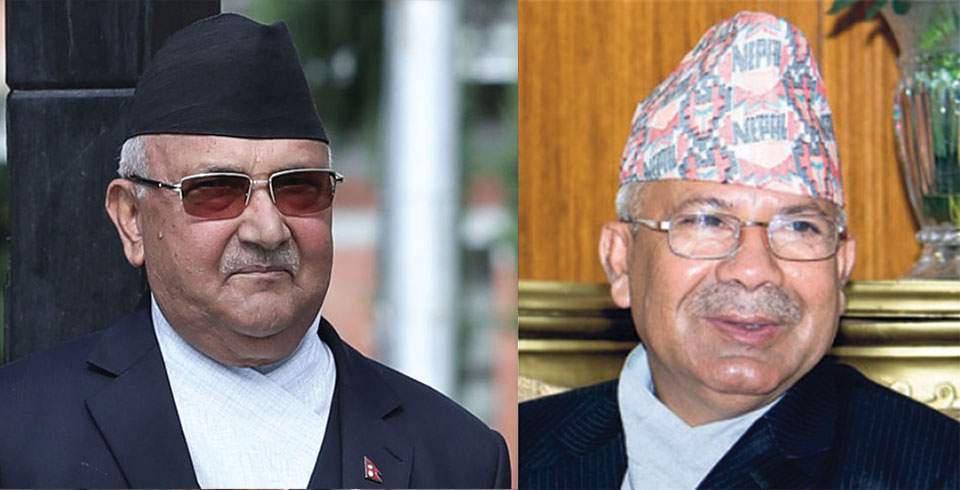
Now it is the turn of the CPN-UML to undergo a formal spilt following the expulsion of 11 senior leaders by the Oli-led UML standing committee. Among those expelled are heavyweights such as Madhav Kumar Nepal and Jhalanath Khanal, two ex-PMs. They were booted out after they petitioned with President Bidya Devi Bhandari to name Nepali Congress’ Sher Bahadur Deuba as the new prime minister. Once again, ideological differences had nothing to do with the latest fissure in the ruling party. It was an all-out personality clash.
The Nepali communist movement has been turbulent since the formation of the Communist Party of Nepal (CPN) in 1949 under Pushpa Lal Shrestha. But while earlier fissures in the communist movement were at least partly ideological—for instance, in 1962 the CPN split over the debate of whether communists and royals could work together—in recent times, such fissures (and later fusions) have largely, if not exclusively, been guided by personal calculations.
Then there is the question of whether any of Nepal’s big, nominally communist forces are in fact communist. Of late, it is hard to distinguish the Nepali Congress from the CPN-UML or CPN (Maoist Center). Though all three swear by democratic socialism, in reality all of them support crony capitalism. Communist candidates are the biggest spenders in electoral campaigns and control big chunks of the economy. Their commitment to the welfare state is wafer-thin. Without greater ideological clarity and walking-the-communist-talk, Nepali communist movement faces an existential crisis.

Biz Brief | Xiaomi unveils POCO X3 Pro in Nepal
POCO this week announced the launch of its latest smartphone, POCO X3 Pro building on the #PROformance legacy of POCO F1 in Nepal. The phone is tailor-made for young tech and gaming enthusiasts.
“At POCO, we strive to deliver the best of technology in line with our consumers’ requirements. Our first phone, POCO F1 continues to be the performance champion till date,” Sourabh Kothari, Country General Manager for Xiaomi Nepal, said.
POCO X3 Pro is available in three color variants: Graphite Black, Steel Blue, and Golden Bronze at the price of Rs 31,999(6GB +128GB) and Rs 36,999(8GB +256GB) across authorized stores, online and retail partners.

Panorama | Medical mission

Medical mission: Health workers in the process of transferring a Covid-19 patient to a Simrik Air helicopter in Charikot, Dolakha district. The patient was airlifted to B&C Medical College in Birtamod, Jhapa. With most of the country under lockdowns, Nepali helicopter operators have flown on many such missions over the past fortnight | Bimal Sharma Sapkota

Business | Daraz continues to disappoint customers
If you are on TikTok you’d probably come across a video that has gone viral. In the video the TikToker orders an electric kettle from Daraz, Nepal’s biggest online shopping platform. He plugs the kettle in.
Then something unexpected happens. A female voice emerges from the device, “Your Bluetooth device is now connected.” The TikToker is perplexed. He concludes he has been duped into buying a cheap Chinese instrument.
Perhaps the video was made to poke fun at Daraz and its services, but many customers who have ordered goods from the platform have had their share of real surprises. When you place an order, you never know what you will get and in what form, customers say.
Bijay Adhikari (name changed) ordered groceries worth over Rs 10,000 from Daraz for this month. A few days ago, a Daraz delivery guy knocked at his door with a carton box. Inside was a small bottle of peanut butter wrapped in bubblewrap and tape. Adhikari, an environment science student, felt guilty that so much resource was wasted on a jar of peanut butter.
Social media is flooded with anecdotes on Daraz’s surprises. A user said he was delivered women’s innerwear when he ordered a speaker, another says she received a water bottle when she ordered a water filter. And when she wanted to return the water bottle she was asked to go through a lengthy process, including filling up a requisition form. She vows to never order from Daraz again.
Yet another customer at Ratopul was handed an incredibly light package when she ordered a frying pan. When she questioned the delivery boy what he had bought in the package, he didn’t have a clue.
The list of complaints goes on and on.
Last year, the Department of Commerce fined Daraz Rs 300,000 after receiving complaints from consumers. But that doesn’t seem to have made much of a difference. These days, people ask themselves, “Maile Daraz bata saman nai kina magako?” (“Why did I even order goods from Daraz?”)

Editorial: Speak up on Palestine
Over the past week, Nepali media outlets have been flooded with accounts of Nepalis working in Israel worried about their personal safety. Hamas, the Gaza-based Palestinian militant group, has been dropping rockets on neighboring Israel and more than 10 Israelis have already been killed. People living there are justifiably afraid. Yet such accounts have also helped paint, if inadvertently, a misleading picture. They make it seem like Hamas is largely to be blamed for the current conflict. Such accounts also make Israel, rather than Palestine, the victim party.
The truth is the exact opposite. In the latest instance, Hamas started propelling rockets into Israel because the Israeli government under Benjamin Netanyahu refused to stop building Jewish homes in the Palestinian territory in the West Bank. This is the area that Israel illegally occupies by displacing Palestinians who have been living there for generations. Israel has also closed vital crossings into Palestinian territories and stormed a place of worship. Cornered, some Palestinians retaliated.
This is not to justify any kind of terrorist activities. Hamas is wrong to use rockets on civilians. But what about Israel? It labels Hamas a terrorist organization but itself employs even more brutal tactics. While around 10 Israelis were killed by Hamas bombing as of this writing, Israel had indiscriminately killed at least 120 Palestinians in the Gaza Strip, including women and children.
It has also refused to talk to the ‘terror group’. In fact, such disproportionate use of force has been the preferred Israeli modus operandi in recent times as the government in Tel Aviv comes under pressure from far-right Zionists to bulldoze the Palestinian aspiration for their own homeland.
The government of Nepal, which likes to weigh in on events from around the world, often unnecessarily, has maintained complete silence on Israeli actions in Palestine. Perhaps the fear is that any such statement will hamper the prospect of lucrative jobs for Nepalis in Israel. Plus, Nepal is an old friend of Israel—it was the first South Asian country to host a resident Israeli embassy.
Precariously placed countries like Nepal have little margin for error in the international arena. But it could, at the least, urge restraint on both the sides and ask Israel to come up with a roadmap for a viable two-state solution.

Biz Brief | Nimbus’ CSR against Covid-19
Nimbus has decided to show its support to the organizations, frontline workers, and volunteers fighting for everyone’s safety, risking their own by donating Pro-Tect masks and sanitizers. The company is all set to donate masks and sanitizers at places where it’s needed the most, prioritizing hospitals, quarantine centers, frontline workers including health workers, volunteers, media personnel, and government bodies.
Nimbus has already distributed masks at Shahid Ganga Lal Hospital, Federation of Nepali Journalists, and Heartbeat, an organization run by volunteers to provide free meals to those in need.
“We are deeply grateful and have immense respect for every person who has risked their life and safety to fight this pandemic. In one of the toughest challenges faced by the world today, we can only win if we all work unitedly,” said Anand Bagaria, managing director.
Pro-Tect is a health and sanitation brand by Nimbus which includes high-quality anti-microbial Kn95 masks, 3ply mask and sanitizer made with WHO-recommended hand rub formulations with 76% ethanol. Organizations and volunteers can apply for Pro-Tect masks and sanitizer stating the required number by logging into www.nimbusbazar.com and clicking on ‘Donate Pro-Tect’, or by calling 977-9828091691.

Biz Brief | Nimbus’ CSR against Covid-19
Nimbus has decided to show its support to the organizations, frontline workers, and volunteers fighting for everyone’s safety, risking their own by donating Pro-Tect masks and sanitizers. The company is all set to donate masks and sanitizers at places where it’s needed the most, prioritizing hospitals, quarantine centers, frontline workers including health workers, volunteers, media personnel, and government bodies.
Nimbus has already distributed masks at Shahid Ganga Lal Hospital, Federation of Nepali Journalists, and Heartbeat, an organization run by volunteers to provide free meals to those in need.
“We are deeply grateful and have immense respect for every person who has risked their life and safety to fight this pandemic. In one of the toughest challenges faced by the world today, we can only win if we all work unitedly,” said Anand Bagaria, managing director.
Pro-Tect is a health and sanitation brand by Nimbus which includes high-quality anti-microbial Kn95 masks, 3ply mask and sanitizer made with WHO-recommended hand rub formulations with 76% ethanol. Organizations and volunteers can apply for Pro-Tect masks and sanitizer stating the required number by logging into www.nimbusbazar.com and clicking on ‘Donate Pro-Tect’, or by calling 977-9828091691.

Biz Brief | NIBL and HBL merger confirmed
Nepal Investment Bank Ltd and Himalayan Bank Ltd—two of the oldest commercial banks in the country—have confirmed their merger deal, creating the biggest bank in Nepal with a total paid-up capital of nearly Rs 27 billion.
NIBL and HBL this week jointly signed a memorandum of understanding to merge with the intention of strengthening the banking sector of the country in line with Nepal Rastra Bank's Merger and Acquisition Policy. NIBL Chairman Prithvi Bahadur Pandé and HBL Chairman Tulsi Prasad Gautam signed the MoU.
Pandé will remain the chairman of the bank, whereas Ashoke SJB Rana, the chief executive of HBL, will be the chief executive officer of the merged entity. The board of the merged bank will comprise three members each from NIBL and HBL, in addition to an independent member.


