


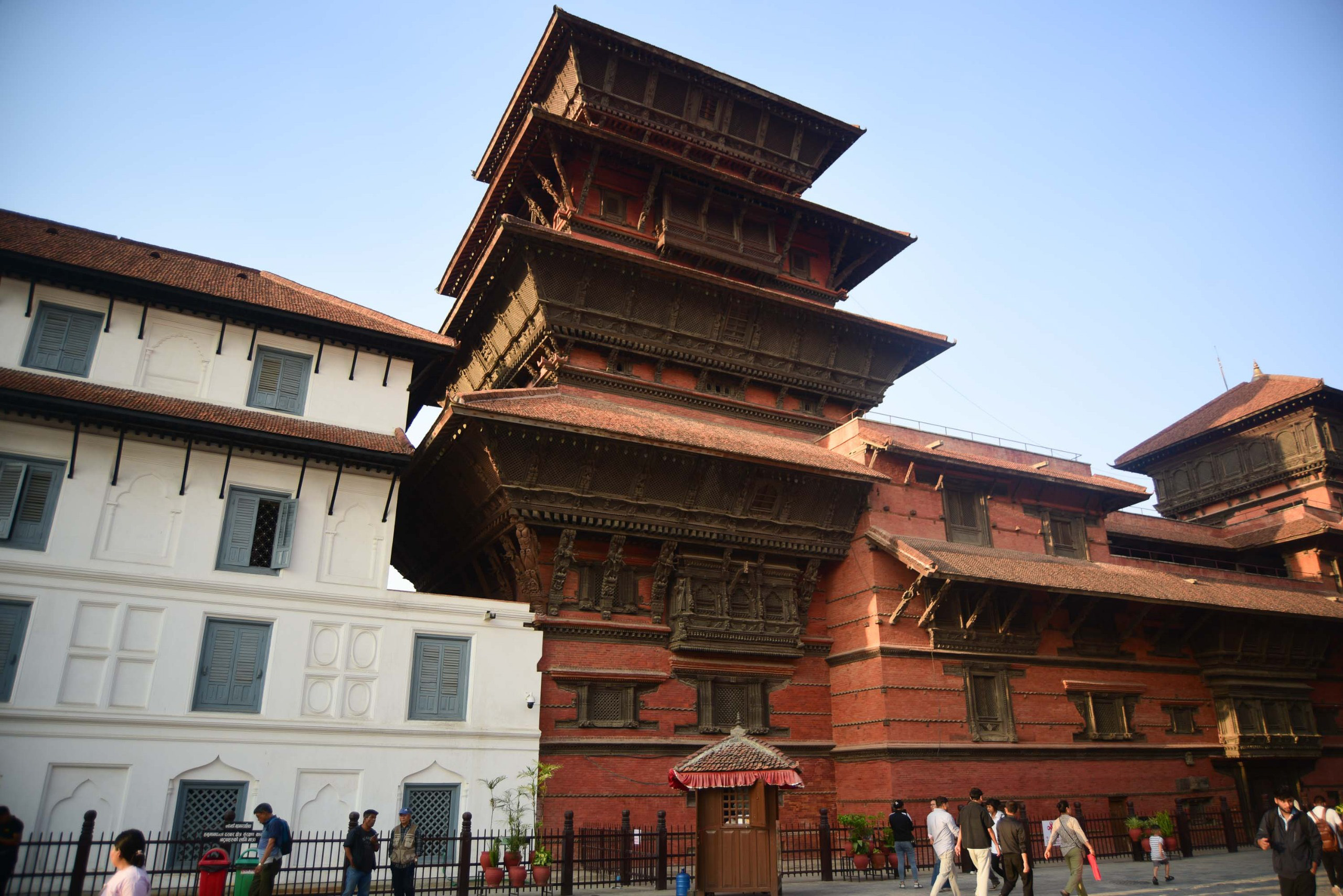
Ten years since Gorkha earthquake: Basantapur area—then and now

The 10th Memorial Day of the Gorkha Earthquake is being observed across the country by organizing various programs.
A total of 9,079 people were killed and 22,309 others sustained injuries in the disaster. It damaged over 800,000 private houses, government offices, school buildings and 1,500 cultural heritages.

The earthquake also caused significant damage to Basantapur and Hanuman Dhoka Durbar areas in Kathmandu.
In the 10 years since the earthquake, the reconstruction of Kasthamandap, Gaddi Baithak, nine-storey palace, Vishnu Temple and Trailokya Temple among others in Basantapur area has been completed.

Many organizations have provided assistance for the reconstruction of the area.
The reconstruction work was carried out through the Department of Archaeology, Kathmandu Metropolitan City, provincial government, foreign donor agencies, Guthi, and consumers committees.



Kathmandu's maximum temperature likely to drop from Sunday
The temperature in the Kathmandu Valley is expected to fall from Sunday.
The Department of Hydrology and Meteorology stated that the temperature is likely to drop from Sunday after rainfall.
The Department said that the days in the Kathmandu Valley will be hot on Saturday as well.
The maximum temperature in the valley is likely to remain from 31 degree Celsius to 34 degrees Celsius, according to the Department.
Likewise, the weather will remain fair in the country today except partly to generally cloudy in the hilly areas of Koshi, Gandaki, Karnali and Sudurpaschim Provinces.
Chances of light rainfall along with thunder and lightning are there in one or two places of hilly areas of Koshi, Gandaki and Karnali Provinces.

Adrian Pokharel’s book 'The Momo War’ available on Amazon
The book 'The Momo War’ written by Nepali-American author Adrian Pokharel is now available on Amazon.
Along with being a writer, Pokharel is known as an American politician, songwriter, singer, artist, social worker, and businessman.
The book has incorporated various issues like stories of immigrants, political upheaval as well as humor and sharp cultural commentary, Pokharel said.
The price of the book, which has 150 pages in English, is $21.99.
The ‘Momo War’ has also been depicted as Unity and Division in Little Everest.
“Not only in English, the book will also be published in other languages,” Pokharel said.

Protests, power struggles, and policy gridlocks
The ongoing teachers’ protest has compelled Minister for Education, Science, and Technology, Bidya Bhattarai, to resign. On one hand, she was under mounting pressure to address the demands of teachers; on the other, Prime Minister KP Sharma Oli was reportedly dissatisfied with her performance.
A clear divergence emerged between the interests of the ruling CPN-UML and Bhattarai’s method of handling pressing issues in the education sector. With her background as a university lecturer, Bhattarai was seen as a competent and knowledgeable figure to lead the ministry. Yet, despite her credentials, tensions within the government and on the streets reached a breaking point. For over three weeks, secondary school teachers have been staging protests in central Kathmandu, severely disrupting the education of thousands of students in public schools. These demonstrations have also caused traffic congestion, significantly affecting transportation systems and local businesses.
In response to the leadership vacuum, senior UML leader Raghuji Pant has been nominated as the new Education Minister. According to government sources, fulfilling the teachers’ demands is no easy task. They argue that some grievances can only be addressed once the long-awaited Education Bill is passed by Parliament. However, the unrest is not limited to teachers. Numerous groups and organizations have taken to the streets to voice their own frustrations and demands.
Resident doctors are rallying for fair allowances, local government staff are staging demonstrations, and in recent years, victims of cooperatives and loan sharks have also mobilized. The cumulative pressure from these groups poses a serious challenge for the government. How these compounding issues will be handled remains uncertain, but many fear the situation may escalate beyond control if not addressed promptly.
Within the Nepali Congress (NC), internal efforts are reportedly underway to topple the current government, despite party president Sher Bahadur Deuba's preference for maintaining the coalition. Other senior leaders—such as Purna Bahadur Khadka, Shekhar Koirala, Gagan Kumar Thapa and their allies—are advocating for a renewed alliance with the CPN (Maoist Center). This week, Khadka publicly criticized the coalition’s performance, emphasizing the urgent need to improve the government’s working style.
At the same time, Maoist Chairperson Pushpa Kamal Dahal has made it clear that his priority is to form a coalition with the NC. Political analysts suggest that Dahal is maneuvering to increase his party’s bargaining power with both NC and UML in the context of upcoming electoral alliances. If negotiations with the NC fail, Dahal is expected to revive the idea of a leftist coalition as a strategic alternative.
Amid these political shifts, the government is preparing to unveil new policy programs and the national budget. However, these initiatives could spark further friction between coalition partners NC and UML. Historically, budget and policy disagreements between ruling parties have often become flashpoints that lead to instability or even regime change.
Meanwhile, the recent wave of pro-monarchy protests appears to have lost steam. Last week, the Rastriya Prajatantra Party staged demonstrations in Kathmandu and several locations outside the valley. However, the low turnout has prompted the party to reconsider its strategy before organizing further events. Following the arrest of Durga Prasai, his supporters have remained largely absent from the streets. Dozens of them have been detained for alleged involvement in the arson and vandalism that occurred on March 28.
After nearly a month of house arrest, Nava Raj Subedi has returned to lead the pro-monarchy movement, but the campaign seems to have lost momentum. Former king Gyanendra Shah has reportedly urged calm, expressing concern that further violence could trigger government retaliation against him. According to sources, Gyanendra has instructed his followers to keep protests peaceful. However, the extent of coordination between him and pro-monarchy groups remains murky. As the movement weakens, mainstream political parties and the government have noticeably softened their tone regarding the former monarch.
In other political developments, top leaders from UML, NC, and Maoist Center convened this week to discuss critical matters, including the stalled transitional justice appointments and pending education legislation. Despite the meeting, no substantial progress was made.
Nevertheless, the appointment process for the transitional justice mechanism has resumed. Meanwhile, Prime Minister Oli publicly addressed rumors of an internal challenge to his leadership, allegedly spearheaded by former President Bidya Devi Bhandari. Speaking at a public function, Oli asserted that the UML is unimaginable without him, boldly claiming that he “won’t grow old” for another 20 to 25 years.
In recent weeks, Bhandari has become increasingly vocal about her political ambitions, stating that numerous party leaders are urging her to take the helm. Dissatisfaction with Oli’s leadership has led some senior UML figures to shift their allegiance to Bhandari, who is emerging as a new power center within the party. “Some people are raising concerns about my age and health, but no one should imagine this party without me,” Oli recently declared.
In a move to reassert control and respond to public criticism, Oli has announced the formation of a high-level good governance committee, which he will personally lead. While the initiative is ostensibly aimed at combating corruption and restoring good governance, public skepticism about its efficacy remains high. Governance has been one of the biggest casualties of the NC-UML coalition, with many key decisions delayed due to inter-party disagreements. One such example is the government’s failure to appoint a new governor for the Nepal Rastra Bank, a deadlock rooted in internal political differences.
Meanwhile, the Rastriya Swatantra Party (RSP) continues to face criticism for lacking a clear ideological direction. This criticism intensified when the party opted to remain silent during the recent wave of pro-monarchy protests. However, this week, senior RSP leader Swarnim Wagle outlined the party’s position on several national issues during a public event outside the valley. He stated that the RSP supports scrapping the current federal structure, arguing that it imposes an unsustainable financial burden on the state. He also proposed a downsizing of both federal and provincial legislatures—positions that clearly suggest the party is not fully aligned with the principles enshrined in the 2015 constitution.
In a related development, two Madhes-based parties—the Janamat Party and the Nagarik Unmukti Party—are preparing for a merger. CK Raut is expected to take the helm of the unified political force, signaling a new chapter in regional political realignment.


