



Corporate houses compete for new stock exchange license

It’s battle royale on a card. In a high-stakes game, the who's who of the Nepali corporate world are in a race to get the license to operate a new stock exchange. This is turning out to be the most important contest in the Nepali corporate world in recent times. Even before the Securities Board of Nepal (Sebon) opened applications for the license, the business head honchos were busy forming their groups to apply for the permit. As the deadline for application submission ends on Sunday, three companies have applied for the license to start a new stock exchange. The Himalayan Stock Exchange is the first one to apply for the permit. Promoted by the major shareholders of Himalayan Reinsurance Company, the company applied for the license on April 21. There was fierce competition among the top corporate houses during the license issuance of the second reinsurance company. While five reinsurance companies sought the licenses, it was Himalayan Reinsurance that came out as the winner. The company is promoted by Nepal's leading business houses, namely Golchha Group, Shanker Group, Lucky Group, Ramesh Corp, Murarka Group, and KL Dugar Group, among others. The major promoters of the Himalayan Stock are Shanker Group and Deepak Bhatta Group. Besides, former FNCCI presidents - Bhawani Rana, Pashupati Murarka, and Shekhar Golchha along with Rajendra Khetan, Saurav Jyoti, Vivek Dugar, Kumud Kumar Dugar and Amit Kumar More are also the promoters of the Himalayan Stock Exchange. On Sunday (April 23), two more companies- National Stock Exchange and Annapurna Stock Exchange- reached the Sebon to file their applications. The National Stock Exchange has been backed by non-resident Nepalis (NRNs) businessmen, Agni Group, Kedia Group, and Reliance Group. The NRN businessmen Upendra Mahato, Jiba Lamichhane, Badri KC, and Kul Acharya are also shareholders of this proposed stock exchange. Deepak Timilsina, Mahesh Kumar Shrestha, Rishi Aggarwal, Ankit Kedia, and Ramji Regmi have been proposed as the board of directors of the National Stock Exchange. The third one—Annapurna Stock Exchange—also submitted its application on Sunday. The Annapurna Stock is led by Surendra Raj Wagle and has seven directors as Ganesh Kumar Shrestha, Mukti Bodh Neupane, Anil Sapkota, Prakash Kumar Shrestha, Shekhar Subedi, and Balram Upreti. Making a second amendment to the Securities Market Operation Regulation 2064 in the second week of September 2022, the Sebon initiated the process to establish the second stock exchange in the country. On September 18, 2022, the Sebon invited applications for a new stock exchange, commodity exchanges, and stock brokerage firms. However, the process stalled for five months after advocate Deepak Bikram Mishra went to the Supreme Court (SC) demanding to stop the licensing process. The licensing process was stalled after the apex court issued an interim order on October 21, 2022. But, the joint bench of Justices Sushma Lata Mathema and Anil Kumar Sinha in the second week of April 2023 dismissed the petition, paving the way for the Sebon to move ahead with the licensing process. Following this, the Sebon on April 13 again invited applications from interested parties for new stock exchange and commodities exchanges. According to Sebon, the new stock exchange should have a paid-up capital of Rs 3 billion, of which 70 percent will be institutional investments. Currently, the Nepal Stock Exchange (Nepse) is the only stock exchange in the country. The government has a majority stake in the Nepse. While there have been talks of bringing strategic investors into the Nepse, the process has not moved ahead. Sebon is trying to create a competitive environment by adding one more stock exchange. According to Sebon Chairman Ramesh Kumar Hamal, the board will award the license following the necessary process. "Now the evaluation committee will evaluate the companies' application. The license will be awarded based on the recommendations of the evaluation committee," he said. Four companies applied for commodity exchange license According to Sebon, four companies have applied for commodity exchange licenses. The board has called for proposals for granting licenses to two commodity exchanges. Among them are Multi Derivative Exchange Limited, Multi-Asset Derivative Exchange Limited, Himalayan Commodity Derivative Exchange Limited, and Nepal Multi Derivative Stock Exchange Limited.

Gold price drops by Rs 200 per tola on Monday
The price of gold has dropped by Rs 200 per tola in the domestic market on Monday. According to the Federation of Nepal Gold and Silver Dealers’ Association, the yellow bullion is being traded at Rs 109, 100 per tola today. The yellow metal was traded at Rs 109, 300 per tola on Sunday. Meanwhile, tejabi gold is being traded at Rs 108, 600 per tola. It was traded at Rs 108, 800. Similarly, the price of silver has dropped by Rs 20 and is being traded at Rs 1,420 per tola today.

Nepse plunges by 18.80 points on Sunday
The Nepal Stock Exchange (NEPSE) plunged by 18. 80 points to close at 1,885.60 points on Sunday. Similarly, the sensitive index dropped by 4. 00 points to close at 359. 13 points. A total of 2,734,307-unit shares of 265 companies were traded for Rs 828 billion. Meanwhile, Sunrise Bluechip Fund and Adarsha Laghubitta Bittiya Sanstha Limited were the top gainers today with their price surging by 10. 00 percent. Likewise, Sunrise Focused Equity Fund was the top loser with its price dropping by 10. 00 percent. At the end of the day, the total market capitalization stood at Rs 2. 74 trillion.

Rise in imports makes NRB cautious
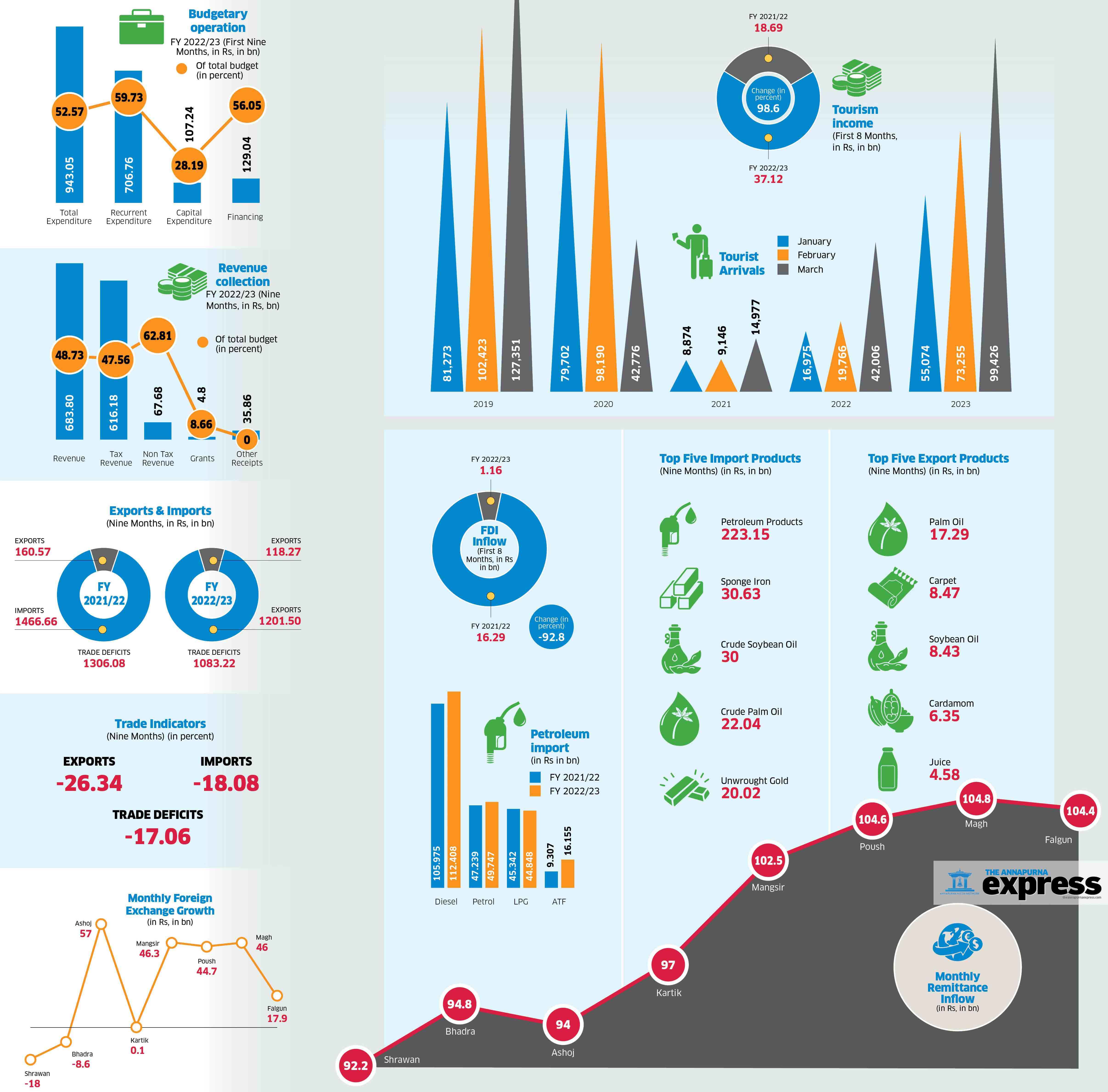
After the government eased import restrictions, the country's imports increased for the second straight month. Nepal imported goods worth Rs 143.123 billion in Chaitra (mid-March to mid-April), the highest on a month-to-month basis, in the current fiscal year. The Nepal Rastra Bank (NRB), which resorted to strict import-cutting measures a year ago after foreign exchange reserves depleted drastically, is said to be watching the rise in imports closely as this growth can again derail the external sector of the economy. The country had imported goods worth Rs 139.22 billion in Falgun (mid-February to mid-March), an increase of 10 percent compared to Magh (mid-January to mid-February). Nepal had imported goods worth Rs 142.31 billion in Bhadra (mid-August-mid-September), the second highest on a month-to-month basis in FY 2022/23. However, the country's total imports in the first nine months of the current fiscal year are lower than the last fiscal year. According to the Department of Customs, Nepal imported goods worth Rs 1,201.508 billion in the current fiscal year compared to Rs 1,466.662 billion during the same period of the last fiscal year. The imports during the first nine months of this fiscal have declined by 18.08 percent. With the government imposing restrictions on luxury items and NRB introducing cash margin provisions on Letters of Credit issuance, the imports have declined till mid-February. The country's Balance of Payment (BoP) has remained positive by Rs 148.11 billion during the first eight months of the current fiscal year while foreign exchange reserves also increased by 15.2 percent to Rs1401.21 billion till mid-March, according to NRB data. Though these restrictive measures contributed to reducing imports and improving the country's external sector, they also resulted in a huge decline in government revenues which are heavily reliant on imports. The slowdown in revenue collection forced the government to lift import restrictions on the imports of vehicles, alcohol, and expensive mobile phones in mid-December, 2022. The central bank also removed the provision of cash margin in January this year. Along with the surge in imports, the amount of money going out of the country for education abroad has also increased significantly. A total of Rs 54.7 billion went out of the country in the first eight months of the current fiscal year, an increment of 80 percent. Central bank officials say they are observing the situation cautiously. "If the imports continue to surge, it would put pressure on the external sector," said Dr. Prakash Kumar Shrestha, Executive director of NRB. According to him, the source of foreign exchange income is not strong at the moment. "Currently, Nepal is receiving monthly remittances of around Rs 100 billion which is not enough to cover the imports." Monthly Import Bill
| Chaitra Rs 143.123 billion Falgun Rs 139.22 billion Magh Rs 126.499 billion Poush Rs 127.92 billion Mangsir Rs 132.055 billion Kartik Rs 131.693 billion Ashoj Rs 127.399 billion Bhadra Rs 142.313 billion Shrawan Rs 131.286 billion |


