

Between a rock and a hard place
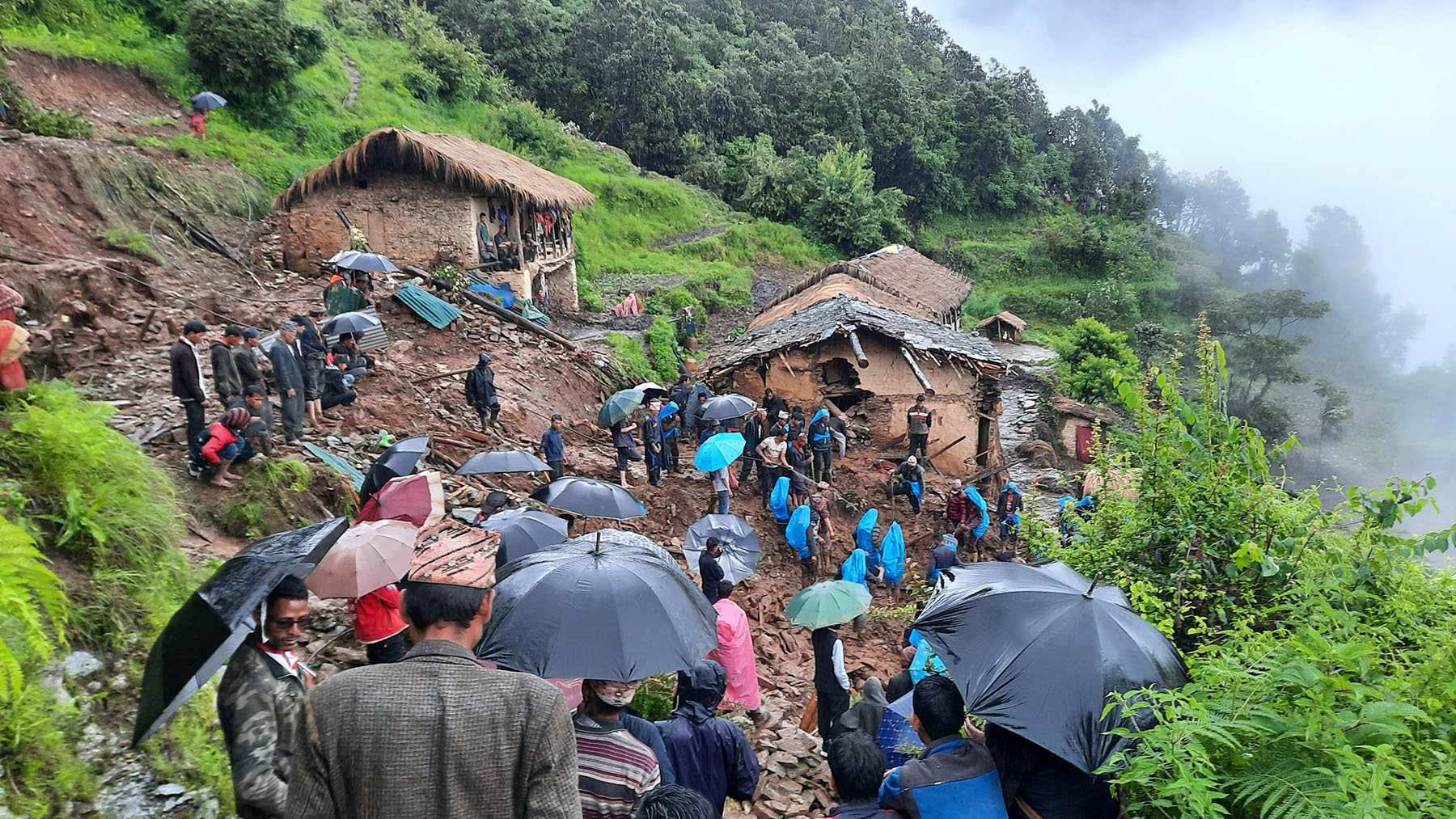
As of early morning, October 9, Dipak GC, 34, of Surkhet district remains trapped in a landslide (rockslide?) at Chumnubri rural municipality-6, Gorkha district, per an Annapurna Post report that quoted municipality Chair Nima Lama. Not for an hour or two, not even for a day but for four long days. When in a difficult situation, four days appear like eternity, with or without Albert Einstein’s theory of relativity. The report shows a moving picture of GC stuck beneath an outcrop of massive boulders. How did GC land in that unenviable position in the first place? Per the report, the construction worker got caught in the landslip while returning from Chekampar, one of his work stations along with Chumchet, and had his left leg broken. Per the report, some locals from Keraunja happened to see this man caught in a massive landslide site (at Lokpa) with a span of about 800 meters taking refuge beneath boulders, on October 08. Apparently, he had been without food and water for three days. After getting this information, Sherap Gurung and his brother Tashi Dorje rushed to the site with edibles and medicine (brufen and moov) for pain relief, received from health workers with instructions for use. After giving him instructions for the use of medicine, the two locals rushed back with the victim’s fervent appeal for immediate rescue. Apart from food, water and medicine, the stranded youth is in need of immediate rescue as his broken leg has started stinking, per the report that quoted Lama as saying that efforts to airlift him are underway. The Annapurna Post report further points, quoting Chumnubri rural municipality Chair Lama: Around 50 foreign trekkers remain stuck at Chumnubri rural municipality ward numbers 4 and 6 in the Manaslu region for four days following incessant rains that have triggered landslides. The report quotes Chair Lama: Yesterday, two helicopters rescued tourists stuck in Pewa. Around 50 still remain stuck. Talks are on with the District Administration Office, the Home Ministry and the Nepali Army for the rescue of the stranded tourists. The report quoted tourist guide Sane Gurung: Some tourists have their visas about to expire, while some others have run out of money. Most of the tourists are old. They are in dire straits. Gorkha is not the only highland district in the eye of natural disasters like rainfall and landslides, unheard of phenomena on the lap of the Himalayas even at the start of the 21st century. Rastriya Samachar Samiti reported the death of seven members of a family in an incessant rainfall-triggered landslide that buried their house at Barkotebada, Kanaksundari rural municipality-5, Jumla, on Saturday (October 08). Per the report, rainfall has blocked/damaged roads in many places in the highland district. Downhill, The Rising Nepal (TRN) reported on October 9 that floods resulting from an ‘unprecedented rainfall’ have caused significant damage to the 35 KW Inglekhola micro hydropower station in Gurja, Dhaulagiri rural municipality-1 (Myagdi district), plunging 265 households in Gurja into darkness. Per the report, rainfall has also blocked Beni-Darbang and Beni-Jomsom roads. According to the report that quoted local residents, hills near Gurja village have been experiencing snowfall since Friday morning, a never-before-seen phenomenon in the month of October, at least in the living memory of those quoted. In the southern plains of Nepal, rainfall-triggered floods have caused huge loss of lives and properties. As per a recent TRN report, a rain-swollen Narayani river has flooded over 100 houses at Baguban of Binayi Tribeni rural municipality-1 and at Seheri, Bhutaha and Prasauni in Madhyabindu municipality in East Nawalparasi district. The report quoted chair of the rural municipality, Ghana Shyam Giri: At least 70 houses have been submerged at Baguban, and over three dozen at Seheri, Bhutaha and Prasauni. Many victims at Baguban were trapped in their houses and waiting for rescue. Other districts in the plains like Bardiya, Banke, Dang, Rupandehi and West Nawalparasi are faring no better. Incessant rainfall, which triggered floods and landslides resulting in significant loss of lives and properties including in the Kathmandu Valley, is a new phenomenon for the country around this time of the year. Hile Dashain (a muddy Dashain resulting from the rains) is sometimes heard in casual conversation with elders but death and devastation of this scale towards the end of the monsoon season was quite unimaginable. The country was ill-prepared to deal with natural disasters this time as well. Once in a while, the Weather Forecast Division would issue flood alerts to local communities living close to river banks, appealing them to move to safer places. For most of the afflicted lot, those safer places were nowhere to be found. As in the disasters of the past, security personnel, spread too thin and ill-equipped, tried their level best to protect lives and properties. But the behemoth called the Nepali state, the government in particular, remained unmoved in the face of this national tragedy that turned Vijaya Dashami into a Dasha (bad luck) for the multitudes, who were already dealing with multiple maladies like chronic corruption, malgovernance, misrule, political instability, soaring inflation and plummeting standards of living. Neither the five-party coalition government, nor the opposition parties, nor the lawmakers put out words of sympathy for the victims, leave alone the hope of fraternal organizations of parties across the political spectrum joining hands with security personnel for rescue and relief distribution efforts. Busy preparing for provincial and federal elections slated for November 20, they had no time for the very country and the people they claim to be serving. Surprisingly enough, no word of sympathy came from the Presidential Palace. This silence in times of a national tragedy is an indication of the apathy of the Nepali state towards climate change and its possible impact on one of the most vulnerable countries in the world. Perhaps it is an indication that powers that be in Nepal—tried, tested, failed and corrupt beyond measure—are hell bent on letting environmental devastation continue in the holy name of development with scant regard for climate change and its impact. Their silence shows that they will keep mum in the face of rampant and illegal mining of construction materials in the Chure, in the mid-Hills and beyond as long as they get their cut. It means they will continue to allow development of roads here, there, everywhere with no regard for the carrying capacity of the local terrain. At a time of glacial retreat, glacial lake outburst flood, severe drought and rapid desertification resulting from climate change, this silence points that our good-for-nothings will continue to give a go-ahead for the construction of projects meant to rob Nepal of all her waters, export the benefits across the border and make successive generations of Nepalis pay costlier than ever environmental bill associated with these projects. Wrapping up, let’s revisit the site at Chumnubri where Dipak GC remains trapped beneath an outcrop of boulders that continues to stand somehow. Let’s revisit the site where 50 or so tourists remain stranded. Let’s do whatever we can for their rescue. Coming to the point, Nepal is no less vulnerable than GC and those tourists, caught as she is between a rock and a hard place in the context of climate change, thanks to a political leadership shorn of long-term vision for the country and the peoples it claims to be serving. Let’s join hands and work a way out to rescue the country from this trap without further delay, for the time is running out.

May demonic forces bite the dust
Two vital organs of the Nepali state stand jarringly close, physically. So close that when the resident animal of the Lion Palace roars, the Themis Palace at Ramshahpath starts trembling along with the statue of Themis. The Greek goddess of truth and justice is blindfolded, but she, unlike numerous pleas for truth, peace and justice, can hear the roar for sure, despite years of state-sponsored neglect towards her health. The goddess stands as a mere shadow of her past in which she even dared challenge the all-powerful royal palace and democratically-elected governments alike, telling them in strictest terms to not obstruct justice by trampling on the supreme law of the land, the Constitution. Alas, those days are gone. At a time when even the sole superpower appears to be on the decline, the Greek goddess also seems to be past her prime. In ‘normal times’ also—by the way, turbulent times have become a new normal in this country—it will be no surprise if an inquiry commission finds the goddess in frail health to be sweating profusely at her very own palace close to the Nepal government secretariat. That would be hardly surprising in a country where the statue of a native deity, Dolakha Bhimsen, said to have the might of a thousand elephants, sweats every now and then, instilling fear of oncoming disasters, manmade or natural, among the masses. By the way, in a country where the executive appears like one hell of a disaster at all times, there’s no need for more disasters, even for international humanitarian agencies lodged quite comfortably in Nepal, for there’s a lot to do anyways. Still, the unwelcome guests come in droves, in the form of monsoon floods, landslides, never-ending quakes and their aftershocks, among others. Perhaps the sweating, every now and then, of a super powerful Bhimsen is the result of instability, unbridled policy-level corruption and misrule that has been plaguing this country for generations despite waves of ‘political transformations’ that come and go like seasons in a space of a decade or so, bringing some new rulers but no meaningful change in the lives of the laity. Glimpses of a country mired neck-deep in corruption are everywhere, including in the yearly-published Transparency International’s Corruption Perception Index, where Nepal often fares poorly, getting a paltry 33 or so out of 100 despite decades of ‘epoch-making changes’. Perhaps this continued success in getting a below-par CPI score is the only factor stopping Nepal from becoming a failed state! The Lion Palace, of course, has a huge role to play in this sorry state of affairs. Of the three organs of the state, tyranny is in the DNA of the executive regardless of its shape or form, more so in a country where the judiciary cannot flex moral muscles, owing to transactional relations with the executive. As for the Parliament, it acts as a beast of burden, doing the bidding of a whip-wielding executive, often at the expense of the country and her people. Nepal’s parliamentary history is testimony to the fact that the legislature has become a headquarters of policy-level corruption, thanks to corrupt practices like horse-trading and floor-crossing in times of crucial votes. All this pushes the public onto the streets. Whenever the opportunity arises, the Lion Palace entrusted with the legitimate use of force rides roughshod over civil liberties, making a mockery of cherished ideals like human rights and democracy. Powered by a majority (manufactured or gotten through a popular mandate) in the Parliament, it often tramples on the Constitution, giving two hoots to long-held principles like separation of powers and checks and balances. There’s a long list of policy-level corruption that the Lion Palace has indulged in during the democratic-transformative era that began with the overthrow of the Ranarchy in 1950. The sellout of Nepal’s lifelines, the rivers that have the capacity to change the country for the better, despite protests in the ‘sovereign’ Parliament and on the streets, is a glaring example of such corruption and so is the tweaking of citizenship laws with the intent of bringing about a demographic shift and turning the sons and daughters of the soil into a minority in their own land. Stewing in its own juice under the shadow of a looming Lion Palace, the Themis Palace, especially during the last decade or so, has been unable to make the beast abide by the Charter. In a country with open borders festering like open wounds, the Lion Palace is again seeking to tweak the citizenship law after the sellout of Nepal’s lifelines, a move that will have huge impact on national security, water sovereignty, national sovereignty and the future of successive generations of Nepalis, a move that will leave the provinces and smaller units of the state with precious little to survive on. Notably, this bid to turn a country with a manageable population of around 30m into a wet nurse through a very very controversial bill comes at a time when elections are around the corner. While Themis lies in a vegetative state at this crucial juncture (By the way, does anyone know as to how to invoke the Basantpur-based Kal Bhairav, the deliverer of truth and justice in the good old days, and restore Themis? Or is it possible to instill Kal Bhairav into the Themis Palace itself and infuse life into him through some occult ritual?), another Palace has woken up to the latest threat to our cherished ideals from the executive. Will it be able to rein in the executive? This question looms large at a time when Vijaya Dashami, which marks the victory of Goddess Durga over demonic forces, is around the bend. In the life of every country, there comes a time when the people have to protect their country from a tyrannical government. In our lifetimes, that time has come more than once or twice. What we did in those times is past us. What we do this time will matter a lot. It is quite clear that this government, like many of its predecessors, does not have a will of its own. Foreign visits of self-styled emissaries in the manner of extraordinary renditions and hush-hush deals show that it has scant regard for the core interests of Nepal and the Nepalis, that it is more comfortable with ‘foreign masters’ than it is with the people that it claims to be serving. That means we should be more alert than ever. As some leading light said, eternal vigilance is the price of liberty. May truth triumph once again in this land. May the demonic forces bite the dust, once again. Here’s wishing you all a happy Dashain.

Protect our lifelines
Let’s have a look at some of the recent decisions of the Sher Bahadur Deuba-led five-party government. 8 Sept 2022: A go-ahead for the construction of 62-km Amlekhgunj-Lothar and 50-km Siliguri-Chariali (Jhapa) pipelines. The Siliguri-Chariali pipeline will be the second Nepal-India pipeline after the 69-km Motihari-Amlekhgunj pipeline, which is up and running. Aug 18: The Investment Board Nepal and the NHPC Limited, an Indian state-owned entity, sign a memorandum of understanding for the development of two more export-oriented, reservoir-based multipurpose projects—750-MW West Seti hydropower project and 450-MW Seti-VI projects. 18 July 2022: Grandhi Mallikarjuna Rao (GMR) gets two more years from the Deuba government for completing the financial management of a much lucrative, export-oriented 900-MW Upper Karnali Hydropower Project, virtually legitimizing the Indian company’s years-long hold onto the project. 8 April 2022: The government scraps the license issued to the China Gezhouba Group Corporation, a Chinese state-owned entity, for the development of a 1200-MW Budhi Gandaki hydropower project, in an indication of further muddying of Budhi Gandaki waters. Interestingly, the government has decided to develop the national pride project on its own. However, it will be no surprise if this scrapping is part of government efforts to literally ‘gift’ the project to a neighboring company that is closer to its heart. Now, a look into some decisions of the predecessor of the Deuba government. In its dying moments, the KP Sharma Oli government, much touted for its ‘patriotic’ orientation, took a major decision. That takes us to 11 July 2021. On that day, the Investment Board Nepal (IBN) and SJVNL, an Indian state-owned entity, signed a memorandum of understanding for the development of a 679-MW Lower Arun hydroelectric project located in Sankhuwasabha and Bhojpur districts. Two days later, with its last mission of the tenure accomplished (perhaps), the Oli government would become history. 11 May 2018: Prime Minister KP Sharma Oli and his Indian counterpart Narendra Modi lay the foundation stone for the export-oriented Arun III Hydropower Project (900MW), located in Sankhuwasabha, remotely from Kathmandu. The gifting of Nepal’s lifelines to the dear neighbor in a very very opaque and controversial manner, despite public protests against the sellouts, is nothing new. It has been continuing unabated since the handover of the Koshi and the Gandaki after the political changes of the 1950’s that abolished the Ranarchy and ushered the country in an era of ‘multiparty democracy with constitutional monarchy’. During its 30-year rule after the royal coup, the Panchayat regime somehow managed to hold onto the Karnali and the Mahakali, despite tremendous pressure for handover of these lifelines from New Delhi. But right after the political changes of the 1990’s that put an end to the Panchayat regime and restored multiparty democracy with constitutional monarchy, the Nepali Congress-headed government gave away the Mahakali river despite public protests, making analysts wonder if the reluctance to gift the Mahakali proved to be the death knell for the Panchayat regime. In the wake of tremendous pressure from India, the United Kingdom and the United States, the ‘sovereign Parliament’ endorsed the much controversial Mahakali Treaty with a two-third majority through unethical practices like horse-trading and splitting of a party, turning the legislature into the foreign masters’ ‘rubber stamp’. Even after the 2005’s political changes that made way for a federal secular democratic republic of Nepal, the sellout of our lifelines continues. In a short span of time, Nepal has lost more of her lifelines through Upper Karnali, Arun III, Lower Arun, Arun IV, West Seti and Seti VI deals, while governments should have focused on reclaiming Nepal’s water sovereignty lost through above-mentioned deals, which have severely weakened Nepal’s national sovereignty. Worldwide, inter-state tensions over freshwater sources are rising. The Mekong river is a case in point, so is the Nile and so is the Brahmaputra. Just recently, Bhutan has said ‘Thanks but no thanks’ to the Indian proposal to jointly harness the Sunkosh river, highlighting once again that countries like Nepal should harness natural resources by taking their national needs into account. Worldwide, prices of oil and gas have been rising, pushing prices of goods and services northwards and proving once again that increasing reliance on fossil fuel will end up bleeding the world economy. Despite this, governments of different hues and shades in Nepal seem hell bent on selling our lifelines for a pittance and increasing the import and consumption of oil and natural gas, whose prices have never been stable. The government nod for the construction of two more pipelines comes at a time when the country is already in dire straits and dues to the Indian Oil Corporation, the soil supplier of oil and natural gas, are mounting and giving rise to fears that mounting fuel bill may become the ultimate debt trap for Nepal. Who will rein in on our governments? Who will save Nepal from a looming debt trap? It is a given that student unions will not hit the streets against anti-Nepal moves like these and compel the government of the day to do a rethink as they have to do the bidding of their political masters. ‘Public intellectuals’ may not voice their concerns about matters like these for reasons best known to them. The House is a rubber stamp, always at the service of a majority, manufactured or gotten through a popular mandate. The judiciary is on deathbed, so expecting it to do something about the matter will be far-fetched. Many mass media outlets have vested interests to serve. That leaves us with the Presidential Palace. Can a hard-pressed Sheetal Niwas do something about it and save us all from a looming debt trap?

When things fall apart in Nepal
August 30, 2021. That was when the United States completed the pullout of its troops from a war-torn Afghanistan. This withdrawal marked the end of a 20-year American operation in Afghanistan that started after the 11 September 2001 Al-Qaeda attacks on the United States homeland. Interestingly, roughly a decade before that important date, troops from the erstwhile USSR had pulled out from the neighboring Afghanistan after their failure to establish a socialist/communist regime in that strife-torn country. Apparently, the US support for the Mujahideen fighters gave the Soviets a bloody nose and prompted their hasty withdrawal. Coincidentally, the dissolution of the USSR followed the Afghan pullout. The story does not end there, though. In time, it became clear that the fighters, who gave the Soviets a hard time, would not spare the Americans either. Historically Afghanistan has been known for making foreign invaders bite the dust. Before the Soviets and the Americans, great powers like the Brits, the Persians, the Greeks, the Arabs, the Turks and the Mongols suffered a fate no different. They all incurred colossal losses in the rugged terrains. All that makes Afghanistan a graveyard of empires. Prolonged American presence in Afghanistan was a matter of concern, especially for two mighty countries in the neighborhood—Russia and China. No wonder the American withdrawal provided them some solace, offered them an opportunity for celebration, for shoring up their presence in their ‘backyard’. But the party time appears to be over. Towards the end of 2021, the movement of Russian men and machines into Ukraine began. This indicated that the theaters of war were shifting in a fast-changing world marked by increasing sub-regional, regional and international tensions and the formation of defense-military alliances like the AUKUS (Australia, the United Kingdom and the United States) and another bloc called the Quad (loosely termed the Asian NATO) consisting of the United States, Japan, Australia and India. Apparently, these groupings are meant to bolster a US-led international order by curtailing the rise of China that has countries like Iran, North Korea, Russia and Pakistan as its allies (or so it seems), at least for now. While all this was going on, another international war theater emerged. Russia started the invasion of Ukraine towards the last week of February, 2022. The involvement of the US-led North Atlantic Treaty Organization (NATO) in the conflict has complicated matters further not just for the immediate neighborhood but for the entire world. After the start of the war in Ukraine and the involvement of NATO in the same, it will be no surprise if the crop of experts reading the tea leaves start having second thoughts about their analysis vis-a-vis the decline of the reigning superpower and the automatic ascension of China in the coveted position. Indeed, decline of global powers is a slow and painful process marked by years of conflict, fall of economic fortunes and military might. For example, decades have passed since the sun set on the British Empire but the Brits continue to be a formidable force in South Asia and beyond. Following the Russia-Ukraine conflict, prices of oil and gas are skyrocketing, leading to hikes in the prices of both goods and services throughout the world. Disruption in the supply of wheat and sunflower oil from the Black Sea region, one of the six grain baskets of the world, has worsened food insecurity in ill-prepared countries like Nepal. That again is not the end of the story. Ratcheting up tensions not only in the already-tense Taiwan Straits but well beyond, Nancy Pelosi, the Speaker of the United States House of Representatives (HoR), visited Taiwan in early August 2022 leading a congressional delegation. Reports indicate that the Joe Biden administration was not comfortable with the visit of Pelosi. She has consistently raised issues like the Tiananmen Square massacre of 1989, held talks with the Dalai Lama and other pro-democracy activists, and expressed support for pro-democracy protests in Hong Kong, much to the discomfort of Beijing. The high-profile Taiwan visit of the American leader that comes 25 years after another important visit—of then Speaker of the HoR Newt Gingrich—has Beijing seething. In the wake of the visit, the People’s Liberation Army fired missiles that landed not only in Taiwan but also in Japan’s exclusive economic zone. These shots may continue to reverberate in the Asia-Pacific region and much beyond. The Pelosi visit and the PLA shots come amid talks of the Asian century marked by a steady rise of China and India, increasing tensions between the two neighbors and a steady decline of our national prowess. Also, they come at a time when at least a section of the Japanese ruling elite wants to do away with the Pacific Charter and wants the country’s defense-military wings to play an active role in national defense as well as global peace and security. Add to it Nepal’s recent hush-hush high-profile visits to New Delhi and the oncoming five-day visit of India’s Chief of Army Staff here. Five days are a long time in a country whose rulers have gained infamy for taking important yet very controversial decisions at the stroke of midnight, regardless of where they stand in the ideological spectrum. Not to be forgotten is the recent assassination of Japan’s former prime minister Shinjo Abe in the calm waters of Nara, the murder of a staunch Vladimir Putin supporter in the heart of Moscow and a fresh push for lax citizenship provisions in Nepal that’s been sheltering displaced populations not only from the extended neighbourhood but well beyond, thanks to a border that’s open on our side. All these scenarios have geostrategic dimensions and make it clear that the waters of the Asia-Pacific region will get choppier in the days to come. Nepal is not known for navigating roiling waters well. Treading with caution by adopting a policy of pragmatic neutrality may be the best bet for Nepal, given that the country has lost pounds of flesh during turbulent times when things fall apart and Singha Durbar cannot hold. The Treaty of Sugauli with the Brits (1816) and the 1950’s India-Nepal Peace and Friendship Treaty are two cases in point and so are controversial accords over ‘sharing’ of our lifelines—our rivers. Who knows this better than our mandarins in the Lion Palace?

The larger message of a town-hall meet
A library equipped with ICT facilities. A yoga center. A rainwater harvesting system equipped with a large storage facility. Wider roads, bigger boulevards, a well-functioning mass transit system that serves this end of the valley. A relatively fail-proof local street lighting system. A CCTV-based community safety and security system. These and many other problems surfaced, once again, at a town-hall meeting one recent Saturday morning. The meeting of minds, lack-of-minds, halfwits and many others on the margins of these broad categories was quite intense and interesting, pointing at a vibrant democracy that we have at the grassroots around here. For one thing, the meeting again showed how vibrant and diverse our small community is. It revealed that it is full of experts of different kinds, giving individual and collective confidence a big boost. For those outsiders looking for news in every event, a major news was this: Our own mini-polis abutting the hip and happening metropolis of Kathmandu did not have a town hall of her own! This lack of infrastructure was a real smack in the face of the old guard that had gotten the popular mandate to run the municipality once again. But then such things happen in our polity every now and then, making our governance system a unique one and giving our state a unique identity. All those seeking a bright future in this country must get used to this, for the sake of their mental, physical and spiritual health. The absence of a town hall and the unavailability of other appropriate venues meant the organizers had to make adjustments, which they did. They held the meeting at a private house. The tea served at the meet tasted great and so did the cookies. The venue was spacious enough for about 100 people. For 50-odd, it provided quite a lot of breathing space. The owner of the property moderated the session all too well. Between the cup and the lips, another news came to the fore. A meeting of the coterie that mattered revealed that an inter-ward coordination committee meant to act as a bridge between local communities and the municipal office had already taken shape the other day. Who all were in this committee? The moderator cum house-owner, of course. His neighbors. And his neighbors’ neighbors. And what was this committee meant to do? A kind of policy adviser, it was to report problems facing the communities to respective ward offices and work out solutions. That day’s meeting in which yours truly was taking part was meant to inform the communities that one such committee consisting of birds of a feather had just come into existence. Well and good. After all, that’s how ‘democracy’ has been working in this part of the world for decades, despite waves of political change. Let’s shed a bit more light on this. After the ‘political transformations’ of the 1990s and the mid-2000s, an informal system has been ruling this country, dashing popular aspirations for peace, progress and prosperity. In common parlance, it is called ‘setting’. What is it? It’s all about filling the organs of the state with people that are loyal to the rulers. They don’t need to be exceptionally bright or qualified. Not possible? Then how about putting the right people in the right place, albeit differently? How about putting people, whose morals are questionable and loyalties up for sale, in positions of power? Still not possible? Then smash the organs that do not do your bidding, for even without these organs, a state can run as per the whims and fancies of despots donning the garbs of democrats. In recent days, the judiciary has come under repeated attacks from the all-powerful executive, much to the former’s detriment. The legislature has become a tool that does the bidding of the executive. Crack a whip and all the lawmakers fall in line to do their masters’ bidding. The country is in crisis, but these people have been partying. That’s why it’s hard to find lawmakers even during discussions on issues of utmost importance like citizenship laws. That’s why the government does not land in soup even after a massive scandal involving preparation of fiscal budget. The years after the political change of the mid-2000s have seen this system of settings ruin the country further and further. Like the fish, our political system has been rotting from the head and the stink is getting unbearable. Was the town-hall meeting yet another indication of a polity stewing in its own juice? Was it a serious indication of polity metastasis spreading? Most probably. I would be all too happy if this analysis of the town-hall and other goings-on in this country proved far-fetched. But I doubt it.

Weak spine a threat for Nepal
Every now and then, our political leaders, civil servants, policymakers and planners fly to near and far-off shores with different agendas.
Chances are that if our political leaders are not smearing each other, they are on foreign trips. For one thing, our leaders are always in dire need of medical treatment of all sorts.
Is it the result of having to fight too long and hard for democracy, human rights, secularism, federalism and what not?
Does it not mean that time has come for the old guard to retire instead of burning themselves out? Anyways, what significant gains has their supposed hard work over the decades brought to the country? Are we doing better in facets of national life like the rule of law, national security, good governance, living standards, corruption control and financial health?
Is there more to it than meets the eye when it comes to these engagements?
Who would know? Medical professionals? Political pundits? Astrologers, perhaps?
The VIPs and VVIPs of this country will always get numerous opportunities to go abroad for state-funded medical treatment.
But what about the members of the general public? At private medical facilities, services cost a small fortune. This means the people in general have to rely on a public health system not in the pink of health. Even treatment at public health facilities does not come cheap. An ‘ancient’ joke telling how those lacking money end up exiting Bir Hospital through a labyrinth without getting treatment is but a mild satire on our public health system.
Families going broke in the course of treatment of ailing member/s has become a regular affair.
Appeals for funds for medical treatment of kith and kin along the clogged arteries of our metropolises, through mass and social media have started sounding like a cry in the wilderness.
Even after a series of epoch-making changes over the decades, a reliable public health system for treating hearts, limbs, brains, stiff backs and a myriad other aching/ailing parts is lacking. Isn't it a pity?
Back to the foreign trips of our leaders and others in positions of power.
Medical treatment is but a ruse, members of the public feel, and they start speculating about the hidden agendas of impromptu visits, guessing whether this country will lose more pounds of flesh after such a trip.
This is because important agendas are almost always under wraps in our high-level bilateral, multilateral and international engagements. Details of secretive engagements and the prices attached with them coming to light decades later come as a rude shock for successive generations.
At our bilateral engagements in particular, notetakers are always missing. Occasional pictures of our leaders engaged in important discussions taking notes on loose sheets of paper show that the Nepali state needs to act far more professionally, not like a college student attending a lecture that he is least interested in.
Grabs from such meetings show the other side dictating our representatives. The whole idea of this photo-up, it appears, is to show who is the boss/the gangster in this rough neighbourhood that is at the center of a massive global transformation.
During such engagements, our side does not get that much air-time. Even if it does, its concerns do not get due attention. This again brings to notice the unjust and unequal nature of our adjectives-filled relationship.
On the other side of the table, notetakers are always there to keep record of agendas discussed and understandings reached, thereby boosting institutional memory of the other party and giving them an upper hand in future negotiations.
Our functionaries hardly bother to inform the people about their upcoming impromptu visits, what takes them to those, who take the entire subcontinent as their own backyard (read: fiefdom), the decisions taken after such exchanges and their possible impact on generations to come. These people never feel the need to apprise the sovereign Parliament of their engagements and what national interest they served.
This lack of transparency during such crucial engagements makes a mockery of ideals like democracy, sovereign equality of nations, human rights and a rules-based international order.
‘Powers that be’ are choosing to remain silent on the agendas discussed and understandings reached may be a stark pointer that they, once again, furthered the interests of a clique by selling the country down the river.
Our functionaries lacking the spine to stand for Nepal has been a chronic problem spanning decades. In this context, facilitating and funding medical treatment of our leaders is like treating the symptoms instead of getting at the root cause of the disease. Therefore, national energies should be channelized to strengthen the spine of our subservient political leadership so as to enable it to stand upright and safeguard national interest.

Let petro rivers flow
A 69-km cross-border pipeline with a capacity to supply to Nepal two million metric tonnes of petroleum products a year.
What’s the big deal? Per ancient tales, King Bhagirath brought the river Ganga to Planet Earth from the heavens without much pomp and show.
That was cakewalk. That was a gravity-flow water supply system, modern-day engineers are likely to argue.
Well, the Homo sapiens of this day and age are a bit different (About the ways of Bhagirath, we don’t know much). We go for easy things. We take things like time, effort and money into account.
Consider the alignment of the pipeline. The pipeline originates at Motihari, at an altitude of 66 meters, passes through Raxaul (78 meters), the Parsa national park in Nepal and culminates at an altitude of 303 meters in Amlekhgunj where Nepal has one of her vital fuel storage and distribution infrastructure.
For a country of eight-thousanders, 300-meter elevation is no big deal. That’s beside the point here. The point to note is the difference in altitude between the pipeline’s start and end points.
What’s more, the government is quite serious about extending the pipeline all the way up, literally, to Kathmandu via Chitwan (Lothar).
Defies logic?
Let’s take Thankot (Kathmandu) as the endpoint of the to-be-extended pipeline.
Even our planners, policymakers, ministers and government officials know that Thankot is way above sea-level. They know that it qualifies to be a mountain of sorts (or do they not?).
It’s quite difficult and costly to transport goods, fossil fuel included, to the hills and mountains. Well, that is what this Hillian read and also experienced in his school days. But this does not mean our mountains should be devoid of vikas (development). As for vikas, successive governments have been as serious as India’s Prime Minister, Narendra Modi, whose rallying cry is ‘Sabka Saath Sabka Vikas’. Yours truly shall not dare translate this gem of a slogan, for his words are all too shallow.
What better way to bring vikas to the mountains than in the form of a cross-border petroleum pipeline?
The skeptics may argue: Why build petroleum pipelines in a country with a good, if not huge, hydropower potential? Pipelines are costly, time-consuming and take a lot of effort.
Why not? Our development-friendly government would like to answer, perhaps.
You see, generating hydropower in Nepal is quite easy. Every Tom, Dick and Harry can do that.
Easy things are what our governments, this government in particular, detest. This government loves challenges. Challenges like transporting fuel and gas to the mountains from almost sea-level points across the border. Such feats give our governments a sense of achievement.
Hard to believe this line of logic? Let’s turn the pages of history of the pipeline project.
With a vikas-premi sarkar in place at Singhadurbar, planning for the 69-km Motihari-Amlekhgunj petroleum pipeline began as early as 2004. The idea was to bring down the cost of shipping fuel (oil and gas are still mostly transported from across the border in tankers) and ensure a smooth supply by reducing chances of supply-related obstructions and disruptions.
Millions of Nepalis not born back then but lucky enough to get a taste of good governance these days will envy millions like yours truly for sure. Why? Because we have grown up and gotten old savoring the yummy flavor of this particular brand of governance. But don’t lose heart, guys. Competent astrologers with friends in high heavens have predicted that the current prime minister will have two more tenures.
Thanks to the pipeline, a mini-Amazon type petro river has been flowing in a country known for streams and mega-rivers like the Koshi, Gandaki and the Mahakali.
With utmost loyalty comparable to the Gurkha soldiers, these water bodies have been fulfilling drinking water, energy and irrigation needs of the neighbor across the border, with a little bit of taming and training, of course. In the coming days, more of our rivers like the Arun and the West Seti will be in the special service of our dear neighbor, thanks to our very own visionary prime minister and his predecessors, who have signed deals to this effect.
These days, certain quarters are busy spreading lies in Nepal. They have been claiming that soaring fossil fuel import bills, going further northwards due to factors like the Russia-Ukraine war, are already having an impact on the Nepali economy. They have been speculating that these soaring bills may land the country into an economic crisis. Nothing could be further from the truth.
Ever the land of milk and honey, we Nepalis have been living happily as ever before. Our trademark smile tells it all.
Don’t believe us? Come, visit us from every nook and corner of this globe and beyond. Check with your very own eyes…
You guys love Nepal and the Nepalis? Want to do us a favor?
Spread the Nepali model of development far and wide.

Dealing with demi-gods due south
Age-old. Special. People-to-people. Unparalleled. Unique. Time-tested.
Make no mistake, these are not just flowery words. Rather, they are some of the sacred, power-packed mantras that our foreign policy pundits, diplomats and high officials chant all too often to describe our relations with India.
Indeed, these incantations form a very important part–or perhaps the only important part–of their job. Over the years, these people have taken this important skill to a whole new level.
There may come a time, sooner than later, when high heavens become happy with these sweet-sounding chants and shower the devout band with flowers.
But let us also remember the sad times in the history of our adjectives-filled relations. The blockade in 2015 after the promulgation of a federal republican constitution through a popularly-elected Constituent Assembly meant even those faithful lips used to singing the glory of our bilateral ties had to mute themselves for a while and deal with the death and devastation that the 2015 Gorkha Earthquake had left behind. By the way, in the course of seven decades or so, Nepal has weathered at least three blockades from the wrathful gods of the modern-day Indraprastha aka Hastinapur. Despite this, our relations remain rock-solid.
Pity is, even those super-powerful mantras are no help when you are under the rubble. You have to extricate yourself, with a little help from friends and well-wishers.
Unsurprisingly, help from the modern-day Indraprastha took quite a while in coming as the demi-gods became quite angry with us for trying to chart our own destiny by shedding a bit of the historic baggage that was getting heavier and heavier, that too on a rather steep journey.
At that crucial juncture, Nepal’s supposed tilt towards Beijing did not help. Nor did the Limpiadhura-Lipulek-Limpiadhura dispute and Nepal’s move to include the 400-sq km land in her political map. Apparently, Nepal ended up paying a heavy price for giving refuge in her land to vanquished troops at the end of the Sino-Indian war of 1962.
Then came a dispute over the birthplace of Lord Ram, with Nepal’s learned Prime Minister, KP Sharma Oli, pointing that the actual birthplace was at Ayodhyapuri in Bara district of Nepal.
Despite the beating of the patriotic drum for the domestic audience, efforts to propitiate the Indraprastha were also in progress.
The ruling dispensation tried a time-tested way to appease the Indraprastha by offering a pound of flesh. Indeed, gifting of the lucrative Arun III hydropower project contract perhaps undid some of the damage.
But it became clear later that the Indraprastha was not comfortable with the Oli-led dispensation that was dealing with bruised egos and was on the verge of a split, anyways.
The ouster of the Oli government should be read in this context as well.
Things are back to normal after the installation of the Sher Bahadur Deuba government–or are they? The Janakpur-Jaynagar train service that has started its operation will move at its own pace, neither not too slow nor too fast as it is based on a technology that is neither too old nor too new.
Meanwhile, efforts to propitiate the Indraprastha, which is trying to assert itself here, there, everywhere in a fast-changing global geopolitical scenario, are going on in full swing by gifting more of our lifelines, our rivers that have the potential to quench our thirst, light our homes, power our factories and run our transport systems. Indeed, they have the power to make us an economic powerhouse of sorts, provided they remain in
our hands.
These propitiatory efforts come amid escalating energy prices resulting mainly from the Russia-Ukraine conflict and the involvement of the North Atlantic Treaty Organization and in the wake of reports that future wars will be over fresh water.
During his recent Indraprastha visit, Prime Minister Deuba agreed to the Nepal-India Joint Vision Statement on Power Sector Cooperation. Whether this instrument will benefit us or sell us down the river further is anyone’s guess. Pity is, our good-for-nothings don’t care.
During the return Buddha Jayanti visit of India’s Prime Minister Narendra Modi to Lumbini, the birthplace of Gautam Buddha, Nepal was expecting the Indraprastha to open more air entry points. But that was not to be. Nonetheless, Prime Minister Deuba took the occasion to gift him another lucrative hydro project: Arun IV.
Notably, the Indraprastha is already in possession of Arun III and Lower Arun projects and has been holding on to the Upper Karnali with impunity, for quite some time.
All this is in keeping with the Nepali Congress’ practice of gifting major river systems in its continued efforts towards appeasing the Indraprastha that had fed it and sheltered it during its struggle against the Rana and Shah regimes. Successive generations of Nepalis should never forget that this party, while ruling the country for decades, has gifted Nepal’s lifelines like the Koshi, Gandaki, Mahakali and the Upper Karnali in its desperate bid to please its demi-gods.
Having exploited our mega-rivers to the hilt through the construction of regulatory structures in the plains and inundated large chunks of our territories, the demi-gods of the Indraprastha have begun moving northwards for the construction of multipurpose projects that not only generate green energy but also feed its river-linking project, which will transfer water from its water-surplus to water-deficit territories.
Imagine the ecological losses we will suffer, the disasters that will result in and the ecological gains the Indraprastha will enjoy as a result of these projects! Notably, among other parts of Nepal, eastern hills are already experiencing severe drought. It will be no wonder if this is due to development works carried out with little regard for the environment, like the transfer of huge quantities of water for the construction and operation of hydropower projects.
As the demi-gods move towards the sources of these rivers and we move with them not so willingly, the air will get thinner and thinner and we will start gasping for breath even as the burden of maintaining these relations and ‘taking them to new heights’ will largely be upon us.
Apparently, our troubles are growing by Himalayan proportions.


