


Fog and mist to continue in Tarai
The weather today will be partly cloudy in the hilly areas of Koshi, Bagmati and Gandaki Provinces, and clear in the rest of the country.
This is due to the general effect of westerly winds in the country, according to the weather forecast bulletin issued by the Weather Forecasting Division under the Department of Hydrology and Meteorology.
According to the bulletin, fog and mist will occur in many places of Tarai. Later in the afternoon, the weather will be partly cloudy in the hilly areas of Koshi Province and mainly clear in the rest of the provinces.
Meanwhile, the department has requested all to adopt necessary precautions as there is a possibility of fog and mist in some places of Tarai and Valley of the country in the next 24 hours. This may affect daily life, agriculture, health, road as well as air transport.

World Wetlands Day being observed today
The World Wetlands Day 2025 is being observed today under the theme ‘Protecting Wetlands for Our Common Future’.
The day is observed every year to raise public awareness about the need to promote the conservation and restoration of wetlands, while preventing the rapid decline of wetlands.
The United Nations on August 30, 2021 had decided to observe Wetlands Day worldwide on February 2 of every year. It is also a day to commemorate the adoption of the Convention on Wetlands in Ramsar in 1971.
The Convention aims to enable nations to take the necessary steps for the conservation and sustainable use of their watersheds through the declaration of protected areas, implementation of effective policies and exchange of knowledge. The convention has been ratified by a total of 172 countries so far and it requires the party states to include at least one watershed in the list of wetlands of international importance (or Ramsar sites).
Currently, Nepal's Koshi Tappu Wildlife Reserve, Rara Lake, Mai Pokhari, Phoksundo Lake, Bisahajari Lake, Ghodaghodi Lake, Gosainkunda Lake, Gokyo Lake, Jagdishpur Reservoir and Pokhara Valley and a group of nine lakes in the area are included in the Ramsar List.
Out of the total area of Nepal, 819,277 hectares (about five percent) are occupied by wetlands.
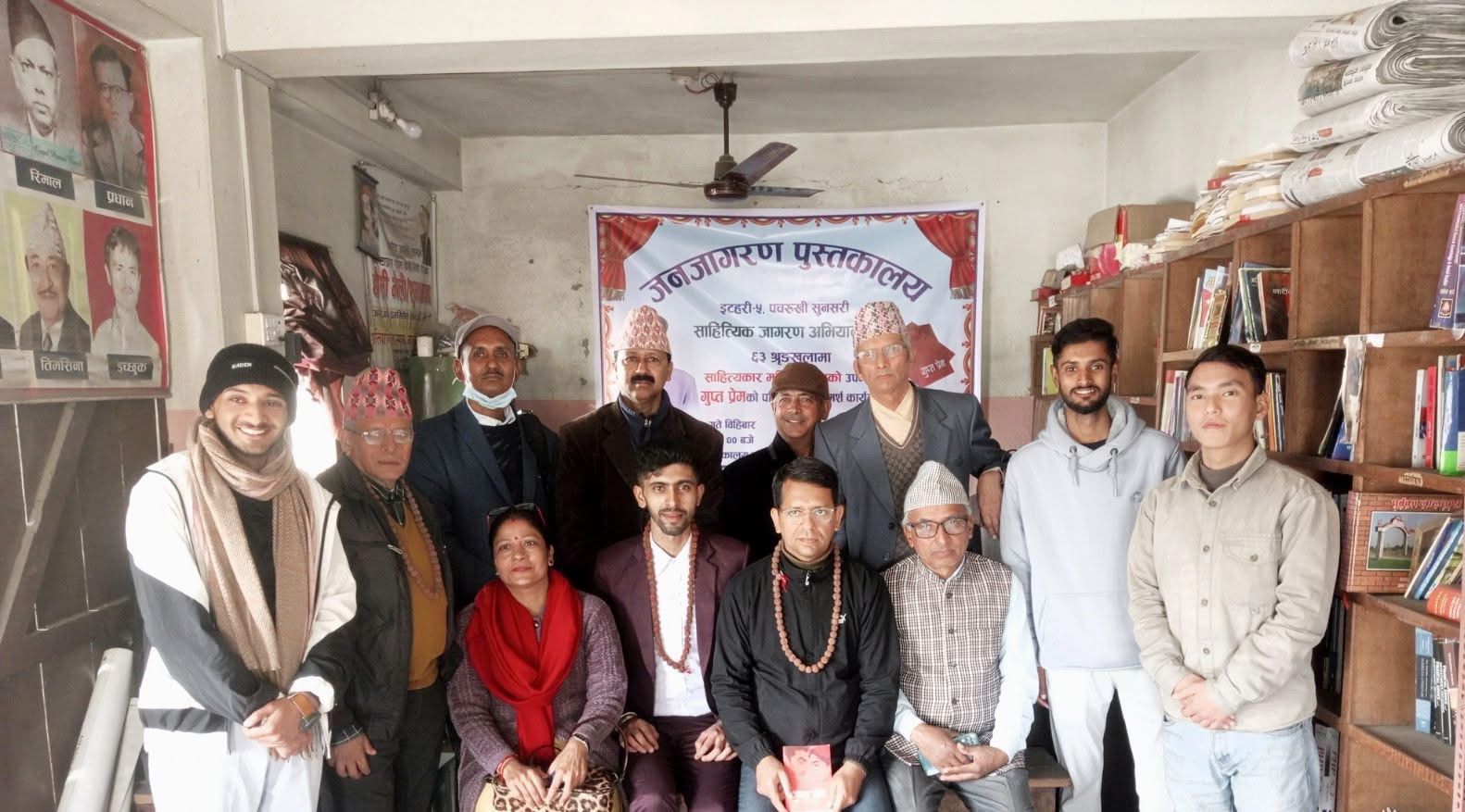
Discussion on Niraula’s “Gupta Prem” held
The 63rd edition of the ‘Literary Awakening Campaign’ of Jagaran Library featured a discussion on the novel ‘Gupta Prem’ by young writer Mani Niraula. The event was chaired by Bhairav Prasad Sapkota, president of the library, with Krishna Adhikari as the chief guest. The program was hosted by poet Kalidas.
Among the distinguished guests were senior journalist and writer Krishna Binod Lamsal, event coordinator Tika Milan, Prales Sunsari President Bimala Pokhrel, and artist Krishna Prasad Nepal, alongside various other literary figures and attendees.
During the discussion, poet and writer Tika Atreya described Gupta Prem as a novel that captures the essence of teenage years and young adulthood, resonating deeply with the youth. Another speaker, writer Ram Prasad Kharel, noted that having a youth-focused literary work from Koshi Province was a significant achievement. He also praised the novel’s suspense-thriller genre, highlighting Neupane’s ability to craft unique narratives.
Artist Krishna Prasad Lamsal entertained the audience with a humorous poetry recitation. Meanwhile, senior journalist Krishna Binod Lamsal emphasized the growing interest of young people in Nepali literature, calling it a positive development for the literary landscape.
Author Niraula shared the challenges he faced in publishing the novel and expressed gratitude for the positive reception his book has received.

Reports of two bills tabled in NA
Reports of two bills have been tabled in today's meeting of the National Assembly.
In the 17th session of the NA, commenced from today, President of Legislative Management Committee, Tulasa Kumari Dahal, presented the Committee's reports on 'Media Council Bill, 2080' and 'Renewable Energy and Energy Efficiency Bill, 2081'.
Presenting the reports, Dahal mentioned that goals of maintaining professional ethics in the journalism sector as well as achieving sustainable development goals from the promotion of renewable energy through these bills have been set.

“Winter session will be productive in terms of enacting laws, addressing issues of public concerns”
House of Representatives (HoR) Speaker Devraj Ghimire has expressed his hope that the fifth session (winter session) of the Federal Parliament that commenced today will be productive in terms of enacting laws and addressing the issues of public concerns.
Welcoming the HoR members to the meeting, the Speaker said that the Parliament carries a significant value in democracy, and disputes, discussions, and dialogues are expected in the Parliament. "But our conclusions should be for finding an agreement. Political parties representing here with people's mandate should not confine themselves to a narrow space but should explore a wider course for the national interests."
The respectful exchanges of logic and opinions by ruling and opposition parties would help make the parliamentary function effective, he said, adding that mutual respect, cooperation, and unity will help find a historic success for formulating policies and laws by ending existing issues in the nation.
"I hope the session will inspire all of us to deliver in the interest of the nation and citizens by going on with good practices of the past," he said.

RSP President Lamichhane meets Speaker Ghimire
Rastriya Swatantra Party (RSP) President and suspended parliamentarian, Rabi Lamichhane, held a meeting with Speaker Devraj Ghimire, over the issue of his suspension.
During the meeting held at the office of the Speaker at Singha Durbar, today, President Lamichhane submitted a petition requesting Speaker Ghimire to lift his suspension from the post of a member of the Parliament.
Deputy Speaker Indira Rana Magar, acting RSP Chair Dol Prasad Aryal, Vice-Chairperson Dr Swarnim Wagle, Chief Whip Santosh Pariyar, among others were also present along with Lamichhane in the meeting.
The Federal Parliament Secretariat had suspended the member of House of Representatives, Lamichhane, from the post on December 23.

Nepal pushes for new air routes with India again
Nepal has raised the issue of new air routes with India yet again.
During a recent meeting with the visiting Ministry of External Affairs Additional Secretary, Munu Mahawar, in Kathmandu, Minister for Foreign Affairs Dr Azu Rana Deuba raised the issue of new air routes that Nepal has been demanding for a long time.
Nepal has been in discussions with India for over a decade regarding new air entry routes. The government has been negotiating with the Indian government to utilize the airspace of Bhairahawa, Mahendranagar, Nepalgunj and Janakpur for air route access. However, Nepal has not yet secured air routes from these locations.
Gyanendra Bhul, the information officer at the Civil Aviation Authority of Nepal (CAAN), said that Nepal has presented all proposals to India regarding new routes. “Nepal has raised the issue of new air routes in all bilateral meetings - from the Prime Minister level to the ministerial level. While Nepal has presented its case, the Indian side has not yet reached a decision,” he added.
Due to India’s inability to provide a conclusive decision on new routes, the government’s plan to bring aircraft into Nepal using the airspace of Bhairahawa, Mahendranagar, Nepalgunj and Janakpur has been stalled.
Nepal had formally requested India to allow air access through Janakpur, Bhairahawa, Nepalgunj and Mahendranagar during Prime Minister Narendra Modi’s visit to Kathmandu in 2014. In May 2023, talks were held in New Delhi between officials from Nepal's Ministry of Culture, Tourism, and Civil Aviation, the Civil Aviation Authority of Nepal, and the Airports Authority of India, but no conclusion was reached.
According to CAAN, if India provides new air entry routes as requested by Nepal, it would save flight costs and time, and also resolve the issue of air traffic congestion. Currently, 90 percent of international flights enter Nepal through Simara, while flights from China enter through the Makalu region in Sankhuwasabha district and flights from Bhutan enter through Mechi. The air routes for exiting Nepal include Simara, Biratnagar, Janakpur, Mahendranagar and Bhairahawa.
Nepal has been facing several challenges such as air traffic congestion, disrupted flight schedules, and the need to hold aircraft in the air for extended periods due to the reliance on a single route. CAAN has been saying that if additional routes are made available, managing air traffic would become easier. If India agrees to at least allow the Bhairahawa and Nepalgunj routes, the distance for flights entering Nepal would be significantly reduced, CAAN officials say.
Currently, aircraft coming to Gautam Buddha International Airport in Bhairahawa from Gulf countries enter the Nepali airspace from Simara and fly westward to Bhairahawa as they are not allowed to enter the country from the west. Experts say new international airports in Bhairahawa and Pokhara will be unfeasible if aircraft are not allowed to enter from the west.

Gold price increases by Rs 2, 300 per tola on Friday
The price of gold has increased by Rs 2, 300 per tola in the domestic market on Friday.
According to the Federation of Nepal Gold and Silver Dealers’ Association, the precious yellow metal is being traded at Rs 162, 800 per tola today. It was traded at Rs 160, 500 per tola on Thursday.
Similarly, the price of silver has increased by Rs 30 and is being traded at Rs 1, 915 per tola today.


