

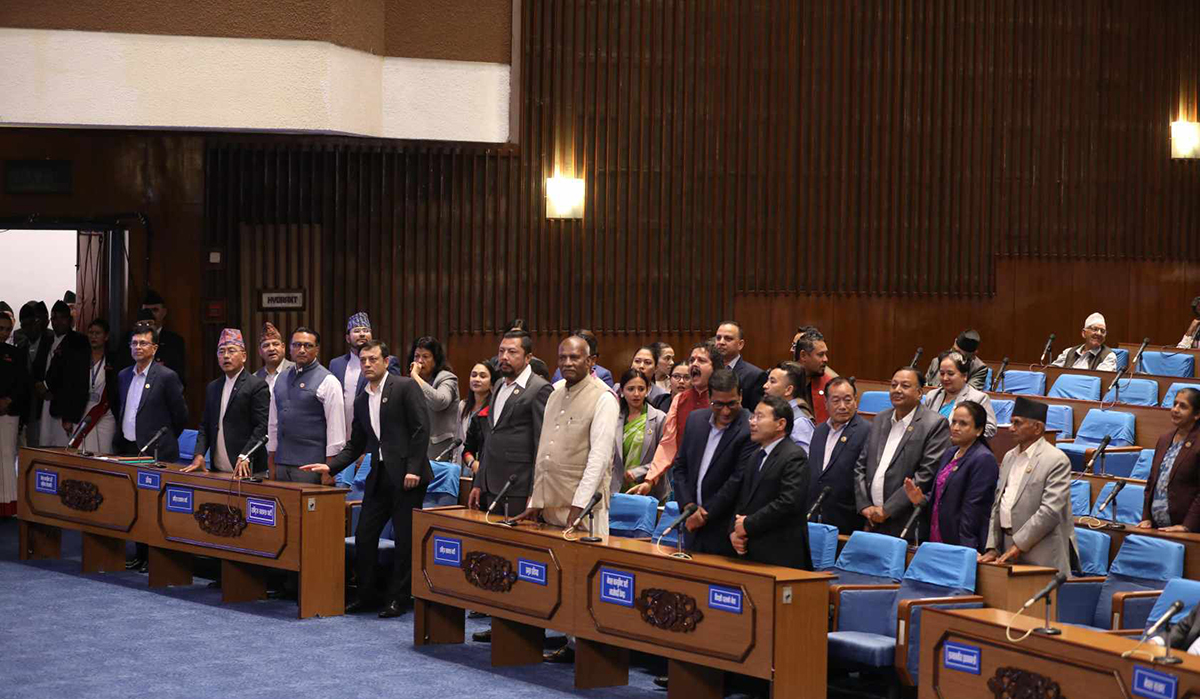
Opposition parties obstruct House meeting, demand resignation of Home Minister Lekhak
Opposition parties on Tuesday obstructed the Parliament meeting demanding resignation of Home Minister Ramesh Lekhak.
Soon after Speaker Devaraj Ghimire commenced today’s session of the House of Representatives, lawmakers from the opposition parties stood up in protest, prompting the Speaker to give time to CPN (Maoist Centre) lawmaker Barshaman Pun to speak.
Lawmaker Pun called attention to the fact that the media have reported this week about corruption in the 'visit visa' process at Tribhuvan International Airport, stating as per the reports ordinary citizens who go abroad for work are being charged between Rs 5 million to 30 million.
The main opposition demanded that an investigation should be conducted into the allegation that the Home Minister himself sent the main accused, Joint Secretary Tirtharaj Bhattarai, at the TIA.
"Since the Home Minister's Secretariat is involved in this and as all the investigating bodies are under the Home Ministry, the Home Minister should resign to facilitate the investigation. He must resign, and the parliamentary proceedings will not be allowed to proceed ahead until the Home Minister resigns," said MP Pun.
Immediately after the commencement of today's meeting, opposition parties including the CPN (Maoist Centre), Rastriya Swatantra Party, and the Rastriya Prajatantra Party (RPP) obstructed the house demanding the resignation of the Home Minister.
After the obstruction, Speaker Ghimire adjourned the meeting for half an hour.
Prior to this, the Speaker had allocated time for the Chief Whip of the Nepali Congress Shyam Ghimire to speak on behalf of the ruling party.
The lawmakers of Rastriya Swatantra Party had chanted slogans to prevent the ruling party lawmaker Ghimire from speaking.
Rastriya Swatantra Party lawmaker Shishir Khanal demanded the formation of a high-level investigation commission to investigate the involvement of Home Minister Lekhak in the 'Visit Visa' scam.
He mentioned that the opposition would not allow the House to go ahead with its proceedings until a high-level investigation commission is formed in connection with the 'organized corruption' in that matter.
"At Tribhuvan International Airport, a racket is being run under the guise of visit visas, looting innocent youths and collecting millions illegally. The joint secretary sent by the Home Minister to the TIA seems to have a controversial background. But why was he sent to TIA immigration? The Home Minister has his own interests," lawmaker Khanal charged.

South Korea bans former top officials from leaving country amid insurrection probe
South Korean police have imposed travel bans on former Prime Minister Han Duck-soo and former Deputy Prime Minister for Economic Affairs Choi Sang-mok as part of an ongoing investigation into alleged insurrection, Xinhua reported.
The two former officials were listed as suspects earlier this month and are being investigated in connection with a failed martial law operation reportedly headed by ousted President Yoon Suk-yeol.
They were summoned for questioning on Monday by a special police investigative team, along with former Interior Minister Lee Sang-min, who has been under a travel ban since December, as reported by Xinhua.

Josh Inglis and Priyansh Arya score fifties as Punjab Kings defeat Mumbai Indians to guarantee Top 2 finish
Josh Inglis and Priyansh Arya scored stereo fifties as Punjab Kings defeat Mumbai Indians by seven wickets to go to the top of the points table and guarantee themselves a top 2 finish. After Arya and Inglis departed late into the match, skipper Shreyas Iyer anchored the innings and dragged PBKS over the line, The Indian Express reported.
Suryakumar Yadav anchored the Mumbai Indians innings yet again with a half century as they posted 184/7 against the Punjab Kings on Monday. Except for SKY, the MI batters couldn’t convert their starts with PBKS bowlers keeping them on a lease. Vijaykumar Vyshak, Arshdeep Singh and Marco Jansen all took 3 wickets apiece to keep MI under 200 runs.
Shreyas Iyer won the toss and said that the Punjab Kings will be bowling first against Mumbai Indians at the Sawai Mansingh Stadium in Jaipur. With Gujarat Titans dropping more points on Sunday, it presented a golden chance to Mumbai or Punjab to finish in the Top 2, according to The Indian Express.

Palestinian flag to fly at WHO after symbolic vote
The World Health Organization approved a motion allowing the Palestinian flag to be flown at its headquarters, following a vote at its annual assembly. The proposal passed with 95 votes in favor, four against, and 27 abstentions.
Brought forward by China, Pakistan, and others, the move is seen as a symbolic step toward broader international recognition of Palestinian statehood, Reuters reported.
Israel rejected the resolution, describing it as a threat to legal standards. The United States, which intends to leave the WHO, did not participate in the vote.
Palestinians presently have observer status at the WHO and were recently granted access to worldwide health alerts under WHO standards, according to Reuters.

Two killed, one injured in Nawalparasi bike accident
Two persons died and another sustained injuries in a motorcycle accident at Amrasa Jungle of Madhyabindu Municipality-7 in Nawalparasi on Tuesday.
Two of the three persons riding the motorbike (Lu 9 Pa 8116) declared dead upon reaching the hospital. They were heading towards Chormara from Amrasaa when the rider lost control of the bike and met with an accident this morning, DSP Yadav Dhakal of the District Police Office, Nawalparasi said.
The deceased have been identified as Nubin Kumal (24) and Radim Midhun (22) of Chormara. Manish Ghartimagar (28) of Madhyabindu-7, Bardaghat Municipality was critically injured in the incident.
Incapacitated in the accident, all of them were rushed to the Madhyabindu Province Hospital but doctors pronounced Kumal Maidhun dead on arrival.
Ghartimagar has been referred to New Medical College, Chitwan for further treatment.

Light rain with thunder, lightning likely today
Impact of westerly and local winds is in effect in the country at present.
There is a partial impact of the wind with water vapor emanating from the Bay of Bengal and the Arabian Sea, according to the Weather Forecasting Division.
The weather service predicted generally cloudy weather in the hilly region of the country while other places will be partly cloudy. Similarly, some parts of the hilly region and one to two places of other areas will have light rainfall coupled with lightning and thunder.
Similarly, high hills and mountainous belts will have light rains and snowfall today.
In the coming night, the hilly belts of the country and Madhes, Gandaki, Karnali and Sudurpaschim Provinces will have partially to generally cloudy weather while rest of the places clear weather.

Economic survey to be presented in Parliament today
The economic survey is being presented at the meeting of the House of Representatives (HoR) today.
Deputy Prime Minister and Finance Minister Bishnu Prasad Paudel is scheduled to present the economic survey for the fiscal year, 2025/26 in the Parliament meeting, according to the Federal Parliament Secretariat.
The HoR is meeting at 11 am.
As per schedule, related ministers will be furnishing responses to the lawmakers' queries relating to culture, tourism and civil aviation; energy and irrigation; and forest and environment.
Minister for Women, Children and Senior Citizens Nawal Kishor Saha Sudi is tabling the bill on child rights (first amendment), 2082.
Minister for Education, Science and Technology Raghuji Panta will be tabling a proposal, seeking consideration on a bill relating to Tilganga Eye University, 2081.
General Secretary at Parliament Secretariat Padma Prasad Pandey shared this information.

Mexico opposes US proposal to tax remittances
Mexican President Claudia Sheinbaum has urged US lawmakers to reject a proposed tax on remittances sent from the United States to Mexico. She cited a 1992 US-Mexico treaty that prohibits double taxation, calling the proposal discriminatory and harmful.
Sheinbaum noted that Mexican migrants, regardless of legal status, contribute greatly to the US economy and already pay taxes. Only around 20 percent of their revenue is paid in remittances, Xinhua reported.
Experts warn that such a tax could drive migrants to use informal channels, fueling black market activity. Mexican lawmakers and advocacy groups are actively campaigning against the measure.


