


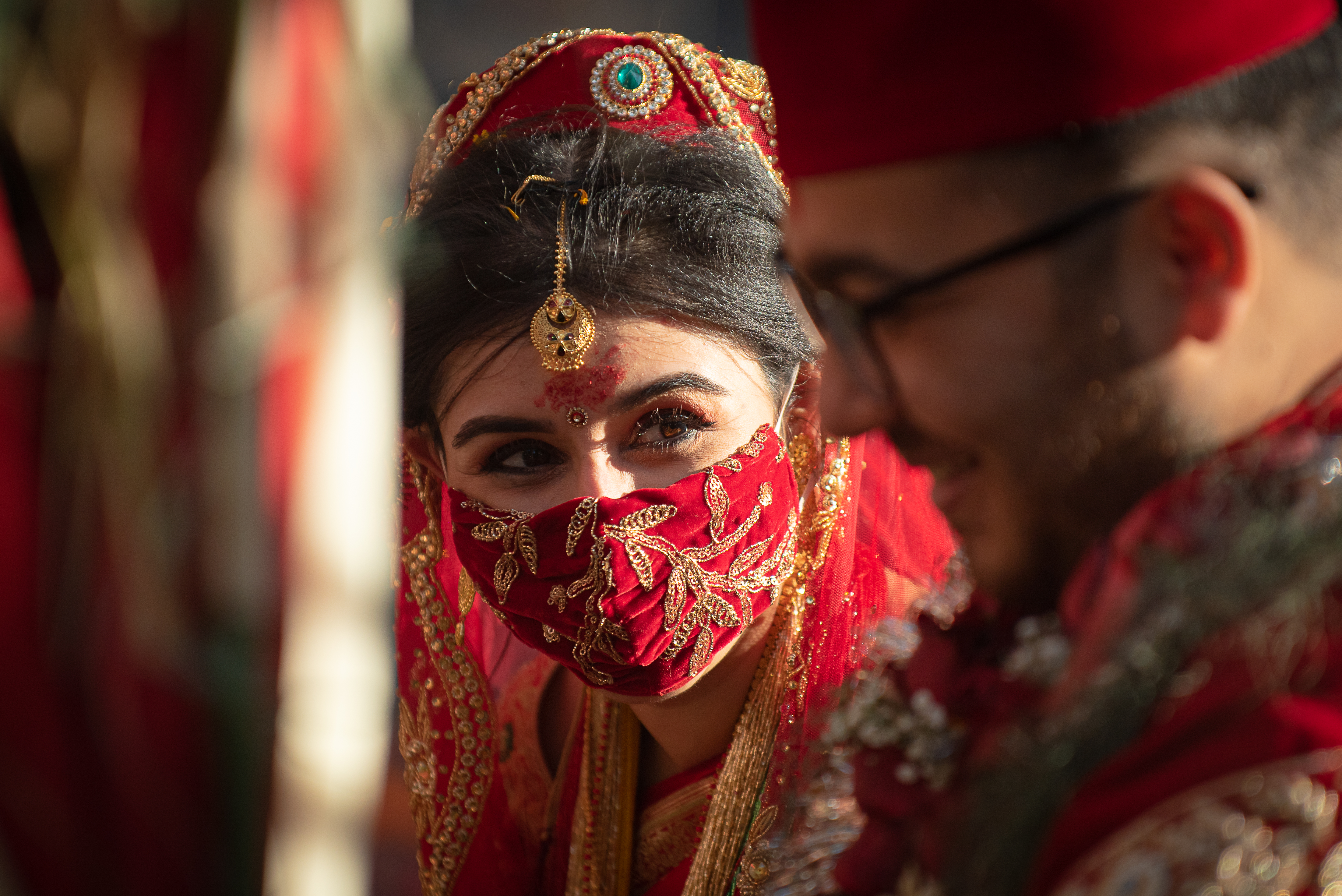
Panorama | Where’s your mask, hubby-to-be?
Where’s your mask, hubby-to-be?: The Nepali month of Baisakh marks the beginning of the wedding season in Nepal. But following the recent Covid-19 surge, the government has issued protocols that cap the number of participants in social or religious ceremonies at 25. Prior CDO approval is also required. In these unprecedented times, ApEx advices its valued readers to follow on the (pictured) bride's footsteps. Wear your mask at all times in public. Stay safe | Photo: Pratik Rayamajhi

Biz Brief | MoneyGram-eSewa Money Transfer partnership
MoneyGram International, Inc., a global leader in cross-border P2P payments and money transfers, this week announced a partnership with F1soft Group’s subsidiary, eSewa Money Transfer Pvt. Ltd. The partnership will enable MoneyGram customers around the globe to send money to family and friends in Nepal directly into the beneficiary’s bank account or eSewa wallet. While the account deposit service has been launched, the service to eSewa wallet is expected to be launched shortly.
With connectivity to more than 65 banks, including all major banks, the account deposit service can deliver funds to bank accounts held with most banks across Nepal. With over 4.2 million registered eSewa wallet users in Nepal, the upcoming service to eSewa wallet will be a huge milestone in Nepal inbound remittances. Nepal is one of the highest recipients of remittances in the world and is estimated to have received 8.25 billion USD in remittances in 2019 as per the World Bank.
Through this partnership, MoneyGram and eSewa Money Transfer are enabling customers to easily transfer money from around the globe, especially from where there are large numbers of Nepali immigrants, such as the United States, South Korea, Australia, countries across Europe and more. With simple receiver details required to send money, this service also ensures a hassle-free experience for remitters and receivers.

Editorial: Corona and confusion
‘Chaotic’ is the word to describe Nepal’s anti-Covid vaccination drive thus far. Take the new confusion of those in the 60-65 age bracket. Earlier phases of vaccination had covered those over 65. When the next age-wise vaccination started, it was said those aged 45-49 would be jabbed. The 60-65 bracket seems to have escaped the minds of those who decide these things—or if there is a valid reason for the omission, most of the elderly folks in this age group have no clue about it. There appears to be as big a confusion over the safety of the Chinese vaccines now being administered.
If the vaccines are safe, the government has not bothered to inform the people and remove their doubts. This in turn has sparked a further speculation: perhaps even those administering the vaccines are unsure. To make things more confusing, it was announced that the 800,000 available doses of the Chinese vaccines would be given to all “essential workers”, without clarifying who fell into the two categories. As we have argued in this space before, if the contagion is to be halted, the government needs to do a far better job of informing and taking people into confidence.
Meanwhile, on April 19, new Covid-19 restrictions were announced. For the next three weeks, congregations with over 25 people have been banned. Schools and colleges have been forced shut. Restaurants will have to shut down by 8 pm. These restrictions had been expected amid the galloping rates of new Covid-19 infections, especially among school- and college-going students. A general lockdown of the kind enforced in 2020, which seemed to do more harm than good, has been wisely avoided.
To make a credible dent in infection rates, implementing a stricter surveillance mechanism on the porous Nepal-India border has to be the first order of business. As in the past, this time too Nepal has imported most Covid-19 infections across land borders with India. And a lot more vaccines need to be brought. What happened to Russian vaccines, one wonders. Wasn’t Russia sending enough of its Sputnik V vaccines to inoculate nearly every Nepali? Why haven’t any of them come? There is not a moment to lose in this fight against a cunning, shapeshifting virus. We certainly can’t afford the kind of chaos that has characterized Nepal’s vaccination drive to this point.

In Focus | The exoticness of Alev
Kathmandu gets a taste of exquisite Middle Eastern cuisine with the newly opened Alev Kebab Sultanate at Naxal. The posh restaurant offers a fancy fine dining experience in its strikingly decorated indoor premises in Tangalwood, which also offers plenty of parking space to save you the hassle of finding a wheel-lock-free place to park.
The menu at Alev consists mostly of Turkish delicacies, with authentic names as well as their English translations to guide you through. Also guiding you will be its well-trained waiting staff, making for a rich Mediterranean hospitality. A bit on the higher side in terms of price, Alev’s food and service experience makes up for it.
Tangalwood, Tangal

Opening hours: 8am to 10pm
Location- Tangalwood, Naxal
Cards- Accepted
Reservation- 01-4427343
Chef’s special:
Karisik Izgara- Mixed grilled platter
Kiymali Pide- Pita bread with minced meat
Karides Sis- Shrimp shish kebab with pineapple
Meal for 2: Rs 3,000

Panorama: Washed up

Washed up: The Tribhuvan International Airport and Boudhanath Stupa seen from Tarebhir, Budhanilkantha after heavy rainfall in the valley on April 10 | Pratik Rayamajhi

Editorial: Ominous 2078
We know it is coming. Yet we seem to have given up even before the dreaded second Covid-19 wave arrives. There is zero trust between the government and the citizens it supposedly represents. The presence of enormous, unmasked crowds at various party venues to bring in 2078 BS, all over the country, suggests people either don’t believe the new Covid-19 contagion is serious enough or they don’t give a damn. Rather than trust an incompetent, lying government, they would take their chances. Rather than stay cooped up in their homes like caged animals—and for what, they might ask after their previous lockdown experiences?—they would live freely to their last breath.
The government response has been blasé. It has shown no commitment to screen the thousands of people who have been streaming into Nepal from India on a daily basis. Since India placed restrictions on its nationals from traveling abroad from Indian territories following the new Covid-19 wave, many of them are making a beeline to Kathmandu in order to fly to third-country destinations. Most of them admit to evading border surveillance mechanisms that would have meant lining up for Covid-19 screening for hours. Similar apathy has characterized government efforts to import vaccines. Not even a tenth of the population has been jabbed till date.
Private school owners meanwhile are reluctant to shut down their institutions, willfully ignoring a clear evidence of spread of a dangerous variant of Covid-19 among young students. Unlike the previous variant that afflicted mostly the elderly, this one hits the youth the hardest. Hospital beds are quickly filling up. A more credible government should have had no problem making the school owners see sense. But as the Oli government battles for its very survival, it has been badly distracted from the growing virus menace, and its credibility is crumbling fast.
There is confusion all around. Even amid a severe shortage of vaccines, those who remain to be vaccinated are already having second thoughts after hearing of severe side-effects of the Oxford-AstraZeneca vaccines. The government has done a very poor job of communicating why getting the vaccine is worth the risk, or if people should really hold back. As it vacillates, people are coming to their own conclusions. The previous year in Bikram Sambat was a forgettable one for Nepal. The omens are ominous for 2078 BS as well.

Breakfast, brunch and dessert
Only this week, a popular newspaper editor posted about Over Easy BnB on his Facebook page. “It’s a hidden gem in Bansbari. Excellent breakfast,” he wrote, alongside a picture of what he called a ‘satiating Saturday morning breakfast.’
This is exactly what we have been hearing about Over Easy at Bansbari. The quiet little place nestled between suburban houses on the way to Dhapashi from Bansbari road has had people raving about its breakfasts, brunches and desserts, not to mention its peaceful outdoor seating,
Not that Over Easy only serves breakfasts and brunches though. It is open for late lunches, dinners and drinks as well as live music on the weekends. A jazz duo called Nanashi is performing this April 9, which would be the perfect time for you try out the place if you haven’t already.
Over Easy, Bansbari
Chef’s Special:
Mountain madness,
Buddha Bowl,
Opening time 7:30am - 10:00pm
Cards: Accepted
Reservation: 9841587695
Meal for two: Rs 1,500

Tika Bahadur Shrestha: The man behind Beni ko bazara
Birth: 26 April 1945, Myagdi
Death: 25 March 2021, Butwal
His biggest claim to fame came on Democracy Day 1963, in the company of then royals and other high-ranking government officials. The song he sang that day at the Rastriya Nach Ghar during in what was an inter-zonal competition had beat the entries of 13 other zones.
Tika Bahadur Shrestha’s ‘Beni ko bazara, jata maya tetai cha najar’ became an overnight sensation. In 1974, in the process of collecting and singing folk songs, he recorded the famous track with Mana Chhantyal, at Record Nepal. Soon, the two developed an unbeatable chemistry. Shrestha would go on to marry Chhantyal as his second wife in 1978, eight years after his first marriage. (It was common practice at the time to take a second wife even with the first marriage still intact.)
The song helped establishing Beni, now a municipality, as a town of lovebirds. Moreover, this evergreen song has been able to create a loyal fan-base even among the youths.
An all-round instrumentalist, Shrestha loved collecting and recording songs but for the past one decade, he had been completely out of the music industry, and inclined more and more towards social work. Separately, Shrestha was also the first person to establish a boarding school in Butwal.
Shrestha, 75, a long-time kidney patient, had spent over half a century with his first wife, before her death in late 2020. He leaves behind a spouse, two sons and two daughters.
Taking to ApEx, Premdev Giri, a senior folk song collector and composer from Pokhara, said Nepal had lost an irreplaceable pillar of folk music.


