Tourism in Nepal returning to normalcy

Tourism - one of the sources of Nepal's economy - is gradually limping back to normalcy after being battered by the COVID-19 pandemic for nearly two years.

This spring season witnessed a considerable number of foreign tourists arriving in Nepal with a total of 42,006 tourists coming via air route in March alone.

Last year, 14,977 foreign tourists had visited Nepal during the same period. According to statistics of the Department of Tourism, Nepal has received a total of 78,747 foreign tourists from January to March end this year.

The government has formed a Tourism Revival Steering Committee under the chairmanship of the Minister for Tourism, Culture and Civil Aviation, which is tasked with taking initiatives to revive the tourism industry by exploring new possibilities, identifying and promoting tourism industry and creating enabling investment climate in the tourism sector, among others.

The Nepal Tourism Board has been organising Travel Mart in all the seven provinces.

Fewa Festival is going to be held on April 13 and 14. A team of foreign chefs led by MasterChef UK contest winner Santosh Shah will reach various destinations for 10 days and participate in tourism promotional events with special focus on culinary tourism.

Mahesh Phuyal, general-manager of Ramada Encore, a 4-star hotel in Thamel, Kathmandu, said the hotel had 70 per cent occupancy lately.

"The hotel comprising 90-rooms mostly has American, Indian and European tourists," he shared.

The inflow of foreign tourists has enthused tourism entrepreneurs in Pokhara, one of the popular tourist destinations in the country.

Bharatra Parajuli, a local entrepreneur, said tourism entrepreneurs like him were upbeat due to the increasing number of tourism activities in Pokhara. He said development and promotion of adventure tourism destinations in and around Pokhara, famed for lakes and natural landscapes, had helped boost the country's tourism.

Similarly, Hotel Association of Nepal's Acting President Binayak Shah shared that the hotels in Pokhara were receiving so many inquiries lately. He opined that tourism had been gradually reviving in Nepal after two years of pandemic-induced crisis.

Likewise, Trekking Agencies' Association of Nepal former vice-president Nilhari Bastola has suggested that the government of Nepal spread the message that Nepal is ready and open to tourists, to revive tourism in Nepal. According to him, this can be done through foreign ambassadors and consuls stationed in Nepal.

He further recommended that the government devise attractive packages such as free visa for a month, among others, to bolster the influx of foreign tourists.

NTB's CEO Dr Dhananjay Regmi informed that the number of tourists from India and Bangladesh had increased significantly as the Board had conducted targeted promotional events in these countries.

Echoing Shah, Regmi said tourism in Nepal, which was plagued by COVID-19 was slowly coming back into normalcy.

He stressed the need to facilitate Indian tourists arriving Nepal by roadways through various border points. RSS

Biska Jatra begins in Bhaktapur

The historically famous and important Biska Jatra of Bhaktapur has begun from today.

The Biska Jatra, which begins with the arrival of the New Year, begins this evening by pulling the chariot of Nakinju Azima to Ghatkha from the front of the Panchatle temple in Tamari and pulling the chariot of Bhairavnath.

The Jatra is celebrated with much fanfare for eight nights and nine days.

Before pulling the chariot, Bhairavnath is worshipped and the pilgrims pull the chariot with the help of ropes attached to the front and take it to their respective tole. The main attraction of the procession is pulling the chariot, which is also done in a competitive manner among the toles or settlement blocks.

There is a religious belief that watching the Biska Jatra destroys the enemy, so this Jatra is also called Shatruhanta Jatra.

On the last day of the procession, Bhairavnath’s chariot is pulled from Gahiti as it was on the first day by the residents of Thane and Kwane Tole.

Meanwhile, Chief District Officer Rudra Devi Sharma said that a strategy has been prepared after holding discussions with the stakeholders to complete the Jatra in a dignified and timely manner.

Metropolitan Police Chief Shiva Kumar Shrestha informed that 950 Nepal Police and 400 Armed Police personnel will be mobilized for the Jatra. The CCTV cameras have been installed at the crossroads to identify the rioters during the Jatra. RSS

Bangalore defeat Mumbai by 7 wickets

Royal Challengers Bangalore defeated Mumbai Indians by seven wickets in an IPL match here on Saturday, The Indian Expresa reported.

Invited to bat, Rohit Sharma (26) and Ishan Kishan (26) added 50 runs off 38 balls but MI suffered a collapse to slump to 62 for 5. However, Suryakumar Yadav (68) hit a rearguard unbeaten fifty to lift MI to a respectable 151 for six.

In reply, RCB chased down the target, scoring 152 for 3 in 18.3 overs, riding on a half-century from Anuj Rawat (66) and Virat Kohli (48 not out), according to The Indian Express.

Thousands in Sri Lanka insist Rajapaksa family quit politics

Sri Lankans are continuing to demand President Gotabaya Rajapaksa’s resignation, with thousands rallying in the capital, Colombo, saying neither he nor members of his family could be trusted to steer the country out of its deepening economic crisis, Aljazeera reported.

At the Galle Face Green on Colombo’s waterfront on Saturday, students, teachers, lawyers, actors and architects – many of whom said they were protesting for the first time – chanted “madman Gota” and “Go home Gota”, in a reference to the president’s nickname, as they gathered under a blistering sun.

They waved the Sri Lankan flag and held up hand-written placards in Sinhalese and English that carried messages such as “No more corrupted politicians” and “Save Sri Lanka from the Rajapaksa family”.

“This is a do-or-die moment,” said 29-year-old Buddhi Karunatne, who works in advertising.

“For the first time, people of all kinds of political and social beliefs are coming together, with non-negotiable demands for the president to resign and hand over power to people who are capable of getting us out of this socioeconomic crisis.”

The display of anger marked a stunning reversal for Rajapaksa, 72, who won the presidency in 2019 by a big margin and whose party went on to secure a two-thirds majority in the parliament less than a year later. Those victories allowed Rajapaksa to appointhis brother Mahinda Rajapaksa as prime minister and amend the constitution to strengthen the president’s powers, according to Aljazeera.

He also went on to hand three other Rajapaksa family members key positions in his cabinet, including the finance, agriculture and sports portfolios.

At the time, many voters said they believed Gotabaya and Mahinda Rajapaksa would boost security and stabilise the country following a spate of ISIL-inspired bombings that killed at least 250 people in 2019. That is partly because the brothers had overseen the military defeat of Tamil separatists in 2009 after 26 years of bloody conflict. Mahinda was then president and Gotabaya, his younger brother, the defence secretary, Aljazeera reported.

But instead of improving things, the Rajapaksas “have proved incompetent and incapable of taking the right decisions”, said one protester at Saturday’s rally. “Gota simply can’t run a country,” said another. “He doesn’t have a brain to deal with this kind of crisis.”

Shanghai hospital pays the price for China’s COVID response

A series of deaths at a hospital for elderly patients in Shanghai is underscoring the dangerous consequences of China’s stubborn pursuit of a zero-COVID approach amid an escalating outbreak in the city of 26 million people, Associated Press reported.

Multiple patients have died at the Shanghai Donghai Elderly Care hospital, relatives of patients told The Associated Press. They say their loved ones weren’t properly cared for after caretakers who came into contact with the virus were taken away to be quarantined, in adherence to the strict pandemic regulations, depleting the hospital of staff.

Family members have taken to social media to plea for help and answers and are demanding to see surveillance video from inside the facility after getting little to no information from the hospital. 

The conditions and deaths at the hospital are a sharp rebuke of China’s strategy of sticking to a zero-COVID policy as it deals with the outbreak in Shanghai in which most of the infected people don’t have symptoms. With a focus on forcing positive cases and close contacts into designated collective quarantine facilities, the costs of zero-COVID may be outweighing the risk of getting sick, according to the Associated Press.

On Saturday, Shanghai Vice Mayor Zong Ming said the lockdown could soon be lifted or eased in communities that report no positive cases within 14 days, after another round of citywide COVID-19 testing. 

Shen Peiming, 71, was one such casualty of harsh measures. She died Sunday morning at the hospital, without any relatives by her side. A family member said they have been calling the hospital non-stop to find out the circumstances of Shen’s death, but have not gotten a clear answer. “How many times have there been lockdowns since 2020? They still don’t have experience managing this?” the family member said.

All they know is her doctor and nurses had not been there to care for Shen, who was partially paralyzed after a stroke. Her last nursing assistant had been quarantined for being a close contact of a positive case, the relative said, speaking on condition of anonymity out of fear of retribution. An unfamiliar worker called to inform them of her death. Later, the hospital said it was due to a chest infection.

The hospital had a COVID-19 outbreak, the family heard from orderlies, but Shen had tested negative as of last week.

Shanghai authorities have reported no deaths from this outbreak, but questions have been raised about the reliability of the data. A city health official, speaking on condition of anonymity because of the sensitivity of the topic, said that the criteria for confirming cases and deaths are very strict and susceptible to political meddling, Associated Press reported.

It is unclear how many patients have died at the hospital, and whether any died of COVID-19. Families say they are talking with other families whose relatives have also died. An article from Chinese news outlet Caixin describing the deaths and infections was taken down shortly after it was published, apparently targeted by censors. Calls to the main office of Donghai Elderly Care went unanswered. The Shanghai government did not respond to a faxed request for comment.

Most experts agree that China’s zero-COVID approach was highly successful in keeping deaths to a minimum when there were limited drugs or vaccines. But now that shots are widely available in China, and with the advent of the omicron variant, many say the government should abandon the policy and focus medical resources on the elderly and vulnerable instead.

Instead, Shanghai has locked down its 26 million people and carried out repeated mass testing to tackle an outbreak driven by the highly contagious omicron BA.2 variant. On Saturday, the city reported more than 23,000 new local cases, of which only 1,015 had symptoms.

“If you’re asymptomatic, what’s going to hurt you?” said Ray Yip, the founding director of the US Centers for Disease Control office in China, who maintains close ties with Chinese health officials. “The only people who get sick are those with diabetes, obesity, chronic disease, old people. Protect those people. You can protect them.”

A low vaccination rate among the elderly, though, remains a concern. Only 62% of Shanghai residents over 60 have been vaccinated, according to the latest data available. Some experts support the strict approach, saying China needs to raise that rate before it can safely live with the virus, according to the Associated Press.

The US guidelines for asymptomatic cases, as in the UK, are that individuals isolate at home for five days. In Shanghai, workers are rushing to set up massive temporary facilities in exhibition halls and elsewhere to try to house everyone who tests positive.

The citywide lockdown has disrupted daily life and the economy. Many residents, trapped in their apartment buildings, are scrambling to buy food through apps and place bulk orders with neighbors. Some in quarantine have posted videos showing chaotic scenes of people rushing to get food and a lack of clean toilets. Others have posted pleas for relatives who need medicine urgently. 

The US said Friday that it is allowing the voluntary departure of non-essential personnel and family members from its consulate in Shanghai because of the situation, Associated Press reported.


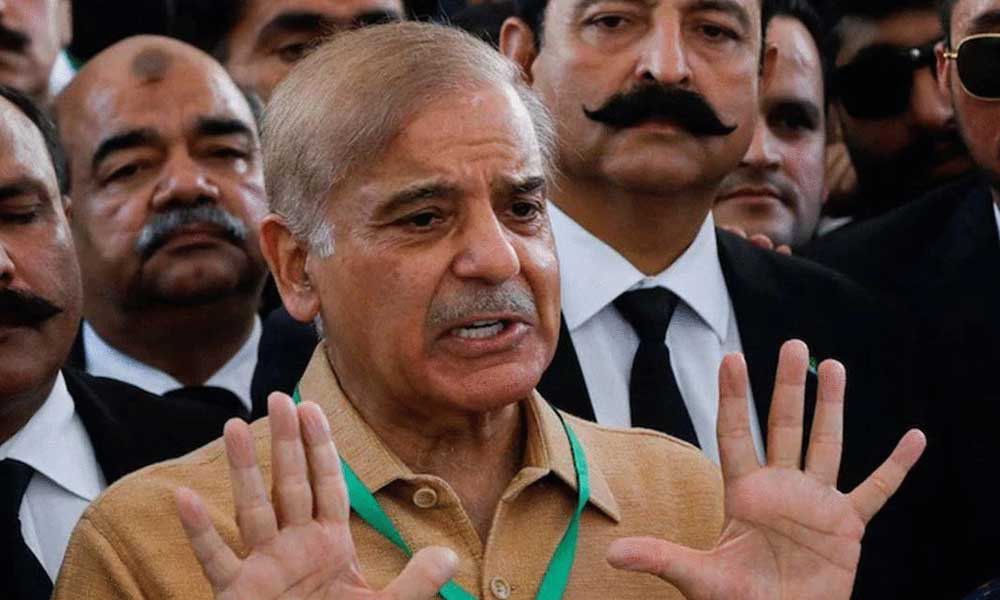
Pakistan’s embattled PM ousted in no-confidence vote

Pakistan’s political opposition ousted the country’s embattled prime minister in a no-confidence vote early Sunday, which they won after several of Imran Khan’s allies and a key coalition party deserted him, Associated Press reported.

The combined opposition that spans the political spectrum from the left to the radically religious will form the new government, with the head of one of the largest parties, the Pakistani Muslim League, taking over as prime minister.

Anticipating his loss, Khan, who charged the opposition colluded with the United States to unseat him, has called on his supporters to stage rallies nationwide on Sunday. Khan’s options are limited and should he see a big turnout in his support, he may try to keep the momentum of street protests as a way to pressure Parliament to hold early elections.

Khan earlier had tried to sidestep the vote by dissolving Parliament and calling early elections but a Supreme Court ruling ordered the vote to go ahead.

The vote comes amid cooling relations between Khan and a powerful military who many of his political opponents allege helped him come to power in general elections in 2018. The military has directly ruled Pakistan for more than half of its 75 years and wields considerable power over civilian governments, who worry a disgruntled army could unseat them.

The opposition called for Khan’s ouster charging economic mismanagement as inflation soars and the Pakistani rupee plummets in value. The vote caps months of political turmoil and a constitutional crisis that required the Supreme Court to sort out, according to the Associated Press.

In an impassioned speech Friday, Khan doubled down on his accusations that his opponents colluded with the United States to unseat him over his foreign policy choices, which often seemed to favor China and Russia and defied the US. 

Khan said Washington opposed his Feb. 24 meeting with Russian President Vladimir Putin in the Kremlin hours after tanks rolled into Ukraine, launching a devastating war in the heart of Europe.

Ahead of the vote, his lawmakers addressed Parliament to express outrage about a letter Khan said told of a senior US official, who was not named, who informed top Pakistani diplomats that Washington’s relations with Pakistan would improve if Khan was ousted. Human rights minister Shireen Mazari said the memo named Khan and said that if he was out of power “all would be forgiven.”

She went on to ask: “Forgiven for what? What is our sin?”

The US State Department has denied any involvement in Pakistan’s internal politics. Deputy State Department spokeswoman Jalina Porter told reporters on Friday there was “absolutely no truth to these allegations.”

Still, Khan urged his supporters to take to the streets, particularly the youth who have been the backbone of his support since the former cricket star turned conservative Islamist politician came to power in 2018. He said they needed to protect Pakistan’s sovereignty and oppose US dictations, Associated Press reported.

Zelenskyy: Russian aggression not limited to Ukraine alone

Ukrainian President Volodymyr Zelenskyy said late Saturday that democratic countries are united in working to stop the Russian invasion as civilians continued to flee eastern parts of the country before an expected onslaught and firefighters searched for survivors in a northern town no longer occupied by Russian forces, Associated Press reported.

In his daily late-night video address to Ukrainians, Zelenskyy said that “Russian aggression was not intended to be limited to Ukraine alone” and the “entire European project is a target for Russia.”

Several European leaders have made efforts to show solidarity with the battle-scarred nation. Zelenskyy thanked the leaders of Britain and Austria for their visits Saturday to Kyiv, Ukraine’s capital, and pledges of further support. He also thanked the European Commission president and Canada’s prime minister for a global fundraising event that brought in more than 10 billion euros ($11 billion) for Ukrainians who have fled their homes.

Zelenskyy repeated his call for a complete embargo on Russian oil and gas, which he called the sources of Russia’s “self-confidence and impunity.”

“Freedom does not have time to wait,” Zelenskyy said. “When tyranny begins its aggression against everything that keeps the peace in Europe, action must be taken immediately.”

More than six weeks after the invasion began, Russia has pulled its troops from the northern part of the country, around Kyiv, and refocused on the Donbas region in the east. Western military analysts said an arc of territory in eastern Ukraine was under Russian control, from Kharkiv — Ukraine’s second-largest city — in the north to Kherson in the south, according to the Associated Press.

But counterattacks are threatening Russian control of Kherson, according to the Western assessments, and Ukrainian forces are repelling Russian assaults elsewhere in the Donbas, a largely Russian-speaking and industrial region.

Civilians were evacuating eastern Ukrainefollowing a missile strike Friday that killed at least 52 people and wounded more than 100 at a train station where thousands clamored to leave.

Ukrainian authorities have called on civilians to get out ahead of an imminent, stepped-up offensive by Russian forces in the east. With trains not running out of Kramatorsk on Saturday, panicked residents boarded buses or looked for other ways to leave, fearing the kind of unrelenting assaults and occupations by Russian invaders that brought food shortages, demolished buildings and death to other cities.

“It was terrifying. The horror, the horror,” one resident told British broadcaster Sky, recalling Friday’s attack on the train station. “Heaven forbid, to live through this again. No, I don’t want to.”

Ukraine’s state railway company said residents of Kramatorsk and other parts of the Donbas could flee through other train stations. Deputy Prime Minister Iryna Vereshchuk said 10 evacuation corridors were planned for Saturday, Associated Press reported.

Zelenskyy called the train station attack the latest example of war crimes by Russian forces and said it should motivate the West to do more to help his country defend itself.

Russia denied responsibility and accused Ukraine’s military of firing on the station to turn blame for civilian casualties on Moscow. A Russian Defense Ministry spokesman detailed the missile’s trajectory and Ukrainian troop positions to bolster the argument, according to the Associated Press.


Sri Lanka doubles interest rates to tame inflation; stabilise economy

Sri Lanka's central bank doubled its key interest rates on Friday, raising each by an unprecedented 700 basis points to tame inflation that has soared due to crippling shortages of basic goods driven by a devastating economic crisis, Reuters reported.

The heavily indebted country has little money left to pay for imports, meaning fuel, power, food and, increasingly, medicines are in short supply.

Street protests have been held nearly non-stop for more than a month, despite a five-day state of emergency and a two-day curfew.

The Central Bank of Sri Lanka's (CBSL) monetary board raised its standing lending facility to 14.50% and its standing deposit facility to 13.50%.

The build-up of aggregate demand, domestic supply disruptions, the plunge of the local currency and high prices of commodities globally could keep up the pressure on inflation, CBSL said in its monetary policy decision statement.

"The rate hike will give a strong signal to investors and markets that we are coming out of this as soon as possible," governor P. Nandalal Weerasinghe said at a post-policy decision briefing, according to Reuters.

INDEPENDENT CENTRAL BANK

Weerasinghe said that he wanted to run the central bank independently without any external influence and that he had been given the authority to do so by the president and has been asked to expedite measures to get the country out of the current crisis.

"I want to be very clear that my message is not one of blind positivity. Things are challenging and we need to take decisive action. Things will get worse before they get better, but we need to apply the breaks to this vehicle before it crashes," he added.

Inflation hit 18.7% in March.

An analyst had expected hikes of up to 400 basis points, Reuters reported.

"With the monetary policy tightening now finally clear, the stage is set to take the next vital steps with regards to IMF and debt restructuring and clearly communicate this to the international stage," said Thilina Panduwawala, head of economic research at Frontier Research.

Finance Minister Ali Sabry said earlier that the country must urgently restructure its debt and seek external financial help, while the main opposition threatened a no-confidence motion in the government and business leaders warned exports could plummet.

"We cannot step away from repaying debt because the consequences are terrifying. There is no alternative, we must restructure our debt," Sabry told parliament.

J.P. Morgan analysts estimate that Sri Lanka's gross debt servicing costs will amount to $7 billion this year, with a $1 billion repayment due in July, according to Reuters.

"We have to go for a debt moratorium," said Sabry, who offered to quit a day after he was appointed on Monday but later confirmed that he was still finance minister.

"We have to suspend debt repayment for some time and get bilateral and multilateral support to manage our balance of payments."