


Climate change: No ‘credible pathway’ to 1.5C limit, UNEP warns
There’s “no credible pathway to 1.5C in place” today, the UN Environment Programme (UNEP) insisted in a new report, despite legally binding promises made at the 2015 Paris Climate Conference to prevent average temperatures rising by more than 1.5C above pre-industrial levels.
Uncomfortable truth
“This report tells us in cold scientific terms what nature has been telling us all year, through deadly floods, storms and raging fires: we have to stop filling our atmosphere with greenhouse gases, and stop doing it fast,” said Inger Andersen, Executive Director of UNEP. “We had our chance to make incremental changes, but that time is over. Only a root-and-branch transformation of our economies and societies can save us from accelerating climate disaster.” Despite Nationally Determined Contributions (NDC) promises made by governments in favour of reducing their carbon footprint, pledges made since the last climate summit in Glasgow in 2021 will lead to cuts of less than one per cent of projected 2030 greenhouse gas emissions, according to UNEP.Paltry reductions
This is the equivalent of just 0.5 gigatonnes of CO2, UNEP calculated, adding that only a 45 per cent emissions reduction will limit global warming to 1.5C. As it stands today, latest data indicates that the world is on track for a temperature rise of between 2.4C and 2.6C by the end of this century. “In the best-case scenario, full implementation of unconditional NDCs and additional net-zero emissions commitments point to only a 1.8C increase, so there is hope. However, this scenario is not currently credible based on the discrepancy between current emissions, short-term NDC targets and long-term net-zero targets,” UNEP said.Fossil fuel-free solution
For the situation to improve, a “large-scale, rapid” and fossil fuel-free shake-up is needed of our “electricity supply, industry, transport and buildings sectors, and the food and financial systems” to cut emissions by 45 per cent to limit global warming to 1.5C, and by 30 per cent to keep average temperature rise to 2C, the UN agency explained. And although the transformation towards net-zero greenhouse gas emissions is underway in electricity supply, industry, transportation and buildings, it needs to move “much faster”, the report concludes.Food system reform
Rapid and lasting emissions cuts are needed in food production industries too, as this accounts for about a third of greenhouse gases, UNEP continued. It noted that action in four areas - protection of natural ecosystems, dietary changes, improvements in farm food production and decarbonization of food supply chains – would reduce food system emissions by 2050 to around a third of current levels.
Three die in assorted road accidents in Sunsari
Three people died in separate road accidents in Sunsari Thursday night. The deceased have been identified as Tej Narayan Sah (45) of Itahari-17, Geevan Raut (27) of Barahchhetra-8 and Gulab Mehata (35) of Supaul Banauli Panchayat, India. Sah died when a motorcycle (Pradesh 1-02-043 P 9087) heading towards east from west hit a cart at Pakali of Itahari-17 along the East-West highway. Bike Bikram Khadka (45) of Belbari-8, Morang was injured in the accident and he is being treated at the Biratnagar-based Neuro Hospital. Similarly, Raut, who was severely injured when an unidentified motorbike hit his bicycle along the Duahabi-Inaruwa road section in Inaruwa-5, breathed his last in the course of treatment at the District Hospital, Inaruwa. Police said that they are searching for the motorcycle. Likewise, Mehata, who was critically injured when a car (Ga 3 Cha 5576) hit a bicycle at Bhokraha Narsingh Rural Municipality-4, died while undergoing treatment at the District Hospital Inaruwa, DSP Raj Kumar Rai said. Police said that they have impounded the car and arrested its driver for investigation.

Prof Rahul Mukherji: Declining trend of democracy in India is not good for the region
Prof Rahul Mukherji is associated with South Asia Institute of Heidelberg University, Germany. He teaches and conducts research in the area of comparative and South Asian politics and international relations. His current research involves democratic backsliding, politics of welfare and India’s emergence in the global order. In September, Mukherji visited Nepal to share his view on the status of democracy in South Asia. Kamal Dev Bhattarai of ApEx talked to him about the latest trend of democracy in South Asia and Nepal. What is your view on the current state of democracy in South Asia? The status of democracy in South Asia is quite precarious in many respects. India’s situation in 2016 and 2021 is comparatively worse than Poland and Hungary, the two countries that the world is talking about because their democracies are falling short of expectations. Sri Lanka and India are very close to each other, but India has been ranked worse than Sri Lanka in the V-Dem report. The global report shows that India’s democracy is declining in this period. Pakistan’s status of democracy is even worse and Bangladesh seems to be backsliding even more. So, this is a sort of negative side of the story. The positive story is that Nepal and Bhutan are consolidating their democracy. In many ways, it is difficult to make a comparison between Nepal and India. In terms of democracy, Nepal has a positive trajectory, while India has a somewhat negative trajectory. India’s trajectory in the South Asian region is very important because other countries in this region look at India’s democracy. India’s democracy is important not only for India itself but also for the entire region. If India’s democracy declines, it will not be good for Nepal. How does India’s backsliding democracy affect the region? It will certainly have a huge impact for the countries in this region. For example, In Bangladesh, the Awami League government, considered to be more secular, could find it difficult to sustain itself if Hindu nationalism in India is pursued in a certain way. If there are leaders with an autocratic bent in Nepal, Sri Lanka, or any other country in the region, they will draw inspiration from India, and there are already some indications of it. What is the role of civil society in protecting democracy in South Asia? Civil society organizations in South Asia are becoming weak and that is partly because the state is not letting them grow. Civil Society needs the state. Several legislations introduced by India over the past few years have led to cutting off of foreign lending to non-governmental organizations. The Prevention of Money-Laundering Act has been used to attack both opposition politicians and non-governmental organizations. Likewise, the Unlawful Activities (Prevention) Act has been used to catch many people from civil society and some of them are in prison. These are only but a few of the facets that I have been discussing now. In Bangladesh, the situation is even worse than India. Civil society organizations there are harshly dealt with, which is why the V-Dem ranking of Bangladesh is very low than that of India and Sri Lanka. Civil society is not certainly dead because we have seen farmers’ protests, which led the Indian government to repeal the controversial farm laws. In Sri Lanka, too, the civil society movement led to the ouster of the Rajapaksa family. I guess Nepal must be in a better position, as it has a lot of civil society organizations. Despite some problems, civil society is more alive in Nepal. In India, too, civil society is active, but it is becoming more and more difficult for it to sustain because the state is trying to restrain them, which is not good for democracy. How do you observe the state of democracy in Nepal? Nepali democracy is currently in the transitional phase. It seems that Nepal is trying to consolidate its democracy. It took a long time to promulgate the constitution. Before that I was wondering whether the Nepali politicians were actually interested in the constitution. When the constitution was finally endorsed, many people hailed it for its many good features. But only having a good constitution is not enough. Nepal is sandwiched between India and China. Along with a good constitution, Nepal needs strong political parties, which carry a certain agenda. Now it seems that power is the main goal for every political party of Nepal rather than a real agenda. No matter what your ideology, you can come together for a coalition to ascend to power. If power becomes the goal, then it does not matter how good a constitution you have. Consequently, the people of the country will be the ones who will suffer. How optimistic are you about the future of democracy in South Asia? The future of democracy in South Asia will certainly depend on countries like India, Nepal and Bhutan. India, because it led the way for democracy in the region. When India became a democracy in 1947, no recognized global scholars thought that the country could consolidate as a democracy. Because modernization theory and a lot of statistics suggest democracy comes only after a certain level of per capita income is secured. At that time, India was very poor, it hardly had a middle class. But there was democracy nonetheless. In many ways, India challenged the world sustaining its democracy. India had a coalition government after 1980 and people thought that there was a need for a strong politician. And today, they have such a strong leader that democracy itself is getting a challenge. In many ways, India is going to become an important country in the region. If it is able to secure its democracy, it will have a good impact on other South Asian countries. If not, it is going to become difficult for the region. Meanwhile, the trajectory of democracy in Nepal and Bhutan are reasons to be hopeful. I hope democratic Nepal and Bhutan will not follow India. Some countries are consolidating democracy on their own but if India does not do so, it will have a negative impact in the region. I am still hopeful that India’s democracy will rise.
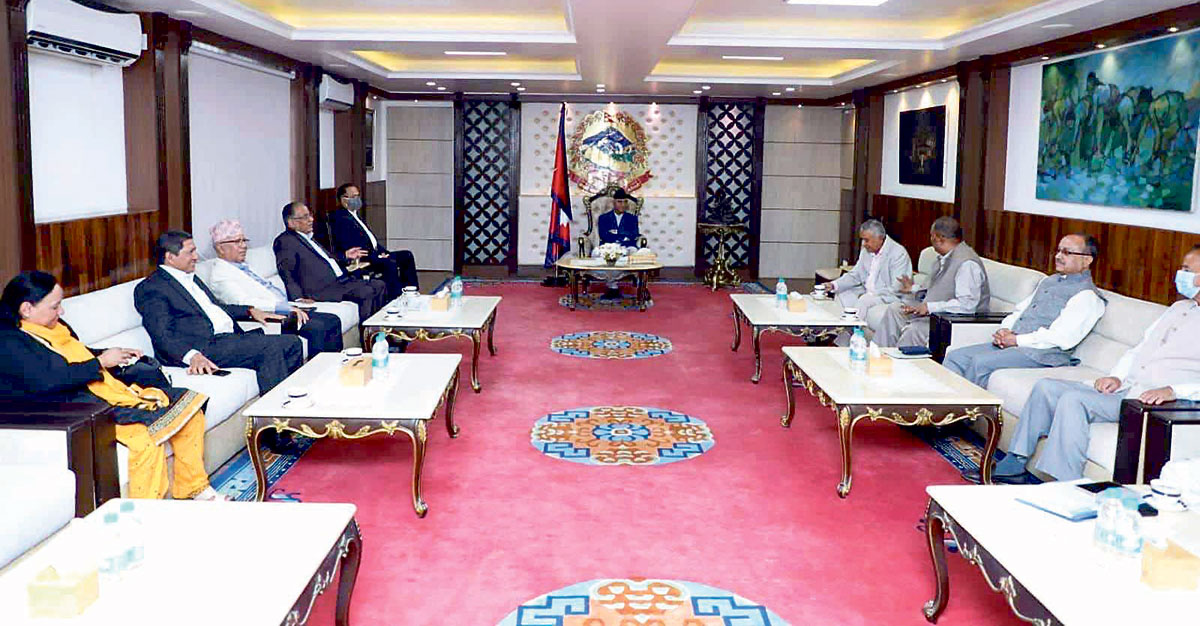
Ruling coalition appeals to all voters to make its candidates victorious in upcoming polls
The ruling coalition has appealed to all the voters to make the candidates of the ruling parties victorious in the elections of the House of Representatives and Province Assembly slated for November 20. Issuing a statement on Friday, the alliance has expressed its commitment to resolve the problems seen in some places through discussions. The coalition said that it has also made public the final list of the common candidates of alliance. Meanwhile, there will be friendly competition among the coalition partners' candidates in some places, the statement read. The statement was signed by Prime Minister and Nepali Congress President Sher Bahadur Deuba, CPN (Maoist Center) Chairman Pushpa Kamal Dahal, CPN (Unified Socialist) Chairman Madhav Kumar Nepal and Rastraiya Janamorcha Party Chairman Chitra Bahadur KC.

Elon Musk's Twitter ownership starts with firings
Elon Musk became Twitter Inc's (TWTR.N) owner on Thursday, firing top executives and providing little clarity over how he will achieve the lofty ambitions he has outlined for the influential social media platform, Reuters reported.
"The bird is freed," he tweeted, referencing Twitter's bird logo in an apparent nod to his desire to see the company have fewer limits on content that can be posted.
The CEO of electric car maker Tesla Inc (TSLA.O) has, however, also said he wants to prevent the platform from becoming an echo chamber for hate and division.
Other goals include wanting to "defeat" spam bots on Twitter and make the algorithms that determine how content is presented to its users publicly available, according to Reuters.
Yet Musk has not offered details on how he will achieve all this and who will run the company. He has said he plans to cut jobs, leaving Twitter's approximately 7,500 employees fretting about their future. He also said on Thursday he did not buy Twitter to make more money but "to try to help humanity, whom I love."
Musk terminated Twitter Chief Executive Parag Agrawal, Chief Financial Officer Ned Segal and legal affairs and policy chief Vijaya Gadde, according to people familiar with the matter. He had accused them of misleading him and Twitter investors over the number of fake accounts on the social media platform.
Agrawal and Segal were in Twitter's San Francisco headquarters when the deal closed and were escorted out, the sources added, Reuters reported.
Twitter, Musk and the executives did not immediately respond to requests for comment.

2 killed in Arghakhanchi motorbike accident
Two persons died in a motorbike accident at the under construction airport in Sandhikharka, Arghakhanchi. DSP Mukunda Rijal of the District Police Office said that Roshan Sunam (26) and Kritim Rayamajhi of Media Chowk, Sandhikharka Municipality-1 died on the spot when the motorbike (Province No. 2-038-Pa-5038) met with an accident. He said that the incident occurred when they were riding the bike on the runway at Shikharbarni in Sandhikharka-10. DSP Rijal said that Bishnu Parajuli (20) and Hemraj Bhusal (57) were injured in another motorbike (Ba 25 Pa 8876) accident. They are undergoing treatment at the Marcity Hospital, police said.

Mind Matters | Struggling with OCD
I’m a 25-year-old lawyer trying to figure out if I have Obsessive Compulsive Disorder (OCD). I feel like I compulsively do certain tasks until and unless I’m satisfied, but then I don’t know if that means having OCD or just being a perfectionist. Everybody says they have OCD these days. I don’t know what that means. I really need to understand what I’m going through. Please help!—M.K Answer by Rishav Koirala, psychiatrist, researcher For you to understand what Obsessive Compulsive Disorder (OCD) is, first you need to be clear about the terms ‘obsession’ and ‘ego dystonic’. A person is ego-dystonic when s/he constantly has unpleasant thoughts. For instance, I had a patient who felt like washing clothes a lot. She did not want to actually do the task but she just thought about it a lot. To make things more relatable, I believe you have seen people around you continuously washing their hands or starting to clean every time they are anxious. Most of it is because of their ego-dystonic thoughts. Getting these thoughts continuously can be considered an obsession. This obsession makes a lot of people anxious, making them resort to the compulsive behavior of performing the same task again and again. It’s a way of relieving their anxiety. Having this behavior can be considered as having OCD. But that is not always the case. Only when your thoughts compel you to perform a task again and again for a momentary relief from anxiety, is it known to be OCD. There is no definite way to diagnose OCD. You have to be aware of your thoughts, feelings, and emotions. And for that, you need to work with a mental health professional. But I have also seen many of my patients find their own way to deal with this compulsive behavior. You can find your way too. First, with the help of the above information that I gave you, try to figure out if you have OCD. There is a difference between being a perfectionist and having OCD but unfortunately no one can determine that better than you. Secondly, if you do feel like you have OCD, meditation is one of the ways to tackle this compulsive behavior. But for that, you have to visit a psychiatrist. Some people try to stop themselves from continuously performing a task, reducing it from being a compulsion and thus dealing with their issues and anxiety. But this can prove to be difficult on your own which is why seeking professional help might ultimately be the right course of action.

Political leaders receive tika
CPN-UML Chairman KP Sharma Oli received tika from his sisters on the occasion of Bhai Tika on Thursday.
The former prime minister received tika from his sisters—Bishnu Maya Dhakal, Koisalya Koirala and Bishnu Kumari Paudel—at his residence in Balkot this afternoon.
Talking to journalists after receiving tika, Oli said that it is necessary to protect and promote festivals.
 Similarly, Nepal Samajbadi Party Chairman Baburam Bhattarai also received tika from his sisters at his residence on Thursday.


