


Rajendra KC: Our education system needs a revision
Rajendra KC is the founder of Southwestern State College and one of the founding members of Nepal PhD Association. He has previously served as the chief advisor to HISSAN central committee, chairperson of Rural Environment and Development Association (REDA-Nepal) and board member of Kathmandu Capital Ltd as well. A notable person in the education fraternity, KC now has developed a concept of University of Three Generation (U-3G). Pratik Ghimire ApEx talks to him in this context. How did the concept of the U-3G come about and what does it actually mean? If we look around the world, we see different institutions teaching students a variety of courses in the name of universities. But they are essentially operating only to provide academic certificates. This makes it difficult for the students in the future, because certificates alone can’t help them compete in the global market. What we need to do is connect formal and informal education. In this method of education system, a senior professor, for example, can share his or her career story, of all the ups and downs. And as formal education, students are taught the academic curriculum. U-3G means three generations coming together and sharing their understanding, experience and knowledge. It brings all three generations: youths, working men and women, and retired citizens together to empower and involve the students, so that they could lead and transform society. Why do you think we need such a university? A large number of Nepali youths are abroad. Young energy, be it physical, mental or psychological, is extremely important for a country. But our youngsters have been migrating overseas for jobs and higher studies. To stop this, what we thought would come into use was the experience of adult citizens. The citizens mostly of the 50-59 age bracket who are experienced in different areas could motivate the youths. Their network or finance could also be helpful. This exchange of experience between adult citizens and those below 40 years will act as an informal education to enhance the overall personality of our students. And since this university aims to promote, foster, and encourage all stakeholders for collaboration, partnership, alliances, and development based on 4Ps modalities (public-private-people partnerships), this concept is the need of the hour. Are the works going well with the establishment of university? Yes. We are in our initial phase and all the legal work has been completed. We have a team of experienced individuals like former government secretaries, retired Nepal Army officers, bank CEOs, academicians, and social workers, among others. How could we utilize human capital? In Nepal, especially for political leaders, capital basically means property, house and vehicle. What we have failed to realize is that the first capital for any nation is its citizens. This human capital is what eventually makes what we know as financial capital. Human capital includes the ideologies of the youth and their enthusiasm and the experience of adult citizens. As a university, we can provide the best education and experience to our students with which the trend of moving abroad could be reduced. Of course, we cannot and should not stop anyone if they wish to go abroad, but we can limit the trend of Nepali citizens migrating overseas permanently. What should our educational system look like? In the name of globalization, we are adapting a combined curriculum from different countries. We should plan our own curriculum depending on our needs and resources. So, it is clear that our educational system has many loopholes. They should be revised as soon as possible.

Act on tobacco emergency, now
Tobacco Emergency is one of the most serious preventable public health hazards the world is facing, something that’s killing more than 8 million people per year, including nearly 1 million from exposure to second-hand smoke. Tobacco consumption and addiction lead to poverty by diverting household savings on tobacco rather than on basic needs such as food, shelter, and health. Over 80 percent of the 1.3bn tobacco users worldwide live in low- and middle-income countries, where the burden of tobacco-related illnesses and deaths is the heaviest. The economic costs of tobacco use are substantial and include significant healthcare costs for treating the diseases caused by tobacco use as well as the lost human capital that results from tobacco-attributable morbidity and mortality. The scale of the human and economic tragedy that tobacco imposes is shocking, but it’s also preventable. In 2007, WHO introduced a practical, cost-effective way to scale up the implementation of the main demand reduction provisions of the WHO FCTC on the ground. Called 6 MPOWER, it involves the following steps: 1. Monitor tobacco use and prevention policies 2. Protect people from tobacco use 3. Offer help to quit tobacco use 4. Warn about the dangers of tobacco 5. Enforce bans on tobacco advertising, promotion, and sponsorship 6. Raise taxes on tobacco Many countries have ratified and implemented this measure to control tobacco consumption. Continuous monitoring and evaluation of this measure are essential for determining its effectiveness. Consumption of E-Cigarette, Vape, Hookah is also a rising trend among the youths. Sadly, there are no strong policies to control it. Second major cause of death in Nepal According to the Nepal Development Research Institute's recent report titled “Health Impact of Tobacco in Nepal”, around 1.34m Nepalis will die from tobacco consumption in the next 30 years at current rates. Nepal became a Party to the WHO Framework Convention on Tobacco Control on 5 Feb 2007. The Tobacco Product (Control and Regulation) Act, of 2010 is the primary law governing tobacco control in Nepal and regulates, among other things, smoking in public places, workplaces, and public transport; tobacco advertising, promotion, and sponsorship; and tobacco packaging and labeling. One regulation and three directives have been issued under the Act to implement its provisions: 1) The Tobacco Products (Control and Regulation) Regulation – 2068 (2011); 2) the Directive for Printing and Labeling of Warning Message and Graphics in the Boxes, Packets, Wrappers, Cartons, Parcels and Packaging of Tobacco Products; (3) Tobacco Product Control and Regulatory Directive, 2014; and (4) Directive on Printing Warning Messages and Pictures on Tobacco Product Boxes, Packets, Cartons, Parcels and Packaging Materials, 2014. The last directive listed increased the size of the graphic health warnings from 75 percent to 90 percent of the front and back of all tobacco products packaging starting from 2015. Reports suggest that enforcement of these provisions has not been comprehensive and widespread. Balen Shah, Mayor of Kathmandu Metropolitan City, and Chiribabu Maharjan, Mayor of Lalitpur Metropolitan City, have led a policy of “Banning Smoking in Public Areas” of Kathmandu and Lalitpur Metropolitan Cities recently but the consumers do not strictly follow it. Finance Minister’s solemn pledge NDRI is one of the think tanks of Nepal that is working on tobacco control by researching, analyzing, and recommending the required response strategy to deal with the Tobacco Emergency. It initiated a campaign seeking written commitments from election candidates to work on reducing tobacco consumption in Nepal. At least 36 influential leaders of major political parties signed on the pledge. They were from the Nepali Congress, UML, CPN (Maoist Center), RSP, RPP, CPN (United Socialist), and others. Finance Minister Janardan Sharma, signing on the pledge, expressed solidarity with the campaign on Dec 15, 2022 (29 Mansir, 2079). Chief Minister of Karnali Province, Jeevan Bahadur Shahi, also expressed his solidarity. Former prime minister Pushpa Kamal Dahal and general secretary of Nepali Congress, Gagan Thapa also signed the pledge ahead of federal elections, 2022. The pledge includes the following four points: 1. Match the levels of tobacco taxation in India by 2025 2. Ban the sale of cigarettes as single sticks 3. Stop reopening of government cigarette factories 4. End tobacco sale within 100 meters of schools and hospitals The NDRI team plans to follow up on implementation of tobacco control commitments during their tenure. Box Disturbing findings Annapurna Media Network conducted a survey to examine public perceptions regarding tobacco use in Nepal. The major objectives of the study were to know what people think about tobacco use and how the government can take action to control it. The findings of the study, among other things, point that adolescents seem to be highly involved in addictive activities. Among the users surveyed, the study found that some teenagers consume tobacco to show off and influence others. It found that 95 percent of the respondents want to see the new government take the Tobacco Epidemic seriously.

Economic slowdown hits IRD’s revenue collection hard
The government's internal revenue collection has taken a beating this fiscal year as economic activities in the country go through a sharp slowdown. The Inland Revenue Department (IRD) which is responsible for the administration of value-added tax (VAT), income tax, excise duties, health service tax, and education service fees in the country, has missed the revenue collection target in the first five months of the current fiscal year. The department missed the target by 14 percent as it collected revenue worth Rs 150 billion till mid-December against the target of Rs 155 billion. IRD's revenue collection in the first five months of this fiscal is lower than that of the same period of the last fiscal; in FY 2021/22, the department collected Rs 155 billion in revenue in the first five months. Revenue administration officials attribute multiple factors to the decline in the collection of revenues. According to them, import restrictions, and slackness in the financial market, weaker demands in the market have affected economic activities. The import cost has also gone up due to the new provision on the letter of credit (LC) margin. High revenue-generating sectors such as real estate, construction and automobile are going through a phase of recession while capital market business has declined notably as well as retail and wholesale trade. Similarly, a surge in illicit trade in areas bordering Nepal and India has also affected IRD's revenue collection. As law enforcement agencies were busy with election duties, the smuggling of goods from the southern neighbor increased, say the department's officials. The Department of Revenue Investigation (DRI), which has been tasked to control the leakage of revenues, also failed to work assertively during this period as there was frequent change in its director general position. The IRD Director General Dirgha Raj Mainali said revenue collection will gradually improve in the coming months as the department is now working on controlling the loopholes in order to increase revenue collection. "Of late, the authorities including IRD, DRI have increased their vigilance," said Mainali, "The overall revenue will move in an upward trajectory." According to Mainali, compared to earlier months, there have been some improvements in the fifth month. The IRD's overall revenue target has been affected as it failed to collect income tax and value-added tax (VAT) as equal to last year. The department collected Rs 46.48 billion in income tax, which is 80 percent of the target of Rs 57.66 billion. Corporate profit tax, remuneration tax, and investment tax are the major sub-headings of income tax that the department collects as direct tax. Income tax collection during the first five months of the last fiscal year was Rs 56.96 billion. Likewise, the IRD also fell short of the VAT target. The department collected Rs 42.3 billion in VAT which is 82.98 percent of the target. This year's VAT collection is also lower than last year's when the department collected Rs 44.53 billion. However, excise duty collection is better than that of the last year, it still fell short of the target by 7 percent. IRD received Rs 42.45 billion in excise duty against the target of Rs 43.64 billion during this period.

Nepse surges by 3. 83 points on Monday
The Nepal Stock Exchange (NEPSE) gained 3. 83 points to close at 1,858. 89 points on Monday. Similarly, the sensitive index surged by 1. 15 points to close at 363. 97 points. Meanwhile, a total of 2,699,331 unit shares of 251 companies were traded for Rs 88 billion. Meanwhile, Dhaulagiri Laghubitta Bittiya Sanstha Limited was the top gainer today, with its price surging by 10. 00 percent. Similarly, Eastern Hydropower Limited was the top loser as its price fell by 7. 79 percent. At the end of the day, total market capitalization stood at Rs 2. 68 trillion.

Newly elected lawmakers to be administered oath of office and secrecy on Dec 22
Newly elected lawmakers will be administered the oath of office and secrecy on Thursday. Federal Parliamentary Secretariat Secretary Gopalnath Yogi said that preparations are underway to administer the oath of office secrecy to the lawmakers at 1 pm on December 22. The federal parliamentary secretary has to issue a notice three days before the swearing-in ceremony. The Article 88 of the Constitution requires that every member of the Federal Parliament has to take the oath of office and secrecy as provided in the law before taking part in the meeting of the Parliament or its committees for the first time. According to a provision, the senior-most (by age) member should take an oath from the President before administering oath to other members. This should be done before the House elects the Speaker. The Secretariat has urged all the elected members to be present in the oath-taking ceremony with the certificates of the election, a photocopy of the Nepali citizenship and two recent passport size photos. The members are requested to wear the national uniform and their cultural attires during the ceremony. For any member wishing to take oath in mother tongue, the translated version of the oath details shall be presented to the Secretariat beforehand.

NC to hold Parliamentary Party election on December 21
The Nepali Congress has decided to hold the election to choose the party’s Parliamentary Party leader on December 21. A meeting of the Election Committee held on Monday made the decision to this effect. Earlier on Sunday, the NC had formed a three-member committee under the headship of Bhishmaraj Angdembe to hold the election for the parliamentary party leader. Pushpa Bhusal and Prakash Snehi are the other members of the committee. The Congress has 89 lawmakers. Party President Sher Bahadur Deuba, senior leader Ram Chandra Paudel, Shekhar Koirala and General Secretary Gagan Thapa have staked claim for the post of prime minister.

Anil Kumar Upadhyay: There is no injustice as said by private sector
Times are difficult for banks and financial institutions at present. International and domestic economic uncertainties have surrounded the Nepali financial system creating problems like a severe shortage of investment-grade liquidity, skyrocketing inflation rate, and problems in the external sector of the economy affecting the profits of banks. Anil Kumar Upadhyay, the President of Nepal Bankers’ Association and CEO of the Agricultural Development Bank, says that the current focus of banks is to sustain rather than earn profits. In a conversation with ApEx, he talked about the current problems surrounding the banking system, emerging challenges to the banks, and digitization, among other topics. Excerpts: Of late, umbrella organizations of the private sector have upped their ante against banks, accusing them of charging high-interest rates. As the President of Nepal Bankers’ Association, do you think that banks have treated businesses in unjust ways as claimed by businesspersons? The banking sector works under certain regulatory frameworks of the Nepal Rastra Bank. But those various regulations are applicable in different situations. When there is adequate liquidity in the banking system, we can have various offers to our customers but when the situation is difficult like at present, we are required to become very careful to sustain. So, this is not an injustice as said by businesspersons. This is just a result of the situation. Unless any bank demands interest rates higher than allowed by the central bank, it is not unjust. We have seen a shortage of liquidity at different times over the past couple of years. How is the current situation? Why does the acute shortage of investment-grade liquidity continue despite a sharp decline in demand for loans and a hike in deposit interest rates? Currently, the liquidity situation has improved. The recent festive season and the elections have helped the flow of cash in the market. But the fact is the banks have not aggressively invested and lent money to borrowers. Yet, we have a shortage of investment-grade liquidity because there is a huge gap in financial resources and demand for loans. It will take some time to get things back on track. These days, banks are more into portfolio management so that we would not hamper regulations. Given the current economic slowdown as well as the prolonged liquidity crunch, what major challenges do you anticipate for the banking sector in this fiscal year? The major challenges are the continued shortage of resources, inflationary pressure, and impacts of the global and domestic economic recessions. Besides, the adaptation of new technologies and the transfer of data from paper to online networks is also challenging. The expectations and demands of customers are also high which will be a challenge for us to meet. Unless there is wise management of resources, the banking sector will suffer during these uncertain times. Amid a slowdown in economic activities, are we seeing a surge in non-performing loans (NPLs) of banks as debtors are struggling to repay the loans? We have to extend loans no matter what the situation is. Even during the height of the Covid-19 pandemic, we disbursed loans. We have been helping customers whenever they are in need. However, we have fewer resources and this is a problematic situation. Now, when we didn’t receive installments and interest payments, we had to search for new incomes. There are no other choices left for us. The central bank has recently reduced the spread rate in the first quarterly review of the monetary policy. What impact will it have on the banking sector, especially on profitability? Definitely, the new monetary arrangement will reduce the profits of banks. However, given the current uncertain global economic situation, we are more focused on sustainability than on earning profits. What kind of impact will the recent mergers and acquisitions make in the Nepali banking sector? Are we heading towards large but few banks in our system? In other countries, whenever a bank sees a continuous decline in profit, has less capital, or is not in a position to afford the expenses, it opts to merge with another bank. In Nepal too, due to problems in the economy, our banks have felt the same. When the banks go for a merger, it reduces the expenses in various aspects but increases the size of the business along with the quality and service. Mergers provide a chance to improve competitiveness among organizations. So, it feels like we are really heading for a large but few banks in the system and I think it is good for the industry. Digital banking has taken a new direction post-Covid-19 pandemic. How is your bank digitizing products and services for customers? How will digitization shape banking in Nepal in the coming days? Digitization is the biggest achievement in the banking sector after the Covid-19 pandemic. In the Asia-Pacific region, I think Nepal is after India to progress digitally. In our bank too, we have updated ourselves digitally. Previously, we had only around 10,000 mobile user customers but now, this number has reached around half a million. So, we have extended our online and QR-based services in rural areas too. For the farmers, we have added content and information related to agriculture in our bank app. It provides a situation of farming, market and weather. We are also soon introducing a mobile loan service. Besides, like other banks, we have provided all the banking facilities to our customers digitally.
Resurrecting economy: New government has its task cut out
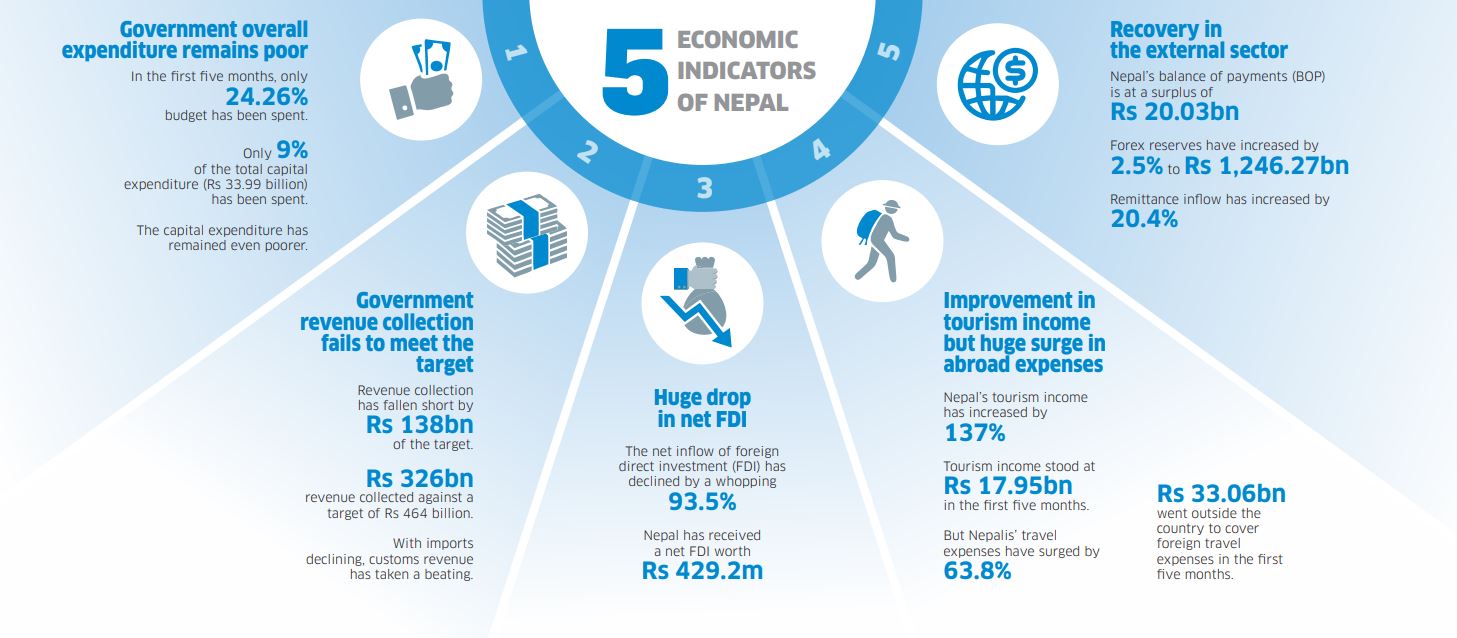
As the new government's formation gets pace, the new dispensation that will come to Singhadurbar, the country's main administrative center, will have a tough job ahead to resurrect the current state of the economy. As the economy grapples with multiple issues, data from different government agencies shows contrasting pictures. The Nepal Rastra Bank (NRB) last week published a new set of data that shows the country's external sector is on the path of recovery. At the same time, the data of the Financial Comptroller General Office (FCGO), which tracks the government's budgetary operation, shows revenue collection has plummeted drastically with capital expenditure remaining dismal as earlier. Amid the fast depleting forex reserves, the government in April this year enforced import restrictions on certain ‘luxury’ goods. This move was also guided by the fact that the country could be heading in the direction of Sri Lanka which went through a severe forex reserves crisis earlier this year. The central bank also introduced a tightened monetary policy for the current fiscal year, controlling the expansion of credit. Along with the tightening of credit, a prolonged liquidity crunch that resulted in higher interest rates in the banking system coupled with import restrictions has hit the country's economic activities. As imports decline along with economic activities slowed down, the government is now feeling the heat. The government’s major source of income, revenue, has been declining drastically. While the import restrictions on vehicles, expensive mobile sets, and foreign liquors, helped the country to avert the looming forex reserves crisis, the government is now facing another crisis as it struggles to collect the targeted revenue as current revenue collection is not sufficient even to meet growing recurrent expenditure. The government has failed to meet the revenue collection target in the first five months. According to FCGO, the government's revenue collection has a shortfall of Rs 138 billion of the target during this period. The government had set a target of collecting Rs 464 billion in revenue from mid-July to mid-December this year. But the FCGO data shows a total of Rs 326 billion in revenue has been collected by mid-December. The overall expenditure of the government during the same period stood at Rs 438.79 billion. The revenue collection of the government has continued to remain lower compared to the recurrent expenditure from the early days of the current fiscal year. Amid the slowdown in most types of economic activities, the Inland Revenue Department (IRD) is struggling to meet the target. The department's revenue collection in the first five months is 14 percent behind the target. The department, which aimed to collect revenue of Rs 174 billion by mid-December has managed to collect only Rs 150 billion. “As our revenue sources are heavily reliant on imports, restrictions on the imports of the major revenue generating items really hit the collection hard,” said economist Keshav Acharya. “The government must end over-reliance on imports for revenue generation and increase revenue from other sources, particularly internal revenue.” Customs revenue contributed nearly 40 percent of total revenue in the last fiscal year, according to FCGO. The government collected 17.82 percent of revenue from customs duty, 16.82 percent from import-based value-added tax (VAT), and 5.14 percent from import-based excise duty. With imports declining, customs revenue also has decreased in this fiscal. The slowdown in internal economic activities has hit the VAT and income tax collection, according to officials of the Finance Ministry. The federal budget has set a target of Rs 1403 billion in revenue collection for this fiscal. However, after the first five months, less than a quarter of the annual target (about 23 percent) has been collected. Given the current state of the revenue collection, it will become difficult for the government to raise the expenditure for daily administration and development expenses. The government has spent only 24.26 percent of the budget in the first five months. According to FCGO, the government's spending stood at Rs 435.21 billion till mid-December. As per the FCGO data, the government's capital expenditure has remained dismal. The government has utilized only 9 percent of the total capital expenditure in the first five months. According to FCGO, the capital expenditure till mid-December stood at Rs 33.99 billion. While the data shows the external sector is slowly recovering, economists cast doubt on the sustainability of the progress. "The external sector improved when the government imposed a ban on certain products. We have to see if the situation will be the same in the next three months," said Acharya. The recent government decision of lifting import restrictions, according to economists, could cost the economy dearly. As the government relaxed imports, there are fears that the country's external sector, which has finally come to a comfortable position, will again be under stress. According to them, instead of reducing the cost, the government went for a compromised solution to maintain fiscal balance. "The government, instead of cutting down the cost, opted for opening up the imports to increase revenue for maintaining fiscal balance," said Acharya. According to economists, the government should be clear on its priority. " Whether it wants to increase revenue to manage recurrent expenditure or go for structural reform to strengthen the country's external sector, is what the government should decide," said Acharya. As the government struggles to expedite capital expenditure, economists say controlling costs should have been the priority. While the government promises austerity measures, such measures have not been implemented effectively. The government is yet to implement the report of the Public Expenditure Review Commission. The government hiked the salary of the government staff by 15 percent and additional liability was created by lowering the eligibility age for elderly allowance to 68 years from 70 years. Before the recent parliamentary elections, the political parties promised to lower the eligibility age for elderly allowance and increase the amount of allowance, provide free electricity up to certain units and provide free drinking water to certain liters. “If you continue to increase recurrent liabilities, how can revenue sustain such liabilities,” the economist said. “You have to rely on domestic and foreign borrowing to meet growing resource needs.” Nepal’s public debt has been on the rapid rise in recent years. According to the PDMO, the country’s total public debt stood at Rs2.01 trillion as of the last fiscal year. The total debt stood at 41.5 percent of the Gross Domestic Product (GDP) in the fiscal year 2021-22, up from 30.3 percent in 2017-18. “ You have seen the economic crisis of Sri Lanka, Greece, and several Latin American countries and how overexposure to debt could create the crisis.” Box for graphics Government overall expenditure remains poor
- In the first five months, only 24.26 percent of the budget has been spent.
- The capital expenditure has remained even poorer.
- Only 9 percent of the total capital expenditure (Rs 33.99 billion) has been spent.
- Revenue collection has fallen short by Rs 138 billion of the target.
- Rs 326 billion in revenue was collected against a target of Rs 464 billion.
- With imports declining, customs revenue has taken a beating.
- The net inflow of foreign direct investment (FDI) has declined by a whopping 93.5 percent.
- Nepal has received a net FDI worth Rs 429.2 million.
- Nepal's tourism income has increased by 137 percent.
- Tourism income stood at Rs 17.95 billion in the first five months.
- But Nepalis' travel expenses have surged by 63.8 percent.
- Rs 33.06 billion went outside the country to cover foreign travel expenses in the first five months.
- Nepal's balance of payments (BOP) is at a surplus of Rs 20.03 billion
- Forex reserves have increased by 2.5 percent to Rs 1,246.27 billion
- Forex reserve is sufficient to cover the merchandise imports for 9.7 months, and merchandise and services imports for 8.4 months.
- Remittance inflow has increased by 20.4 percent


