


Status of Federal Budget Implementation: Zero progress in 36 economic sector programs announced in federal budget
The implementation of the programs announced by the government in the federal budget has always remained sluggish in Nepal. A study by the Confederation of Nepalese Industries (CNI) shows that in the first seven months of the current year, there has been no progress in 57 percent of the economic sector programs announced in the budget for the current fiscal year. The study highlights there is no satisfactory progress in most of the policies and programs that are directly related to the economic sectors. In its 'CNI Budget Watch' initiative, CNI has identified 63 points related to the economic development of the country, investment, and the private sector. According to the study, the progress of 36 of those points has been zero. As per report, about 48 percent of the points suggested by the CNI for the budget of the current fiscal have been included in the annual policy and program (budget) of the government. However, the implementation side is far from satisfactory. The 'CNI Budget Watch' has included eight sectors, namely new entrepreneurship, innovation and information technology, tourism, industry, small and medium industries, investment, energy, infrastructure and agriculture, domestic production, and export promotion. The CNI study says, of the 63 points related to economic sectors, only nine points (14.28 percent) have been fully implemented by the government agencies till mid-February. Among those are the policy of a minimum threshold of Rs 20m in foreign direct investment, arrangements of automatic approval of investments up to Rs 100m, 10 percent share reservation in the initial public offering (IPO) of companies for Nepalis in foreign employment, and initial approval of large foreign investments through electronic means within seven days. Similarly, the study shows 28.57 percent (18 points) were partially implemented. However, the remaining 57.14 percent (36 points) of policies and programs have no progress at all. "The ineffective implementation of the budget has not only hit the government revenue collection but an uncomfortable liquidity situation and the contraction in demand has also discouraged the private sector from new investments," states CNI. Most of the policies and programs announced in the budget related to the industry, land, infrastructure, foreign direct investment, and public-private-partnership which are important for economic development, have made no progress. "81.48 percent of the 27 important announcements of the federal budget related to these areas have not yet been implemented," said the study. Similarly, there has been no progress in the announcement such as the construction and operation of the industrial areas in potential areas including Shaktikhor in Chitwan in public-private-partnership, reviewing the provisions regarding the delimitation of land required for the establishment of industries, arranging the land lease for 50 years for industries, and mortgaging of land in excess of the limit in the name of industrial businesses to take loans. Budget announcements related to improving laws and procedures related to foreign investment to bring in investment from non-resident Nepalis, granting permission to Nepali construction professionals to do construction business abroad, raising resources for infrastructure development by issuing green bonds, making arrangements for the construction of the Mirchaiya-Lukla-Sagarmatha Expressway with private sector investment are also yet to see implementation. Status of Budgetary Programs' Implementation
| Fully Implemented | 15.6 percent |
| Partially Implemented | 28.1 percent |
| Not Implemented | 56.3 percent |
| Sector | Total | Zero Implementation | Partial Implementation | Full Implementation |
| Startup | 5 | 0 | 5 | 0 |
| Information Technology | 4 | 0 | 3 | 1 |
| Tourism | 8 | 4 | 3 | 1 |
| Industry, SMEs | 9 | 6 | 2 | 1 |
| Land | 3 | 3 | 0 | 0 |
| Foreign Investment | 8 | 4 | 0 | 4 |
| PPP | 2 | 2 | 0 | 0 |
| Energy | 4 | 2 | 1 | 1 |
| Infrastructure | 10 | 7 | 3 | 0 |
| Agriculture | 3 | 3 | 0 | 0 |
| Domestic Product and Export Promotion | 4 | 2 | 1 | 1 |
| Others | 3 | 3 | 0 | 0 |
| Total | 63 | 36 | 18 | 9 |
Growing number of tourists fuels speedy recovery of Nepal's tourism
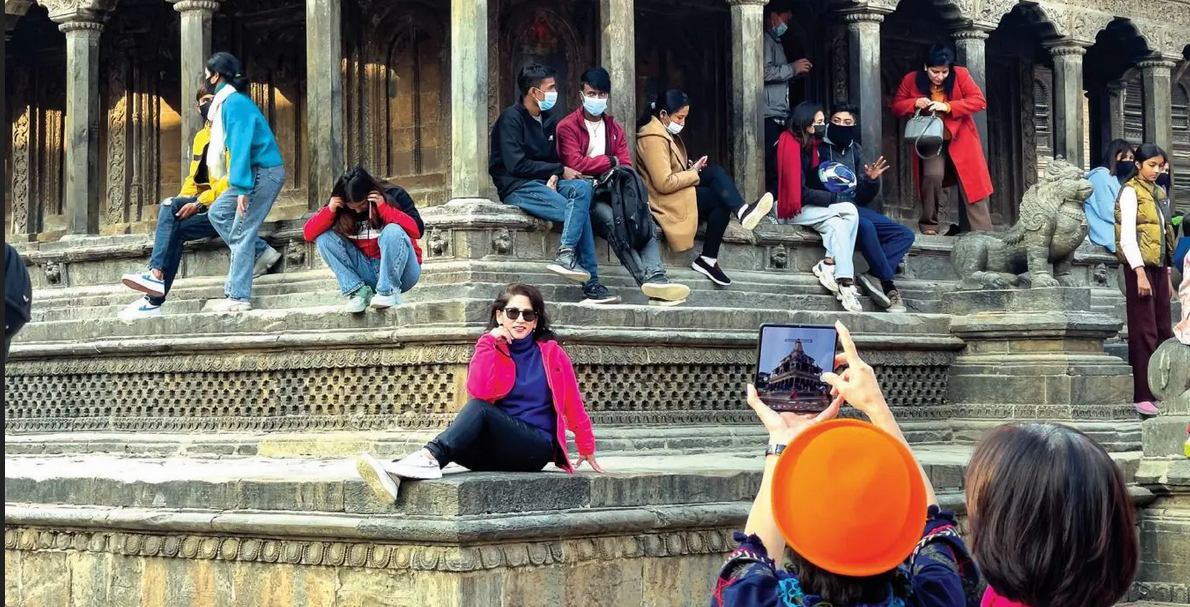
In what could be seen as a relief to the Nepali tourism sector, tourist arrivals in the country in February stood at 73,255. There were fears that the Yeti Airlines plane crash in Pokhara in January could affect the arrival of foreign visitors. However, the latest statistics of the Nepal Tourism Board (NTB) show a growing number of tourists coming to Nepal. According to NTB statistics, 128,329 tourists visited Nepal in the first two months of 2023. The tourist arrival in February this year is the highest in the last three years. Nepal welcomed 19,766 tourists in February 2022 and 9,146 tourists in February 2021. Before the global travel restrictions due to the Covid-19 pandemic came into force, 98,190 tourists had come to Nepal in February 2020. With China announcing the reopening of outbound travel for its citizens, there has been growth in the number of Chinese tourists in February. A total of 2,266 Chinese tourists came to Nepal in February compared to 1,426 in January. While the number of Chinese visitors is gradually growing, Nepal received the highest number of tourists from India and the US in February. According to NTB, 18,401 Indian tourists and 7,887 US visitors came to Nepal in February. The country welcomed 4,802 tourists from Thailand, 4,325 from the United Kingdom, 3,246 from South Korea, 2969 from Australia, 2,232 from Myanmar, 2,175 from Sri Lanka, and 2108 from Germany. With the easing of travel restrictions and China reponing outbound travel, Nepali tourism entrepreneurs are pinning high hopes for 2023. NTB on its 24th anniversary announced that it aims to attract at least one million foreign tourists in 2023. In 2022, tourist arrivals reached over 600,000 without any significant contribution from China. Nepal welcomed only 9,595 Chinese tourists in 2022. Tour operators say they are receiving increasing inquiries from major source markets including China of late. While the FITs (free independent travelers) have already started coming to Nepal, group travelers from the northern neighbor are yet to come here. Travel trade entrepreneurs say that a significant contribution of Chinese tourists would be required if Nepal wants to meet the target of one million in 2023. The tour operators expect Nepal to be included in the next list of China's destination countries hopefully as early as possible. However, China has failed to include Nepal in its list of countries where its citizens can travel starting from February 6. China has included 20 countries in the first phase where Chinese travelers can travel. The northern neighbor included Thailand, Indonesia, Cambodia, Sri Lanka, Maldives, Malaysia, the Philippines, Singapore, Laos, United Arab Emirates, Egypt, Kenya, South Africa, Russia, Switzerland, Hungary, New Zealand, Fiji, Cuba, and Argentina as an outbound destination for Chinese citizens to travel as the pilot destinations. Besides China opening the door for its citizens to visit Nepal, their arrivals will also depend on how quickly flights between the two countries are normalized, according to tour operators. Himalaya Airlines has recently resumed its Kathmandu-Beijing direct flight after a hiatus of 32 months. Tourist Arrivals
| Month | 2022 | 2023 |
| January | 16,975 | 55,074 |
| February | 19,766 | 73,255 |
| India 18,401 US 7,887 Thailand 4,802 UK 4,325 South Korea 3,246 |

UML leaders urge CPN (US) Chair Nepal to support Subash Nembang in presidential election
CPN-UML leaders held a meeting with CPN (Unified Socialist) party Chairman Madhav Kumar Nepal at the latter’s party office in Aloknagar on Thursday to discuss the presidential election. Presidential candidate UML Vice-Chairman Subash Nembang, Vice-Chairman Bishnu Paudel, Deputy General Secretary Prithvi Subba Gurung, Raghubir Mahaseth and Bimala Rai had reached CPN (US)'s party office this morning to meeting Nepal. On the occasion, UML leaders urged Nepal to support Nembang in the presidential election. CPN (Unified Socialist) Chairman Madhav Nepal, Vice-Chairman Prakash Hamal, General Secretary Beduram Bhusal and Deputy General Secretary Prakash Jwala among others were present in the meeting. The presidential election is scheduled for March 9. Nepali Congress senior leader Ram Chandra Paudel from the new alliance and UML Vice-Chairman Subash Nembang have filed their nominations for the election. The CPN (Unified Socialist), however, has decided to support Congress leader Paudel in the presidential election.

Koshi Province govt announces public holiday today to celebrate naming of province
The Koshi Province government has announced a public holiday in the province on Thursday to celebrate the naming of the province. The Internal Affairs and Law Ministry on the recommendation of the Cabinet meeting decided to grant a public holiday today. A meeting of the Province Assembly held on Wednesday decided to name Province 1 as Koshi Province. The name proposed by the CPN-UML was endorsed by a majority. Nepali Congress, CPN (Maoist Centre), and Rastriya Prajatantra Party lawmakers voted in the favour of the proposal to name Province 1 as Koshi Province. Earlier, the CPN (Unified Socialist) and the Janata Samajbadi Party had demanded that the province be named Kirat-Limbuwan-Sagarmatha.

Covid-19 expenditure slump amid a handful of reported cases
With the Covid-19 pandemic no longer being considered a major health concern at the moment, government spending on the control and prevention of the disease has slumped this fiscal year. During the first six months of the current fiscal year, the government spent Rs 700,000 for the prevention, control, and treatment of Covid-19, according to the mid-term review of the budget of the current fiscal year. The government had allocated Rs 15.47bn for the purpose in FY 2022/23. “Even though there has not been fresh spending from the dedicated budget for Covid-19, many activities are underway against Covid-19 through the regular health budget too,” said a senior official of the Department of Health Services. “Nevertheless, low spending of dedicated budget shows that Covid-19 is more or less under control. But it has not been eliminated yet.” Even though the government spent a lot of money on purchasing vaccines last fiscal year, it is now receiving the Covid vaccines free of cost under COVAX, a global initiative aimed at equitable access to Covid vaccines. According to the report, the government had spent Rs 22.21bn for the purpose in the last FY 2021/22 against the allocation of Rs 38.96bn. Spending in the fiscal year 2020/21 was Rs 12.56bn while it was Rs 2.6bn in FY 2019/20 when the pandemic began. The country spent a total of Rs 37.38bn for controlling Covid since the beginning. This spending however does not cover spending for social safety and welfare and economic recovery programs. The country spent even more on social safety and welfare and economic recovery to address the crisis caused by the Covid-19 pandemic. According to a report published by the Ministry of Finance, the government had spent Rs 72.93bn for health care, social safety, and economic recovery programs by mid-January 2022. Only Rs 30.35bn was spent on health care related to Covid while the rest of the amount was spent on social safety and economic recovery, according to the Program Completion Report of the Covid-19 Active Response and Expenditure Support Program. As a result of the pandemic, the country’s economy suffered a negative growth of over two percent in FY 2020/21. Official statistics show more than 12,000 people have lost their lives in Nepal due to the pandemic.

Gold price increases by Rs 300 per tola on Thursday
The price of gold has increased by Rs 300 per tola in the domestic market on Thursday. According to the Federation of Nepal Gold and Silver Dealers’ Association, the precious yellow metal is being traded at Rs 102, 600 per tola today. The gold was traded at Rs 102, 300 per tola on Wednesday. Meanwhile, tejabi gold is being traded at Rs 102, 100 per tola. It was traded at Rs 101, 800 per tola. Similarly, the silver is being traded at Rs 1,270 per tola today.

Nepal to receive $52m in second tranche of ECF
The government and International Monetary Fund (IMF) have reached a staff-level agreement on policies and reforms needed to complete the combined first and second review of the Extended Credit Facility (ECF) arrangement. Nepal will receive USD 52m as the second tranche of the ECF once the IMF executive board approves the agreement. Nepal was expecting to receive the second installment in May 2022, but the Washington DC-based lender delayed the tranche of USD 395.9m in loan to Nepal till February 2023, stating that the country is yet to fulfill the obligations. The IMF approved the USD 395.9m ECF for Nepal in January 2022 of which the Himalayan nation has already received the first installment of USD 110m. According to the IMF, despite a challenging global and domestic environment last year, Nepal continued to make progress with the implementation of the ECF-supported programs. "Notable achievements include the external audit of the Nepal Rastra Bank with the assistance of international auditors—in line with international best practices, publication of reports on both Covid-related spending and custom exemptions to enhance transparency, drafting of amendments to bank asset classification regulations, and strengthening bank supervision by launching the donor-supported Supervision Information System," IMF said in a press statement. IMF further said Nepali authorities have taken decisive actions to maintain a stable macroeconomic environment. "The much-needed monetary policy tightening last year, together with the gradual unwinding of Covid support measures, helped moderate credit growth and contributed to the moderation of inflation stemming from the global commodity price shock caused by the Ukraine war," said the statement. The monetary policy tightening last year helped stabilize the external economy and is contributing to lower inflation, while the recent mid-year budget review is expected to address near-term fiscal risks stemming from lower-than-expected revenue growth. The IMF has highlighted that sustainable medium-term growth will require fiscal reforms in line with debt sustainability, advancing reforms on banking regulations and supervision, reducing the cost of doing business and barriers to FDI, and enhancing governance. The multilateral agency has pointed out that bank asset quality has deteriorated, reflecting a decline in the repayment capacity of borrowers due to higher lending rates and rising leverage. "Discussions recognized the need for the Nepal Rastra Bank to ensure appropriate reclassification of loans and close monitoring of the impact of a potential deterioration in the repayment capacity of borrowers," said the IMF. The IMF has projected Nepal's GDP growth in FY 2022/23 to be 4.4 percent. However, Nepal remains vulnerable to international shocks, from volatile and higher global commodity prices and from natural disasters and weather variability. Hence, the IMF has suggested a cautious monetary policy is appropriate to bring the still elevated inflation down towards the Nepal Rastra Bank’s 7 percent target and to allow the economy to grow without placing undue pressure on international reserves. "Monetary policy should focus on maintaining a cautious and data-driven stance supported by macroprudential measures. This will help avoid large boom-bust credit cycles, which can create financial sector instability and are not supportive of sustainable growth," reads the statement. During the meeting, Nepali officials and IMF staff agreed that priority should be given to achieving a fiscal deficit that ensures debt sustainability while securing additional concessional financing and enhancing debt management. There were discussions on the need for Nepal to adopt an ambitious structural reform agenda to help establish a sustainable and inclusive long-term growth path. According to the IMF, reducing the cost of doing business and barriers to FDI would support growth potential, especially in sectors such as high-value agricultural products, information technology, energy, and tourism. "Reforms to develop financial instruments tailored to migrant workers, promoting better access to finance, and improving financial literacy can enhance financial inclusion," said IMF. Nepali officials expressed commitment to the policies and reforms envisaged in the ECF-supported program, in particular, formulating a comprehensive revenue mobilization strategy, aimed at enhancing tax collection and making room for priority spending, strengthening the management of fiscal risks, especially those arising from public enterprises, by developing systems for their prompt identification and monitoring, improving efficiency and transparency of public investment spending; continuing to advance reforms on banking regulations and supervision and ensuring bank asset quality and further strengthening NRB’s governance by amending the NRB Act in line with best international practices. Nepali officials also expressed the government's readiness to implement recommendations from the ongoing AML/CFT Mutual Evaluation conducted by the Asia/Pacific Group. The IMF staff mission led by Jarkko Turunen arrived in Nepal on February 15 and stayed in Kathmandu for almost two weeks for a comprehensive review.

Sandeep Lamichhane leaves for the UAE to play ICC World Cup League 2
Rape-accused cricketer Sandeep Lamichhane has left for the UAE to play ICC World Cup Cricket League 2 on Wednesday. Lamichhane will replace Shyam Dhakal (Mausam) of the Nepali team as he got injured during the practice session, the Nepal Cricket Association (CAN) said. The CAN sent Lamichhane to the UAE after the Supreme Court allowed him to go abroad.


