


Construction of diversion tunnel of UT-1 completes
The construction of the diversion tunnel of the 216 MW Upper Trishuli-1 (UT-1) run-of-the-river hydroelectric project in Rasuwa District has been completed. The UT-1 is the largest hydroelectric project under construction with foreign direct investment in Nepal. The project in a press statement informed that a full concrete lining diversion tunnel with a length of 420 meters and diameter of five meters diameter has been successfully constructed. "The Trishuli river has been diverted via a diversion tunnel on Feb 28 to commence the construction activities of the head works," reads the statement. According to Tae Hak Yoon, CEO of Nepal Water and Energy Development Company (NWEDC), river diversion is a significant achievement in the development of UT-1. The project has completed a 4.5 km excavation of the 13.5 km tunnel, which includes the headrace, adit, and tailrace tunnel. The excavation work of the underground powerhouse has advanced by 21 percent, and the overall progress rate of the Project is 14 percent. The developer of the project plans to complete the construction within December 2026. The project's main construction started in January 2022 and is estimated to complete in December 2026. According to the statement, approximately 700 workers work at the construction site, including 300 local residents from Project affected Rasuwa district. The Korean firm Doosan Eneribility is the engineering, procurement, and construction (EPC) contractor for the project. UT-1 is expected to generate up to 1,533 GWh of electricity annually. Out of the total annual energy generated by the project, 38.75 percent will be generated during the dry season, which is higher than most of the other run-of-the-river hydropower projects in Nepal, thus contributing vastly to managing the dry season electricity shortfall. The project is considered attractive for the country's power system as it is close to the Kathmandu Load Center and will get 104 MW of electricity even in the dry season with high electricity demand. The generated energy will flow to the national grid by connecting it to the Trishuli-3B hub substation that the Nepal Electricity Authority is constructing currently. The USD 647.34 million project is financed through 70 percent debt and 30 percent equity. The project partners will provide an equity investment of USD 194.20 million. The credit oF USD 453.12 million is being provided by a group of international lenders, including the International Finance Corporation (IFC), Asian Development Bank (ADB), Korean Exim Bank (K-EXIM), Korean Development Bank (KDB), Asian Infrastructure Investment Bank (AIIB), FMO (The Netherlands), the British International Investment (BII), Proparco (France), and the OPEC fund for International Development (OFID). The shareholders of NWEDC include Korea South-East Power Company Limited, Korea Overseas Infrastructure and Urban Development Corporation, International Finance Corporation, and a local Nepali partner.

Gold price drops by Rs 100 per tola on Friday
The price of gold has dropped by Rs 100 per tola in the domestic market on Friday. According to the Federation of Nepal Gold and Silver Dealers’ Association, the yellow bullion is being traded at Rs 102, 500 per tola today. The yellow metal was traded at Rs 102, 600 per tola on Sunday. Meanwhile, tejabi gold is being traded at Rs 102, 000 per tola. It was traded at Rs 102, 100. Similarly, the price of silver has dropped by Rs 5 and is being traded at Rs 1,265 per tola today.
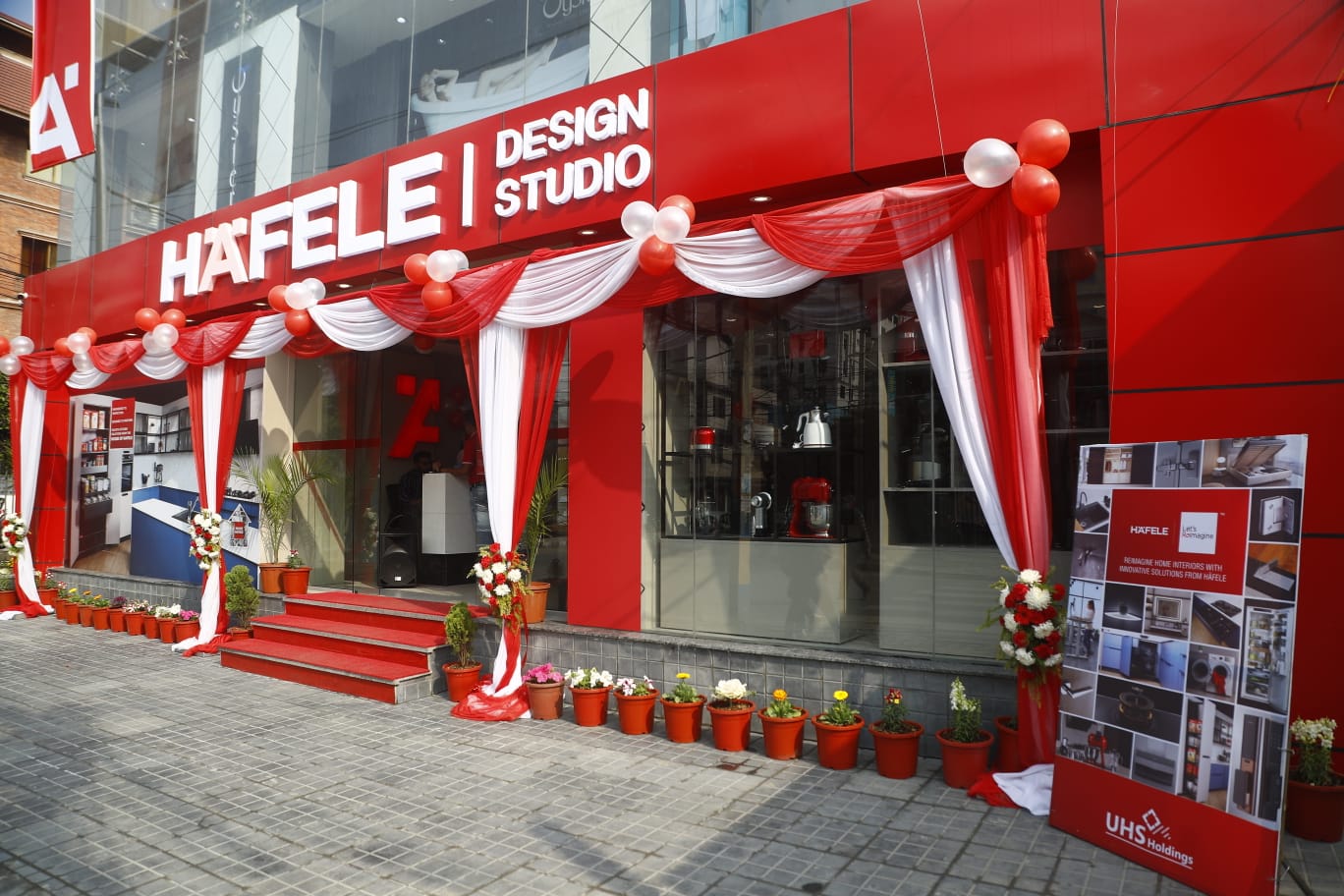
Hafele opens outlet in Nepal
UHS Holdings, a leading provider of interior solutions, has brought the German brand Hafele in Nepal. The company opened Hafele Design Studio at the Hafele Showroom in Gairidhara, Kathmandu on Thursday. The studio was inaugurated by Frank Schloeder, Managing Director, Hafele South Asia, and Purushottam Nyaupane, Chairman, UHS Holdings. UHS said that Hafele Design Studios are franchise-shop formats by Hafele that emulate the same retail environment and display settings that you will find in any of their company-owned showrooms. According to the company, the new studio will be home to all Hafele solutions represented in live and real-time display settings from architectural hardware and glass fittings, furniture fittings, and wardrobe solutions to digital security solutions, surfaces, lighting, appliances, and lots more. The Studio also displays Hafele’s in-house manufactured and engineered range of Kitchen fittings. During the event, Hafele and UHS Holdings' representatives highlighted the benefits of the cutting-edge technologies and superior functionality of Hafele’s product range designed to inspire architects and interior designers worldwide as well as its strong service proposition. Guests were also given a sneak peek into Hafele's latest offerings. "UHS Holdings is proud to be associated with Hafele, a brand that has a strong global presence and a reputation for excellence in interior solutions," said UHS Holdings Chairman, Nyaupane. "We are confident that our new Hafele Design Studio will provide our customers with access to smart concepts, innovative solutions, and infinite possibilities that are sure to enhance their living spaces”. UHS Holdings is known for its high-quality bathroom, ceiling, and railing furniture and other interior solutions.

Hyundai all-new Grand i10 NIOS hits Nepali roads
Laxmi Intercontinental, the authorized distributor of Hyundai vehicles in Nepal has launched the facelift version of Hyundai Grand i10 Nios in the market with the slogan "More. The Merrier". Issuing a press statement, the company claimed that the new Hyundai hatchback is 'set to take the automotive segment by storm' due to its new and innovative combination of cutting-edge technology, high performance, attractive design, distinctive features, and thoughtful safety features that cater to the modern driver's needs. With its new benchmark-setting features, the company anticipates that Grand i10 Nios will become another best-selling car in the Nepali market. "With its sleek, new-age style and state-of-the-art features, The hatchback will surely turn heads wherever you go. Revolutionary and distinctive touch is added to the overall appearance of the new Grand i10 Nios with its first in-segment-extended LED Tail Light with a connected light bar at the rear of the vehicle. The new Painted Black Radiator Grille and LED Daytime Running Lamps (DRLs) on the front of the new Grand i10 Nios give the vehicle a stylish and sporty edge. Similarly, its 15-inch Dual Tone Styled Steel Wheel, Projector Headlamps, Shark Fin Antenna, and Roof Rail give the hatchback an unmistakably unique identity," reads the statement. According to the company, the interior of the all-new Hyundai Grand i10 Nios boasts a modern and refreshing layout with its Dual Tone Gray interiors. The hatchback comes with new features like semi-fabric seats, tilt steering, a cooled glove box, footwell lighting, an 8'' Infotainment System and a rear USB charger. "Furthermore, the all-new Grand i10 Nios is packed with high-tech features and has set a new standard as a technology-friendly car. Its latest features include a Wireless Phone Charger, Fast USB Type C Charger, Cruise Control, Voice Recognition, Apple CarPlay, and Android Auto," said the company, adding, "The driver can obtain other information such as fuel economy, average vehicle speed, and service reminders from the Multi-Info Display (MID) feature in the digital instrument cluster of the new Grand i10 Nios." According to the statement, the safety features in the all-new Hyundai Grand i10 Nios are unmatched. The body of the hatchback is made with Advanced High-Strength Steel (AHHS), making it stronger and safer than ever before. It features Four Airbags, Tyre Pressure Monitoring System, Automatic Headlamps, Electronic Stability Control (ESC), Vehicle Stability Management (VSM), Hill-Start Assist Control (HAC), Rear Parking Camera with Display on Audio, and other special features. Additionally, the facelift model has safety features like a Speed Alert System, Burglar Alarm, Rear Defogger, Impact Sensing Auto Door Unlock, Speed Sensing Auto Door Lock, Headlamp Escort System, and Emergency Stop Signal. The company informs that the Grand i10 Nios comes with a powerful 1.2L petrol engine. With a ground clearance of 165mm, the hatchback offers the perfect combination of power and agility for that thrilling driving experience. The Grand i10 Nios is available in Era, Magna, and Sportz variants in the MT option and Magna and Sportz in the AMT Option with a starting price of Rs 29,96,000.

Editorial: Tread with caution
A close neighbor and a very good friend of Nepal, India is currently holding the G20 Summit featuring global and regional powers like the US, China, India, the United Kingdom, South Africa and France. This event points at the emergence of India as a force to reckon with in a comity of nations, though the presidency of G20, representing around 85 percent of the global GDP, over 75 percent of the global trade, and about two-thirds of the world population, is part of a rotating arrangement. Remarkably, the summit comes at a time of heightened international tensions, marked by the Russia-Ukraine war, worsening relations between the US and China, India and China, among others. In such a forum, war of words between the countries that otherwise do not see eye to eye is but natural. Such exchanges surely have much more than entertainment value, though. The exchanges happening just across the border offer us a golden opportunity to observe a fast-changing world and its evolving power equations from a vantage point, and ask ourselves as to what threats and opportunities await us when the world seems to be at the cusp of a Cold War 2.0. Amid signs of winds of change sweeping the world yet again, it will also be worthwhile to have a brief look into Nepal’s contemporary history marked by some epoch-making changes. Political transformations in Nepal have always coincided with important changes in the international order, whether it’s in the 1950s, the 1990s or the early-to-mid-2000s. But let’s not see these events just as tornados sweeping the world making a landfall in Nepal. Successive generations of Nepalis have aspired for ideals like democracy, human rights and dignity, rule of law, a better future and a prosperous Nepal. These changes are reflections of Nepali aspirations, though it will be naive to separate Nepali consciousness from global consciousness and undermine the power of global waves of change. As the world is no longer a collection of isolated isles, geopolitics and geostrategy will surely have a more profound bearing, especially on small, medium-sized and instability-plagued countries like Nepal. What should worry our rulers, though, is that Nepal and the Nepalis have not arrived, as yet, despite political movements. Worryingly, recent years have seen the global push and pull factors in full play, threatening to dislodge Nepal, a country located between two emerging giants, from its coveted position of avowed neutrality. If the past is any guide, rulers’ tilt toward one or the other camp has ended up further weakening national sovereignty. Events like the G20 should inspire our rulers to negotiate turbulent waters of international diplomacy with extreme caution.

Nepal register stunning seven-run victory over the UAE, qualify for U-19 World Cup
Nepal registered a stunning seven-run victory over the host UAE by seven runs in the final match played today under the ICC U-19 Men’s World Cup Asia Qualifiers tournament in the UAE. With the win, Nepal have been qualified for the ICC U-19 World Cup to be held in Sri Lanka next year. In the match played at the Eden Garden Oval in Ajman, Nepal set a target of 192 runs against the UAE. In the run chase, the UAE scored 184 runs losing all the wickets in 48 overs. Meanwhile, the Cricket Association of Nepal (CAN) has announced Rs 100,000 each to the members of the U-19 cricket team.

Broader consensus government will be formed after presidential election: Singh
Nepali Congress leader Prakash Man Singh has said a broader consensus government would be formed after the presidential election. Talking to journalists in Dhanusha on Thursday, leader Singh, who arrived here to attend a program, said that a broader consensus government would be formed after the presidential election slated for March 9 as per the agreement signed among the eight political parties. He said that the politics which had lost direction has come to the right track. Singh claimed that Nepali Congress senior leader Ram Chandra Paudel’s victory is certain in the presidential election. He said that the onus rests on the shoulders of all the political parties to take the country towards the path of prosperity by creating a conducive political environment.

Nepse plunges by 26. 47 points on Thursday
The Nepal Stock Exchange (NEPSE) plunged by 26. 47 points to close at 1,969.02 points on Thursday. Similarly, the sensitive index dropped by 4. 81 points to close at 373. 56 points. A total of 3,657,154 unit shares of 256 companies were traded for Rs 1. 33 billion. Meanwhile, Buddha Bhumi Nepal Hydropower Limited was the top gainer today with its price surging by 4. 29 percent. Likewise, Global IME Laghubitta Bittiya Sanstha Limited was the top loser with its price dropped by 7. 00 percent. At the end of the day, the total market capitalization stood at Rs 2. 84 trillion.


