


Gold price increases by Rs 400 per tola on Friday
The price of gold has increased by Rs 400 per tola in the domestic market on Friday. According to the Federation of Nepal Gold and Silver Dealers’ Association, the precious yellow metal is being traded at Rs 110, 200 per tola today. The gold was traded at Rs 109, 800 per tola on Thursday. Meanwhile, tejabi gold is being traded at Rs 109, 650 per tola. It was traded at Rs 109, 300 per tola. Similarly, the silver is being traded at Rs 1,445 per tola today.
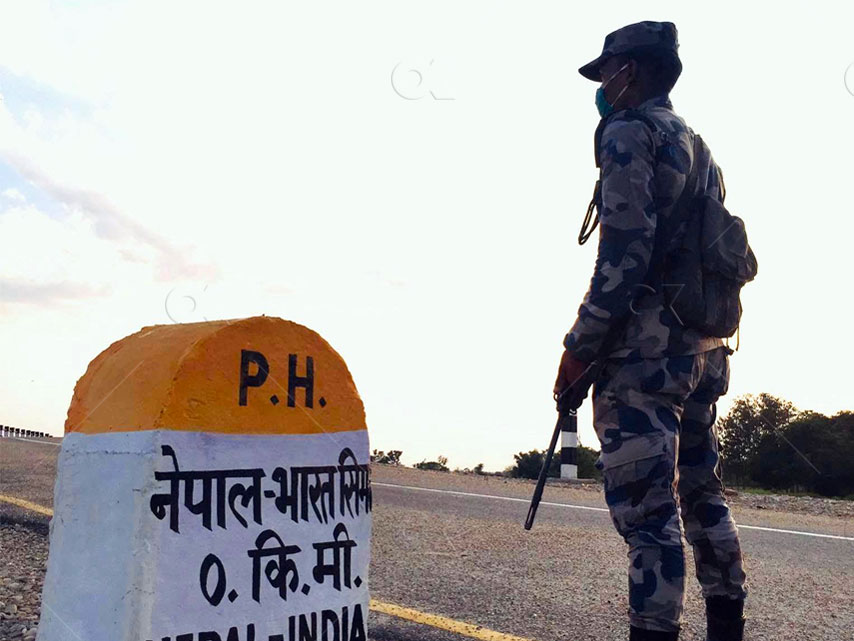
Nepal-India border in Bara sealed for 72 hours ahead of by-election
The Nepal-India border points in Bara district have been sealed for 72 hours from today in view of the by-election taking place in Bara constituency-2 on April 23. Issuing a press statement, the District Administration Office Bara said that the border points shall remain closed from 12:00 midnight today to Sunday midnight. The sale and supply of liquor has been banned in the district until the vote counting is completed, Chief District Officer of Bara Nabaraj Sapkota said. Similarly, the vehicular movements along the Postal Highway in the district have been closed except for emergency ones from Saturday midnight to Sunday 7:00 pm.

13-year-old boy burnt to death in Gulmi
A 13-year-old boy, who sustained critical burn injuries while trying to bring the fire that broke out at a community forest in Dhurkot Rural Municipality-3 of Gulmi under control on Thursday, died during the course of treatment on Friday. The deceased has been identified as Dipak Mukhiya. He breathed his last while receiving treatment at the Mission Hospital in Palpa district this morning. He was rushed to Gulmi Hospital for treatment last night and then was referred to Palpa for further treatment. Likewise, 55-year-old Dhan Bahadur Jogi Kunwar sustained serious burn injuries in the accident. Kunwar has been sent to Butwal from Palpa for further treatment. Meanwhile, two houses and three cowsheds were destroyed in the fire that occurred at Isma Rural Municipality in Gulmi district on Thursday. The District Police Office, Gulmi, said the houses and cowsheds of Shivalal Kumal and Rudra Bahadur Kumal of Damar village were destroyed in the fire that broke out in a nearby community forest. The district has recorded several cases of bushfire in recent days amid the dry season.

By-election: Silence period comes into effect
The silence period for the by-election to the House of Representatives has come into effect from today. The by-election is taking place in Tanahun-1, Bara-1 and Chitwan-2 on April 23. The Election Code of Conduct, 2079, issued by the Election Commission on April 7 for the by-election has made provision for a silence period from 48 hours before the voting day until the voting is closed in order to hold the election in a free, fair and fearless environment. The silence period will come into effect from today till the polls are closed on April 23. Election campaigning and any type of discussion, interaction, assemblies, workshops and gatherings are prohibited during the silence period. The EC has drawn the attention of all not to solicit votes through online, social networking sites, print or any medium in favor or against any candidate or party. The EC urged the concerned sides not to publish and broadcast any press release or any content related to prediction about the victory or defeat of a candidate through media, including social sites.

Expert panel formed for budget formulation
The government has appointed three economists as economic advisers to the Ministry of Finance. Finance Minister Dr. Prakash Saran Mahat has formed an expert group to prepare the federal budget for the next fiscal year. Economists Biswo Paudel, Dr. Posh Raj Pandey, and Dr. Gunakar Bhatt have been appointed as the economic advisors through the ministerial decision on Thursday. According to the Secretariat of Finance Minister, Paudel has been appointed as the Chief Advisor of the Ministry of Finance. Paudel is the former vice-chairman of the National Planning Commission (NPC), while Pandey has also served as a member of the NPC in the past. Bhatt is the executive director of Nepal Rastra Bank. The advisors are expected to assist Finance Minister Dr. Prakash Saran Mahat in the drafting of the budget for the next fiscal year. The government is working to present the budget for the next fiscal year at the parliament on May 29 (Jestha 15), as per the constitutional mandate. After taking the helm of the Finance Ministry, Dr. Mahat has been putting his efforts to resolve the current economic downturn and introduce long-term reform measures.

Editorial: Lion Palace’s federal challenges
The basic idea behind Nepal’s switch to federalism was to take the government to the people’s very doorsteps. But federalism also comes with bills attached, in terms of money and several other thorny issues. One can of course argue that decentralization can be a low-cost alternative to federalism in a medium-sized country like Nepal, making way for heated and (perhaps) never-ending discussions on the topic. But the country is unlikely to take a back-gear and hurtle toward decentralization, at least not in the immediate future. So, making federalism work will be the foremost challenge for our ruling elites. A feature of federalism is increased instances of conflict between different tiers of government. This of course does not mean the center has the license to ride roughshod against the will of local communities in their localities under the unitary system. Such a conflict can be over rights, responsibilities, natural resources and revenue sharing, among others. That feature is in full glare on the issue of waste management in the Kathmandu Valley, with the Kathmandu Metropolitan City refusing to collect waste from nerve centers of the federal government for a few days after Singha Durbar’s indifference toward its concerns. As if this row were not enough, Kakani rural municipality (Nuwakot district) and Dhuniveshi municipality (Dhading) have issued a 15-day ultimatum to concerned authorities to fulfill agreements reached earlier, warning that they won’t allow waste disposal at the landfill sites of Banchare Danda and Sisdole otherwise. Add to it increasing tensions in the province after the renaming of Province 1 as Koshi Province. In a province or other subordinate levels, different sections of populations can have different sets of interests, expectations and ambitions. Addressing all these concerns is not easy, to say the least. But the onus is on the center to maintain amity. As provincial and local governments grow more and more aware of the importance of local as well as inter-state resources like forests, mountains, rivers and streams for their survival and prosperity, instances of conflict between different tiers of government are likely to increase. But Singha Durbar (the Lion Palace) presiding over a young federal secular republic does not seem much aware of the challenges that lie ahead on the path of federalism. The Lion Palace should realize that the party time is long over. It should muster strength, show more compassion and govern rather than rule by learning lessons from the immediate neighborhood and beyond. After all, the onus is on this very place to make sure that things do not fall apart in a shaky republic.

Nepal reports 103 new Covid-19 cases on Thursday
Nepal reported 103 new Covid-19 cases on Thursday. According to the Ministry of Health and Population, 456 swab samples were tested in the RT-PCR method, of which 72 returned positive. Likewise, 1, 189 people underwent antigen tests, of which 31 tested positive. The Ministry said that no one died of the virus in the last 24 hours and 61 infected people recovered from the disease. As of today, there are 397 active cases in the country.

Dozens injured as police, locals clash in Siraha
Dozens of people were injured when a clash broke out between police and locals in Mirchiya Municipality of Siraha on Thursday. The locals have been staging demonstrations for the past few days after the municipality demolished their houses. The locals had tried to picket the municipality office this afternoon. The protesters had said that Mayor Shrawan Yadav should answer the issues raised by them. They started pelting stones after Mayor Yadav did not come out of the office. DSP Rabindra Raj Pandey, who is also the spokesperson of the District Police Office, Siraha, said that police fired 27 rounds of bullets into the air to take the situation under control. A few days ago, the municipality demolished 37 houses in the village block land. In which, Mayor Yadav claimed that the municipality had vacated the land owned by the government. The locals, however, said that they had been living in the village block land for generations.


