


3rd Quarterly Review of Monetary Policy: All eyes on the central bank
As the third quarterly review of the monetary policy draws near, all eyes are on the Nepal Rastra Bank (NRB). From government officials, business community members, and economists to ordinary citizens, people are looking at the central bank whether it will announce measures to bring down borrowing rates and ease margin lending and real estate financing. With the economy performing badly, the government wants NRB to move away from its 'conservative' stance in the third quarterly review of the monetary policy. Finance Minister Prakash Saran Mahat has been publicly speaking that he has asked the central bank to be cooperative with the issues faced by the private sector. The private sector has been urging the government to convince the NRB to be ‘liberal’. Finance Minister Mahat during the meeting to formulate revenue policy in Koshi province this week said that he was expecting liberal monetary policy from the central bank. “There is a need for liberal monetary policy. I have asked the leadership of Nepal Rastra Bank about it. I am waiting for the answer,” he said. The government is facing consistent pressure from the private sector to influence the central bank for lowering interest rates. Over the past one and a half years, the central bank has adopted a tighter monetary policy to address the high inflation and worsening external sector of the economy reflected in the ballooning balance of payment deficit and depleting foreign exchange reserves. “The much-needed monetary policy tightening helped stabilize the external position and lower inflation,” said the International Monetary Fund, in its assessment of Nepal’s economy after its Article IV observation mission in Nepal in February. According to NRB, the balance of payments remained at a surplus of Rs 148.11bn as of mid-March this fiscal year while foreign exchange reserves increased 15.2 percent to Rs 1,401.21bn in mid-March 2023 from Rs 1215.80bn in mid-July 2022. But inflation has been high at 7.44 percent in mid-March 2023, according to NRB. To support external stability and control inflation, the central bank raised the interest rate corridor in February 2022 and again in July and increased the cash reserve ratio in August, further raising lending rates. “Looking forward, a cautious and data-driven monetary policy stance supported by macroprudential measures will help avoid large boom-bust credit cycles, which can create financial sector instability and are not supportive of sustainable growth,” the IMF has advised. As the IMF is advising against the loose monetary policy, the central bank is unlikely to make a major shift in monetary policy despite the desire of the finance minister, according to NRB officials. A senior NRB official said that the main task of the central bank is to maintain financial stability in the country and to keep inflation at a manageable level. “The central bank cannot compromise on that as it is the mandated task by the NRB Act,” the official said. "A sudden U-turn on current policy could again destabilize the external sector. There is a limited scope of compromise on tighter monetary policy as long as inflation remains elevated." NRB Governor Maha Prasad Adhikari has also clearly hinted that a major shift in current policy is unlikely. “Those who are expecting much from the monetary policy should understand its limitations,” said Adhikari, speaking at the Business Summit-2023 organized by the Confederation of Nepalese Industries (CNI) this week. “The NRB will take private sector friendly policy within the boundary of monetary policy.” Given the diverse interests of the government and the central bank, there is the risk that the fiscal and monetary policy will take different directions further complicating matters for the already troubled economy of the country. The budget for the current fiscal year and monetary policy has moved in different directions with the government introducing an expansionary budget while the central bank introducing a tighter monetary policy. “We cannot expect fiscal and monetary policy to always go in the same direction, but it is important that a certain adjustment on both is necessary to take forward the economy without major upheavals,” the central bank official said.
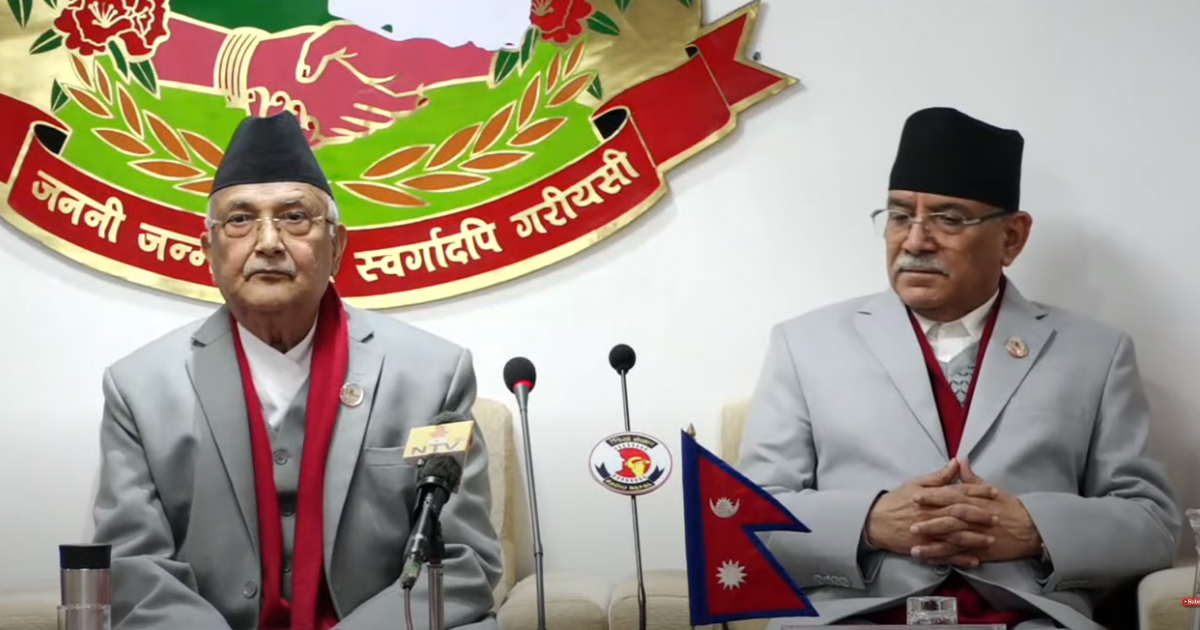
Top leaders of three major political parties hold discussion
Top leaders of three major political parties held a discussion on various issues including the bill related to the Truth and Reconciliation Commission. During the meeting held at the Prime Minister’s official residence in Baluwatar today, the positive discussion was held on the issues including the bill related to Truth and Reconciliation Commission and the bill related to Constitutional Council, said Prime Minister Pushpa Kamal Dahal's Press Coordinator Govinda Acharya. It is learnt that important and positive discussion were held in today's meeting on the issues including bills related to transitional justice and formation of Parliamentary Hearing Committee at a time when Monday's meeting of the Constitutional Council has recommended Hari Krishna Karki for the appointment as Chief Justice. Prime Minister and CPN (Maoist Centre) Chairman Dahal, Nepali Congress President Sher Bahadur Deuba and CPN-UML Chairman KP Sharma Oli were present in the meeting.

Upper Karnali Hydroelectric Project: Deck cleared for GMR for financial closure and PPA
With the Supreme Court scrapping the writ petition against the project development agreement (PDA) of the Upper Karnali Hydroelectric Project, the deck has been cleared for the Indian company GMR Energy to move ahead with the financial closure and power purchase agreement (PPA) of the 900 MW project. The constitutional bench comprising Acting Chief Justice Hari Krishna Karki, and justices Bishwombher Prasad Shrestha, Sapana Pradhan Malla, Ananda Mohan Bhattarai, and Tanka Bahadur Moktan on Sunday scrapped the writ filed by advocate Ratan Bhandari against the deadline extension given to the GMR. On July 15, 2022, the government decided to extend the deadline for GMR Energy to develop the Upper Karnali Hydroelectric Project, on the condition that the financial closure of the project is completed within two years. Before the cabinet decision, a high-level committee led by the then Vice Chairman of the National Planning Commission, Bishwa Poudel had recommended the deadline extension for the project. However, advocate Bhandari challenged the government's decision and filed a writ at the Supreme Court. The apex court in the first week of November 2022 stayed the government’s decision to extend the deadline for GMR Energy to complete the financial closure of the 900MW Upper Karnali Project, throwing the future of the project into uncertainty. A single bench of Justice Ishwar Prasad Khatiwada issued the interim order not to implement the government decision until the final verdict. Then, the government moved the court in mid-November seeking to vacate its November 3 interim order, arguing that GMR won’t be able to work towards financial closure. Responding to the government petition, justices Kumar Regmi and Til Prasad Shrestha on January 3, 2023, sent the dispute of Upper Karnali to the constitutional bench citing concerns of constitutional interpretation. With the constitutional bench finally scrapping the writ, GMR now can move ahead with the completion of the PPA and financial close for the project. The Supreme Court Spokesperson Bimal Poudel said that Sunday's decision has cleared the way for the developer (GMR) to proceed with the project development. "The full text of the verdict will be published soon," he said. The Investment Board Nepal (IBN) and GMR Energy signed the PDA on September 19, 2014. As per the PDA, the Indian company was supposed to complete the financial close within two years. But the deadline was extended further on January 8, 2017, by a year. On November 10, 2017, the Investment Board again extended the deadline by an additional year. Despite repeated deadline extensions, the Indian company has been struggling to conclude the financial closure of the project though some progress has been achieved in the purchase of power generated from the Upper Karnali Project. It is said that GMR's inability to move ahead with the project development is related to the contractor's high debt level and insolvency which has affected the company's power projects in India and elsewhere. In April 2017, Bangladesh signed a memorandum of understanding with India’s NTPC Vidyut Vyapar Nigam Limited (NVVN) to import electricity from the Upper Karnali HEP. Bangladesh has also issued a letter of intent to GMR expressing its interest to enter into a contract to purchase 500 MW of electricity from the Upper Karnali Project. During the meeting of the Joint Working Group and Joint Steering Committee on the energy between Nepal and Bangladesh in late August, it was notified that the Bangladesh Power Development Board, NVVN, and GMR were preparing to sign a trilateral power sales agreement. Following the scrapping of the writ, it is said that GMR officials will visit Nepal this week.

Gold price increases by Rs 300 per tola on Tuesday
The price of gold has increased by Rs 300 per tola in the domestic market on Tuesday. According to the Federation of Nepal Gold and Silver Dealers’ Association, the precious yellow metal is being traded at Rs 111, 200 per tola today. The gold was traded at Rs 110, 900 per tola on Sunday. Meanwhile, tejabi gold is being traded at Rs 110, 650 per tola. Similarly, the silver is being traded at Rs 1,445 per tola today.

Grade 12 exams begin across the country
The Grade 12 examinations have started across the country on Tuesday. More than 56,000 non-grade (NG) students have been appearing for the exams. The exams that started today will continue till May 19. The exams are being held in 1,453 centers across the country. The exams will be held from 8 am to 12 pm, according to the National Exam Board. Exam Controller at Board Krishna Prasad Sharma said that students who had secured non-grade (NG) in at least three subjects last year are sitting in the exams this year.

Mind Matters | Trouble saying no
I’m a 22-year-old student and I don’t like saying no to people. Sometimes people ask me for help when I’m in no position to help them out or when I simply don’t want to do what they ask of me. All I want to do at times like that is say no. But I feel like I’m being selfish and end up saying yes. Going beyond my means to do something I can’t or don’t want to do is stressful. I still feel guilty when I think of the times I’ve said no in the past. What should I do?—SP Answered by Kapil Sharma, counseling psychologist, Nepal Institute of Mental Health There are a lot of underlying reasons for not being able to say no. It might be different for every individual. For many, deciding whether to say yes or no is an everyday battle. Some people think they need to please everyone they encounter or fear coming across as rude. But sometimes tasks/favors you’re asked to do might be impossible for you. In that case, there is nothing you can do but say no. The bottom line is that everyone has the right to say no to anything they can’t or don’t want to do. We often forget that. You’re having some issues being assertive while communicating. On top of that, you overthink what others might think when you say no. Even if you do say no, the overthinking doesn’t stop and you end up feeling guilty. When guilt becomes the major outcome, we call that going into a guilt cycle. But you can’t be there for everyone all the time, can you? That’s going to be exhausting. Sometimes, saying no is a form of self care rather than a selfish act. I know it’s easier said than done. But there are ways you can manage the feeling of guilt or the dilemma you go through when saying yes or no. Next time someone asks you for a favor, stop thinking about the ‘what ifs’ and just think about what you are able to do or say at that moment. Will you be able to help them out? Do you already have a lot on your plate? Or do you simply want to take some time for yourself and are unable to do what they ask for? Once you know your answer, the next step is to figure out a way to let them know your situation. But that doesn’t mean you have to get into the details of why you are saying no. To help yourself be more assertive while communicating, you can follow what we call a ‘sandwich model’. It’s a method of expressing negative feedback in a positive manner. Start by acknowledging their request and then show your disagreement with a decent reason. You don’t have to go into details on why you can’t help them out but you can give them the gist of it. For example, you can say, ‘I would love to help you out, but I’m in the middle of a task’, or that you have a lot going on right now and are in need of some alone time. There are people who will ask you for help/favors all the time. It’s best to avoid them and their requests. You have to do it for your mental health. Learning to say no is a gradual process. It will take some time for you to be comfortable with it. But having someone around you who isn’t willing to understand why you’re saying no and comes up with his/her own issues all the time might drag you back into the cycle of guilt. We don’t want that to happen. If helping yourself with these methods becomes challenging, then you might want to consider consulting a mental health professional.

RSP’s Bindabasini Kansakar appointed HoR member
Bindabasini Kansakar of the Rastriya Swatantra Party has been appointed as a member of the House of the Representatives under the PR category on Monday. The Election Commission appointed Kansakar to one of the vacant posts this afternoon. Rastriya Swatantra Party leader Deepak Bohara confirmed that Kansakar has been appointed as the lawmaker. The RSP had suspended party lawmaker Dhaka Kumar Shrestha after the audio of him asking Rs 20 million from medical entrepreneur Durga Prasain was leaked. The RSP had sent a letter to the Election Commission to appoint Kansakar to the post of lawmaker in the place of Shrestha. Kansakar was attacked with acid at her parents’ store in Hetauda in 2013.

KMC starts removing unmanaged cables from Kathmandu streets
The Kathmandu Metropolitan City (KMC) has started removing unmanaged cables from the electric poles in the streets of Kathmandu. The removal of cables followed an agreement between the KMC, the Nepal Electricity Authority and internet service providers on Sunday. The cable removal started today from Maitighar Mandala, and New Road area, said Superintendent of Police at the KMC police, Manoj Lamichhane. Earlier, the KMC had asked the NEA and internet service providers to remove unmanaged cables from electric poles in Kathmandu within May 10. But, the Ministry of Communications and Information Technology has issued a circular to the KMC not to remove cables that may disconnect internet service at local levels across the country. The KMC is at work to remove cables if the concerned authorities do not do it by themselves within the deadline, said Lamichhane. "The meeting yesterday agreed to remove cables from today (Monday). So, the removal of cables starts today," he said. The meeting decided to manage unmanaged cables in various phases from several areas of the Kathmandu Valley, said the Internet Service Providers' Association of Nepal (ISPAN). As per the agreement, unmanaged cables, tangling and unused ones, would be removed from the electric poles in the Valley, it has been said.


