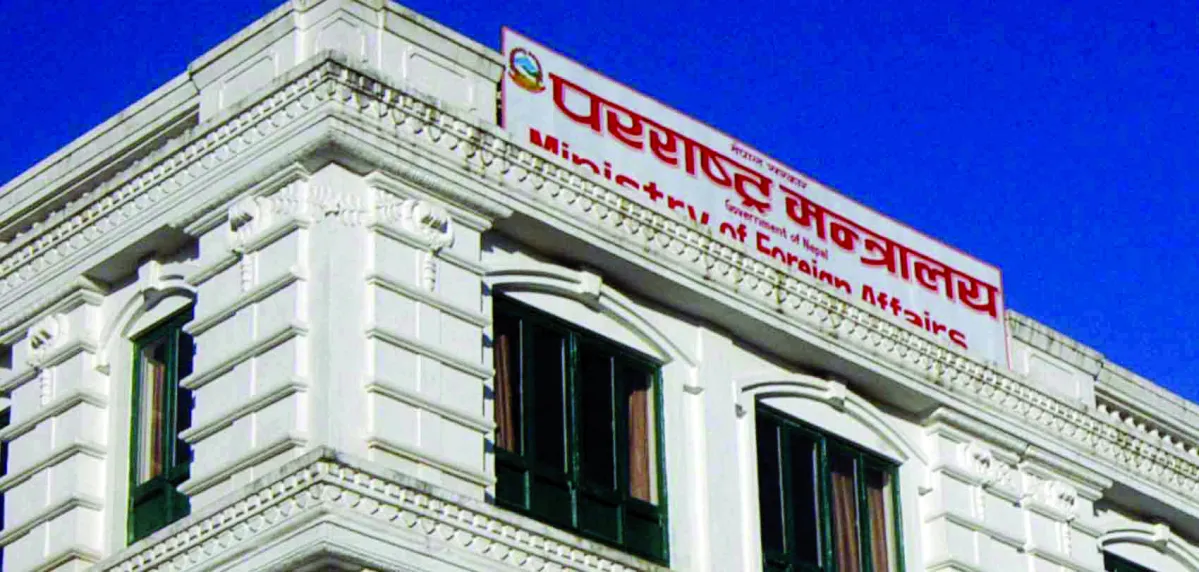
Kathmandu is changing its tune. Foreign Minister Shisir Khanal just wrapped up a three-day official visit to New Delhi. His meetings with Dr. S. Jaishankar reveal a shift in how Kathmandu deals with New Delhi.
For many years, these bilateral talks followed a predictable, tense script. Nepal would routinely bring up the 1950 Peace and Friendship Treaty. They would demand answers on border disputes like Kalapani and Lipulekh. They would push for the implementation of the Eminent Persons Group (EPG) report.
Not this time. Khanal chose a completely different path. He essentially left the old baggage at the door. The official statements completely omitted these disputed issues. Instead, the focus shifted entirely to economic growth, infrastructure, and development partnership. This clear turnaround in approach signals that Nepal's new leadership prefers enhanced economic and development partnership with rising India over the long-standing disputed issues.
This new approach makes perfect sense when you look at who is actually in charge. The Rastriya Swatantra Party (RSP) is remarkably young party. It was formed only in 2022. When Nepal's Parliament unanimously adopted a new map in 2020, this party did not even exist. When the EPG report was submitted in 2018, the party was still years away from conception.
Since even RSP leaders and cadres lack deep insight into these issues, the party leadership is unlikely to face the typical pressures experienced by traditional political parties.
Both the RSP and Balendra Shah, however, used border-related issues to bolster their domestic political standing. They regularly urged the governments of the time to take up these matters with both New Delhi and Beijing, bringing them into the forefront of domestic political discourse.
As far as the EPG report is concerned, except for the CPN-UML, almost all political parties have already abandoned the issue. Madhes-based parties never took ownership of the EPG, stating they were not represented in it.
The language used by senior RSP leaders indicates they believe traditional political parties raised these issues purely for domestic political benefit, meaning they are no longer a priority for either country. While the new government may still address border disputes with a dim voice—largely because they are now part of the constitution—the fate of other legacy issues remains highly uncertain.
To sidestep these friction points, the RSP and Khanal have intentionally chosen fresh framing. They emphasize that they "came without past baggage," that "relations are based on facts and evidence, not emotions," and that they "detest the ultra-nationalistic rhetoric used by traditional politicians."
Prime Minister Balen Shah's government is powered by Gen-Z voters. These young people are tired of business-as-usual politics. They care about jobs, digital connectivity, transparency, and a better economy. They do not care about the decades-old issues that traditional politicians love to exploit. Khanal himself comes from a professional background rather than a traditional political career.
He wants to talk about numbers, execution, and tangible results.
Nepal has largely stagnated for three decades while India’s economy has surged ahead. The new government in Kathmandu realizes that weaponizing bilateral issues for domestic votes has cost the country precious time. They want a slice of India's growth. To fulfill the high expectations of their voters, they need increased Indian investment and assistance.
So, what does this new development diplomacy look like? It rests on clear, tangible goals. Energy is a massive part of the plan. The Nepal-India energy partnership is already underway, and Nepal wants to strengthen it, with plans to export more electricity to Bangladesh. Connectivity is another major focus. Khanal wants to connect Janakpur to Ayodhya by rail, alongside better roads and air routes through Nepal's newly built airports.
Digital cooperation is also moving fast. The two countries just launched a linkage between India’s UPI and Nepal’s NPI, making cross-border remittances incredibly simple for ordinary citizens. They even signed a deal to co-create a voice-first language translation platform using artificial intelligence. Khanal explicitly stated his desire to shift the entire vocabulary of Nepal-India relations away from geopolitical friction and place it firmly on development diplomacy.
"Our core agenda is to transform diplomatic missions into engines of investment, trade, and economic partnership. We desire a relationship that delivers measurable results down to the daily lives of the ordinary citizens of both nations," he said.
You cannot just erase history, though. The official silence on the border issue is striking, standing in stark contrast to the tensions that preceded the visit. Just recently, Kathmandu objected to India using the Lipulekh route for the 2026 Kailash Mansarovar Yatra.
Prime Minister Balen Shah even floated the idea of British mediation to resolve the boundary dispute. India immediately shot that down, insisting the issue must be addressed bilaterally. Nepal’s Foreign Minister later clarified that Nepal is not seeking third-party involvement; instead, it is seeking historical evidence from the UK archives.
Khanal had to walk a very fine line during his trip. To the public and the media, he insisted that border issues were discussed behind closed doors, knowing that opposition parties are watching his every move back home. But by keeping the official press statements clean of these disputes, he gave New Delhi exactly what it wanted.
India welcomed this new vision with open arms. Jaishankar spoke about strong complementarities between the two governments. He noted that both countries have a unique opportunity to decisively shift their trajectory.
Can you truly build a lasting friendship by sweeping core issues under the rug? The RSP argues that these disputes can be resolved later, based on historical facts and mutual understanding. They want dialogue backed by evidence, not emotional election speeches.
A stable, prosperous Nepal is a natural guardrail for India's northern border. Conversely, a politically fractured Nepal makes New Delhi nervous about instability in the neighborhood. Economic development is a strategic necessity for both sides. Right now, a unique window of opportunity has opened.
The rivers continue to flow, and Kathmandu seems determined to build a bridge over old differences. Time will tell if this corporate-style pragmatism can survive the intense scrutiny of domestic politics back home.