

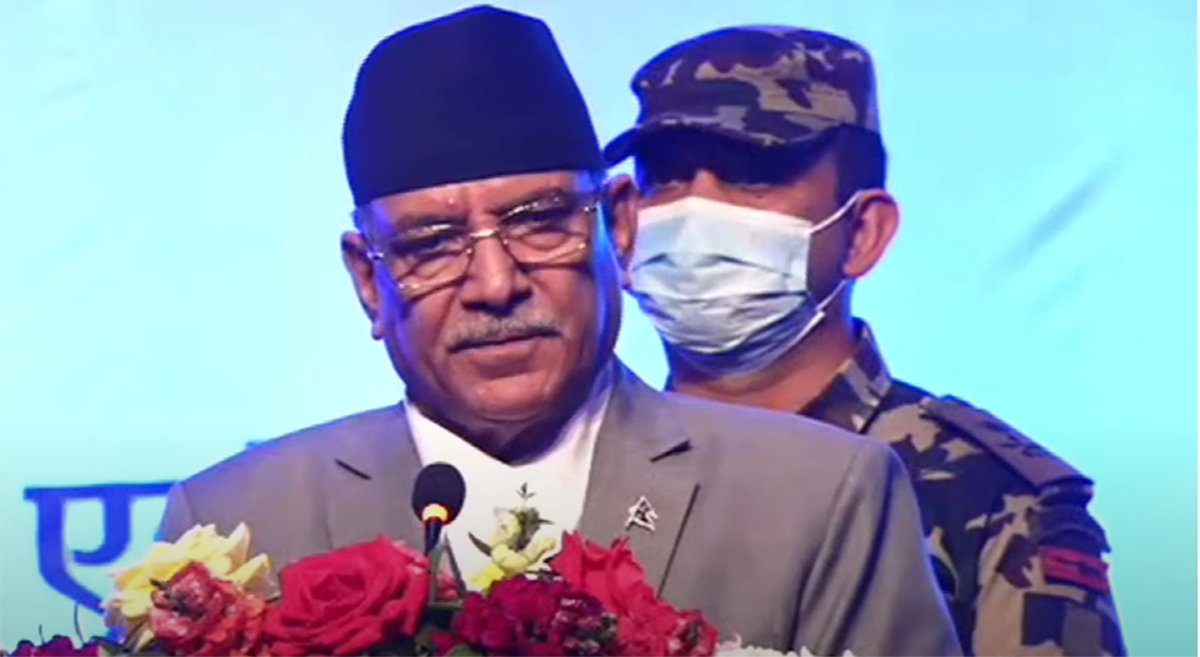
PM Dahal to visit India from May 31 to June 3
Prime Minister of Nepal Pushpa Kamal Dahal will pay an official visit to India from May 31 to June 3 at the invitation of his Indian counterpart Narendra Modi. This will be the first bilateral visit abroad by the Prime Minister of Nepal after assuming office in December 2022. He will be accompanied by a high-level delegation. During the visit, the Prime Minister of Nepal will call on the President and Vice-President and will hold extensive talks with Prime Minister Narendra Modi to discuss the diverse areas of the bilateral partnership between India and Nepal. Other Indian dignitaries will call on the Prime Minister of Nepal, reads a statement issued by the Ministry of External Affairs of India. In addition to the official engagements, the Prime Minister of Nepal will also be visiting Ujjain and Indore as part of his visit. The visit continues the tradition of regular high-level exchanges between India and Nepal in furtherance of our ‘Neighborhood First’ policy. The bilateral relations between the two countries have significantly strengthened in the last few years in all areas of cooperation. This visit underscores the importance given by both sides in adding further momentum to the bilateral partnership.

Gold price drops by Rs 200 per tola on Sunday
The price of gold has dropped by Rs 200 per tola in the domestic market on Sunday. According to the Federation of Nepal Gold and Silver Dealers’ Association, the yellow bullion is being traded at Rs 108, 100 per tola today. The yellow metal was traded at Rs 108, 300 per tola on Friday. Meanwhile, tejabi gold is being traded at Rs 107, 600 per tola. It was traded at Rs 107, 800. Similarly, the silver is being traded at Rs 1,360 per tola today.

Public transport fare decreases in Bagmati Province
The public transport fare has decreased in Bagmati Province, including in the Kathmandu Valley. The Ministry of Labor, Employment and Transport has reduced the fare, nine days after Nepal Oil Corporation (NOC) slashed the price of diesel. The Ministry has decreased the fare of public transport vehicles operating on short routes within the Bagmati Province. The reduced transport fare has been published in the Nepal Gazette. According to the public transport latest fare determined by the Ministry, the fare has been decreased by 5.9 percent in the Kathmandu Valley, and by 4.18 percent in public vehicles and by 5.69 percent in goods-carrier vehicles operating in short routes in places outside the Valley, said Asman Tamang, Secretary at the Ministry. "The reduced public transport fare would come into effect from today itself as it has already been published in the Gazette," he said. The transport entrepreneurs had determined the fare on their own before this as the public transport fare of vehicles operating on short routes was not increased even as the price of diesel went up. The public transport fare of only vehicles operating on long routes was increased at that time. NOC had reduced the price of diesel effective from Wednesday last week. Immediately after this, the government had increased the public transport fare on vehicles operating on long routes. The transport fare of long route or inter-province is determined by the federal government while that of the short route or inter-municipality is fixed by the province government. The NOC on April 3 slashed the price of diesel and kerosene by Rs 10 each per liter and petrol by Rs 3 per liter. It reduced the price of diesel and petrol by Rs 10 each per liter effective from last Wednesday. As per the reduced fuel price, diesel costs Rs 155 per liter. The transport fare of public transport vehicles operated in short route within the province was increased last year. As per the increased transport fare, passengers are charged Rs 20 upon boarding the public bus in Kathmandu Valley.

UML lawmakers obstruct Parliament meeting
The main opposition CPN-UML lawmakers obstructed a meeting of the House of Representatives (HoR) on Friday. The lawmakers stood from their seats in protest and obstructed the meeting, saying that the Parliament could not start its business until the government clarified whether the 'jalahari' installed at the sanctum sanctorum of the Pashupatinath Temple is made of gold or brass. Following the protest, Speaker Devraj Ghimire gave time to the UML's Chief Whip Padam Giri to speak. Giri said that the House could not proceed ahead with its business until the government responded to the allegation made by Lekhnath Dahal, a ruling party lawmaker, that the 'jalahari' installed at the Temple when UML Chair KP Sharma Oli was the Prime Minister was not gold but brass. He reiterated that the House session could not proceed with its business until the government investigated whether the 'jalahari' in Pashupatinath Temple is made of gold or brass, and responded to the allegation. Similarly, UML Parliamentary Party deputy leader Subas Chandra Nembang said that it was not for the sake of fun that the main opposition party has obstructed the meeting, but for the seriousness of the false allegation that a 'responsible' lawmaker from a 'responsible' party has leveled against the former prime minister. The UML lawmakers expressed regret, stating that the ruling party lawmakers made a serious accusation against them that they had committed corruption by offering the 'jalahari' made of brass instead of gold. They demanded that an investigation be made to find out the truth. Speaker Ghimire time and again requested the UML lawmakers to take seats and cooperate in allowing the House meeting to proceed ahead as per the parliamentary process. Despite the Speaker's repeated requests, the UML lawmakers picketed the rostrum, shouting slogans. The Speaker then adjourned the meeting for 20 minutes after his requests went unheeded even after the sloganeering that lasted for about five minutes.

Profit of non-life insurance companies jumps by 27 percent
While non-life insurance companies saw their business grow by single digits in the nine months of the current fiscal year, the profits of the insurers have increased by double digits. The financial reports for the third quarter of non-life insurance companies show their profits have increased by 26.68 percent. Of the 17 non-life insurance companies operating in Nepal, all have published their third-quarter reports except for National Insurance. In the review period, the 16 non-life insurance companies earned a net profit totaling Rs 4.43bn, up Rs 933.9m from Rs 3.5bn in the same period of FY 2021/22. As the country grapples with the economic slowdown, the insurance business has taken a beating in the current fiscal year. Both life and non-life insurance business grew in single digits in the first nine months of the current fiscal year. According to the Nepal Insurance Authority (NIA), the premium collection of non-life insurance companies stood at Rs 30bn in the nine months of the current fiscal year compared to Rs 28.70 billion during the same period of the last fiscal year. The premium collection of non-life insurance companies has grown by only 4.58 percent. Insurers say their profits improved mainly due to the high-interest rates on deposits of banks and financial institutions. Insurance companies keep most of their investable capital in fixed deposits of commercial banks. Over the past year, institutional depositors such as insurance companies have benefitted from high deposit rates as banks struggled with a prolonged liquidity crunch. According to insurers, their profits may increase further after the actuarial valuation. However, such an assessment will be done after the completion of the fiscal year, during which up to 10 percent of the insurance fund can be transferred to the profit and loss account. According to Sunil Ballabh Pant, CEO of NLG Insurance, the expenses of companies have also declined following the mergers. Among the non-life insurance companies, the government-owned Rastriya Beema Company recorded the highest profit of Rs 686.43m. Siddharth Insurance (now Siddhartha Premier Insurance) posted the second highest net profit at Rs 392.65m followed by Oriental Insurance at Rs 392.24m.

Keshav Nepal: WorldLink envisages expanding services to every ward in Nepal
In the third week of March, the British International Investment (BII) and Dolma Impact Fund announced a combined funding of Rs 1.98bn to WorldLink Communications Ltd in their series B investment. WorldLink, which had already received Rs 1.35bn in investment from BII in October 2019, has been focusing on expanding its network coverage across Nepal. ApEx talked to the company’s CEO Keshav Nepal to know about the current focuses of WorldLink and its future plans. Excerpts: How is WorldLink Communications utilizing the Rs 1.98bn funding from the British International Investment (BII) and Dolma Impact Fund? What areas the company is focusing on with the investment? The business model of an internet service provider (ISP) is more focused on capital expenditure, and money is spent mostly on network expansion and consumer equipment like router setup boxes that are offered for a deposit of just Rs 500 while the ultimate cost can come around Rs 8,000 in whole. So, we are spending the funds on capital expenditure. In Nepal, ISPs are more than plentiful in urban areas, but few only in rural areas. Our current focus is on increasing capital expenditure in rural areas than in urban areas. How do you see the evolution in the internet connectivity landscape in Nepal? According to official statistics, there are roughly 6.6m households in Nepal, and around 92 percent of them are electrified which is high for a developing nation. Smartphone penetration is equal to the literacy rate which is around 76 percent of the population. This suggests that those who can read and write use smartphones and the internet more frequently. I don’t see any affordability issues currently because, in Nepali households, there is also a sharing culture on the internet. For Rs 1,000 worth of monthly internet subscriptions, the customer shares the Wi-Fi network with their neighbors. And ultimately, the cost comes to around Rs 100 per person per month, which is affordable as it also avoids the cost of mobile data payments, meet-up transportation costs, and more. If we compare the census data from 2011 to 2021 for internet usage from fixed broadband, we can notice a substantial increase in connectivity and development over the course of the decade, from three percent of total households to 38 percent. So, this evolution has been great. ISPs in Nepal reported massive growth in business after the start of the Covid-19 pandemic. How is the business growth of WorldLink? Although online and digital communication was fairly prevalent in Nepal during Covid-19, I don’t believe the pandemic had a major impact on the expansion of WorldLink. WorldLink is a premium brand compared to other companies. Therefore, those who could afford it had already subscribed. Those who were in a dilemma if they should subscribe or not were among the new subscribers during the pandemic. As we’ve expanded our services to rural areas in the past couple of years, we have been growing to around 175,000 customers per year; it was around 100,000 per year before and during the pandemic. Tell us about the company’s presence in Nepal. Now, there are almost 800,000 households who are subscribed to WorldLink. Out of 6,743 wards in the country, we are present in about 3,000. WorldLink envisages expanding services to every ward in Nepal. How will internet business in Nepal evolve in the coming days as ISPs are now competing to give larger speed internet services? The new companies are attempting to reduce the price and get a larger market share through a marketing gimmick. However, the expense of the business will eventually increase, causing the price to go up. Because the business can’t sustain with very low rates. I think internet business leans toward when the affordable rate meets with the highest quality. There could be a variety of challenges customers can come through including latency (ping), fluctuations in connectivity, and router problems and I think addressing these issues and providing better experiences to customers will determine the caliber of internet business. What new areas in internet services WorldLink is planning to get into to keep up with the changes? For the past two years, we have developed a relatively straightforward approach to improve the quality of the experience in serviced areas and to build internet connectivity in areas lacking services. Our internet data reveals that WorldLink’s service has significantly improved in this context. We follow up on complaints that have been resolved, and our business ensures that issues are settled within two hours. We are making work toward a quick solution and aim to lower the time from two hours to half an hour. We keep track of each complaint for better further services. Due to its large range and two modes of connection, the WorldLink network in Kathmandu does not frequently go down. Our main focus is on providing high-quality service to the customers. Your company has recently tied up with the video game PUBG to provide a better gaming experience in Nepal. How does this partnership work? Nepal is a very popular region for PUBG. The owner of PUBG wanted to ensure a high-quality gaming experience in Nepal, and they were looking for a reliable partner. We’re happy to be recognized as their Nepali partner. For now, we are developing packages and working to reduce latency. This is not only for the WorldLink customers but for everyone who plays PUBG. The establishment of a PUBG server in Nepal may be possible in the future, along with any other positive developments. Additionally, creating a Nepali workforce for the gaming business is what we've suggested to them. For instance, premium customers need real-time support which Nepalis can provide as they are interested in this game. They can expand job opportunities in the gaming industry. I’ve seen call centers and agents in Nepal playing various popular games. I believe that this could be a good chance for aspiring gamers in Nepal. These things are not discussed thoroughly with them, but we are just sharing the possibilities.
Editorial: 15 long years
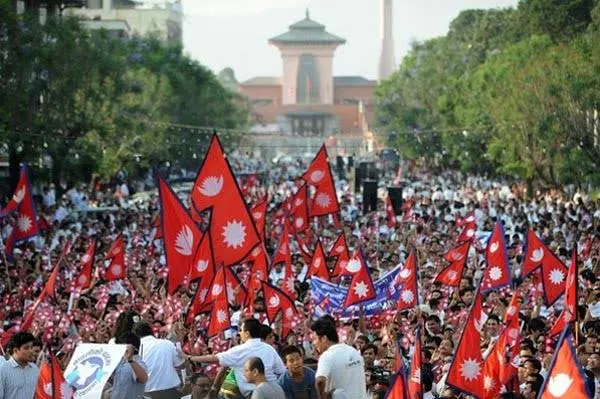
Fifteen years is a long time, even in an ancient country and a young republic. Without beating about the bush, let’s get the facts straight. Fifteen years ago, Nepal underwent a political transformation of Himalayan magnitude. It consigned a unitary system of governance and the monarchy that formed a part of it to history. The erstwhile Hindu state of sorts embraced secularism despite reservations from a large section of the Nepali populace. After the monumental change in polity, it was but natural for the people to expect things to get better. But that hardly happened. New political parties came to power and soon got corrupt. Governments came and went, leaving behind a legacy of corruption scandals, misrule, cronyism and chronic instability. The new order was supposed to build institutions to run the republican system efficiently and effectively. It ended up institutionalizing corruption instead, with major corruption scams like PLA cantonment, Yeti, Omni, Wide-body and Bhutanese refugee scandals. Without giving a hoot about the principles of separation of powers and checks and balances, the executive rode roughshod over the judiciary and imposed its will on the legislature, instead of letting it act as the truly sovereign body reflecting the people’s will. Federalism was supposed to bring the state to the very doorsteps of the people. Instead, what people have gotten are the Singhadurbars of their own—at provincial and local levels—that are quite hard to keep. Paradoxically, these monoliths resemble the state of affairs in the princely states of the yore. Like those palaces, the republican durbars also impose heavy taxes on their ‘subjects’ and they too are neck-deep in corruption and instability-plagued, with frequent changes in provincial governments becoming a new normal. Indeed, the more things change, the more they remain the same. Or do they get worse, actually? Not a day passes by without the country bidding farewell to an increasing number of youths heading abroad for jobs, education or permanent settlement. Hardly a day passes by without youths driven away by endemic corruption, instability, breakdown of law and order and a deepening economic crisis returning home dead. The transformation that was supposed to bring cheers to the people has ended up pouring cold water on popular aspirations. This has emboldened forces that were against the transformation all along. Things cannot get any worse than this, can they? Even in a gloomy scenario like this, there’s a glimmer of hope. The police probe into the refugee scam has given the government a unique opportunity to dig into infamous corruption scandals of yesteryears, those related to policy corruption in particular, and bring the guilty to justice. It can go a long way in cleansing the governance system through and through. Singhadurbar should exhibit the political will to do this, if it is indeed serious about protecting and institutionalizing the gains of the political changes that have taken place since the end of the Rana regime in 1950.

President Paudel observes Bhoto Jatra festival (With photos)
President Ram Chandra Paudel today observed the Bhoto Jatra festival, a ritualistic festival dedicated to the Rato Machhindranath, the deity of rain and bountiful harvest.
The President attended the Bhoto Jatra festival at Jawalakhel this afternoon and observed the ritual of displaying the Bhoto (the jewel-studded mythical vest believed to belong to the deity).
As part of this ritual, an employee of the Guthi Sansthan Lalitpur displayed the Bhoto from the pinnacle of a chariot of the Rato Machhindranath deity. It is a tradition to display the Bhoto on the fourth day the chariot of the deity is towed in a procession up to Jawalakhel from Lagankhel.
On the occasion, the Head-of-the-State paid homage to the Rato Machhindranath deity and also took the prasad. He also paid obeisance to the living goddess Kumari on the occasion.
The chariot festival which started from April 24 concluded today with the displaying of the Bhoto.
Vice President Ram Sahay Prasad Yadav, Prime Minister Pushpa Kamal Dahal, Speaker Devraj Ghimire, Deputy Prime Minister and Home Minister Narayan Kaji Shrestha and the government ministers were also present on the occasion.
A large number of people had also gathered at Jawalakhel to observe the festival.


