

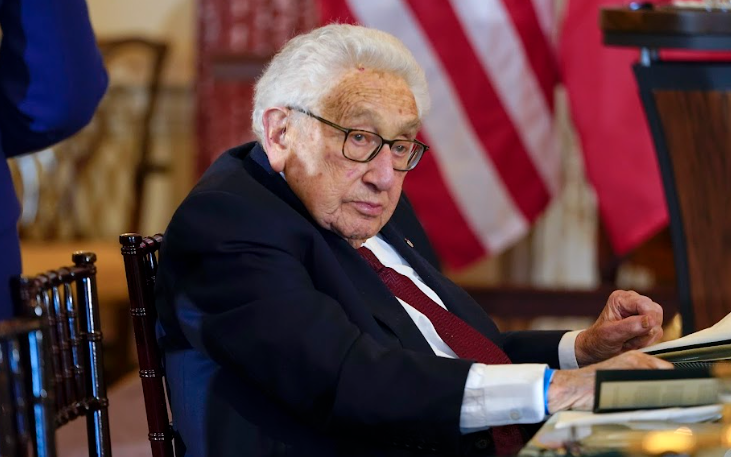
Kissinger, 100, still active in global affairs
Former diplomat and presidential adviser Henry Kissinger marks his 100th birthday on Saturday, outlasting many of his political contemporaries who guided the United States through one of its most tumultuous periods including the presidency of Richard Nixon and the Vietnam War. Born in Germany on 27 May 1923, Kissinger remains known for his key role in American foreign policy of the 1960s and 1970s including eventual attempts to pull the US out of Vietnam, but not before he became inextricably linked to many of the conflict’s most disputed actions. David Kissinger, writing in The Washington Post on Thursday, said his father’s centenary “might have an air of inevitability for anyone familiar with his force of character and love of historical symbolism. Not only has he outlived most of his peers, eminent detractors and students, but he has also remained indefatigably active throughout his 90s.” The elder Kissinger will celebrate this week with visits to New York, London and his hometown of Fürth, Germany, David Kissinger wrote. In recent years Kissinger has continued to hold sway over Washington’s power brokers as an elder statesman. He has provided advice to Republican and Democratic presidents, including the White House during the Trump administration, while maintaining an international consulting business through which he delivers speeches in the German accent he has not lost since fleeing the Nazi regime with his family when he was a teenager. As recently as this month, Kissinger opined that the war in Ukraine is reaching a turning point with China entering negotiations. He told CBS News that he expects negotiations to come to a head “by the end of the year.” He has called for peace through negotiation to end the conflict. Kissinger also coauthored a book about artificial intelligence in 2021 called “The Age of AI: And Our Human Future.” He has warned that governments should prepare for the potential risks associated with the technology. During eight years as a national security adviser and secretary of state, Kissinger was involved in major foreign policy events including the first example of “shuttle diplomacy” seeking Middle East peace, secret negotiations with China to defrost relations between the burgeoning superpowers and the instigation of the Paris peace talks seeking an end to the Vietnam conflict and the US military’s presence there. Kissinger, along with Nixon, also bore the brunt of criticism from American allies when North Vietnamese communist forces took Saigon in 1975 as the remaining US personnel fled what is now known as Ho Chi Minh City. Kissinger additionally was accused of orchestrating the expansion of the conflict into Laos and Cambodia, enabling the rise of the genocidal Khmer Rouge regime that killed an estimated 2m Cambodians. Among his endorsements, Kissinger was recognized as a central driver in the period of detente, a diplomatic effort between the US and the Soviet Union beginning in 1967 through 1979 to reduce Cold War tensions with trade and arms negotiations including the Strategic Arms Limitation Talks treaties. Kissinger remained one of Nixon’s most trusted advisers through his administration from 1969 to 1974, his power only growing through the Watergate affair that brought down the 37th president. Gerald Ford, who as vice president ascended to the Oval Office following his predecessor’s resignation, awarded Kissinger the Presidential Medal of Freedom in 1977, saying Kissinger “wielded America’s great power with wisdom and compassion in the service of peace.” Others have accused Kissinger of more concern with power than harmony during his tenure in Washington, enacting realpolitik policies favoring American interests while assisting or emboldening repressive regimes in Pakistan, Chile and Indonesia. AP

Economic survey forecast paints a bleak pic of economy
It’s official. The country's economic growth will be limited to 2.16 percent. Findings of the Economic Survey presented by Finance Minister Prakash Saran Mahat at the parliament on Sunday point out that the economic growth as projected by FY 2022/23 budget will not be achieved this fiscal year. A sharp slowdown in economic activities, slackened domestic demand, tighter monetary policy, and persistent global headwinds have adversely affected Nepal's economy in the current fiscal year. According to the survey, the slump in the construction, mining, transport, manufacturing, and wholesale and retail trade sectors dragged down the overall economic growth this year. The consumption of Nepalis is projected to increase by 8.34 percent in the current fiscal year with the Nepalis likely to spend more than Rs 5,036bn on consumption alone. The total investment has decreased by about five percent this fiscal. As per the survey, the total investment that stood at Rs 1,846bn, has decreased to Rs 1,754bn in this fiscal ‘due to a slowdown in credit disbursement and higher interest rates’. The survey has projected that the mining sector will grow by a meager 1.11 percent in FY 2022/23 compared to a growth of 8.8 percent in FY 2021/22. The construction sector, which grew by 7.08 percent in the last fiscal year, is expected to remain negative by 2.62 percent this fiscal. The wholesale and retail trade growth is projected to be negative by three percent this fiscal compared to a 7.5 percent growth in the last fiscal. The growth of the manufacturing sector is likely to decelerate by 2.04 percent in FY 2022/23 due to higher interest rates, import restriction measures, and the slowdown in domestic consumption. The electricity and accommodation (hospitality) sectors will have the highest growth in FY 2022/23, per the report. The electricity sector will grow by 19.4 percent while accommodation will grow by 18.6 percent. A gradual recovery in the tourism sector with a surge in tourist arrival has helped the hospitality sector. The survey shows the government’s capacity to spend the allocated budget has weakened. The fact that only 248 kilometers of road were blacktopped in the current fiscal, compared to 618 kilometers last year, illustrates this decline. The survey says only 104 kilometers of new roads have been constructed till the first eight months of FY 2022/23 compared to 155 km in the corresponding period of FY 2021/22. The same is the case with bridge construction. Only 75 new bridges were constructed this fiscal, compared to 80 bridges in the last fiscal. The silver lining is the energy sector where the installed capacity of electricity generation has increased by 21.7 percent this fiscal. Nepal’s electricity generation capacity has reached 2666 MW from 2190 MW in mid-July 2022, according to the survey. It is estimated that 57 hydropower projects will be completed by the end of this fiscal year, adding 811 MW to the national grid. “It is estimated that an additional 754 MW of electricity will be generated from 36 projects to be completed in the fiscal year 2080/81,” the survey states. In a nutshell
- Economic growth in FY 2022/23 projected at 2.16 percent
- Size of GDP estimated at Rs 5,381bn
- Negative growth in manufacturing, construction, wholesale and retail trade sectors
- Energy and hospitality sectors to grow by double-digits
- 811 MW likely to be added the national grid
- Growth of mining and transportation sectors to remain lower than last fiscal
- Consumption of Nepalis is projected to increase by 8.34 percent in the current fiscal

Nepse plunges by 17. 35 points on Sunday
The Nepal Stock Exchange (NEPSE) plunged by 17. 35 points to close at 1,941.77 points on Sunday. Similarly, the sensitive index dropped by 1. 90 points to close at 369. 42 points. A total of 7,049,699-unit shares of 268 companies were traded for Rs 2. 63 billion. Meanwhile, Aatmanirbhar Laghubitta Bittiya Sanstha Limited was the top gainer today with its price surging by 10.00 percent. Likewise, Himalaya Urja Bikas Company Limited was the top loser with its price dropped by 6. 40 percent. At the end of the day, the total market capitalization stood at Rs 2. 83 trillion.

50 injured as police, protesters clash in Biratnagar
At least 50 persons were injured when police and groups protesting against the renaming of Province 1 as Koshi clashed near Koshi Province Assembly building in Biratnagar on Sunday. According to the police, 38 security personnel and 12 protesters were injured in the clash. It has been learnt that 23 Nepali Police and 15 Armed Police Force (APF) personnel were injured in the incident. Police said that the number of injured from both sides may increase. “The details of all the injured have not been received as it is in the early stage,” police said. All the injured are undergoing treatment in various hospitals of Biratnagar. A source said that police fired 16 rounds of bullets in the air and also lobbed 61 teargas shells to take the situation under control. Police said that they were attacked with stones, batons and bottles. The situation near the Province Assembly building and other places has returned to normal. Police have also arrested 24 persons, who played a role to incite the protest, from the incident site. Prior to that, 37 persons were apprehended. The second and budget session of the Koshi Province Assembly was called at 2 pm today.

The ever-increasing social security expenses
Amid concerns over the high cost of pensions, French President Manuel Macron didn’t hesitate to increase the retirement age in France from 62 years to 64 years, despite months of protests against the plan. While countries are taking prudent measures to manage pensions and other long-term liabilities, not much serious thought has been given in Nepal about managing pensions as well as ever-increasing social security expenses. In fact, successive governments in recent years have been competing to increase social security allowances even though the cost of such allowances has been rising rapidly. The rise in life expectancy of Nepalis has also put a question mark on such practices. While presenting the budget for the fiscal year 2021/22, the government led by then Prime Minister KP Sharma Oli raised all social security allowances by 33 percent, including the elderly allowance to Rs 4,000 per month from Rs 3,000 per month. A year later, the Sher Bahadur Deuba-led coalition government lowered the eligibility age for receiving an elderly allowance to 68 years from 70 years. This move has come at a time when the life expectancy of Nepalis has been rising. The lowering of the age for elderly allowance coupled with the decision to hike the civil servants' salaries contributed to a massive rise in government expenses in the current fiscal year. As a result, the government struggled to pay salaries to its employees and pensions respectively in a timely manner in this fiscal year as revenue shrank owing to the contraction in economic growth and decreased imports. Economists said that the government should have streamlined the social security scheme. According to them, the government could spend a higher amount of state resources on improving the quality of health and services and make these services affordable to the majority of people instead of doling out cash for individuals. “The state cannot roll back social security allowances as the constitution has mandated the government to provide social security coverage to the citizens,” said economist Chandra Mani Adhikari, “However, it has increased the liabilities of the government. Hence, it should be managed properly.” According to Adhikari, given the resource crunch the government is going through currently, it is high time to avoid duplicity in social security. “Those who’re receiving pensions from the government should not be given the elderly allowances,” he said. According to the Department of National ID and Civil Registration, the number of beneficiaries to receive elderly allowance increased by 295,281 as of mid-April of the current fiscal year 2022/23 since the eligibility age was lowered. As of mid-April this year, there were 1.60m beneficiaries of elderly allowance above the age of 68 years while there were only 1.31m beneficiaries over the age of 70 years at the end of the last fiscal year 2021/22. With each beneficiary receiving Rs 4,000 per month, the overall stood at Rs 14.17bn by mid-April and it is bound to rise by the end of the current fiscal year mid-July. Over the last several years, the number of beneficiaries of social security allowance and the amount to be given to each beneficiary has been rising rapidly. There were 2.04m beneficiaries of social security allowance in fiscal 2011/12 which increased to 3.57m in the last fiscal 2021/22. The amount being spent on them has however been rising even faster. For example, the government spent Rs 68.61bn on social security allowances in the fiscal year 2020/21, according to the Department of National ID and Civil Registration. In FY 2021/22, it rose to Rs 88.68bn. The government is expected to spend nearly double that amount in the current fiscal year due to an increased number of beneficiaries and an increased amount for them. The government has allocated Rs 105.7bn for social security allowance in the current fiscal year, according to the Finance Ministry. However, the department has already said that the allocated budget would not be enough because of lowering the age to receive the elderly allowance. The government’s social security expenses surged at a time when it is struggling to pay salaries and pensions to its employees and retired employees due to a severe constraint on resources. In the current fiscal year, revenue collection has dipped and the transfer of funds from donors has gone down significantly. According to the Financial Comptroller General Office, the revenue collection of the government decreased to Rs 778 billion as of May 24 of the current fiscal year, down from Rs 887 billion during the same period last fiscal year. But there has been rising pressure on government resources with each government focusing on increasing the long-term liabilities. Besides elderly allowances, the government also distributes social security allowances to Dalit children, widows, disabled people, tribes on the verge of extinction, and children from communities on the verge of extension among others. The first social security scheme in Nepal was launched in 1994/95 by the government led by the then CPN (UML) leader Manmohan Adhikari. The scope of the scheme, which started by providing Rs 100 a month to the elderly, was gradually expanded to include other types of beneficiaries. In South Asia, Nepal’s spending on social spending is relatively higher than many other countries. According to a report of the United Nations Children Fund (UNICEF) released in 2020, India, Nepal, and Maldives are the only ones where public spending on social assistance exceeds 1 percent of the Gross Domestic Product (GDP). These estimates indicate that India has the highest spending in the region (1.5 percent of GDP). At the other end of the distribution, Bangladesh, Sri Lanka, Pakistan, and Bhutan all spend less than 1 percent of GDP on social assistance. The World Bank in a report has said the overall public spending on social protection rose rapidly in Nepal for a decade—from the fiscal year 2010/11 to fiscal 2019/20. According to the report, the government’s spending on overall social protection was Rs 26bn in the fiscal year 2010/11, which surged to Rs 189bn in fiscal 2019/20, which includes both cash dole-out and other social protection programs.

Govt preparing to close ‘sick’ projects
The government is working on bringing a policy to shut down the ‘sick’ projects that have not seen any meaningful physical progress for a long time. According to government sources, the federal budget for the fiscal year 2023/24 is introducing a policy to close down such projects. While billions of rupees are being spent every year to complete the projects, not much progress has been achieved which has resulted in an additional financial burden on the government. With the government currently battling with a severe resource crunch, it is not in a situation to allocate budgets for such projects. “The government has been spending huge resources in the name of sick projects. However, such projects have not been completed,” said a senior official of the National Planning Commission (NPC). “Now there is no rationale to continue such projects. We are bringing a policy to end such projects.” Government officials said that a separate study will be initiated after the federal budget about the need for such projects. While construction of some projects will be taken forward based on priority, the majority of sick projects will be shut down. The government plans to close sick projects by shifting the human resources and machinery to other projects. Currently, many projects in the sectors such as road, irrigation, and hydropower are in ‘sick’ condition. There are a lot of sick projects, especially in the road sector. The Ministry of Physical Infrastructure and Transport had recently identified 264 contracts as being in a bad state. While the government is yet to release the latest data on ‘sick’ projects, the number of such projects is estimated to be over 1,200. The report of the Commission for Investigation of Abuse of Authority (CIAA) three years ago, had stated that as many as 1,202 projects with a combined value of Rs 86.44bn are in a bad state. These projects—some of which were signed in 2009—are related to seven development-focused ministries. Following this discovery, the anti-graft body has repeatedly instructed the government agencies to either ensure that the works in sick projects are accelerated or terminate their contracts. One of the reasons why so many contracts have remained sick is the trend of awarding a large number of contracts to a small number of contractors. After the Covid-19 pandemic, the government extended the deadline for such projects amending the Public Procurement Regulation. Starting construction work without preparing a detailed project report (DPR), no clarity in the project implementation modality, land acquisition, and compensation disputes, and lack of inter-agency coordination in the transfer of utility services have plagued the development of the projects and billions of rupees go to waste. According to the CIAA report, the highest number of 'sick' projects are related to the Ministry of Physical Infrastructure and Transport, followed by the Ministry of Urban Development (442), and the Ministry of Energy, Water Resources and Irrigation, according to the report. The CIAA also studied the projects under the Ministry of Urban Development, the Ministry of Federal Affairs and General Administration, the Ministry of Tourism, and the Ministry of Water Supply.

Meet Nepal’s youngest doctor
Dr Himani Vyas is the youngest doctor of Nepal. The 22-year-old got her bachelor of medicine and bachelor of surgery (MBBS) degree from All India Institute Of Medical Sciences (AIIMS), and is now looking forward to pursuing a postgraduate degree. She received the 55th all India rank and the first rank for foreign national category in the Institute of National Importance Combined Entrance Test (INICET), an entrance test conducted by AIIMS for post-graduate degree enrolment program in India. Born in Biratnagar, Vyas spent most of her life in Kathmandu. She did her schooling from Little Angels’ School and DAV Sushil Kedia Vishwa Bharati School in Lalitpur, and completed her high school from Nasa International College. But never did she once think that she would be choosing a medical career in the future. As is common in case of most Nepali students, Vyas elected to study science because she had a good score. “I took biology because I received good grades on my school days,” she says. “Although there came a time when I wanted to switch to math, my teachers convinced me to continue with biology, and so I did.” Vyas says she was never into botany, but she was very much interested in zoology, which encouraged her to study medicine. “I liked knowing about human and animal anatomy, but plants were not my thing.” Vyas studied out of sheer curiosity, rather than with an intent of acing her test. “My curiosity and the habit of doing an in-depth study on the subject of my interest helped me in my exams,” she says. This habit was fostered by her parents, both of them teachers. Vyas’ brother, Dhurv is also a brilliant student in his own right. He discovered an asteroid at the age of 11, while participating in the All-Nepal Asteroid Search Campaign. Her habit of studying different topics to satisfy my curiosity led her to pass the entrance test to pursue MBBS. The same can be said for the ranks she received in INICET. “I honestly never thought I would do MBBS, but somehow I ended up becoming a doctor,” says Vyas, whose interest was engineering. She says while she was still doing her MBBS, she even thought about becoming a researcher. But she is happy that she decided to stick with the study of medicine. But studying to be a doctor and actually working in the field is quite different. This, she learned during her internship in AIIMS, which she completed in Jan 2023. During her internship period, Vyas and her fellow medicine students visited different parts of India to treat patients. “We had no supervisors, and it was up to us to treat all these patients,” says Vyas. “It could be overwhelming at times.” Sometimes, some patients would not make it, and Vyas says confronting their family members was the most difficult part. “We were always told by our teachers that sometimes patients die, that we have to be objective. But when it happens before you and you have to be the bearer of bad news, it isn’t easy.” “It will never get easy,” adds Vyas, “but then you have to stay strong because you have other patients to look after.” Currently, Vyas is looking forward to getting her PG at AIIMS. “It’s a three-year course, and I hope it’ll be fun and I’ll get to learn a lot,” she says. Vyas doesn’t have a specific plan on where she will practice her discipline after getting her degree. She wants to return to Nepal, but at the same time, fears that she won’t be able to do her job effectively due to the lack of proper healthcare facilities in the country. She can only hope that Nepal’s healthcare sector would have developed a lot in terms of infrastructure and resources by the time she completes her studies. “No matter where I start my career, I will eventually come back to Nepal,” says Vyas. “This is my home and this is where I want to be.”

Govt decides to recommend President’s Office to pardon sentence of Chaudhary
The government has decided to recommend the President’s Office to pardon the jail sentence of Resham Chaudhary, who is serving a life term in Dillibazaar Prison after being convicted of masterminding the 2015 Tikapur massacre. Making public the decisions of the Cabinet meeting held on Sunday morning, government spokesperson and Minister for Communications and Information Technology Rekha Sharma said that the government has decided to recommend the President’s Office to pardon the sentence of Chaudhary. Earlier, President Ram Chandra Paudel had withdrawn the proposal to pardon Chaudhary. Minister Sharma said that the government has recommended the President's Office to pardon Chaudhary on the occasion of Republic Day. Nagarik Unmukti Party leader Chaudhary will be released on the Republic Day if the President’s Office implements the recommendation of the government. Meanwhile, the Cabinet meeting to be held on Monday will decide on the agenda of Prime Minister Pushpa Kamal Dahal's India visit. Prime Minister Dahal will pay an official visit to India from May 31 to June 3 at the invitation of his Indian counterpart Narendra Modi.


