


White House defends Hegseth amid new Signal accusation
The White House defended Defense Secretary Pete Hegseth following reports that he disclosed sensitive military information in a signal chat with his wife and brother. While neither the administration nor Hegseth denied the communication took place, they dismissed the claims as leaks from disgruntled employees, insisting no classified material was revealed, Firstpost reported.
President Trump condemned the accusations as "fake news," blaming them on internal opposition: "He was tasked with eliminating negative individuals, so you don't always make friends." However, Senate Democratic Leader Chuck Schumer has demanded Hegseth's dismissal.
The controversy comes amid heightened scrutiny of the Pentagon, with multiple senior officials departing and an ongoing internal investigation into information leaks. Notably, some of those who left were part of Hegseth’s original team, according to the Firstpost.
The incident follows an earlier Signal chat leak involving discussions of a military airstrike in Yemen.

Harvard sues the Trump administration over funding cuts
Harvard University filed a federal lawsuit on Monday challenging the Trump administration’s proposed $2.2 bn in funding cuts, calling the move an unlawful overreach, according to BBC.
The lawsuit follows escalating tensions after Harvard rejected demands from the Trump administration aimed at curbing diversity programs and addressing anti-Semitism.
The administration’s demands included government-approved audits of Harvard’s curriculum, admissions, and hiring practices. Harvard President Alan M. Garber warned the consequences of the government’s actions would be “severe and long-lasting,” criticizing the intrusion into academic independence, BBC reported.
In addition to freezing federal funds, the Trump administration also threatened the university’s tax-exempt status and its ability to enroll international students.

South Korea finds 'Made in Korea' breaches intended to bypass US tariffs
South Korea’s customs agency has uncovered a rise in attempts to disguise Chinese goods as Korean exports to evade U.S. tariffs.
A recent investigation by the Korea Customs Service uncovered 29.5 bn won ($20.81 m) in origin breaches in the first quarter, with 97% of the shipments destined for the United States, according to Reuters.
This compares to 34.8 bn won in total violations in 2024, with 62% of that amount coming from items intended for the United States. The hike comes after President Trump imposed new tariffs, including a 25% duty on South Korean exports, which is presently postponed for three months.
South Korean and US officials met Monday to explore cooperative investigations amid fears that foreign corporations are using South Korea to avoid trade restrictions, Reuters reported.

Trump threatens $1bn Harvard cut over protest response
The Trump administration plans to cut $1bn in Harvard research funding amid an ongoing clash over the university's handling of pro-Palestinian protests, the “Wall Street Journal” reports.
This follows earlier sanctions over alleged failures to address campus antisemitism, Reuters reported.
Harvard recently rejected White House demands for monitoring of school policy, forcing the administration to halt $2.3 bn in cash and threaten Harvard's tax-exempt status. Officials were stunned when Harvard made private negotiation demands public, according to Reuters.
Since January, Trump has targeted elite universities over protest responses, accusing them of tolerating antisemitism.

Norwegian PM, Finance Minister to Meet Trump in Washington
Norwegian PM Jonas Gahr Stoere and Finance Minister Jens Stoltenberg will meet U.S. President Trump at the White House on Thursday for talks on NATO, Ukraine, and bilateral trade relations.
The conversations take place in the midst of ongoing trade adjustments, including a recent tariff reduction by the United States from 15% to 10% on specified Norwegian imports for a 90-day period. According to Reuters, Stoere stressed the importance of collaboration between the United States and Norway, referring to America as a "key trade and security partner."
The presidents are expected to discuss ways to enhance economic connections while also addressing shared geopolitical challenges, notably in Europe's security picture.
Norway, although not being a member of the EU, has supported Western sanctions against Russia and increased defense spending in response to the Ukraine crisis, Reuters reported.

Russian drone attacks reported by Ukraine after 'Easter truce' ends
Ukraine’s military has reported Russian drone attacks on several regions overnight, shortly after a 30-hour “Easter truce” declared by Moscow expired. Air raid alerts were issued in Kyiv and other areas, while explosions were reported in Mykolaiv, according to BBC.
The Russian Defence Ministry claimed it had “strictly observed the ceasefire,” which was unexpectedly announced by President Putin on Saturday. However, both Ukraine and Russia have accused each other of violating the temporary truce.
The renewed strikes come as the conflict continues into its third year, with escalating drone warfare and no sign of a lasting resolution, BBC reported.
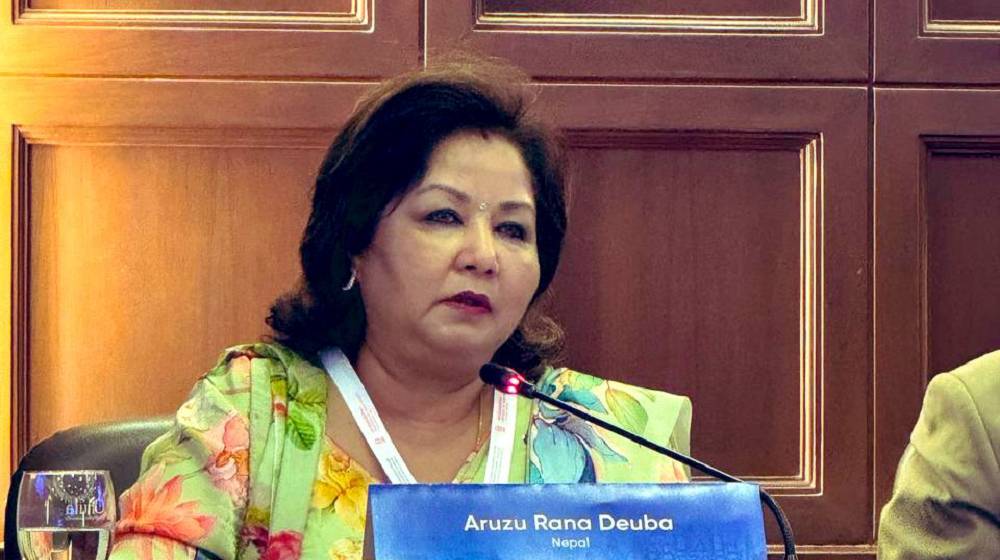
Asia-Pacific region faces number of critical policy challenges: Minister Rana
Foreign Minister Arzu Rana Deuba has said that the Asia-Pacific region faces a number of critical policy challenges.
She said this in her Acceptance Speech as the Chair of the 81st session of the Economic and Social Commission for Asia and the Pacific (ESCAP) in Bangkok, Thailand, today.
According to the Minister, the challenges include: the rising fiscal vulnerabilities as well as financial limitations; trade fragmentation and protectionist trends that threaten to reverse hard-won development gains; the digital divide—particularly between urban and rural communities; the inadequate social protection systems and the region remaining at the frontlines of climate-induced disasters.
Further explaining the challenges, Minister Rana said that the rising fiscal vulnerabilities as well as financial limitations are constraining the ability of governments to deliver essential services and make the necessary long-term investments in human capital and sustainable infrastructure.
"The digital divide—particularly between urban and rural communities—remains stark. Without urgent action, this divide will not only deepen inequality but also hinder inclusive growth," she said, suggesting significantly increasing investments in social protection, drawing from best practices across the globe and tailoring them to our regional context.
Stating that the Asia-Pacific region is on the frontlines of climate-induced disasters, Minister Rana said, "Our cities and communities are vulnerable to devastating floods, droughts, and extreme weather events."
Minister Rana on the occasion stated that the 81st session of ESCAP is taking place at a time of global and regional transformation and the Asia-Pacific region today confronts a number of critical policy challenges.
"Our Himalayas, which are not only the source of water but also the livelihoods and civilization, have been disproportionately affected by the impact of climate change. Building climate resilience and investing in early warning systems is not a choice, but a necessity," she said, adding that in response, many of our governments have taken important steps; but if we are to succeed in protecting the well-being of our people and planet, we must do more—and we must do it together.
Highlighting the theme of the session: “Regional cooperation for resilient and sustainable urban development in Asia and the Pacific”, she said that the urban areas are the engines of growth, innovation, and opportunity.
"But unplanned urbanization would bring many problems. We must have well-planned urban development. To ensure that we achieve resilient and sustainable urban development, we must invest in cities that are inclusive, green, and resilient; strengthen urban networks and city-to-city cooperation; plan proactively for demographic transitions; and mobilize diversified financing," Dr Rana, Chair of ESCAP 81st session, reiterated.
She emphasized on the importance of regional cooperation in these endeavors.
"No country can tackle these challenges alone. Regional cooperation is essential. It is what binds our collective efforts, and the force that multiplies the impact of national actions," she said, adding that in this context, ESCAP plays an indispensable role.
"As the regional development arm of the United Nations, ESCAP provides a common and action-oriented platform for dialogue, knowledge exchange, and policy innovation. At a moment when uncertainties permeate the future, the work of ESCAP is vital to harness regional cooperation and collaboration to realize internationally agreed upon development goals."
Noting that the road ahead is challenging, Minister Rana said, "But with the spirit of cooperation that defines our region, and with the vital work of ESCAP, we can overcome these obstacles. Let us reaffirm our shared commitment to inclusive development, to regional cooperation, and to the values of the United Nations. Let us strengthen our collaboration for the wellbeing of our people and the future of our planet."

Nepse plunges by 4. 04 points on Monday
The Nepal Stock Exchange (NEPSE) plunged by 4. 04 points to close at 2,701.99 points on Monday.
Similarly, the sensitive index dropped by 0. 61 points to close at 455. 96 points.
A total of 21,203,766-unit shares of 319 companies were traded for Rs 8. 77 billion.
Meanwhile, Nepal Micro Insurance Company Limited (NMIC) and Crest Micro Life Insurance Limited (CREST) were the top gainers today with their price surging by 9. 99 percent. Likewise, NMB Hybrid Fund L- II (NMBHF2) was the top loser with its price dropped by 7. 90 percent.
At the end of the day, the total market capitalization stood at Rs 4. 48 trillion.


