

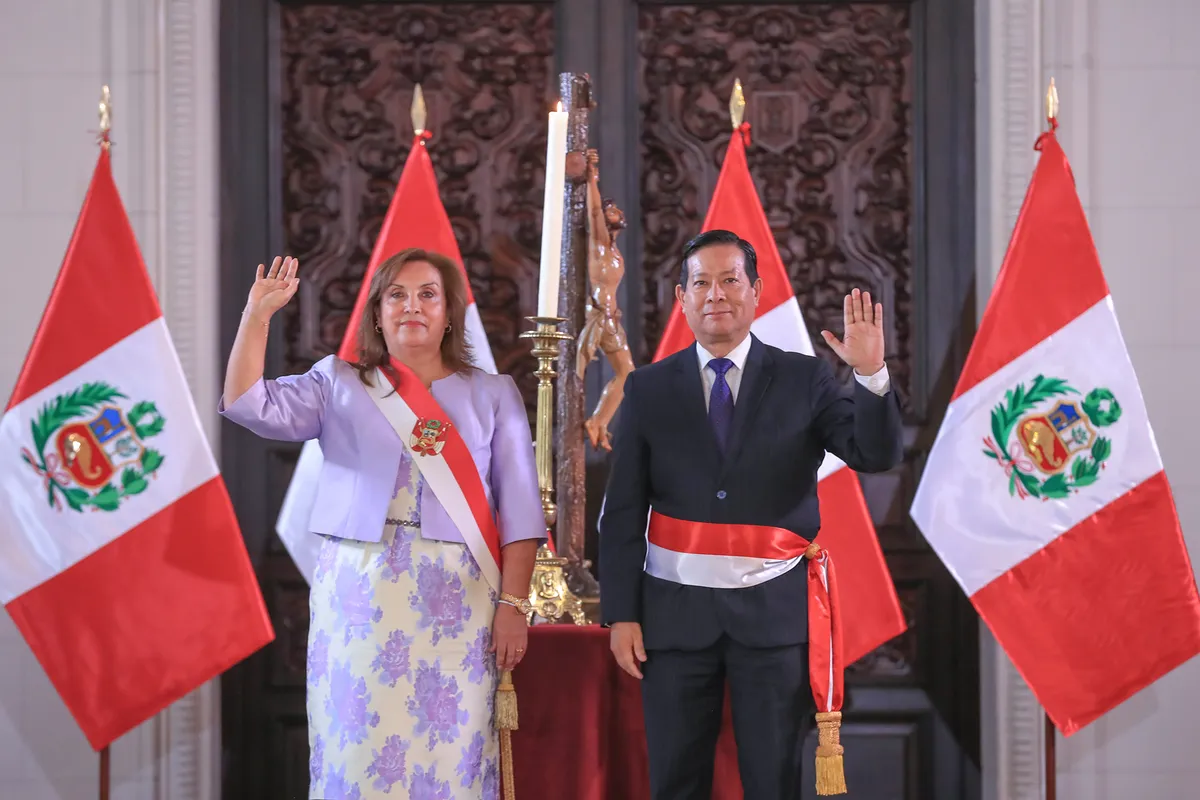
Peru appoints new Prime Minister after resignation
Peruvian President Dina Boluarte appointed Eduardo Arana as the new prime minister on Wednesday, following the resignation of Gustavo Adrianzen.
During the swearing-in ceremony, Arana pledged to serve faithfully and without corruption. President Boluarte also appointed new Cabinet members who will serve for the remainder of her term, ending in 2026, Xinhua reported.

Deep-Sea quake shakes Indonesia’s East
A 5.9-magnitude earthquake struck off Indonesia’s eastern Maluku province on Thursday morning, according to Xinhua.
The earthquake struck at 7:50 a.m. Jakarta time, with the epicenter situated 189 kilometers southwest of Maluku Barat Daya Regency at a depth of 515 kilometers.The tremor was reported with moderate intensity (III MMI) in Tiakur, the regency's capital.
Authorities confirmed there was no tsunami threat due to the quake’s deep origin.
Indonesia is prone to seismic activity as it lies within the Pacific Ring of Fire, Xinhua reported.

Deadly highway crash in Mexico claims 21 lives
At least 21 people were killed in a three-vehicle collision on Wednesday morning along the Cuacnopalan-Oaxaca highway in Puebla state, central Mexico.
Local official Samuel Aguilar Pala confirmed that 18 victims died at the scene, while three others passed away in hospital. Several more were injured and are receiving medical care, BBC reported.
The crash involved a cement truck, a bus, and a van. Initial reports suggest the collision occurred when the truck attempted to overtake the van.

Germany arrests three Ukrainians over alleged Russian parcel bomb plot
German prosecutors stated on Wednesday that three Ukrainian nationals had been arrested in connection with a suspected sabotage plot aimed against Russian-linked transit networks. The arrests took place in Cologne and Konstanz, Germany, as well as in the canton of Thurgau, Switzerland.
The suspects are accused of planning arson and explosive assaults in Germany on behalf of others suspected of working for Russian state officials. Authorities also claim the organization intended to send explosive devices from Germany to Ukraine, designed to detonate during transit, as reported by Firstpost.
The case is being investigated as a foreign intelligence operation designed to disrupt German infrastructure. The suspect apprehended in Switzerland is expected to be extradited to Germany for additional legal proceedings.

Putin skips Ukraine peace talks in Istanbul
Russian President Vladimir Putin will not attend proposed peace talks in Istanbul with Ukrainian President Volodymyr Zelensky, the Kremlin said on Wednesday. This practically puts a stop to the chance of the two leaders meeting in person for the first time since the conflict began.
Instead, Russia will be represented by Vladimir Medinsky, Putin's personal advisor who previously conducted negotiations with Ukraine in 2022, Firstpost reported.
Zelensky had earlier expressed willingness to travel to Istanbul if Putin agreed to join. “If Putin does not arrive and plays games, it is final proof that he does not want to end the war,” he said on Tuesday.
There had been speculation that US President Donald Trump, currently visiting the Middle East, might also participate in the talks, according to the Firstpost.

US cuts $450m in Harvard grants amid policy dispute
The US administration has withdrawn $450m in subsidies to Harvard University in response to Harvard President Alan Garber's criticism of alleged government overreach. This comes on top of the $2.2bn in federal funding that were halted last month.
Harvard, according to the administration's Joint Task Force to Combat Antisemitism, has failed to confront antisemitism and racial prejudice. It has also threatened to suspend the university's tax-exempt status and access to international student programs, as reported by Xinhua.
Harvard has rejected the demands, which include governance reforms and policy adjustments, and is now suing the government. The dispute is part of a larger federal assault on university diversity policies and campus antisemitism.

Twenty states sue over Trump's push to link grants to immigration enforcement
Twenty US states, including California, New York, and Rhode Island, have filed lawsuits against the Trump administration, contesting federal policy linking money to immigration enforcement. The lawsuits, filed in the District of Rhode Island, target the Departments of Transportation, Homeland Security, FEMA, and the Coast Guard, Xinhua reported.
The states claim that the federal government is improperly forcing them to enforce immigration rules by threatening to withhold emergency and transportation funds, which violates constitutional restrictions and state autonomy.
The lawsuits mention a letter from Transportation Secretary Sean Duffy dated April 24 and an executive order issued by President Trump on April 28. Duffy stated that no funds had been withheld and accused the states of violating federal laws, according to Xinhua.

Chinese jets set to shake up global aviation market: IATA
Chinese-made aircraft are ready to promote competition and reduce prices in global aviation, according to International Air Transport Association (IATA) chief Willie Walsh on Tuesday.
Walsh commended Commercial Aircraft Corporation of China, Ltd.'s (COMAC) modern, efficient jets as viable alternatives to existing fleets during a conference in Nairobi, emphasizing that they largely fly in China and neighboring countries with Chinese certification, according to Xinhua.
The IATA Ground Handling Conference gathered global airline leaders to discuss strategies to boost the aviation ecosystem.


