


Quick questions with Asmita Lamichhane
(1)_20200422193042.jpg)
Something you’ve done often during the lockdown?
I have been reading and spending time with my family members. I realized I’d been so busy that I hadn’t seen my family members up close in a long time.
A movie/series you would suggest for the lockdown?
All Nepali movies on my list: “Ujeli,” “Numafung,” “Mukundo,” “Maitighar,” “Basudev.”
Have you read anything lately? Would you suggest it?
I’d definitely suggest “Sumnima” and “Babu, Aama ra Chora,” both by BP Koirala.
Best music to listen to during the lockdown?
Parvathy Baul, Nina Simone, Narayan Gopal, Kumar Sanu.
How do you work out during the lockdown?
I do yoga with my family
How long do you think the lockdown will last?
I don’t know. Maybe a day before till it’s called off?
What is the first thing you’ll do when the lockdown is over?
I want to visit a temple. It’s been long since I’ve met God in His abode.
If not at home, where would you preferably be locked down?
As an actor maybe in a mental hospital since it would be an opportunity to observe different characters (laughs). But as a normal human being, maybe a Vipassana center.
If you were to be locked down with a Nepali celebrity for 21 days, who would it be?
Madhav Prasad Ghimire. I’d make him kheer because I know he loves it and then he could recite poems to me.
One dish you wouldn’t mind eating everyday during the lockdown?
Dal Bhat!

Editorial: PM Oli’s myopia grave risk for Nepal
On April 21, the news of detection of 11 new Covid-19 cases in Nepal added to public unease. They were already struggling to digest the federal government’s untimely decision to amend some important laws. The previous day, the KP Oli-led cabinet had proposed legal changes—swiftly endorsed by President Bidya Devi Bhandari—that made it easier to split political parties. They also made the role of the leader of the main opposition party redundant in the constitutional council, a body tasked with making appointments to vital constitutional bodies. Whatever gloss PM Oli tries to put on these changes, they are unmistakable signs of his desire to cling to positions of power.
If co-chair Pushpa Kamal Dahal and other senior Nepal Communist Party leaders gang up against him, Oli can now split the ruling party with the support of 40 percent of its federal lawmakers. He can then potentially retain his top positions in the government and the breakaway party—in what will be a classic case of cutting off the nose to spite the face. Nepalis are struggling to understand the need for such legal shenanigans when government attention should have been firmly on the Covid-19 crisis. The hope was that this government, with its near two-thirds support in the national legislature, would serve out its five years and give the country much-needed political stability. But untamed ambitions of individual leaders could yet again upend this hope.
The pair of new ordinances makes us question the ability of the NCP-led government to collectively fight the corona pandemic, and threatens to snuff out any hope of the country’s swift post-pandemic economy recovery. Instead, if and when the corona threat dies down, the country could see a repeat of the kind of mad scramble for power that had become a hallmark of the post-1990 polity. Oli can offer no credible justification for his creeping authoritarianism and for inviting yet another era of instability and uncertainty—and certainly not at this time of national emergency.
People had overwhelmingly plumped for Oli and his communist coalition in the 2017 elections, rewarding his resolute stand against India during the blockade. How fast has Oli’s star fallen! His calculations that the new amendments will allow him to cement his power could be wrong. Oli seems to have learned little from the self-inflicted wounds of Nepali ruling parties over the past three decades. Moreover, with his latest attempt at power-grab, the near-septuagenarian prime minister has run a bulldozer over democratic norms and done irreparable harm to his party and his country.

Best VPNs for unrestricted net use
What we’re going to tell you today might be borderline illegal in Nepal. Or it might not be. Without clear directives, we don’t know.
We’re talking about the Virtual Private Networks (VPN). In simple terms, solutions that help you mask your IP Address to protect you from the potential threat of hackers (think using torrents), and let you access websites that have been banned.
When we say banned, we don’t mean only the porn websites that our super-intelligent Nepali government banned to curb sexual violence. It includes offerings of service providers like Netflix, Hotstar and even YouTube that may not show certain videos in Nepal. VPN helps users access those videos and plenty of other materials not available in Nepal.
So it’s not all sex and crimes with VPN. People can use it for protection and recreation.
ExpressVPN
The ExpressVPN is compatible with almost all available routers and operating systems and allows up to five simultaneous connections. With 256-bit AES encryption and a no-logs policy, ExpressVPN with 3,000+ servers in over 90 countries allows unlimited bandwidth and data.
This VPN service has a 30-day money back guarantee and is extremely secure and includes an automatic kill switch to prevent leaks during accidental disconnects, and split tunneling that allows you to choose what traffic passes through the VPN. Access to so many IP addresses allows the service to go undetected even by the strictest anti-VPN measures.
ProtonVPN
The ProtonVPN comes with unlimited free data and no-log policy adhering to Swiss privacy laws to protect your anonymity. It offers a limited free version, which gives you access to servers in Japan, Netherlands and US only. But the unlimited data even on the free version sets ProtonVPN apart from similar other services.
Upgrading to a paid plan will boost the performance and speed but you can use the free virtual locations to bypass censorship and access geo-blocked social media platforms and messaging apps.
Along with an easy-to-use, intuitive interface and multi-platform compatibility, this VPN also offers strong security, including powerful AES encryption and an automatic kill switch.
Windscribe
Windscribe allows 10GB of free data every month and with its robust encryption, malware protection and ad blocking, this VPN also offers a desktop app and browser extension.
The free version restricts you to servers in the US, the UK, Canada, France, Germany, Hong Kong, the Netherlands, Norway, Romania, and Switzerland. But this should be more than enough to unblock most contents on the web.
Windscribe comes with a firewall that blocks all traffic outside the VPN’s secure tunnel in order to prevent unexpected leaks. The company has a detailed privacy policy that clearly explains what data they store, as well as a no-logs policy to protect your privacy.

Subhadra Dulal is a rare Nepali hero during the pandemic
The building of Western Regional Health Laboratory is cordoned off by ropes encircling it. This is the place where the novel coronavirus is tested in Pokhara, the famous tourist city in western Nepal. Before the pandemic, the lab was open to all and it carried out all types of medical diagnostic tests.
The lab is Subhadra Dulal’s office, where she reaches around eight every morning, traveling 25 km. She leaves behind her daughter of 16 months and a son of 4 years with her in-laws. Initially, the in-laws did not know she conducted coronavirus tests; only her husband knew.
Dulal is not scared, unlike many others in her profession who are shirking their jobs over the safety of their own health. When the provincial government wanted to build a rapid response team to handle the Covid-19 pandemic, many of her colleagues refused to be a part.
“Even if I can isolate just one case, I save the family, the society, and the nation as a whole,” says Dulal with visible pride.
When APEX caught up with her outside the lab, she was in a hurry. Some swabs had already been collected for corona testing. Some were on the way. It would take several hours to finish the work. She had to rush back home to breastfeed her daughter.
During last year’s dengue epidemic, she had buried herself in the lab, testing hundreds of samples. In 2015, she was posted in Gorkha, when the earthquake struck. She was 8-month pregnant then. But that didn’t deter her from going out in the village and helping the people. For the graduate in medical lab technology and a government employee, nothing feels as good as giving back to the society.
Covid-19 testing is a serious job. When the provincial government first chose her for it, she felt excited but nervous at the same time. There were few safety measures in place. She went to Lekhnath Community Lions Hospital to get sample from one suspected patient, which was her first corona-related job.
“The first time, I was quite scared while taking the swab. When I reached home, I entered from the back door to avoid touching the kids. I took a shower before going near them,” she recalls. The sample tested negative for Covid-19.
Now her lab is better equipped and she doesn’t worry as much. “In the lab we have adequate personal protective equipment as well as well as a biosafety cabinet. If the virus somehow escapes into the lab, the machine kills them and prevents infection,” she says. The lab is currently operating with six technicians. The federal government has given a PCR machine that can conduct one test an hour. Another, older machine tests 72 samples an hour.
Dulal has always liked helping others, and took up medical technology of her own choice. “The provincial government thinks I can do this job. Many of my colleagues do not have that opportunity,” she says.
Editorial: Nepal must not let down its guard
With another extension of the Nepal lockdown, to April 27, people’s patience is wearing thin. Humans are just not used to being cooped up in their homes for weeks on end. The first few days and weeks of lockdown, as evidence from around the world suggests, can increase family bonding and prompt reflection about our lives and our careers. It also acts as a sobering reminder that however much humankind has progressed, a freak natural accident can still bring the world to a standstill in a jiffy. But a chance at retrospection and renewal aside, there is only so much you can endure.
What if there is no other option, though? Accept it or not, Nepal has only just started on its corona journey. As testing speeds up, so will the number of confirmed corona positives, and it could be months before Nepal reaches its ‘peak’ cases. And as the number of cases mount, the lockdown will get stricter still. Some places are already being sealed off. In the next few weeks and months, if scientific projections are to be believed, South Asia as a whole will be pummeled by the novel coronavirus. The number of infections and deaths will swell. As ominously, with the national economy on the skids, unemployment and privation will rise, hitting those on the lowest rungs of the economic ladder the hardest. In fact, before the corona wave dies down, the pandemic could completely and forever change our lives.
Preparing for the worst is not the same thing as panicking. The only way a poor country like Nepal can deal with a crisis of this magnitude is to assume the worst and prepare for it. Yes, that will entail hardship for many folks. Countless tough decisions will have to be made. But one thing we as a country cannot do—never mind the rising restlessness—is to assume that we will get through this easily. Even the countries that were far better equipped to handle the crisis have struggled—and how! We should thus be closely watching and learning from international experiences every step of the way. Again, besides checking the spread of the virus, ensuring adequate provisions for those struggling for two meals a day should be the immediate priority. This crisis will test our national resolve. Only perseverance and collective effort will pull us out of it.

More cases expected in Nepal as corona confirmed in 14
Kathmandu: The number of the novel coronavirus cases in Nepal has reached 14, including one person who has been cured of the disease. According to the Ministry of Health and Population, the number of positive corona cases has been increasing gradually in line with the greater number of tests carried out.
In a press conference, Dr. Bikas Devkota, spokesperson at the ministry, informed that new two cases had been spotted in the past 24 hours, one in Rautahat district and another in Kailali district. A 19-year boy in Rautahat district, who was in quarantine, tested positive. Likewise, a 65-year-old woman from Kailali district tested positive.
Urging people to follow the lockdown, Devkota said the number of cases in Nepal has been rising. The ministry has informed that contact tracing of previously infected people has been completed, and the process is underway for the two new infections. Till April 11, there had been over 10,000 tests in 52 districts. Similarly, 103 people are in isolation, nine in Kathmandu valley and 94 outside. Around 7,000 people are in quarantine.

Quick questions with Sikshya Shakya

 One activity you’re doing most often during the lockdown?
Spending time with my dogs.
The best film/series you suggest for the lockdown?
Many. But if I’ve to name one, it’ll be F.R.I.E.N.D.S, over and over again!
Have you read anything lately? Would you suggest it?
Hippie by Paulo Coelho
Best music to listen to?
‘State of Grace’ by Liquid Tension Experiment
How do you work out during the lockdown?
Home workouts like before. Been a while since I’ve hit the gym, so not much difference really.
How long do you think the lockdown will continue?
Probably a couple of months more.
What is the first thing you’ll do when the lockdown is over?
Visit my mom.
If you were not at home, where would you prefer to be locked down?
Somewhere in Nusa Penida (an island in Indonesia) with a sunset view and access to food and basic supplies.
If you were to be locked down with a Nepali celebrity for 21 days, who would it be?
Rohit Shakya. I could actually listen to the live sessions for real and hopefully acquire some new skills over time. Maybe even get inspired to play the keys again.
One dish you wouldn’t mind eating everyday during the lockdown?
Pizza, All day, Everyday! Wouldn’t mind it!

Tele-conferencing solutions while working remotely
While the ongoing Covid-19 lockdown has more than half the world’s population cooped up in their homes, people are also learning to work—and communicate— from the comfort of their homes. Here are three online meeting and conferencing services to help you.
Zoom

Zoom is a video-conferencing solution that has a limited service for free; the Pro plan with more features is being offered for $14.99 a month per user. Currently, Zoom is probably the most popular service among professionals to hold remote meetings with their work colleagues.
Zoom has useful features like high definition video and audio and, for the paying members, provision of typed transcripts of all calls you record as videos. It considers the needs of all types of users and is also being used by high profile companies such as Pandora, Box, GoDaddy, Slack, and Uber.
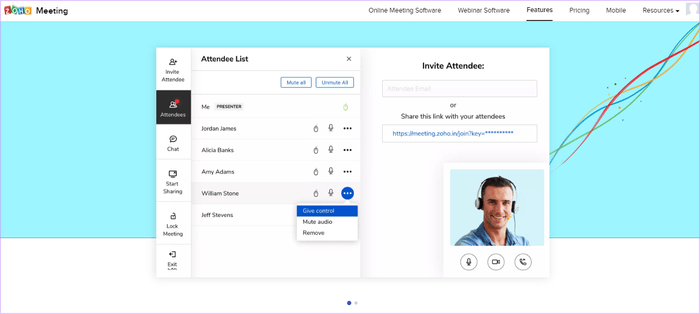 Zoho Meeting is another excellent tool for video-conferencing. It does not offer a free version, but has a 14-day trial period for users to test and get acquainted with the product before purchasing the service. The pricing for Zoho Meeting starts at $10 per host per month for up to 100 participants. The webinar plan starts at $19.
One advantage, if one may call it that, of the Zoho Meeting is that it is web and browser-based, and therefore, you don’t need to download any software or install anything to use the tool. With a simple Chrome extension you can host and record online meetings and webinars. Further, you can share and record screens across various platforms.
EZTalks
 The EZTalks video conferencing solution allows users to access collaboration services such as webinars, online meetings, audio, and video conferencing. With EZTalk, you can share presentations, slideshows, audios, and videos with up to 10,000 participants.
The EZTalks free plan has a 40 minutes limit on group meetings and allows you to host up 100 participants. The paid plans with more advanced features start at $13 per month per host. The software of EZtalks can be used on a wide range of platforms including Windows, Mac OS X, iOS, and Linux.


