


Russia says some forces pulling back amid Ukraine crisis
Russia said Tuesday that some units participating in military exercises would begin returning to their bases, adding to glimmers of hope that the Kremlin may not be planning to invade Ukraine imminently, though it gave no details on the pullback, Associated Press reported.
The announcement came a day after Russia’s foreign minister indicated the country was ready to keep talking about the security grievances that led to the Ukraine crisis — changing the tenor after weeks of rising tensions. Still, Western officials continued to warn that an invasion could come at any moment and said some forces and military hardware were moving toward the border, muddying the picture.
It wasn’t immediately clear where exactly the troops that the Russian Defense Ministry said were pulling back were deployed or how many were leaving, making it hard to understand the significance. The announcement pushed world markets and the ruble up, but Ukraine’s leaders expressed skepticism.
“Russia constantly makes various statements,” Ukrainian Foreign Minister Dmytro Kuleba said. “That’s why we have the rule: We won’t believe when we hear, we’ll believe when we see. When we see troops pulling out, we’ll believe in de-escalation.”
Russia has massed more than 130,000 troops near Ukraine, sparking the fears of an invasion. Russia denies it has any plans to invade Ukraine, despite placing troops on Ukraine’s borders to the north, south and east and launching massive military drills nearby.
The new glimmers of hope accompanied a flurry of diplomacy. German Chancellor Olaf Scholz planned to meet with Russian President Vladimir Putin in Moscow, a day after he sat down with Ukraine’s leader in Kyiv. Foreign Minister Zbigniew Rau of Poland, one of Russia’s most strident European critics, was also in Moscow on Tuesday to meet Lavrov, while Ukraine’s foreign minister hosted his Italian counterpart.
Foreign Minister Sergey Lavrov’s comments came at a made-for-TV meeting with Putin and seemed designed to send a message to the world about the Russian leader’s position. The foreign minister argued that Moscow should hold more talks, despite the West’s refusal to consider Russia’s main demands.
The talks “can’t go on indefinitely, but I would suggest to continue and expand them at this stage,” Lavrov said, noting that Washington has offered to discuss limits for missile deployments in Europe, restrictions on military drills and other confidence-building measures.
Moscow wants guarantees that NATO will not allow Ukraine and other former Soviet countries to join as members. It also wants the alliance to halt weapons deployments to Ukraine and roll back its forces from Eastern Europe.
Lavrov said possibilities for talks “are far from being exhausted.”
Putin noted that the West could try to draw Russia into “endless talks” and questioned whether there is still a chance to reach agreement. Lavrov replied that his ministry would not allow the U.S. and its allies to stonewall Russia’s main requests.
The U.S. reacted coolly.
“The path for diplomacy remains available if Russia chooses to engage constructively,” White House principal deputy press secretary Karine Jean-Pierre said. “However, we are clear-eyed about the prospects of that, given the steps Russia is taking on the ground in plain sight.”
One possible off-ramp emerged this week: Ukraine’s ambassador to the U.K., Vadym Prystaiko, pointed at a possibility of Ukraine shelving its NATO bid — an objective that is written into its constitution — if it would avert war with Russia.
Prystaiko later appeared to back away from the idea, but the fact that it was raised at all suggests it is being discussed behind closed doors.
Even amid the hopeful signs, the U.S. and European countries kept up their warnings.
British Foreign Secretary Liz Truss reiterated Tuesday that the danger of an invasion still exists, telling Sky News that it “could be imminent.” But she added that “there is still time for Vladimir Putin to step away from the brink.”
Norwegian Foreign Minister Anniken Huitfeldt issued a similar warning.
U.S. officials have said the Russian military continued apparent attack preparations along Ukraine’s borders. A U.S. defense official said small numbers of Russian ground units have been moving out of larger assembly areas for several days, taking up positions closer to the Ukrainian border at what would be departure points if Putin launched an invasion.
The official spoke on condition of anonymity to discuss information not publicly released. CBS News was first to report on the movement of the units.

Nepal records 680 new Covid-19 cases, 2 deaths on Tuesday
Nepal logged 680 new Covid-19 cases and two deaths on Tuesday.
With this, the country's active caseload mounted to 1,111,898. Similarly, the death toll has climbed to 11,902.
According to the Ministry of Health and Population, 4,256 swab samples were tested in the RT-PCR method, of which 498 returned positive. Likewise, 2,839 people underwent antigen tests, of which 182 tested positive.
The Ministry said that 1,835 infected people recovered from the disease in the last 24 hours.
As of today, there are 19,400 active cases in the country.
The Ministry said that 19,982 people are staying in home isolation while 757 are in institutionalized isolation.
Meanwhile, the Kathmandu Valley reported 209 new cases today.
According to the Ministry, 171 cases are reported in Kathmandu, 24 in Lalitpur and 15 in Bhaktapur.

President Bhandari, PM Deuba extend grief over Sharma’s demise
President Bidya Devi Bhandari has extended sorrow over the demise of prominent literary figure Dr Tara Nath Sharma.
Late Sharma was a lifetime member of the Nepal Academy.
President Bhandari said that Nepali literature has lost an eminent literary practitioner with the passing away of Sharma,
Taking to Twitter today, She wrote, “With the demise of a prolific literary writer and critic, the Nepali literature has lost a genuine literary practitioner. Sharma will remain immortal among us through his dozens of literary creations. I extend tribute to the late Sharma and expressed deep condolences to the bereaved family members.”
Meanwhile, Prime Minister Sher Bahadur Deuba also extended sorrow over the passing away of the prominent literary writer, Sharma.
Extending tribute to the late Sharma, PM Deuba expressed deep condolences to the bereaved family members. RSS

MCC serves national interest; needs timely endorsement: NC leader Mahat
Former Finance Minister and NC leader Ram Sharan Mahat said that the Millennium Challenge Corporation (MCC) is in the interest of Nepal and it needs to be endorsed at the earliest.
Talking to journalists after the Parliament Party of the meeting held at the Lhotse Hall in the Constituent Assembly building on Tuesday, he said, “Rumours are being created and spread against MCC. This is not under any military strategy. All these are merely baseless things and rumours. I have put my remarks in the meeting in this line.”
Noting that the MCC project has been wrongly made a sponsored propaganda citing it an anti-national agenda, he underlined the need to cut through the misconception propping up against the project.
Mahat said that the NC parliamentarians should clear their misconceptions against the MCC project.
Leader Mahat further said that the MCC was not under Indo-Pacific military alliance but merely a development project.
Saying that MCC endorsement should not be delayed anymore, he noted the project should be endorsed within the given timeframe. RSS

Ukraine president calls for ‘day of unity’ for Feb. 16, day some believe Russia could invade
Ukraine President Volodymyr Zelenskiy on Monday called on the country’s people to fly flags and sing the national anthem in unison on Feb. 16, a date that some Western media say Russian could invade, Reuters reported.
Ukrainian government officials stressed that Zelenskiy was not predicting an attack on Wednesday, but responding skeptically to the foreign media reports.
“They tell us Feb. 16 will be the day of the attack. We will make it a day of unity,” Zelenskiy said in a video address to the nation.
“They are trying to frighten us by yet again naming a date for the start of military action,” Zelenskiy said. “On that day, we will hang our national flags, wear yellow and blue banners, and show the whole world our unity.”
Zelenskiy has long said that, while he believes Russia is threatening to attack his country, the likelihood of an imminent invasion has been overstated by Western allies, responding to Moscow’s efforts to intimidate Ukraine and sow panic.
Mykhailo Podolyak, an adviser to Zelenskiy’s chief of staff, told Reuters the president was responding in part “with irony” to media reports of the potential date of the invasion.
“It is quite understandable why Ukrainians today are skeptical about various ‘specific dates’ of the so-called ‘start of the invasion’ announced in the media,” he said. “When the ‘start of the invasion’ becomes some sort of rolling tour date, such media announcements can only be taken with irony.”
Zelenskiy’s office released a decree calling for all villages and towns in Ukraine to fly the country’s flags on Wednesday, and for the entire nation to sing the national anthem at 10 a.m. It also called for an increase in salaries of soldiers and border guards.
U.S. officials said they were not predicting an assault ordered by Russian President Vladimir Putin on a specific day, but repeated warnings that it could come at any time.
“I won’t get into a specific date, I don’t think that would be smart. I would just tell you that it is entirely possible that he could move with little to no warning,” Pentagon spokesperson John Kirby told reporters. Earlier, Kirby said Moscow was still adding to its military capabilities on the Ukrainian frontier.
Secretary of State Antony Blinken said Washington, which has already sent most of its diplomats home, was moving its remaining diplomatic mission in Ukraine from Kyiv to the western city of Lviv, much further from the Russian border. He cited a “dramatic acceleration in the buildup of Russian forces”.
Blinken said Washington was offering Ukraine up to $1 billion in sovereign loan guarantees to calm markets.
The State Department issued a travel advisory recommending that U.S. citizens leave Belarus, which borders both Russia and Ukraine.
Russia has more than 100,000 troops massed near the border of Ukraine. Russian political leaders deny Western accusations that it is planning to invade, but say it could take unspecified “military-technical” action unless a range of demands are met, including barring Kyiv from ever joining the NATO alliance.
Russia suggested on Monday that it would keep talking to the West to try to defuse the security crisis.
In a televised exchange, Putin was shown asking his foreign minister, Sergei Lavrov, whether there was a chance of an agreement to address Russia’s security concerns, or whether it was just being dragged into tortuous negotiations.
Lavrov replied: “We have already warned more than once that we will not allow endless negotiations on questions that demand a solution today.”
But he added: “It seems to me that our possibilities are far from exhausted … At this stage, I would suggest continuing and building them up.”
Western countries have threatened unprecedented sanctions if Russia invades. The Group of Seven large economies (G7) warned on Monday of “economic and financial sanctions which will have massive and immediate consequences on the Russian economy”.
After speaking with the foreign ministers of Russia and Ukraine, U.N. Secretary-General Antonio Guterres said he still believed “from his own analysis, his own hopes” that there would not be a conflict, a U.N. spokesperson said.
Moscow says Ukraine’s quest to join NATO poses a threat. While NATO has no immediate plans to admit Ukraine, Western countries say they cannot negotiate over a sovereign country’s right to form alliances.
ECONOMIC DAMAGE
Ukraine has already suffered economic damage from the standoff. A surge in the price of 5-year credit default swaps on Ukrainian sovereign bonds suggested that markets gave Kyiv a 42% probability of defaulting.
Ukraine International Airlines, the nation’s biggest airline, said its insurers had terminated coverage for some of its aircraft.
German Chancellor Olaf Scholz held talks with Zelenskiy in Kyiv. Scholz is due to fly to Moscow on Tuesday, following visits by French President Emmanuel Macron and two British ministers went last week.
Scholz said he saw “no reasonable justification” for Russia’s military activity on Ukraine’s border, and that “we are ready for a serious dialogue with Russia on European security issues”. He announced a credit of 150 million euros ($170 million) for Ukraine.

Nepse surges by 53.30 points on Tuesday
The Nepal Stock Exchange (NEPSE) gained 53.30 points to close at 2,754.28 points on Tuesday.
Similarly, the sensitive index plunged by 10.63 points to close at 522. 13 points.
Meanwhile, a total of 6,343,228 unit shares of 224 companies were traded for Rs 3. 23 billion.
In today’s market, all sub-indices saw green. Life Insurance topped the chart with 187.03 points.
Meanwhile, Nyado Hydropower Limited was the top gainer today, with its price surging by 10. 00 percent. NIC Asia Balanced Fund was the top loser as its price fell by 3.14 percent.
At the end of the day, total market capitalisation stood at Rs 1. 34 trillion.

“Implement SC decision to grant voting rights to Nepali citizens living abroad”
Stakeholders have emphasized that it is possible to implement the decision of the Supreme Court to grant voting rights to Nepali citizens living abroad.
In the first of a series of policy dialogues organized by the Nepal Policy Institute (NPI) on Sunday, stakeholders said that it was possible to exercise voting rights through the use of technology. "If a Nepali has an identity in any country, he/she should be given the right to vote. A study has also been done by the Election Commission in this regard,” observed former Chief Election Commissioner Nilkantha Upreti. “There is a court order; but it is not being implemented,” he said.
According to Uprety, in coordination with the Election Commission and the Ministry of Foreign Affairs, Nepalis living abroad can be included in the voter list. “If a photo and fingerprints are taken while making a passport, the same information can be obtained by the Election Commission from the Ministry of Foreign Affairs.”
Prof. Achyut Wagle, Associate Dean of Kathmandu University School of Management, was of the view that the right to vote of a citizen remains until the passport and citizenship are relinquished. “Politics is taking place over the statistics of Nepalis living abroad. It has been said that 4 million people are staying abroad. This is serious issue. It has a huge impact on management,” he said. He further added “Remittances have greatly contributed to the national economy's ability to maintain macroeconomic stability, nutrition, access to primary education, and urbanization. Those who contribute in this manner should not be deprived of the right to vote.”
Senior Advocate Dinesh Tripathi said that the State had no option but to implement the decision of the Supreme Court, which in 2074 BS had decided to give voting rights to Nepalis living abroad. "The constitution does not discriminate between citizens. Now wemare in the world of technology; it sets no boundaries. And technology has made it possible for people to exercise their voting right," he said. His view was that there is inadequate political will to implement this decision, for which there is need to create pressure on a larger scale.
NPI Chairman Khagendra Dhakal, in his opening remarks, mentioned that the State should implement the decision made by the apex court in the interest of 56 percent of the households that rely on remittances. Citing the example of Mexico, Indonesia, and Iceland, some 115 countries have developed voting policies for citizens working abroad. That should be our basis," he said.
NPI Board Member, Shuru Joshi, who facilitated the program, said that if the country relies on the migrants’ resources (ie, notes) to sustain the economy then they should also be concerned with enabling the migrants to have a say in elections (ie, cast votes), for which pressure should be increased on the political parties, for example, by NGOs.
Representatives of migrant worker entities from Saudi Arabia, Malaysia, and India, Dharam KC, Sapna Basyal, and Ram Bahadur Khadka respectively, and Laxman Basnet, general secretary of the South Asia Trade Union Coordinating Committee were positive about supporting the NPI in helping formulate the necessary policies to ensure their right to vote. Similarly, Sita Ghimire, Hari Thapa, Barun Ghimire, and Radhika Regmi Pokharel on behalf of the organizations directly concerned with migrants suggested that the government should formulate necessary policies to speedily and effectively implement the decision of the Supreme Court.
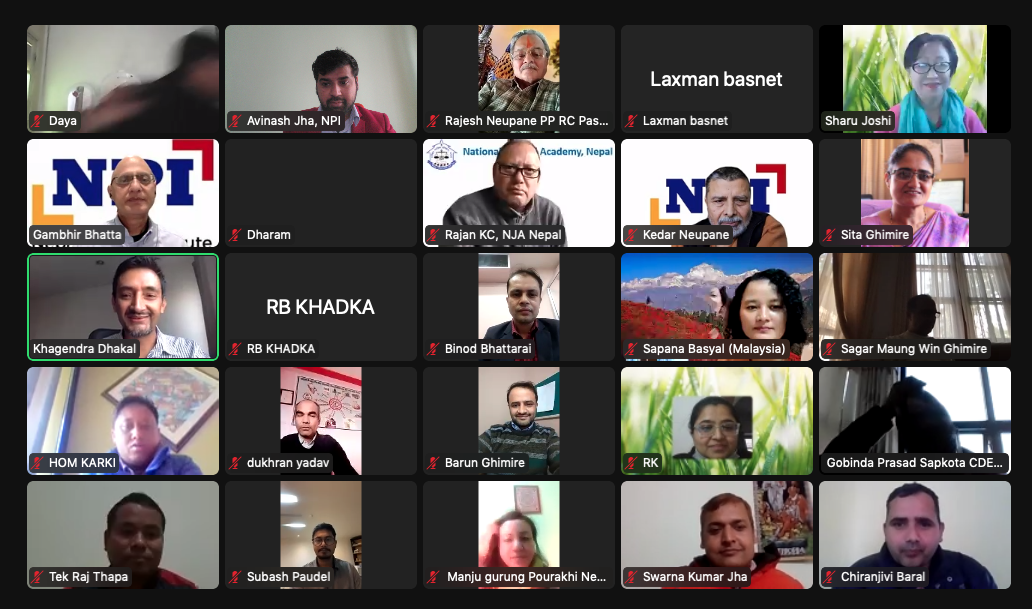
“It is possible to implement SC decision to grant voting rights to Nepali citizens living abroad”
Stakeholders have emphasized that it is possible to implement the decision of the Supreme Court to grant voting rights to Nepali citizens living abroad.
In the first of a series of policy dialogues organized by the Nepal Policy Institute (NPI) on Sunday, stakeholders said that it was possible to exercise voting rights through the use of technology. "If a Nepali has an identity in any country, he/she should be given the right to vote. A study has also been done by the Election Commission in this regard,” observed former Chief Election Commissioner Nilkantha Upreti. “There is a court order; but it is not being implemented,” he said.
According to Uprety, in coordination with the Election Commission and the Ministry of Foreign Affairs, Nepalis living abroad can be included in the voter list. “If a photo and fingerprints are taken while making a passport, the same information can be obtained by the Election Commission from the Ministry of Foreign Affairs.”
Prof. Achyut Wagle, Associate Dean of Kathmandu University School of Management, was of the view that the right to vote of a citizen remains until the passport and citizenship are relinquished. “Politics is taking place over the statistics of Nepalis living abroad. It has been said that 4 million people are staying abroad. This is serious issue. It has a huge impact on management,” he said. He further added “Remittances have greatly contributed to the national economy's ability to maintain macroeconomic stability, nutrition, access to primary education, and urbanization. Those who contribute in this manner should not be deprived of the right to vote.”
Senior Advocate Dinesh Tripathi said that the State had no option but to implement the decision of the Supreme Court, which in 2074 BS had decided to give voting rights to Nepalis living abroad. "The constitution does not discriminate between citizens. Now wemare in the world of technology; it sets no boundaries. And technology has made it possible for people to exercise their voting right," he said. His view was that there is inadequate political will to implement this decision, for which there is need to create pressure on a larger scale.
NPI Chairman Khagendra Dhakal, in his opening remarks, mentioned that the State should implement the decision made by the apex court in the interest of 56 percent of the households that rely on remittances. Citing the example of Mexico, Indonesia, and Iceland, some 115 countries have developed voting policies for citizens working abroad. That should be our basis," he said.
NPI Board Member, Shuru Joshi, who facilitated the program, said that if the country relies on the migrants’ resources (ie, notes) to sustain the economy then they should also be concerned with enabling the migrants to have a say in elections (ie, cast votes), for which pressure should be increased on the political parties, for example, by NGOs.
Representatives of migrant worker entities from Saudi Arabia, Malaysia, and India, Dharam KC, Sapna Basyal, and Ram Bahadur Khadka respectively, and Laxman Basnet, general secretary of the South Asia Trade Union Coordinating Committee were positive about supporting the NPI in helping formulate the necessary policies to ensure their right to vote. Similarly, Sita Ghimire, Hari Thapa, Barun Ghimire, and Radhika Regmi Pokharel on behalf of the organizations directly concerned with migrants suggested that the government should formulate necessary policies to speedily and effectively implement the decision of the Supreme Court.


