


Pakistan appeals to world for flood help amid devastation
Pakistan is appealing for further international assistance after floods wreaked havoc across the country, BBC reported.
The US, UK, United Arab Emirates and others have contributed to a monsoon disaster appeal but much more funds are needed, an interior ministry official told the BBC.
More than 1,000 people have died and millions have been displaced since June, Salman Sufi said.
He said Pakistan's government was doing everything in its power to help people. In the north-west of the country, thousands of people fled their homes after rivers in Khyber Pakhtunkhwa province burst their banks, causing powerful flash floods.
"The house which we built with years of hard work started sinking in front of our eyes," Junaid Khan, 23, told AFP news agency. "We sat on the side of the road and watched our dream house sinking."
The province of Sindh in the south-east of the country has also been badly affected, with thousands displaced from their homes.
Speaking to the BBC, Mr Sufi said the country was in desperate need of more international support, according to BBC.
Funding from a lot of development projects had been rerouted to the affected people, he added.
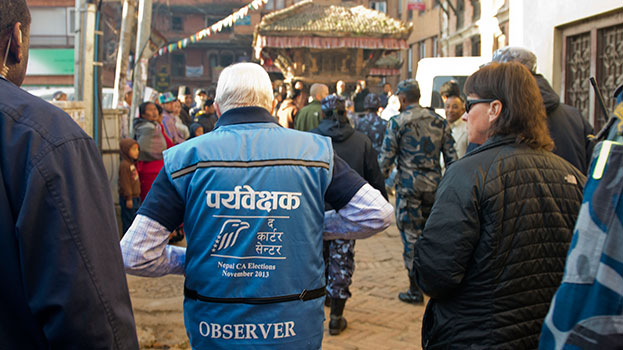
Observing Nepal’s poll observers
The Election Commission (EC) has called for applications from national and international organizations if they wish to carry out the role of observers in the Nov 20 parliamentary and provincial assembly elections. The applicant organization should have working experience in good governance, election, democracy, peace-building and human rights in order to qualify as election observers. The objective of such observation is to ensure election credibility. But there are questions about its effectiveness despite the big sums spent in the process. “Poll observation in Nepal is superficial,” says Binod Sijapati, a political analyst and election-expenditure researcher. In the 2017 elections, the commission had granted poll-observing permits to 53 national organizations but only 47 of them actually monitored the polls. And just 24 of these organizations submitted their election monitoring reports. There was also international monitoring from the likes of the European Union, the Carter Center, and the Asia Network for Free Elections (ANFREL). Representatives from Afghanistan, Bangladesh, Bhutan, India, Pakistan, Maldives, and Indonesia were invited as guest observers. It was Nepal’s first elections after adopting the federal set-up, in which 72 people were deployed as special observers, 1,434 as long-term observers, and 8,528 others as short-term observers. The election governing body issues short- and long-term permits to poll observers. The short-term observers mainly monitor the situation in the run-up to the vote while primarily focusing their assessment on the main election day. The long-term observers, on the other hand, will have the mandate to oversee the entire election process, including the vote-count. But Sijapati says most observers focus just on the election day. Election observers, he adds, routinely certify elections as fair and peaceful after cursory observation of polling stations. “Observers see the deployment of security forces, voters queuing up and the political party cadres helping the voters. That’s about it,” he says. “They fail to go beneath the surface.” Compared to other countries, Nepal has a track record of holding elections in a free and fair manner. Sijapati argues that this is because the poll observers have been endorsing elections in Nepal without really monitoring the electoral process. In the first Constituent Assembly (CA) elections held in 2008, the Carter Center had courted criticism for hurriedly endorsing the polls despite multiple incidents of vote-rigging and violence in several parts of the country. The center had submitted a positive election observation report, stating that despite some challenges the polls were held in a free and fair manner. “A few problems were observed regarding ensuring the secrecy of the vote, family voting, and improper assisted voting, but these cases were relatively isolated,” it had said in its preliminary observation report. Nepali politicians publicly confess to spending millions of rupees on electioneering. Use of political goons to capture voting booths and luring of voters with money and gifts are also common. But national and international organizations fail to monitor and report such activities Sijapati says poll observers either cannot identify these issues or they miss them as they are too focused on the election days. Many election-observing organizations also fail to abide by the laws and codes of ethics prepared by the EC. In 2017, for instance, only half of the organizations submitted their monitoring reports. As per the code of ethics, national and international poll observers should submit their preliminary report within the 15 days of elections and the final report within a month. But Pradip Pokharel, chairperson of Election Observation Committee Nepal, defends the works of the national and international observers. “International community awaits our reports to recognize or give legitimacy to Nepal’s elections,” he says. “The role of election observers in Nepal is pivotal.” He claims election observers do look into the issues that go beyond the voting day. “We provide valuable suggestions to make the election even more free, fair and less expensive. But the Election Commission ignores our recommendations,” Pokharel adds. Dolakh Bahadur Gurung, a former election commissioner, says the EC should strictly monitor the activities of the observers. “While we should discourage the observers from imposing impractical conditions,” he says. “They should also be made to submit their reports on time and to refrain from unethical practices.” Duties of observers -Observers shall at all times recognize and respect the custom, culture, and sovereignty of Nepal -Observers shall respect the election officials, and exhibit a respectful and courteous attitude towards election officials, voters, volunteers, and candidates -Observers must undertake their duties in an unobtrusive manner and not interfere with the election process -Observers shall refrain from influencing or providing guidance to persons involved in the electoral process/voting -Observers must observe the voting on polling day from a reasonable distance, and refrain from talking to voters inside the polling station and from asking voters about their political inclination -Observers shall not issue any disputable statement disturbing the operation of polling -Observers must refrain from slanderous or defamatory public statements regarding the ECN or any other electoral stakeholders or voters -Observers shall maintain due secrecy on the matters pertaining to voting and counting -Observer organization must submit a preliminary report within 15 days of the election and a final report within 30 days after the election result is published (Source: Election Commission)

Nepal logs 324 new Covid-19 cases, one death on Friday
Nepal reported 324 new Covid-19 cases and one death on Friday. According to the Ministry of Health and Population, 1, 673 swab samples were tested in the RT-PCR method, of which 163 returned positive. Likewise, 1, 842 people underwent antigen tests, of which 161 were tested positive. The ministry said that 11, 999 people lost their lives to the virus so far. At least 418 infected people recovered from the disease in the last 24 hours. As of today, there are 3, 943 active cases in the country.

Health Minister Bhawani Khapung admitted to Bir Hospital
Health Minister Bhawani Khapung has been admitted to the Bir Hospital on Friday. Dr Bhupendra Basnet, Director at the hospital, said that the minister was admitted to the hospital today. “He came to the hospital after he complained of dizziness,” he said, adding, “His medical examination has been done, the report is yet to come.” He came to Kathmandu on Thursday after staying in his home district Tehrathum for a week.

Nepse plunges by 16. 93 points on Friday
The Nepal Stock Exchange (NEPSE) plunged by 16. 93 points to close at 2,022.62 points on Friday. Similarly, the sensitive index dropped by 2. 77 points to close at 391.74 points. A total of 3,588,833 unit shares of 213 companies were traded for Rs 1. 29 billion. Meanwhile, Life Insurance Corporation (Nepal) Limited was the top gainer today with its price surging by 5. 95 percent. Likewise, Panchakanya Mai Hydropower Limited was the top loser with its price dropped by 4. 88 percent. At the end of the day, the total market capitalization stood at Rs 2. 89 trillion.

Mind Matters | Struggle with forgetfulness
Query
I am a 25-year-old student struggling with forgetfulness. I cannot remember the tasks I need to complete, people’s names and the conversations I have with them. This started last year. I cannot learn and understand new things and of late, I cannot even hold a conversation for long. I always have a mild yet persistent headache. I am afraid I might have some brain disease. I am terrified. What should I do?—A scared fellow
 Answered by Krishangi, Psychologist, Happy Minds
There can be several reasons for your forgetfulness, both mental and physical: lack of sleep, stress, or some form of mental illness. I suggest you start by going through your daily routine and identifying potential causes of your stress.
If you find no major stressor in your daily life, it is best that you get a thorough physical examination. To understand why you might be having these symptoms, I suggest you get a brain scan.
If the tests indicate no physical problem, we can be sure that this is a mental issue. Perhaps your sleep pattern is wrong, or you are having a tough time with your studies. We have to identify what is causing your symptoms in order to move ahead with treatment.
Check your surroundings for that. Maybe something is happening in your college, or among circles of friends and family, which is causing you stress without you realizing it. Again, we have to find the underlying cause first.
All the things I suggest above, they do seem like a lot. But you can take a step at a time. Start with something small, something easy. For instance, you can start by making improvements in your sleep pattern before moving to other steps.
If you feel like it is too much for you to follow these steps, get an accountability partner, a close friend or a family member, to assist you in this process. You can also reach out to a psychologist.
Answered by Krishangi, Psychologist, Happy Minds
There can be several reasons for your forgetfulness, both mental and physical: lack of sleep, stress, or some form of mental illness. I suggest you start by going through your daily routine and identifying potential causes of your stress.
If you find no major stressor in your daily life, it is best that you get a thorough physical examination. To understand why you might be having these symptoms, I suggest you get a brain scan.
If the tests indicate no physical problem, we can be sure that this is a mental issue. Perhaps your sleep pattern is wrong, or you are having a tough time with your studies. We have to identify what is causing your symptoms in order to move ahead with treatment.
Check your surroundings for that. Maybe something is happening in your college, or among circles of friends and family, which is causing you stress without you realizing it. Again, we have to find the underlying cause first.
All the things I suggest above, they do seem like a lot. But you can take a step at a time. Start with something small, something easy. For instance, you can start by making improvements in your sleep pattern before moving to other steps.
If you feel like it is too much for you to follow these steps, get an accountability partner, a close friend or a family member, to assist you in this process. You can also reach out to a psychologist.

KMC Mayor Balen Shah reaches Passport Department with dozer
Kathmandu Metropolitan City Mayor Balen Shah has given continuity to his drive to demolish illegal structures. Shah along with his team reached the Department of Passport in Tripureshwor on Friday. The KMC had issued a 35-day notice to demolish the illegal structures. The Metropolitan City swung into action after its notice was ignored by the people. Earlier on Thursday, the KMC demolished the basement of the Alfa Beta Complex in New Baneshwor. A team led by Mayor Shah demolished the structure saying that it was built against the rule. The Alfa Beta had been operating a pharmacy in the basement. Shah with his team reached the Alfa Beta Complex after the owner ignored the 35-day notice of the KMC. When the team reached the Complex, managing director of Alfa Beta Dwiraj Sharma asked the Mayor Shah to present his building’s blueprint.

Gold being traded at Rs 95, 800 per tola on Friday
The price of gold and silver has remained constant on Friday. According to the Federation of Nepal Gold and Silver Dealers' Association, the gold is being traded at Rs 95, 800 per tola. Similarly, the tejabi gold is being traded at Rs 95, 300 per tola. The Association said that the silver is being traded at Rs 1, 175 per tola.


