


Tourist arrivals hits three-year high in 2022
In what could be seen as a strong recovery in the Nepali tourism business, tourist arrivals in Nepal rose to a three-year high in 2022. Over 600,000 tourists visited Nepal last year, putting an end to a two-year downward spiral that started in early 2020 when the coronavirus outbreak wreaked havoc across the world. Data from Nepal Tourism Board (NTB) shows that a total of 614,148 international tourists visited Nepal last year, of which 67,932 came in December. While the number of foreign visitors entering Nepal grew by 306.82 percent in 2022 compared to 2021, it is still 48.70 percent lower than in 2019 when 1.19 million arrivals were recorded. According to NTB, the largest number of foreign visitors who came to Nepal in 2022 were from India. A total of 209,105 Indian tourists visited Nepal last year. Similarly, 77,009 came from the US, 44,781 from the UK, 26,874 from Australia, and 25,384 from Bangladesh. With two new international airports—Gautam Buddha Int'l Airport in Bhairahawa and Pokhara Regional International Airport—coming into operation, the tourism sector is buoyant about the footfalls of visitors in the country in 2023. Prime Minister Pushpa Kamal Dahal inaugurated the Pokhara International Airport on Sunday. The Ministry of Culture, Tourism and Civil Aviation has already prepared the strategic framework for the Nepal Tourism Decade 2023-2032 while Nepal Tourism Board has said it is targeting 1 million foreign visitors for 2023. The framework developed by a four-member expert panel led by the former NTB CEO Prachanda Man Shrestha has set ambitious targets of increasing tourist spending to $125 daily from the existing $48, creating 1 million direct jobs in the tourism sector, and increasing the tourism sector's contribution to national GDP to 10 percent. The plan also aims to bring the tourist numbers to pre-pandemic levels by 2024 and increase arrivals in each subsequent year by 15 percent. The NTB CEO Dhananjay Regmi, while addressing the 24th anniversary of the board on Saturday said that the tourism industry is in a revival phase after two disastrous years and the board will focus more in attracting visitors from Asia, mainly from Southeast Asia and the Middle East. For the Nepali tourism industry, the years 2020 and 2021 came as a nightmare. With global travel coming to a grinding halt due to the restrictions enforced by governments across the world, the arrival of tourists fell to record lows resulting in massive financial losses and layoffs in the tourism and hospitality business. In 2020, Nepal’s tourism earnings totaled USD 217 million which was USD 801 million in 2019. The earnings plummeted by 48.2 percent to a meager USD 112.5 million in 2021. Similarly, average expenses per visitor per day plunged to USD 48 in 2021 which was USD 65 in 2020. Tourist Arrivals in Nepal
| 2022 614,148 +306.82 percent 2021 150,962 -34.38 percent 2020 230,085 -80.78 percent 2019 1,197,191 |
| Month Arrivals January 16,975 February 19,766 March 42,006 April 61,589 May 53,608 June 46,957 July 44,462 August 41,304 September 58,314 October 88,582 November 72,653 December 67,932 |

Nepse starts the new year on a positive note
The Nepal Stock Exchange (Nepse) began the new year by continuing the momentum that the index has been on for the last few days after the formation of the new government. The Nepse index surged by 17.26 points on Sunday, the first trading day of the week. The daily turnover at the benchmark index crossed Rs 4 billion, the highest in five months. The last time when daily turnover crossed the Rs 4 billion mark was on August 3, 2022. Despite the increase, volatility was observed in the market on Sunday with the Nepse index touching an intra-day high of 2083.19 points before falling to an intra-day low of 2032.19 points. The index settled at 2046.26 points. After the new government noted in its first meeting that problems in the country's capital market will be resolved in the coming days, the stock market is on an upward swing. In the last five trading days after the Pushpa Kamal Dahal-led government came into power, the benchmark index has surged by 179.08 points. On Sunday's trading, Nabil Bank recorded the highest turnover of Rs 225.7 million while the shares of Api Power Company were the most traded scrips. The share price of 121 companies increased while 87 companies saw their share prices decrease. The Nepse index on December 29 (the last trading day of 2022) surged past the 2000 mark for the first time in four months. The benchmark index had dropped below 2000 points on August 27 amid a bearish run that began over a year ago. The confidence of stock investors seems to have returned after the new government assured that it would address problems in liquidity management and will work to bring down the persistently higher interest rates.

PM Dahal holds talks with EC officials
Prime Minister Pushpa Kamal Dahal held a meeting with office bearers of the Election Commission on Monday. During the meeting held at the Office of Prime Minister and Council of Minister this morning, the Prime Minister urged the office bearers to make necessary preparations for the elections of President, Vice-President and the vacant post of a National Assembly member. "You (EC office bearers) take ahead the process for the election to the vacant post of a NA member. We will hold discussions among political parties for the elections of President and Vice-President. we will reach a conclusion soon," PM Dahal said. On the occasion, he thanked the EC for successfully organizing the local elections and the polls to the House of Representatives and the Province Assembly. Deputy Prime Minister and Finance Minister Bishnu Poudel and DPM and Home Minister Rabi Lamichhane among others were present in the meeting. Chief Election Commissioner Dinesh Kumar Thapaliya and election commissioners apprised the PM of the EC's works and activities, and the election process.

Create environment to provide passports from districts: Home Minister Lamichhane tells CDOs
Deputy Prime Minister and Home Minister Rabi Lamichhane has directed the concerned authority to end the compulsion of people to come to Kathmandu to make national identity cards and passports. During a virtual meeting held with Chief District Officers of 77 districts and security chiefs on Monday, Minister Lamichhane directed the CDOs to create an environment to provide national identity cards and passports from the districts. “Let’s create an environment to provide national identity cards and passports from the districts. The Home Ministry is ready to provide support for the same,” he said. Soon after Lamichhane was appointed as the Home Minister, he had inspected the Department of Passports. During that time, people had complained about the delay in the distribution of passports. They had demanded that the service should be made effective by bringing a token system.

Import of laptops and tablets nosedives
With people back to their workplaces and education institutions starting physical classes with the subsiding of the Covid-19 pandemic, the imports of laptops and tablets have taken a beating in the current fiscal year. The government data shows the import of these portable computers has declined significantly in the first five months of FY 2022/23. As online classes and remote working became the new norm for students and office employees post-March 2020, imports of laptops and tablets surged exponentially in the last two fiscal years. However, the demand for such devices has declined this year. Data published by the Department of Customs (DoC) shows imports of laptops have shrunk by 59.72 percent while that of tablets by 87.66 percent in the first five months of the current fiscal year. Importers say that decline in imports of laptops and tablets is basically due to various factors such as the resumption of physical workspace, rise in gray imports, and saturation of demand in the market. As the Covid-19 pandemic confined most Nepalis to their homes, there was a huge demand for laptops and tablets in FY 2020/21 and FY 2021/22. Schools across the country were closed for most of 2020 and 2021 after the government imposed a lockdown in March 2020 to curb the spread of coronavirus. According to traders, another reason for the import boom was the sudden vanishing of ‘gray’ market products as all transport routes including flights were shut down. The annual data of DoC shows Nepal imported laptops worth Rs 11.42 billion and tablets worth Rs 643.52 million in FY 2021/22. The country imported 190,516 units of laptops and 23,117 units of tablets in the last fiscal year. In FY 2020/21, the country imported 139,447 units of laptops worth Rs 7.77 billion and 29,935 units of tablets worth Rs 639.01 million. The imports of laptops and tablets in FY 2019/20 stood at 2,995 units and 258 units respectively. The majority of laptops and tablets coming to Nepal are from China. In the first five months of FY 2022/23, Nepal imported 36,677 units of laptops from China. Such imports from China during the same period of FY 2021/22 stood at 105,971 units. Nepal imports laptops from 28 countries, as per DoC data.

Nepse surges by 17. 24 points on Sunday
The Nepal Stock Exchange (NEPSE) gained 17. 24 points to close at 2,046.26 points on Sunday. Similarly, the sensitive index surged by 2. 71 points to close at 394. 01 points A total of 10,880,904 unit shares of 261 companies were traded for Rs 4. 04 billion. Meanwhile, Shrijanshil Laghubitta Bittiya Sanstha Limited was the top gainer today, with its price surging by 10. 00 percent. Siddhartha Equity Fund was the top loser as its price fell by 5.57 percent. At the end of the day, total market capitalization stood at Rs 2. 95 trillion.

Pokhara International Airport is another pillar of economic development: PM Dahal
Prime Minister Pushpa Kamal Dahal has expressed his belief that the Pokhara International Airport would contribute significantly in the economic development of the country. He said that the Pokhara International Airport would not only help develop the economy of the district but of the whole country. The Prime Minister had reached Pokhara this morning to inaugurate the airport. He was of the opinion that the dream of the people of Pokhara has been fulfilled with the operation of the airport. Prime Minister Dahal, who is also the Chairman of the CPN (Maoist Center) said that he felt happy and proud to inaugurate the airport less than a week after becoming the prime minister for the third time. He said that he had been saying that an international airport should be constructed in Pokhara since he signed the peace agreement. Prime Minister Dahal further said that he had also held discussions with concerned persons for the construction of the airport.

PM Dahal inaugurates Pokhara International Airport
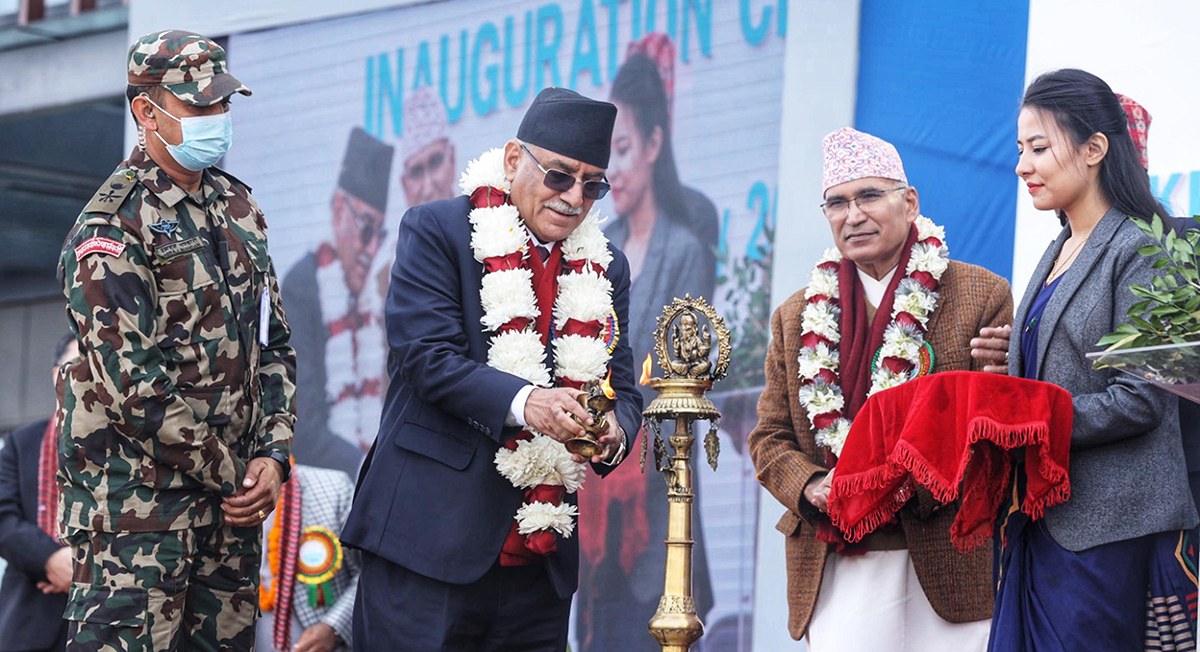
Prime Minister Pushpa Kamal Dahal inaugurated Pokhara International Airport amidst a special program on Sunday.
The Prime Minister had arrived in Pokhara this morning to inaugurate the airport.
He was accompanied by Deputy Prime Minister and Finance Minister Bishnu Poudel. Senior leaders of various political parties had also reached Pokhare to attend the inauguration ceremony.
With the inauguration of the airport, all the domestic flights will be operated from today.
The locals of Pokhara have been elected with the operation of the airport after a long wait.
 The prosperity of Pokhara has been expected from the same.
Though the airport officially came into operation from today, the date for the operation of international flights has not been fixed yet.
Thai Smile Airways and Jazeera Airways among others have been showing willingness to operate the flights, the Civil Aviation Authority said.
The Pokhara Metropolitan City gave its citizens the public holiday today to make the day special.
The prosperity of Pokhara has been expected from the same.
Though the airport officially came into operation from today, the date for the operation of international flights has not been fixed yet.
Thai Smile Airways and Jazeera Airways among others have been showing willingness to operate the flights, the Civil Aviation Authority said.
The Pokhara Metropolitan City gave its citizens the public holiday today to make the day special.


