

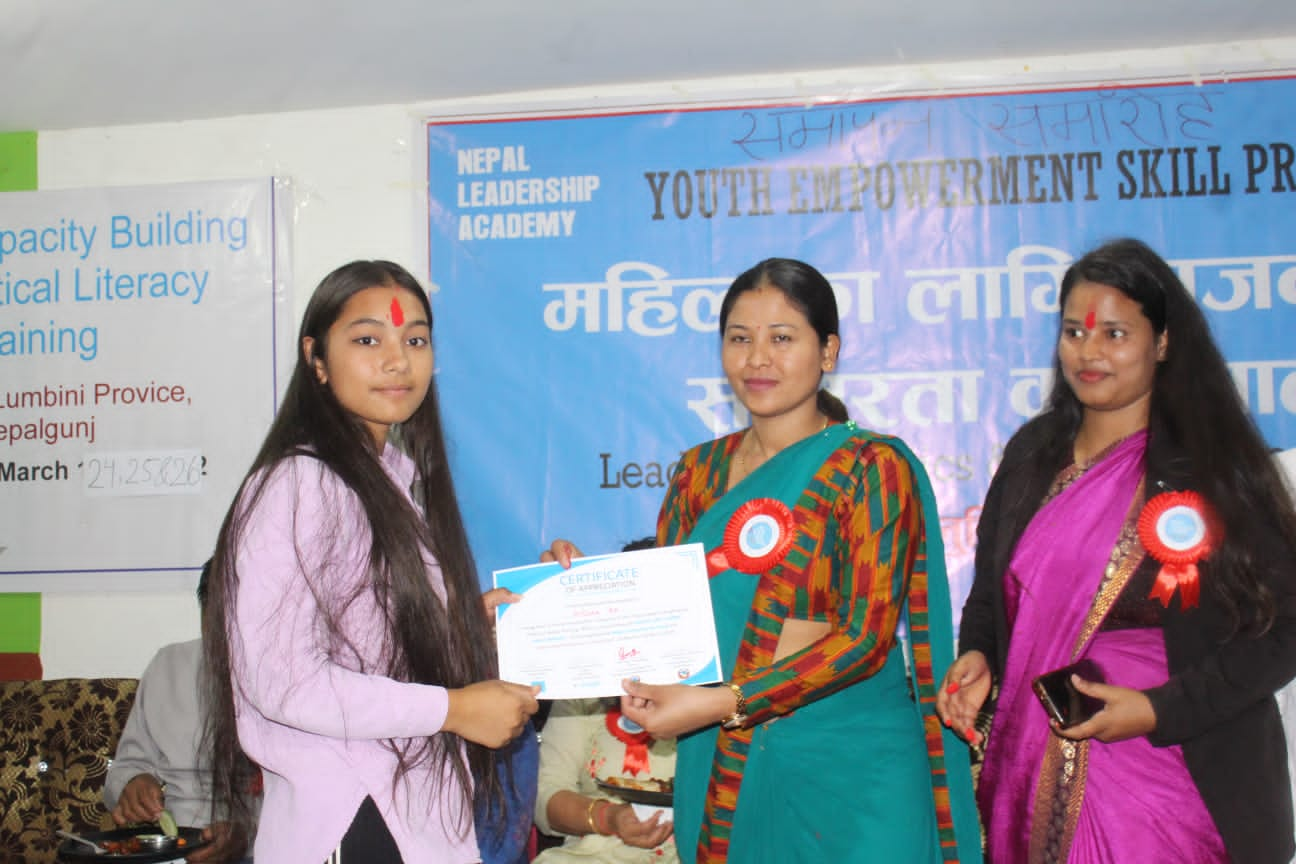
Political literacy and leadership training
Nepalgunj: Political literacy and leadership training has been provided to the women and girls of Banke. A three-day training was conducted in coordination with Nepal Leadership Academy. Chief guest of the program Lumbini provincial assembly member Sanju Kumari Tharu distributed certificates to the participants of the training. She said that although the constitution has guaranteed women’s representation, women still have to fight for their rights due to patriarchal discriminatory thinking. The event was chaired by the Project leader of Nepal Leadership Academy Pooja Kumari Baishya. CPN-UML Accounts Commission Member Bijaya Dhital, outgoing Deputy Chief of Nepalgunj Sub-Metropolis Uma Thapa Magar, JSP provincial assembly member Sushila Paudel, and RPP district member Urmila Shah among others were the trainees. The project leader Baishya said that the capacity building program was conducted due to the low participation of women in politics. She says, “By developing the capacity of teenagers and women, they will be able to take leadership in various responsibilities of the home, society, party and state.” 25 girls and women from Nepalgunj, Khajura, Janaki and other local areas of Banke participated in the training.

Nepse surges by 12. 41 points on Tuesday
The Nepal Stock Exchange (NEPSE) gained 12.41 points to close at 1, 918.41 points on Tuesday. Similarly, the sensitive index surged by 2.49 points to close at 360. 52 points. A total of 4,077,778-unit shares of 258 companies were traded for Rs 1. 44 billion. Meanwhile, Super Mai Hydropower Limited was the top gainer today, with its price surging by 10. 00 percent. Terhathum Power Company Limited was the top loser as its price fell by 3.17 percent. At the end of the day, total market capitalization stood at Rs 2. 77 trillion.

DPR of Raxaul-KTM Railway to be ready in a month
The detailed project report (DPR) of the Raxaul-Kathmandu Cross-border Railway will be ready in a month. On Monday, Deputy Prime Minister and Minister for Physical Infrastructure and Transport Narayan Kaji Shrestha said that India's Konkan Railway Corporation Limited (KRCL), which has been tasked with the preparation of DPR of the railway project connecting Kathmandu with the Indian border town of Raxaul, will submit the report of multi-billion railway project to the government in the next one month. "We have been told that the DPR of the project will be submitted to the government in a month," said Shrestha at a press meet organized at the ministry. As per the memorandum of understanding (MoU) signed between Nepal and India on 8 October 2021, the DPR of the project should be completed within 18 months, by mid-April, 2023. KRCL has already submitted the report of the preliminary engineering and traffic survey of the project to the Nepal government. According to the report, the length of the proposed Raxaul-Kathmandu railway will be 136 km. As per the initial report of the Konkan Railway, a total of Rs 320bn will be required to build the broad-gauge Kathmandu-Raxaul Railway. Once completed, the broad-gauge line will give Nepal's capital a direct connection with the Indian railway network, enabling non-stop train travel to all Indian cities. The initial report of the project has shown that there will be 32 tunnels, with the longest one stretching for eight kilometers. The 136-km-long railway project would have 40 km of tunnelway and 35 small and large bridges. The preliminary study has shown that there will be 13 stations on the railway line. After the DPR is received, the discussion about the modality of construction of the project will begin, according to the ministry officials. Nepal has been requesting India to build the project with a grant. The construction of the project will reduce the transportation cost of goods by a massive amount. Once this railway is constructed, goods can be transported directly to Kathmandu from India and third countries.

5 security personnel injured in clash with protesters in Biratnagar
Five security personnel were injured in a clash with protesters in Biratnagar on Tuesday. Province Police Office, Biratnagar said that three Nepal Police personnel and two Armed Police personnel were injured in the clash. The details of the injured police personnel have not been received yet. Police said that preparations are being made to take them to the hospital. It is not clear how many protesters were injured in the clash. The clash broke out after the security personnel tried to contain the demonstration organized to protest the naming of Koshi Province in Biratnagar. The situation became tense after the protesters pelted stones at the security personnel. Police lobbed 31 rounds of teargas canisters to take the situation under control. A source said that police also fired 15 rounds of bullets into the air. The protesters had staged a demonstration near Panchali of Biratnagar demanding that the government roll back its decision to name Province 1 as Koshi Province. Following the incident, a large number of Nepal Police and Armed Police Force personnel have been deployed in the area. DSP Rajan Kumar Dahal, spokesperson at the District Police Office, Morang, said that the situation is under control. The provincial government on March 1 had named the province as Koshi. Padam Limbu Lajehang was critically injured when police baton-charged the people protesting against the naming of the province. He breathed his last during the course of treatment.

Loan shark victims stage demonstration in Maitighar
Loan shark victims, who came to Kathmandu on foot from Bardibas seeking justice, staged a demonstration in Maitighar on Tuesday.
When they were stopped at Tangal while heading towards the Prime Minister’s official residence in Baluwatar to stage a demonstration, they returned to Maitighar and staged the protest.
During the demonstration, the protesters chanted slogans like formulate a law against loan sharks, release the victims arrested on false charges and provide loans at concessional rates among others.
After the loan shark victims started staging the protest, leaders of various political parties reached Maitighar to express solidarity to them.
In the meantime, they chanted slogans against Rastriya Prajatantra Party lawmaker Gyanendra Bahadur Karki who had reached Maitighar to express solidarity in their protest.
 The government on Tuesday morning formed a four-member committee to address the demands of the loan shark victims.
Joint Secretary at the Home Ministry Rudra Devi Sharma, Under Secretary at the Home Minister Dil Kumar Tamang, Under Secretary at the Office of Prime Minister and Council of Ministers Umakanta Adhikari and Under Secretary at the Law, Justice and Parliamentary Affairs Junga Bahadur Danga are in the committee.
The government on Tuesday morning formed a four-member committee to address the demands of the loan shark victims.
Joint Secretary at the Home Ministry Rudra Devi Sharma, Under Secretary at the Home Minister Dil Kumar Tamang, Under Secretary at the Office of Prime Minister and Council of Ministers Umakanta Adhikari and Under Secretary at the Law, Justice and Parliamentary Affairs Junga Bahadur Danga are in the committee.


Nepal sees slump in capital goods import
Nepal’s overall imports slumped during the first eight months of the current fiscal year. But the worrying part is the decline in the import of capital goods. Capital goods are used by businesses in the course of production activities. The latest data of the Trade and Export Promotion Centre (TEPC) show imports of machinery, equipment, vehicles, and tools have declined sharply in the eight months of the current fiscal year. The import of these goods slumped along with an overall import decline of 19.1 percent in the review period. According to the TEPC, the import of machinery and parts decreased by 33.8 percent to Rs 66.49bn. The import of steel products plunged by 18 percent to Rs 104.81bn. In the eight months of the current fiscal year, the import of vehicles and parts decreased by 57 percent to Rs 32.66bn. The import of aircraft parts decreased by 26.4 percent to Rs 3.5bn. “The reduction in the import of capital goods means there will be little capital formation in the current fiscal year,” said an economic analyst. “As Nepal largely does not produce most of the capital goods, it should rely on imports. Observers say that the decline in the import of machinery also suggests that construction activities in the country have decreased sharply. “It is also due to the government’s failure to spend the capital budget,” said the analyst. Usually, government spending also encourages the private sector to make new investments. As of March 26, only 24.12 percent of the capital budget has been spent, according to the Financial Comptroller General Office (FCGO). The import control measures imposed a year ago were largely aimed at controlling the import of consumer goods. But, a decrease in the import of capital goods also suggests a slump in domestic economic activities. Nepal’s economy grew by just 0.8 percent, hitting a seven-year low in the first quarter of this fiscal year, particularly due to the negative growth in five sectors- construction, mining and quarrying, wholesale and retail, and repair of motor vehicles, transport and storage, and education, according to the National Statistics Office. The office previously known as the Central Bureau of Statistics said mining and quarrying and the construction industry suffered the most, as they reported 29.2 percent and 24 percent negative growth, respectively. The Confederation of Nepalese Industry (CNI), a private sector body, said in its survey report in December last year that overall demand for goods slumped by 28.28 percent during the first quarter of the current fiscal year. According to the report, demand for cement decreased by 40.2 percent and turnover in the engineering and construction sector suffered a decline of 43.7 percent. With the domestic economic activities also decreasing, the government's inland revenue collection has also suffered along with import-based revenue. According to the Inland Revenue Department (IRD), the revenue collection as of March 14 this fiscal year stood at 79.68 percent of the target. The government collected Rs 281.99bn as of May 14 against the target of Rs 353.91bn. The collection is poorer than the total inland revenue collection during the same period last fiscal year 2021/22. IRD collected Rs 284.88bn during the same period last fiscal year.

PM Dahal, CPN (US) Chair Nepal hold talks
Prime Minister Pushpa Kamal Dahal and CPN (Unified Socialist) Chairman Madhav Kumar Nepal held a meeting Tuesday. During the meeting took place at the official residence of the Prime Minister at Baluwatar, they discussed various issues including cabinet expansion. Significant discussion was held between them on the issue of cabinet expansion, said PM Dahal's Press Expert, Manohari Timilsina. The meeting of the ruling alliance is taking place at 4 pm today. CPN (Unified Socialist) leader Jhalanath Khanal, General Secretary Ghanshyam Bhusal and Deputy General-Secretary Prakash Jwala were present in the meeting.

NIA makes it mandatory for insurance companies to open provincial office
Life and non-life insurance companies now need to establish their provincial offices. While some insurance companies are already operating regional offices, the Nepal Insurance Authority (NIA) has made it mandatory for the insurance companies to operate provincial offices in all seven provinces of the country. Issuing the Insurance Branch Office Directive, 2079 on Sunday, NIA instructed the companies to coordinate their activities from branch and sub-branch offices through their provincial offices. As per the directive, insurance companies must delegate various authorities to their provincial offices. These authorities include the right to inspect branch and sub-branch offices and transfer employees, among others. Provincial offices should also be given authority related to insurance claims, insurance marketing, and office management. The establishment of provincial offices is expected to provide respite to customers who have to travel to Kathmandu-based central offices of insurance companies for insurance claims. This problem is especially prevalent in the non-life insurance sector. According to NIA officials, the provincial offices will make the claims process more accessible and convenient for customers. Rajuraman Paudel, executive director of NIA, said that the directive has been issued to make insurance services more accessible and easier for customers. He added that the directive will also simplify the process of paying insurance claims. Once established, payments on insurance claims can be carried out through provincial offices. This means that customers will no longer have to travel to Kathmandu-based central offices to make insurance claims. Additionally, the directive states that branch offices can also make payments on insurance claims of smaller amounts. With the new directive, NIA has made it more difficult for insurance companies to open branches in the Kathmandu valley. As many insurance companies are still city-centric, the NIA has tightened its permission to open branch offices, especially in urban areas. Although there has been growth in the number of insurance company branches outside Kathmandu, few have been opened in rural areas and districts. As per the directive, insurance companies will be allowed to open branches in Kathmandu only after opening three branches outside the valley. Furthermore, when branches are opened within the Kathmandu valley, they must be located outside the Ring Road area. Priority should be given to opening branches in municipalities of the three districts of the valley. NIA has also stated that for every three branches opened outside Kathmandu, two branches must be opened in a municipality or rural municipality. NIA has also paved the way for insurance companies to establish branches and contact offices abroad, provided they receive approval from the authority. However, the regulator has set certain conditions in this regard. According to the directive, insurance companies with a paid-up capital of at least Rs 5bn (for life insurance) and Rs 2.5bn (for non-life insurance) will be eligible to open such offices. NIA has now allowed insurance companies to open extension counters, similar to banks. Under the new directive, insurance companies can open extension counters in various locations such as transport management offices, foreign employment promotion offices, international airport complexes, customs checkpoints, and industrial complexes. However, insurance companies must obtain prior approval from NIA to open such extension counters, through which they can collect insurance fees and conduct insurance-related publicity.


