


4 Indian nationals dead in Sindhuli car accident
Four Indian nationals died in a car accident at Gadhigate in Kamalamai Municipality-3 of Sindhuli along the BP Highway on Wednesday. The identities of the deceased are yet to be established. According to SP Raj Kumar Silwal of the District Police Office, Sindhuli, the car with Indian number plate (BR 06 DD -687) met with an accident at around 12.30 this morning. He said that a person, who was seriously injured in the incident, has been taken to Kathmandu for further treatment. SP Silwal said that the tragedy occurred after the four-wheeler fell some 500 meters down the road. He said that they are facing difficulties to retrieve the bodies from the incident site due to geographical complexities. A team of Nepal Army is heading towards the incident site to help Nepal Police personnel to retrieve the bodies.

6 killed in Baitadi jeep accident
At least six persons died on the spot when a jeep they were traveling in met with an accident at Jholekmod in Patan Municipality-8 of Baitadi section along the Jayaprithvi Highway on Tuesday. The deceased have been identified as Mane Bohora (60), Nare Bohora (42), Gorakh Bohora (35), Man Bahadur Dhami (45), Birkha Dhami (45) and Bire Dhami, 40, of Kedarsyun Rural Municipality-5. The jeep (Se 1 Ja 764) was heading towards Bagthala of Bajhang from Jhulaghat when the tragedy occurred at around 11.00 pm yesterday, Inspector Yogesh Khatry, spokesperson at the District Police Office, Baitadi said. Five other passengers of the jeep narrowly escaped the fatality as they managed to jump before the accident. The jeep carrying 12 passengers had fallen 500 meters down the road. The jeep driver fled the scene after the incident. Reason behind the accident is yet to be established. Police said that they are looking into the case.

Nepal reports 106 new Covid-19 cases, one death on Tuesday
Nepal reported 106 new Covid-19 cases and one death on Tuesday. According to the Ministry of Health and Population, 476 swab samples were tested in the RT-PCR method, of which 74 returned positive. Likewise, 1, 960 people underwent antigen tests, of which 32 were tested positive. The Ministry said that 48 infected people recovered from the disease. As of today, there are 469 active cases in the country.

Nepse surges by 27. 31 points on Tuesday
The Nepal Stock Exchange (NEPSE) gained 27.31 points to close at 1,871.33 points on Tuesday. Similarly, the sensitive index surged by 5. 79 points to close at 355. 45 points. A total of 3,315,720-unit shares of 262 companies were traded for Rs 945 billion. Meanwhile, Kalinchowk Darshan Limited was the top gainer today, with its price surging by 10. 00 percent. Likewise, Sanima Middle Tamor Hydropower Limited was the top loser as its price fell by 3. 54 percent. At the end of the day, total market capitalization stood at Rs 2. 72 trillion.

Sebon gears up for new stock and commodity exchanges again
With the Supreme Court clearing the deck, applications for new stock exchange and commodity exchange companies will be invited again. After the Supreme Court dismissed the writs filed against the license issuance on Sunday, the Securities Board of Nepal (Sebon) said that it would invite applications again for new stock exchange and commodity exchange while it would distribute licenses to brokerage firms based on the earlier applications. According to Sebon Chairman Ramesh Kumar Hamal, the board will hold a meeting and decide to call for proposals for the license of the new stock exchange and commodity exchange after formally receiving the court decision. "The call for licenses for new stock exchanges and commodity exchanges will be made soon," he said, adding, "Broker's license is distributed on the basis of applications already received." The board plans to open applications for stock exchange and commodity exchange with a deadline of 15 days. On September 18, 2022, Sebon issued a public notice inviting interested firms to get brokerage licenses. After the Supreme Court's interlocutory interim order in the first week of November, Sebon stopped the process of issuing new licenses to new stock exchanges, commodity exchanges, and stock brokerage firms. Currently, Nepal Stock Exchange (Nepse) is the only stock exchange in Nepal. Nepse is jointly owned by the government, Nepal Rastra Bank, and Employees' Provident Fund. Established with a working capital of Rs 35m, the capital of Nepse was later increased to Rs 1bn. Now the board is planning to establish another stock exchange from the private sector. The minimum paid-up of the new stock exchange has been set at Rs 3bn. As of now, commodity exchange has not yet been legally operational in Nepal. The board had previously called for proposals for granting licenses to commodity exchanges twice. The board plans to issue licenses to two commodity exchanges for now. As for the broker licenses, Nepse has issued recommendations for broker licenses to 45 companies. There is a provision that any company seeking a brokerage license from Sebon must first get a recommendation from Nepse. Most of the 45 companies that received recommendations are eligible for first-level broker services based on the capital structure set by the board. The capital requirement for a new broker license has been fixed between Rs 200m to Rs 1.5bn. Brokers will be issued three different types of licenses based on their capital structure.

Nepal requests India for 300,000 tons of wheat
Nepal has requested India to supply 300,000 tons of wheat as the country’s flour mills face a shortage of wheat leading to the closure of many of its mills. The shortage of wheat also led to a scarcity of wheat flour triggering a rise in the prices of products made of wheat flour including biscuits, noodles, and bread. “We have sent a request to the Indian government in line with demands from the flour mills,” said an official at the Ministry of Industry, Commerce and Supplies. “It has been around two weeks since the request was sent to India.” India imposed a ban on wheat exports in May last year after unseasonably hot weather hit the harvest in the country. In March 2022, a heatwave curtailed India's wheat production to 100m tons against local consumption of 103.6m tons. In December last year, the southern neighbor allowed the export of wheat to Nepal by setting the quota at 50,000 till March end. But flour mills were asking the government to make a request for at least 200,000 tons of flour. As Nepal does not produce enough wheat, the country has to import from India, the second-largest producer of wheat in the world. After Russia's invasion of Ukraine affected wheat production and supply from the two warring countries badly, the big producers of wheat started to curtail exports considering food security in their own nations. The decline in wheat production due to heat waves gave another reason for India to ban wheat exports. India faced another heatwave in northern and central India in February this year. The heatwave at a time the crop is ripening is threatening to damage grains and dent the country's wheat production for the second straight year, Reuters reported in early March this year. The maximum temperature in some wheat-growing areas jumped above 39 degrees Celsius for a few days in February, nearly 10 degrees Celsius above normal, according to weather department data. In the middle of February this year, India’s Ministry of Agriculture and Farmers Welfare said that wheat production is estimated to reach 112.18m tons during 2022/23, which is 4.12 percent higher than 107.74m tons recorded during 2021/22. Although wheat production in India is forecast to increase in the 2023/24 marketing year, the Indian government is unlikely to relax its export ban on wheat and wheat products, at least through the peak harvest/marketing period, according to a Global Agricultural Information Network report from the Foreign Agricultural Service of the US Department of Agriculture (USDA). “Policymakers are fretting over reports predicting a strengthening of the El Niño later in 2023, potentially impacting Indian agricultural production and food supplies,” the USDA said. “In the run-up to India’s state and national elections and to combat food inflation, the government will ensure the availability of sufficient wheat supplies." The limited export quota set for Nepal has not been sufficient to keep up with the demand which resulted in price rises for everything that is produced with wheat flour. Manufacturers have either increased the price or have kept prices of products unchanged while packaging with less quantity.

Gold price increases by Rs 500 per tola on Tuesday
The price of gold has increased by Rs 500 per tola in the domestic market on Tuesday. According to the Federation of Nepal Gold and Silver Dealers’ Association, the precious yellow metal is being traded at Rs 109, 800 per tola today. The gold was traded at Rs 109,300 per tola on Monday. Meanwhile, tejabi gold is being traded at Rs 109, 300 per tola. Similarly, the price of silver has increased by Rs 5 and is being traded at Rs 1,435 per tola today.
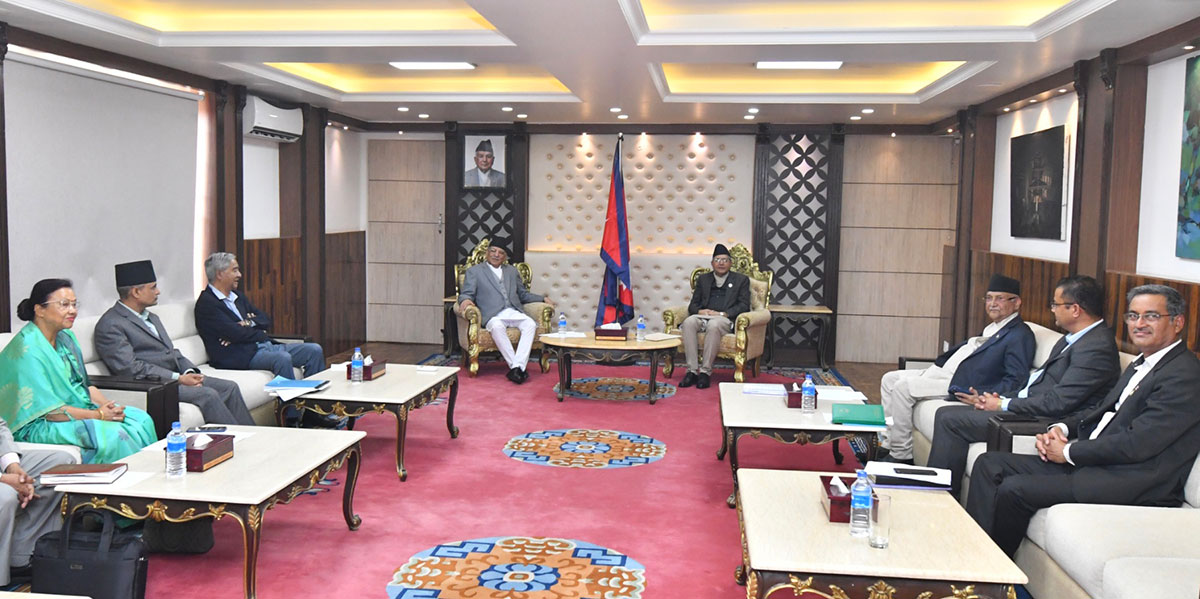
Top three leaders’ meeting ends inconclusively
A meeting of the top leaders of the major political parties, Speaker of the House of Representatives and the chief whips ended inconclusively on Tuesday. Prime Minister Pushpa Kamal Dahal, former Prime Minister and CPN-UML Chairman KP Sharma Oli, former Prime Minister and Nepali Congress President Sher Bahadur Deuba, Speaker Devraj Ghimire and chief whips among others were present in the meeting held in Baluwatar this morning. A Baluwatar source said that the next meeting will be held in Singha Durbar at 1 pm on April 14. Though the leaders have agreed to make the Truth and Reconciliation Commission (TRC) among other bills ‘widely acceptable’, they have decided hold discussions on matters of the TRC bill and its procedures again, it has been learnt. The leaders have also agreed to decide on the leadership and representation of joint committees and other committees on the basis of consensus. UML Chief Whip Padam Giri, CPN (Maoist Center) Chief Whip Hit Raj Pandey, Nepali Congress lawmaker Ishwori Neupane, Attorney General Dinmani Pokharel, former Attorney General Ramesh Badal also took part in the meeting. After the main opposition rejected the government’s proposal to take the TRC bill ahead through fast track, the government has not taken forward the proposal yet.


