


Gold price drops by Rs 500 per tola on Friday
The price of gold has dropped by Rs 500 per tola in the domestic market on Friday. According to the Federation of Nepal Gold and Silver Dealers’ Association, the yellow bullion is being traded at Rs 109, 200 per tola today. The yellow metal was traded at Rs 109, 700 per tola on Monday. Meanwhile, tejabi gold is being traded at Rs 108, 700 per tola. It was traded at Rs 109, 200. Similarly, the silver is being traded at Rs 1,370 per tola today

India-Nepal Economic Partnership Summit 2023 organized in Birgunj
PHDCCI India-Nepal Centre in association with the Nepal SBI Bank Ltd (NSBL), Nepal-India Chamber of Commerce and Industry (NICCI), Birgunj Chamber of Commerce and Industry (BCCI) and the Startup Network (TSN) organized India-Nepal Economic Partnership Summit 2023 in Birgunj on Thursday to create a uniquely important platform for discussing a forward looking bilateral economic partnership agenda. The deliberations supported by the decision-makers were aimed at opening new avenues of business engagements and investments in the key sectors of economy besides giving a much-needed boost to the trade near the crucial India-Nepal border in Birgunj, an economic hub of Nepal. Some of the key points of the Summit were to create a platform through joint action for deeper economic engagement between India and Nepal (with focus on remittance, imports, exports and Balance of Payment (BoP) challenges in Nepal), to channelize investment from India to Nepal and other ways round, to re-establish the India-Nepal bilateral relations as the core strength of the sub-regional co-operation in South Asia, to create a sustained convergence of industry and government for thriving on the mutually beneficial India-Nepal bilateral relations in all crucial realms. Likewise, to bring-in to notice the hidden potential in the Border Area Development Program (with focus on connectivity) and paving the way for India’s major involvement in helping the infrastructural facelift of Nepal’s bordering districts in Bihar and making them the gateways of India-Nepal Trade Connection, to discuss and ideate for making Cluster-based Economic Zones across Nepal and to further relax the cross-border trade norms to secure and sustain the greater economic engagements. During the program, Sushil Bhatta, CEO, Investment Board Nepal, gave an outline of the recent investments from the major Indian entities like NTPC Vidyut Vyapar Nigam Ltd (NVVN) and Dabur—and welcomed the Indian investments citing the advantages Nepal has a friendly destination and with progressive investment policies for projects, reads a statement issued by the PHDCCI India-Nepal Centre. Representing the Consulate General of India, Satish Pattapu, Consul (Economic Cooperation & Commerce), Consulate General of India, Birgunj, Nepal shared an overview of the main constituents of economic cooperation and challenges at policy level that need to be tackled. For further making the border trade movement smoother and more efficient, Shailendra Kumar, Consul (PCS) apprised about the steps being undertaken. Speaking at the same program, Dipak Kumar De, MD & CEO, Nepal SBI Bank Ltd and Rizwan Alam, Deputy CEO & CFO, Nepal SBI Bank Ltd gave a detailed account of NSBL’s initiatives for fostering the entrepreneurial ecosystem of Nepal and help in easing the slowdown in economy. NSBL’s MD and CEO assured the industry captains and startups for offering the best-in-class banking services for Nepal’s successful transition from a recessionary to a booming economy with focus on project finance and landing for removing liquidity crunch, reads the statement. NSBL, with a majority stake of State Bank of India (SBI), has been working for almost three decades in Nepal in the private sector, it has had created a niche for itself as a technology and innovation driven bank with a resolve to support Nepal’s businesses and people. Ajay Kumar Chaurasiya, lawmaker Kumar Agrawal, President of Birgunj Chamber of Commerce and Industry Anukool Bhatnagar, Managing Partner, Comprehensive Financial Assets & Advisory Services LLP and former MD and CEO, Nepal SBI Bank Ltd Deepak Rauniar, founder CEO, Oorja World Sunil KC, Vice President of NICCI Kunal Kayal, Chairperson (Industry & Export Promotion Committee) of NICCI Abhishek Choudhary, President of NICCI Birgunj Chapter Ashok Temani, President (Madhesh Pradesh) of FNCCI Vijay Kant Karna, Executive Chairperson of Centre for Social Inclusion and Federalism Mahesh Kumar Agrawal, Bihar State Coordinator of Seema Jagran Manch Ashok Kumar Baidya and Chairman of Nepal-Bharat Sahyog Manch Chandra Kishore among others were present in program.

Yarsagumba picker dies in Darchula
A person, who was collecting yarsagumba at Kunti in Byas Rural Municipality-1 of Darchula district, died after being hit by a stone that fell from the hill. Bir Singh Yetwal, 42, of Chhangru village died on the spot, Inspector Gyanendra Bahadur Singh, who is also the Information Officer at the District Police Office, Darchula, said. Another Yarsa collector Pushkar Yetwal was injured in the incident and he is receiving primary health care service at home, police said.

1 killed, 35 injured in Dang Bus collision
A person died and 35 others were injured when two passenger buses collided with each other at Phalakapur in Lamahi Municipality-3 of Dang district along the East-West Highway on Friday. The deceased has been identified as Shova Pariyar (43) of Ramtigadhi Rural Municipality-7, Rolpa. Her body has been kept at the Lamahi Hospital for postmortem. DSP Rajan Gautam of the District Police Office, Dang said that the bus (Na 5 Kha 4898) heading towards west from east collided head-on with another bus (Ju 2 Kha 758) at around 6 am today. Among the injured, 13 are said to be in critical condition. They are undergoing treatment at various hospitals. Police said that they are looking into the incident.

President to address joint meeting of federal Parliament today
President Ram Chandra Paudel is scheduled to address the joint meeting of the Federal Parliament to table the government's policy and programs for the upcoming fiscal year on Friday. The Federal Parliament Secretariat said that the President will address the meeting of the Federal Parliament at 4:00 this afternoon in the Federal Parliament Building, Naya Baneshwor. As per the constitutional provision, the President shall address either a meeting of any House or a joint sitting of both Houses of the Federal Parliament, and summon the MPs. This is the first address to the parliament after Paudel's election to the post of the President. The President shall address the first session after election to the House of Representatives and a joint sitting of both Houses of the Federal Parliament after the commencement of the first session of each year, the constitution states. In today's meeting, leaders of the political parties, chiefs and representatives of the constitutional bodies, high-ranking officials of the government and chiefs of diplomatic missions in Nepal will attend the meeting for observation. After the joint meeting, the separate meetings of the House of Representatives and National Assembly would take place. Likewise, Prime Minister Pushpa Kamal Dahal would table the copies, read out by the President in the joint meeting of the Federal Parliament, of the policy and programs of the government in the separate meetings of the two Houses.
Editorial: Fair probe is a must
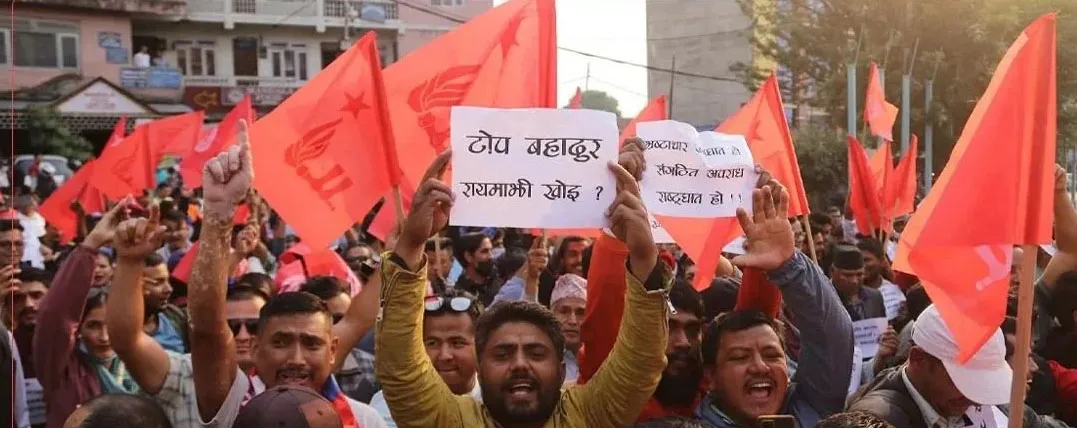
The ongoing police probe into the Bhutanese refugee scam has given the people a glimmer of hope. Fed up with chronic corruption, misrule and instability over the decades, people want a free, fair and transparent investigation into this scandal that has netted a few powerful figures. But some of the recent developments are making the conscious citizenry wonder if efforts are underway to influence the probe. Ever since the arrests started in connection with this scam, top leaders of major political parties have huddled together more than once. It is natural for the birds of a feather to flock together, but these birds are quite different from each other, right? There was a time when these figures would never get tired of hauling each other over the coals and presenting themselves as holier than thou. At a crucial juncture of the probe, what has made them go for marathon parleys? Some kind of national emergency that the fourth estate is unaware of? Anyway, the conduct of top leaders of major political parties is giving ground for suspicion based on which fertile minds are busy developing their own conspiracy theories. In the wake of these hush-hush talks, people have started suspecting that the top brass may be trying to shield themselves as well as their kith and kin. To retain public faith in the investigation and lessen the damage to Nepal’s image in international fora, the government should publicize the findings of the probe on a regular basis by engaging the media—both national and international. How about conducting a regular press briefing to deal with rumors surrounding the scam and bring the facts to the fore? This can help retain public faith in the investigation and discourage conspiracy theorists. It can also be an effective way to engage the international community, which is also a stakeholder in this case as it has given shelter to more than one lakh Bhutanese citizens of Nepali origins, driven away from their motherland by a dictatorial regime. While carrying on with this probe, the plight of these people should not be forgotten nor the state of affairs in Nepal that is literally forcing the people to ‘flee’ by paying human traffickers. The silver lining in this dark cloud is that the scam has given the government a golden opportunity to cleanse the governance system and restore public faith in it. If conducted properly, this probe will mark the start of a mega-probe into a series of cases of corruption, including policy corruption, that have rendered the country gravely ill. The government should not squander this once-in-a-lifetime opportunity. As for the people, they should stay ever vigilant to ensure that the government stays the course. After all, eternal vigilance is the price of liberty.

Bhutanese refugee leader Teknath Rijal arrested
Police on Thursday arrested Bhutanese refugee leader Teknath Rijal in connection with the fake Bhutanese refugee scam. He was dragged into the case after those arrested in the scam mentioned his name during the statement they gave to the investigators, SSP Dan Bahadur Karki of the District Police Range, Kathmandu said. Police said that Rijal has been taken to the court to extend the remand.

Nepse surges by 32. 30 points on Thursday
The Nepal Stock Exchange (NEPSE) gained 32.30 points to close at 1, 877.32 points on Thursday. Similarly, the sensitive index surged by 5.23 points to close at 358. 18 points. A total of 4,422,186-unit shares of 2694companies were traded for Rs 1. 47 billion. Meanwhile, Himalaya Urja Bikas Company Limited and Aatmanirbhar Laghubitta Bittiya Sanstha Limited were the top gainers today, with their price surging by 10. 00 percent. Similarly, NIBL Growth Fund was the top loser as its price fell by 3.14 percent. At the end of the day, total market capitalization stood at Rs 2. 73 trillion.


