


Royal Enfield starts assembly of motorbikes in Nepal
After Bajaj and TVS, Royal Enfield has also started assembling motorbikes in Nepal. The Indian two-wheeler brand on Friday said its assembly plant in Birgunj, set up in collaboration with the Triveni Group of Nepal, has become operational. The complete knocked-down (CKD) assembly unit has an annual capacity of 20,000 units. Royal Enfield also launched its first set of locally assembled motorcycles—the new Classic 350 and the SCRAM 411. The Classic 350 will be available at Rs 499,000 and the Scram 411 will be available at Rs 660,000. The new facility is Royal Enfield’s fifth CKD assembly unit in the world after Brazil, Thailand, Colombia, and Argentina. “This new CKD facility in Nepal is in line with our ambitious global expansion strategy of investing in markets with huge potential to grow,” said B Govindarajan, CEO of Royal Enfield. The motorcycle market in Nepal is on a confident rebound journey, and Royal Enfield sees huge potential for the market to grow substantially, the company said in a press statement. With the market expected to grow at 10-15 percent in upcoming years, the company believes that the trend of premiumization of motorcycles will only increase in the country. The local partner of Royal Enfield in Nepal is Triveni Group. The group's subsidiary company Alfa Automotive Pvt. Ltd. is the official dealer of Royal Enfield in Nepal. Triveni had registered a company named TG Auto Group Pvt Ltd for motorcycle assembly at the Department of Industry. As of now, Golchha Group's Hulas Auto Craft has been producing Bajaj motorcycles in Nepal at its assembly plant in Nawalparasi. Similarly, Shankar Group has also started assembling TVS motorcycles in Nepal at its Simara-based plant. After the government incentivized the establishment of automobile assembly plants in the country, Nepali business houses having authorized dealerships of international motorcycle brands have shown their interest in setting up such assembly plants in Nepal. A year ago, the government led by the then Prime Minister Sher Bahadur Deuba through a substitution bill announced a 50 percent excise duty exemption on two-wheelers, four-wheelers, and assembly kits imported by companies to be assembled in Nepal. The government, however, increased the excise duty on 125cc to 250cc two-wheelers by 10 percent while those with engine capacity between 500 cc and 800 cc by 20 percent. This has forced major automobile dealers to set up assembly plants in the country. The authorized dealers of Yamaha, Hero, Honda, and Suzuki motorcycles have also already started the process to set up an assembly plant. MAW Enterprises, the authorized dealer of Yamaha motorcycles in Nepal, has registered MAW Auto Industry to assemble Yamaha two-wheelers. MAW has planned to set up a plant in Tankisinwari, Morang for the purpose. Meanwhile, Syakar Trading, the authorized distributor of the leading Indian motorcycle brand Honda has started the process to set up assembly plants in Nepal. Syakar has registered Himal Moto Pvt. Ltd. to assemble Honda two-wheelers in Nepal. Likewise, NGM Pvt. Ltd., the authorized distributor of Hero two-wheelers in Nepal, has registered NGM Engineering and Sales Pvt. Ltd. to assemble Hero motorcycles and scooters. Not to be left behind in this race, Vishal Group is also stepping into the automobile assembly business. The group, which is the official dealer of Suzuki motorcycles in Nepal, has recently registered Global Automobiles Pvt Ltd for the assembly of motorcycles, scooters, and three-wheelers.

Citizenship Bill reached court due to PM: Rabi Lamichhane
Rastriya Swatantra Party President Rabi Lamichhane has said that the Citizenship Bill reached the court due to Prime Minister Pushpa Kamal Dahal. Speaking at a Parliament meeting on Monday, Lamichhane said that the Citizenship Bill was certified in an illegal way. President Ram Chandra Paudel authenticated the controversial Citizenship Bill on May 31. On June 1, senior advocate Surendra Bhandari and advocate Bal Krishna Neupane moved the Supreme Court against the authentication of the bill. Hearing the writ petitions on Sunday, a single bench of Justice Manoj Kumar Sharma issued a short-term order directing the government not to implement the Citizenship Bill certified by President Paudel. The Citizenship Act has already been published in the Nepal gazette. On August 15, 2022, President Bidya Devi Bhandari had returned this very Bill to the House of Representatives for a review, in accordance with a constitutional provision, 15 days after its submission for authentication after endorsement from the House of Representatives and the National Assembly on July 22 and July 28, respectively.

Government steps back from new tax arrangement to calm stock investors
After furious stock investors resorted to protest against the provision in the budget for the next fiscal year that has kept the stock transactions above Rs 5 million in the income tax slab, the government has said that the existing arrangement related to capital gains tax (CGT) is the final tax on the income from share trading. The Finance Ministry relented to the demand of agitating share investors on Sunday after the latter threatened to close the Nepse Trade Management System (TMS). Currently, the government levies a five percent CGT on income from long-term trading of shares (shares that are sold after a year of purchase) and 7.5 percent CGT on short-term trading (shares that are sold in less than a year of purchase). The Finance Ministry invited the associations of share investors for talks on Sunday where the government agreed to continue the existing tax arrangement on share trading. During the talks, Finance Minister Dr. Prakash Sharan Mahat himself assured that the current 5 percent and 7.5 percent provision of CGT will be taken as the final tax. Minister Mahat urged the investors to avoid panic and said that no additional taxes will be levied on profits earned from share trading. The government in the new Financial Bill has incorporated the earnings of the share investors under the income tax bracket apart from the existing capital gains tax. As per the new provision, if a Nepali citizen declares income from share or real estate trading from FY 2019/20 to 2021/22, until mid-April, 2024, the 50 percent tax levied in accordance with Income Tax Act, 2058 will be waived. After the government declared imposing income tax for the earnings of shares transactions, the stock market reacted negatively, losing 92 points last Tuesday and Wednesday. The Inland Revenue Department (IRD) issued statements twice last week but that failed to pacify the stock investors. According to the government's new policy, the person concerned had to pay additional tax on the income after tax as per the income tax limit. If that is implemented, the investor would have to pay up to 39 percent tax according to the income limit. Tilak Koirala, one of the stock investors who led the agitation said that the government has backed away from the decision to impose additional tax on share trading. "Now, CGT will be the final tax on share trading," he said. As per the agreement reached on Sunday at the Finance Ministry, section 29 of the Financial Bill, 2080 will now be deactivated through the parliamentary process. As the government has proposed an additional tax on share trading, it must be passed by the Parliament before it is implemented. According to Koirala, there has been an agreement with the finance minister that section 29 would be deactivated. While Sunday's talk has thwarted possible face-offs between the government and investors, capital market experts said the government needs to bring a clear policy on taxes and other issues. Niraj Giri, former Executive Director of the Securities Board of Nepal, said that the government needs to bring a clear policy on taxes and other issues. "Questions have been raised with the government introducing new arrangements in the Financial Bill and backtracking from implementing it. So, the government should bring a clear policy regarding the capital market because it is susceptible to even small policy changes," he said. Nepse post 53 points gain on Sunday After the agreement between the government and stock investors, Nepal Stock Exchange (Nepse) surged by 53.03 points on Sunday. On Sunday, the Nepse index opened at 1,866.35 points and then went to an intraday low of 1,865.73 points before reaching an intraday high of 1,925.11 points and ultimately closed at 1,919.37 points. All the sub-indices at Nepse turned green on Sunday with the hotel sub-index recording the highest gain. The daily turnover of Nepse reached Rs 1.65 billion on Sunday. The share prices of 217 companies increased on Sunday while three companies decreased.

Indian PM Modi positive towards resolving border issues: PM Dahal
Prime Minister Pushpa Kamal Dahal has said that Indian Prime Minister Narendra Modi is positive towards resolving the Nepal-India border issues. Informing about his India visit to the Parliament, Prime Minister Dahal said that his Indian counterpart is positive towards resolving the border differences through diplomatic mechanisms established between Nepal and India. “I have urged Indian Prime Minister Modi to iron out boundary matter seriously,” the Prime Minister said, adding, “Indian Prime Minister Modi is positive towards resolving the disputed issues including the border with Nepal.” “This is the first time that Indian Prime Minister Modi clearly expressed his opinion on the border issue after a long time and this is a positive development,” PM Dahal said.

NEA’s profit drops by 27.65 percent
The profit of Nepal Electricity Authority (NEA) declined by around 27.65 percent in the third quarter of the current fiscal year 2022/23. The state-owned power utility has posted a profit of Rs 8.77 billion (before tax) in the review period compared to Rs 12.12 billion during the corresponding period of FY 2021/22. NEA's annual net profit in the last fiscal year was Rs 16.16 billion, a whopping 157.73 percent increase from FY 2019/20. However, with a sharp drop this year, NEA's profit may not reach the last year's profit level. According to NEA, its operating income dropped by 12 percent in the current fiscal year. The authority earned an income of Rs 84.60 billion in the first nine months of FY 2022/23 compared to Rs 95.95 billion during the same period of the last fiscal. Data shows NEA's expenses declined by 9.54 percent in the third quarter of the current fiscal year to Rs 75.83 billion from Rs 83.83 billion in the corresponding period of the last fiscal year. According to NEA officials, the profits have declined as it had to import more electricity this year due to the prolonged dry season and decrease in water levels in the rivers. NEA has been importing electricity from India during the dry season that runs from December to April. According to NEA, the run-of-the-river type hydropower projects produce less than 40 percent of their installed capacity during the dry season. NEA's Deputy Managing Director Pradip Kumar Thike said the authority's profit generally contracts till the third quarter of the fiscal year. "The actual picture of the NEA's profit will be visible by the end of the fiscal year," he said. In the meantime, NEA has also invested Rs 28.63 billion in shares and loans in various hydropower projects and rural electrification projects. The authority earned Rs 62.52 billion by selling electricity during this period. It has earned Rs 8.43 billion by exporting electricity to India. NEA has purchased electricity worth Rs 30.44 billion from the private sector power developer in this fiscal. Similarly, it has imported electricity worth Rs 12.28 billion from India during this period.

Gold being traded at Rs 111, 600 per tola on Monday
The gold is being traded at Rs 111, 600 per tola in the domestic market on Monday. According to the Federation of Nepal Gold and Silver Dealers’ Association, tejabi gold is being traded at Rs 111, 050 per tola. Similarly, the silver is being traded at Rs 1,415 per tola today.

Redmi Note 12 5G launched in Nepal
The Chinese smartphone brand Xiaomi has launched the Redmi Note 12 5G phone in the Nepali market. According to Xiaomi Nepal, the new Redmi Note smartphone offers lightning-fast 5G capabilities, allowing users to enjoy seamless browsing, streaming, and downloading experiences. The phone comes up with a stunning 120Hz AMOLED high refresh rate display. The 6.67-inch display delivers a flowing and immersive viewing experience. The phone also boasts an always-on display enabling users to stay up-to-date with their important notifications and other useful information on their lock screen. Xiaomi Nepal in a press statement said that equipped with a powerful Snapdragon 4 Gen 1 processor built on the 6nm process, the Redmi Note 12 5G offers impressive performance. "With up to 8GB of RAM and 256GB of storage, one can run more apps and switch between them at faster speeds, and also have plenty of storage to store more of your favorite apps and capture memorable photos and videos without worrying about running out of space," reads the statement. The company said the phone has long battery life and fast charging capabilities with a 5,000mAh battery. The 33W fast charging with MMT technology ensures a stable and efficient charging process. The phone is equipped with a 48MP triple camera setup with ultra-wide and macro camera lenses. According to the statement, users can capture breathtaking scenes in the dark in night mode, while portrait mode creates a natural depth of field, allowing the subject to stand out from the crowd or a busy background. "We are excited to launch the Redmi Note 12 5G, which brings the power of 5G connectivity and exceptional performance to our users. We are confident that this device will exceed the expectations of our customers and enrich their smartphone experience,” said Amit Kumar Panda, country general manager of Xiaomi Nepal. The Redmi Note 12 5G comes in three colors Onyx Gray, Forest Green, and Ice Blue in 6GB+128GB and 8GB+256GB variants. The 6GB+128GB and 8GB+256GB variants are priced at Rs. 29,999 and Rs. 31,999 respectively. Xiaomi Nepal informed that the phone will be available in all the authorized Mi Stores & Xiaomi authorized retailers all over Nepal from June 11.
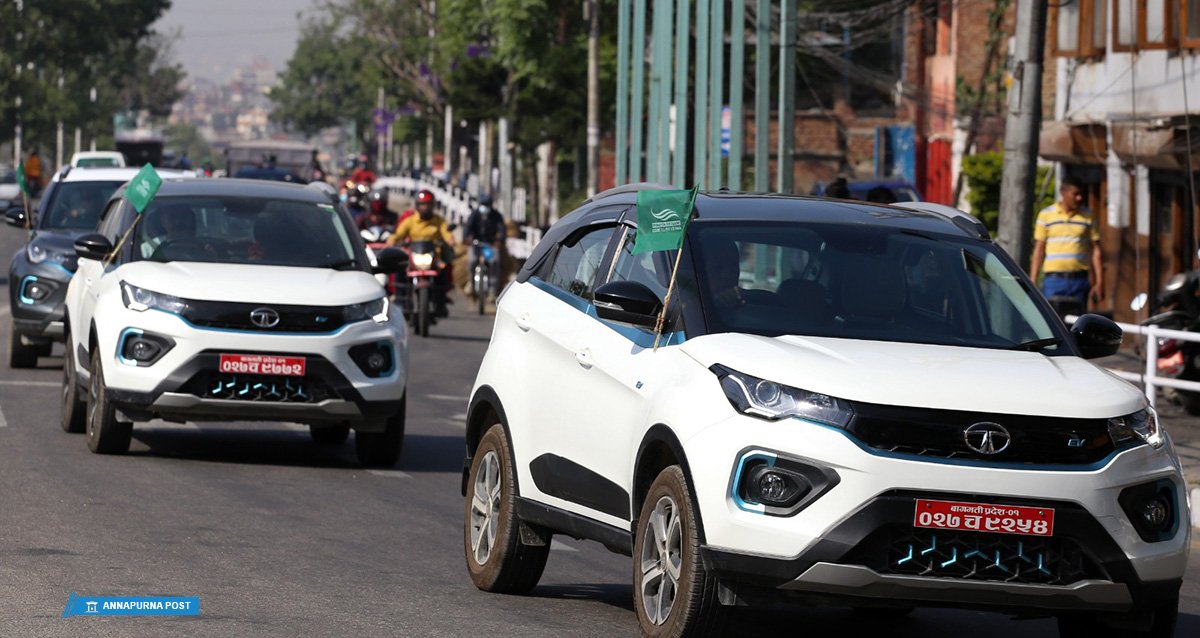
AMN organizes EV rally to mark World Environment Day (Photo feature)
On the occasion of World Environment Day, Annapurna Media Network (AMN) organized an electric vehicle rally in Kathmandu on Monday.
Minister for Energy, Water Resources and Irrigation, Shakti Bahadur Basnet, and Captain Rameshwar Thapa, Chairman of AMN, jointly flagged off the 'Nexon EV AMN EV Rally 2023 in association with Tesla' from Annapurna Tower in Tinkune.
Although 200 EVs, including two-wheelers and three-wheelers, participated in the rally organized with the slogan 'We Believe in Action'.
During the rally, the participants emphasized the importance of collective participation in the journey towards a sustainable future.
The event was supported by TheeGo, World Wildlife Fund-Nepal, Save the Children, and Pan-C Bikes. Additionally, Garden Restaurant served as the food partner, Fruit Agro as the beverage partner, Foodmandu as the online food delivery partner, and Simrik Foundation as the synergy partner for the event.
The rally that started from Tinkune progressed through Gaushala, Chabahil, Balaju, Naya Bazaar, Sorhakhutte, Durbar Marg, Gyaneshwar and Gaushala before concluding at Tinkune.
All must act to protect environment: Minister Basnet
Minister Basnet commended the Annapurna Media Group for organizing the rally. "This event teaches how every person and organization should take the initiative to face the challenges effectively," he added.
Highlighting the impact of environmental pollution on human life, Minister Basnet expressed the difficulty in preserving the interdependent relationship between nature and humanity. "If we do not take initiatives in proportion to the extent to which the problems in people's daily life are expanding, then a great imbalance will arise," he warned.
Minister Basnet reiterated his confidence that the rally would play a significant role in promoting environmental protection and creating a healthier environment. He said that this campaign was not only relevant but also necessary to address the pressing environmental concerns of our time.
Minister Basnet highlighted the role of electric vehicles in reducing air pollution and safeguarding the green environment. "The use of electric vehicles instead of petroleum vehicles will make a positive contribution by reducing harmful emissions," he said, adding that the government has taken a policy of promoting electric vehicles.
During the event, AMN Chairman Captain Rameshwar Thapa highlighted the use of electric vehicles as a positive practice and called on the society, the government, and everyone to act.
Thapa said he joined the campaign to protect the environment and that he believed in taking action. Stating that he has closely witnessed the impact of climate change on the mountains, Thapa expressed concern about the melting snow and its risks for humanity. "It is the responsibility of everyone to reduce the impacts of climate change. We, at AMN, consider it our duty to promote positive awareness. The EV rally is a part of our efforts," he added.
Meanwhile, Shyam Kaji Maharjan has won an electric bicycle as a door prize of the event.


