


India, Australia locking horns today for World Cup title
In a cricketing spectacle of grand proportions, India, the unbeaten hosts, are set to carry the hopes of billions when they face off against Australia in the highly anticipated World Cup final at the majestic Narendra Modi Stadium in Ahmedabad on Sunday.
The 130,000-capacity stadium, named after the Indian Prime Minister, is not only the battleground for this high-stakes encounter but also the canvas for pre-match extravaganzas, the Time of India reported.
A pre-match fly-past by the Indian Air Force and meticulously choreographed displays featuring dancers and light shows during innings breaks are all part of the pageantry, underscoring India's status as the economic powerhouse of the cricketing world.
India's cricketing dominance in the tournament has been nothing short of spectacular winning all 10 games leading up to the final.
Virat Kohli, the tournament’s leading batsman, has been in sublime form, setting a new record of 50 ODI hundreds in the semi-final victory over New Zealand. Mahammed Shami, leading the tournament bowling charts with 23 wickets at an impressive average of 9.13, has been a potent force for the hosts, according to The TImes of India.
Captain Rohit Sharma, acknowledging the immense pressure, stated, “Playing for India is as good as playing any World Cup game because there is so much pressure. There is so much expectation.” He added, “ Not many have played the finals, but like I said, playing for India is as good as playing any World Cup game.”
Australia, bidding for a record-extending sixth World Cup title, enter the final with a team boasting survivors from their triumphant 2015 World Cup campaign. Captain Pat Cummins emphasized the team’s experience, saying, “We know that feeling and won’t be afraid to go out there and be brave and take the game on.”

Chhath, a festival of social and cultural harmony: Deuba
Nepali Congress President and former Prime Minister Sher Bahadur Deuba has said that all festivals of the country are the heritage of our social relations and cultural harmony.
In a message of best wishes on the occasion of Chhath festival, he said that festivals help to develop a spirit of collectivism and help to build the foundation of unity and harmony.
Extending his best wishes for happiness, peace, prosperity and success to all on the occasion of this festival, Deuba said that Nepal is a country with diverse festivals, religious and cultural traditions and with a harmonious tradition of respecting and honoring one another's religious and cultural traditions.
Leader Deuba has also wished that the Chhath festival may inspire all everyone to promote social harmony by creating an atmosphere of happiness, peace and prosperity.

Chhath festival being observed today
Chhath festival, one of the major festivals of the country and predominantly observed in the Tarai region, is being celebrated today by worshiping the sun.
As a major part of the festival, the setting sun is worshiped by offering argha while the same process is followed to worship the rising sun on Monday morning to bring the festival to an end.
Tonight, the revelers observe a fast and stay awake all night and offer prayers to the rising sun tomorrow morning.
Banks of rivers, streams and ponds across the country are decorated for the Chhath festival.
It is widely believed that observing a fast in obeisance of Chhathi goddess will bring desired results and well-being for the family and all of their sorrows and troubles will vanish away.
Meanwhile, the federal government has announced a public holiday today to mark the festival.

Kathmandu gears up for Chhath celebrations (Photo Feature)
The preparations for the Chhath festival in Kathmandu are nearing completion, with the banks of the Bagmati River and the city's ponds adorned in vibrant decorations for the upcoming celebration.

This revered festival, deeply entrenched in Nepali tradition, venerates the Sun God, Surya, and Chhathi Maiya, the Goddess of Purity, Fertility, and Power. Its observance involves meticulous rituals and offerings, symbolizing gratitude, penance, and the pursuit of blessings for well-being and prosperity.

Nepal, renowned for its rich cultural diversity, embraces Chhath with profound enthusiasm and reverence. The festival holds significant importance in the hearts of Nepalis, particularly those dwelling in the Terai region. Rivers and ponds across Kathmandu transform into lively hubs of colorful decorations and communal gatherings during this auspicious occasion.
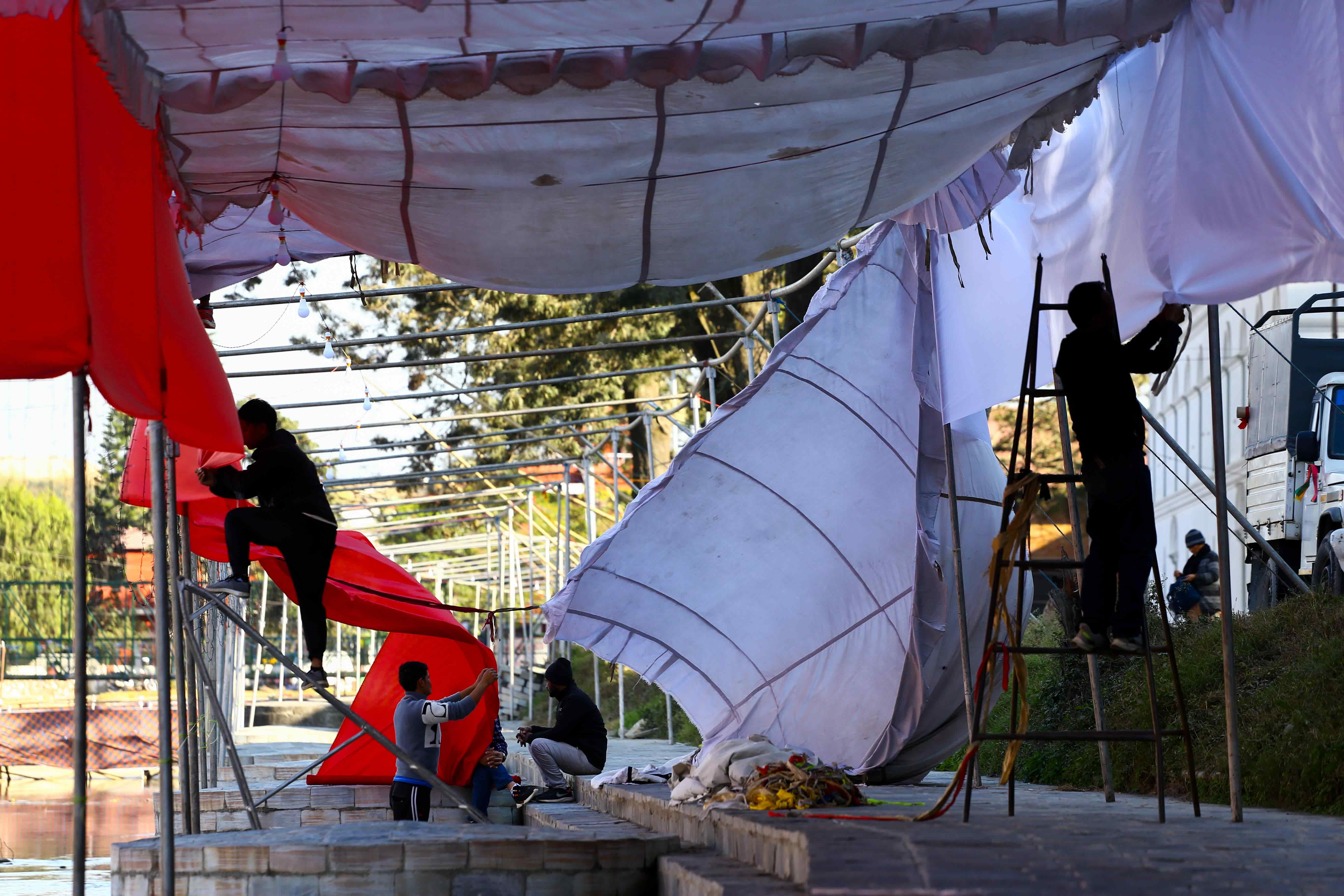
The detailed preparations for Chhath encompass a multitude of activities, from diligently cleaning the riverbanks and ponds to embellishing them with vibrant ornamentation. Elaborate makeshift stages, referred to as 'ghats,' are meticulously constructed along the riverbanks, where devotees will partake in various rituals and offer prayers to the rising and setting sun.


Two elderly men die of cold in quake-hit Jajarkot
Two elderly men died of cold in quake-hit Jajarkot district.
The deceased have been identified as Bhuleshwor Karki (88) of Bheri Municipality-2 and Narendra Bahadur Singh of Barekot Rural Municipality-4. They were residing under the tent after an earthquake destroyed their houses.
A 6.4 magnitude earthquake with its epicenter in Ramidanda of Jajarkot jolted Jajarkot and Rukum West districts on November 3, killing at least 157 persons and destroying properties worth millions.
Both of them were patients of asthma and died due to increasing cold, said Chairperson of Barekot Rural Municipality, Bir Bahadur Giri.
He said that more than 34,000 families of Jajarkot district are living under tents after their houses were completely damaged by the earthquake. Children, new mothers, patients suffering from chronic diseases and elderly persons are mostly affected by the cold.
Chief District Officer of Jajarkot, Suresh Sunar, said that children and elderly persons are found suffering from respiratory problems.
He stated that two chronic disease patients also lost their lives from cold at Nalgad-4 last week.

Media Action Nepal joins GFMD to advance media development
Media Action Nepal, a prominent civil society organization (CSO) defending free and accountable media in Nepal, has joined the Global Forum for Media Development (GFMD) to promote and advance media development worldwide.
Along with thirty-one other new members, on November 2, GFMD welcomed Media Action Nepal to their community of journalism support and media development organizations. "We are thrilled to introduce our newest members, who have joined us on our mission to promote and advance media development worldwide," the GFMD announcement reads. These dynamic organizations bring diverse perspectives and expertise to our network, enriching the collaborative spirit that defines GFMD. Together, we will continue to drive positive change in the global media landscape, GFMD added.
"We are happy to join the largest global network of media development organizations and look forward to contributing in the area with our local, regional and international experiences," shared Laxman Datt Pant, Chairperson of Media Action Nepal.
The GFMD Chairperson Zoé Titus said she is pleased to have Media Action Nepal as a new member of the GFMD. "I look forward to collaborating with Media Action Nepal to further enrich the global network of media development," she added.
Through collective action, the GFMD network of 171 members delivers policies and programmes to sustain journalism as a public good. A member of the Media Freedom Coalition-Consultative Network and ACOS Alliance, Media Action Nepal is a vibrant CSO promoting independent and accountable media in Nepal through direct interventions and across the world through its collaborations with international media rights advocacy organizations.

PM Dahal to address 2nd Global South Summit today
Prime Minister Pushpa Kamal Dahal is to address the 2nd Voice of Global South Summit today.
The PM will address the Summit, hosted by Indian Prime Minister Narendra Modi, by virtual means, the Ministry of Foreign Affairs said.
Heads of Government of various countries, including PM Modi, are scheduled to address the Summit. The theme of the Summit is - “Global South: Together for One Future”.

Banana worth Rs 40 million imported from India in Janakpur for Chhath festival
Bananas worth Rs 40 million have been imported from India in Janakpurdham, the capital of Madhes province, alone for the Chhath festival.
Banana is a must-have fruit for performing the various rituals associated with the Chhath festival. The people observing the Chhath fasting make an offering of a single banana comb to the Sun god.
The demand for bananas is high during the Chhath and the supply is not enough to meet this demand and hence bananas have to be imported every year, said Bishweshwar Yadav, president of Janakpur Fruits and Vegetables Traders' Committee.
According to him, although the soil in the Tarai-Madhes of Nepal is good for banana cultivation, the local production is not enough to meet the growing demand every year.
"Last year, bananas worth 17.5 million were imported in Janakpur. This year, nearly 70 truckloads of bananas have entered the provincial capital," he said.
The Gopal and Bansibhog varieties of banana have been brought to Janakpur from Bhardaha, Bhantabari and Inaruwa of Saptari district of Nepal while the Malbhog, Mirichman, Chini Champa varieties of banana have been imported from Assam, Guwahati, Bangal, Hazipur, Thakurgunj and Champaran of India, said Bhuwaneshwar Purbe, the Committee Secretary.
He said that the price of bananas has increased by 25 percent amidst Chhath this year compared to the last year. "The demand for bananas has been growing as the number of people observing the Chhath festival increases every year. This year, 15 to 20 more trucks of bananas have been imported as compared to the previous year to meet the demand," he said.
Yadav, the Committee president, said there are 1,200 combs of bananas loaded in a truck having 10 wheels. The transportation cost per truck up to Janakpur is Rs 600,000.
Each banana comb is sold in the range of Rs 500 to Rs 1,000 in the market.
The local varieties of banana are grown in every place in Nepal. Some of the popular varieties grown in Nepal are the Malbhog, Jhapali Malbhog, and William hybrid robusta, among others.
The banana traders and cultivators say that although there is immense prospect for banana farming, banana production has not increased in the country due to technical problems.


