Political Briefing | Learning (or not) from China

A lot of what we know about China comes from Western news outlets and books by Western authors. This holds for this writer as well. Besides authors like John Keay, Robert Kaplan, and Martin Jacques, he relies mostly on The Economist and The New York Times to get his fill on China. Besides that, he regularly visits the websites of Global Times and People’s Daily. But is that enough? To understand such a vast country, nay, a civilization, shouldn’t he have lived there for a few years or, short of that, at least understand Mandarin?
This was among the conversation topics in a recent Clubhouse discussion titled ‘Know China’. As ApEx columnist Trailokya Raj Aryal, who studied in China and is fluent in Mandarin, pointed out, outsiders tend to ignore nuances, and much gets lost in translation. Most important pieces of writing on China are to be found on little-known Chinese blogs, he averred. The redoubtable CK Lal, invited to speak, also refrained from saying much because he said he too mostly relied on English texts to decipher China.
One topic of common interest was Confucius. The ancient philosopher is vital to understanding modern China. His emphasis on human relationships and social harmony is often contrasted with the Western obsession with individual wellbeing. Also, his adherents have no temples to visit, unlike the Chinese Buddhists and the Taoists. Confucianism is more a way of life than a religion.
Confucius has been resurrected by successive Chinese dynasties to underpin their rule, and even the modern-day Communists are his die-hard fans. There are now Confucius Institutes to teach the Chinese language all over the world and the Chinese foreign policy has a distinct Confucian whiff. In 2013, unveiling his signature foreign policy initiative, the BRI, Xi Jinping assured the rest of the world that China would never seek a dominant role in regional affairs. He instead expressed his interest in reviving the ancient Silk Route networks, linking countries anew based on “mutual support and trust”, not narrowly defined self-interests.
That many Western critics accuse Chinese leadership of using the benevolent face of Confucius to cloak their authoritarian intentions is another story altogether. Another interesting aspect of modern China that emerged during the CH discussion concerned its meritocratic bureaucracy and party system. In the selection and promotion of CCP cadres, prospective candidates are evaluated both on their intellectual breadth as well as the depth of their soft skills like their ability to get along with and persuade others. Most top-ranking CCP members have tertiary degrees, with engineering majors dominating the highest echelons. It is the presence of these technocrats that ensure things get done well and on time.
Most Chinese communist leaders are clean and efficient and collectively committed to achieving mutually defined goals, which is far from what we can say about Nepali leaders, communists or otherwise. But then the question is: Can we cherry-pick the merit-worthy aspects of modern-day China while blocking out its ugly facets? Is China’s recent breakneck pace of growth and development and its ability to lift hundreds of millions of folks out of poverty in a generation the direct result of its one-party system or did they happen despite it?
There are many things Nepal and its politicians can learn from China. Then there are the things we must avoid. But we can know the difference only by striving to understand China on our terms rather than by seeing it through Western eyes. May many more discussions on China tailored to Nepali audiences follow, in and outside Clubhouse.

Politics | Nepal’s local bodies again prove their worth
When Prime Minister KP Oli was inaugurating the Dharahara tower in Kathmandu even before its construction was completed, Nepalgunj, a border town in western Nepal, was reeling under a severe crisis.
More than 1,000 cases of Covid-19 were being reported a day in the city of 1.3 million people. Nepalgunj Sub-metropolitan City lobbied with the federal government to lock-down the town, to no avail.
The District Covid Crisis Management Committee (DCCMC), headed in the district by a representative of the federal government, decided to impose a lockdown in the city only after April 25 when hospitals’ resources were spread thin as they tended to a surging number of terminally-ill patients.
Constitutionally, all three tiers of government—the local, provincial and federal—are free to exercise their executive rights. But the prevailing pandemic law doesn’t allow local governments to act independently in pandemic-containment or in any other crisis.
According to Annex 5 of the constitution, the federal government reserves the right to prepare health protocols and policies to control infectious diseases.
Soon, the city became a Covid-19 hotspot.
“We had for long been requesting for a lockdown and the closure of border crossing with India. Had the DCCMC acted on time, our city may not have faced a disaster-like situation,” says Uma Thapamagar, deputy mayor of Nepalgunj Sub-metropolitan City.
Against all odds, Nepalgunj Mayor Dhawal Shumsher Rana decided to mobilize available resources to tackle the Covid-19 crisis.
“Unlike during the first wave, the local government this time had to manage hospital beds and oxygen for Covid-19 patients,” says Thapamagar, who also visited isolation centers and hospitals each day to observe the treatment of Covid-19 patients.
After a surge in Covid-19 cases in India, early warnings were issued by experts in Nepal as well. But the government failed to regulate the open border and adopt other precautionary measures. The education minister insisted that the schools remain.
Infectious diseases expert Dr Anup Bastola wrote on his Facebook on April 9, three weeks before prohibitory orders were issued in Kathmandu and major cities, “An alarm bell has already been rung that a second wave [of Covid-19 infections] cannot be avoided in densely populated areas. Let’s not neglect safety protocols.”
Driving the change
As hospitals across the country struggled to isolate and treat the infected, local representatives sprang into action. A local representative in Khotang district even carried Covid-19 patients on his back and drove them to the hospital on his official vehicle.
“I have carried at least nine Covid-19 patients on my back to the road and driven them to hospital,” says Bhupendra Rai, chairperson of Diprung Chuichumma Rural Municipality, Khotang.
According to Rai, when the sole ambulance in the local unit became dysfunctional at the peak of the Covid-19 crisis, Rai turned his official vehicle into an ambulance and started carrying Covid-19 patients with severe symptoms to hospitals wearing a PPE.
“People’s cries don’t reach Singha Durbar. The local representatives who have to work with people every day are concerned about their wellbeing,” says Rai. “I had no option but to take some risk to save my people.”
Rai is not the only one to turn official vehicles into ambulances to ferry Covid-19 patients. Dozens of local representatives have done so, including chiefs and deputy chiefs of Jaljala Rural Municipality, Parbat, Mathargadi Rural Municipality, Palpa, and other local units.
Hira Kewat, Chairperson of Omsatiya Rural Municipality in Rupandehi district, drove the body of a deceased Covid-19-infected person to the cremation site on a tractor.
“I got a call from the ward chairman about the situation. As the army would take time to get there and as the locals were not ready to cremate the body, I donned a PPE and drove the body on a tractor,” he says.
He had heard from doctors that chances of contracting Covid-19 from a dead body were minimal.
“I was socially excluded when I was infected during the first wave. So I could feel the pain of the family members of all those who were later infected,” he says.
Morale-boosters
To boost the morale of covid patients local bodies adopted all possible measures ranging from mobilizing doctors for door-to-door treatment services to the distribution of essential meals to psychosocial counseling.
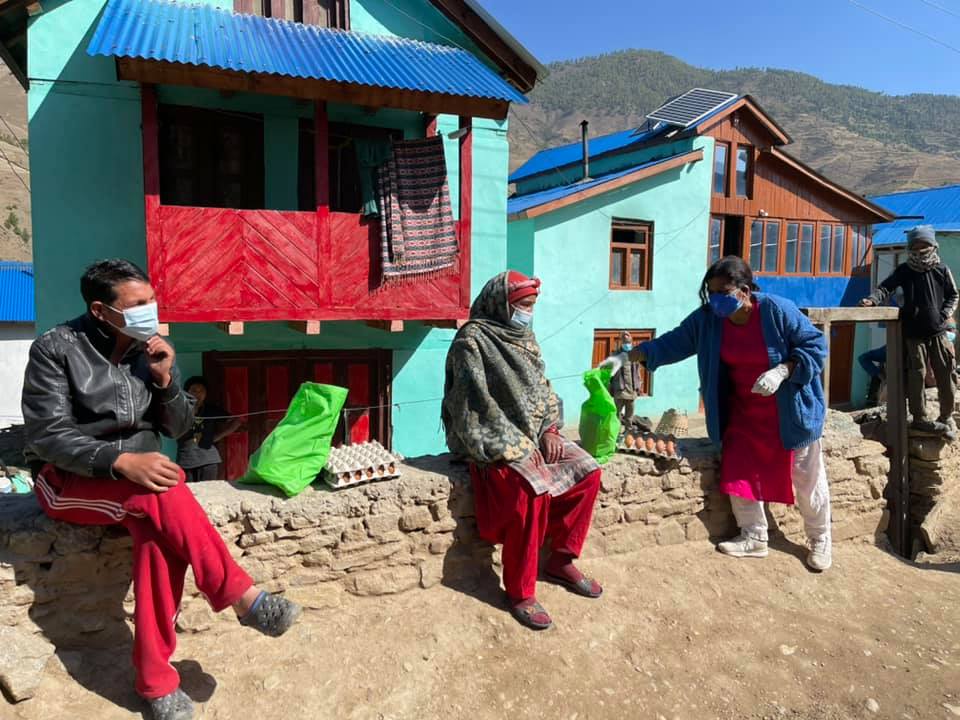 Local representatives of Chandannath municipality in Jumla district distributing food to those in home-isolation.
Kantika Sejuwal, mayor of Chandannath Municipality Julma, decided to visit Covid-19 patients in home isolation with medicines and food rich in protein.
“We were not prepared for the second wave. Our isolation center was not even ready. So I decided to visit patients at home,” Sejuwal says.
According to Sejuwal, local governments are handling the worst crisis they have faced since their formation in 2017.
“The federal and provincial government representatives are busy fighting for power and the local units are paying the price,” she says.
Local representatives of Bheriganga Municipality in Surkhet distributed food and medicines to Covid-19 patients. They visited Covid patients in home-isolation with health workers for counseling.
Dharma Bahadur KC of Banphikot Rural municipality Rukum visited Covid patients with a health worker’s team, counseling them and spreading awareness among villagers. Representatives of Butwal Sub-metropolitan city did the same.
Visits and sympathy from local representatives boost the morale of covid patients that is vital to fighting the disease as well as any social stigma it might bring.
Nepalgunj Sub-metropolitan City also initiated drive-through treatment of Covid patients in home isolation.
Missing money
Prime Minister Oli decided to seek a vote of confidence from Parliament on May 10 at a time when the country was reporting over 9,000 daily Covid-19 cases, and test positivity had reached 40 percent.
“The central and provincial governments, caught up in bitter power tussles, could do little and we had to shoulder the bulk of the responsibility,” says Kantika Sejuwal of Chandannath municipality.
According to Uma Thapamagar of Nepalgunj, had the federal and provincial governments acted on time, losses from the second wave of Covid-19 could have been minimized.
“Almost all local governments, including Nepalgunj, prepared isolation centers for the treatment of Covid-19 patients and managed oxygen on their own, by going beyond their constitutional and legal jurisdiction,” says Thapamagar. “The federal government just watched from the sidelines.”
Madhyapur Municipality in Bhaktapur started its oxygen plant when the country was facing an acute oxygen shortage.
Almost all local governments established isolation centers for the treatment of Covid patients as major hospitals were running out of beds and oxygen.
“The federal government has undermined the role of local units even in the ordinance on Covid-19 management,” says Ashok Byanju, chairperson of the Municipal Association Nepal.
“If infectious disease management is the federal government’s absolute domain, it should manage the emergency on its own. If not, local governments should be adequately empowered,” he adds.
According to him, local governments have yet to recover the Rs 12 billion they spent on covid-management last year.
Some local governments have also sought the federal government’s permission to purchase Covid-19 vaccines. But health ministry officials say local units simply don’t have the wherewithal to do so.

Political Briefing | Don’t count Oli out just yet
Prime Minister KP Oli has tried nearly everything to hang on to the prime minister’s chair: Breaking an opposition party to knit together a governing majority, amending the citizenship law via an ordinance to appease the Madhesi leaders joining his government, anomalously expanding his Cabinet, and repeatedly trying to cajole other senior CPN-UML leaders with empty promises into backing his leadership. Most troubling of them all is that he reclaimed the prime minister’s chair by stepping on contentious constitutional grounds. Now the Supreme Court has started invalidating these questionable moves, one after another. That at least is one way of seeing things.
On June 22 the Supreme Court ruled his two latest Cabinet expansions unconstitutional, as a result of which 20 ministers including three of his deputies have been relieved of their duties. The opposition parties have united against him. Ex-prime ministers believe PM Oli is ready to trade Nepal’s sovereignty to save his chair. Whatever the case, if the prime minister had to make way for someone else, he would have done it long ago. Oli is determined to hang on, any which way, until the next round of elections.
When it appeared that domestic forces could not keep him in power, he sought India’s help, which duly came. India convinced the Thakur-Mahato faction of the Rastriya Samajbadi Party, Nepal (RSPN) to ditch the party’s Yadav-Bhattarai faction and join the Oli government. In return, Oli promised to work for the restoration of Nepal’s ‘Hindu nation’ status. Modi, meanwhile, is in no mood to listen to ex-Indian diplomats who have repeatedly asked him not to pick sides in Nepal. Instead, the BJP government has passed a law that withholds state pensions of ex-officials who criticize the government in public forums.
As I have pointed out in this space before, there are many similarities between the governing styles of Oli and Modi. They are a natural match. Both are intolerant of criticism and choose to silence rather than heed their critics. They also believe in using the iron-fist of the executive to undermine other vital state organs. When other state officials cannot be coerced, they are co-opted. Therefore there are now many adherents of Modi’s Hindutwa agenda in the Indian Supreme Court. Despite his recent court reverses, perhaps Oli too believes he still has enough friends in the Nepali Supreme Court to ensure he remains at the helm during the next elections.
Modi remains popular in India, with 66 percent approval according to a new survey. This is down from his above-80 percent support pre-covid. Yet if the latest approval holds, it will be enough for him to win another election. Perhaps Oli too knows that Nepalis are bitterly divided, and as badly as he has done in the government, the party he leads can still garner a plurality of votes in the next elections. After all, the voting public hardly favors other political figures with chequered records like Madhav Kumar Nepal, Pushpa Kamal Dahal, and Sher Bahadur Deuba.
And rest assured: Oli still has a few more rabbits to pull out from his bulging bag of tricks. Oli’s political obituary has been written many times in the past, and each time he has made a roaring comeback. He would love to prove his critics wrong one final time in the next elections.

Political Briefing | When foreigners shape Nepal’s politics
Foreign policy, we often hear, is an extension of domestic policy. In Nepal’s case, the opposite may be true. The course of Nepali domestic politics is largely determined from the outside, chiefly from New Delhi and increasingly Beijing and Washington DC. This may sound like an affront to proud Nepalis. But a few examples should suffice to show that is the case.
KP Oli became the prime minister by cashing in on the anti-India sentiment that had peaked in the aftermath of constitution-promulgation in 2015. Conveniently, to shore up his image at home, he started inching close to China and subsequently rode to power on his ‘pro-China’ image. Now, in yet another volte-face, Oli is now trying to hang on with Delhi’s blessings. The most important event in recent Nepali political history—the decade-long Maoist insurgency—would not have been possible had the top Maoist leaders not found a safe-haven in India. And now the ex-Raw-wallas openly boast that it is they who booted out the Shah monarchy.
It’s nigh impossible for a Nepali leader to continue his rule without India’s good wishes, as Oli is also finding out. What about China? Well, China too has started treating Nepal as its backyard where no Tibetan protests are permitted, where its ambassador routinely visits residencies of top leaders, and where the Chinese Communist Party conducts training on governance. Arguably, Nepal’s continued sovereignty owes a lot to the presence next-door of a strong China as India’s counterweight.
The Americans too have historically predicated their support for Nepal on the landlocked country allowing it unfettered access to keep a close eye on China. Even King Mahendra had to agree to let the CIA run guerrilla camps in Mustang. In fact, the US has been using Nepal as a listening post for nearly 70 years now.
It was in 1990 that the then US Secretary of State James Baker proposed the idea of a ‘third neighbor’ to Mongolia, which, just like Nepal, is precariously sandwiched between two big powers, Russia and China in this case. The idea was that America would help Mongolia manage its tricky geopolitical act between Russia and China following the end of the Cold War. Nepal has similarly been trying to reach out to the outside world beyond India and China, again starting with the Americans in late 1940s.
Recently, NATO, which was formed specifically to counter the Soviet military threat during the Cold War, said that China posed a ‘systemic challenge’ to the world order. This is a monumental development, indicating that the military coalition against China is growing. India is already a part of the Quad, a security dialogue with US, Japan and Australia. Just as worryingly, anti-China sentiments are growing by the day in India.
But whatever the Americans or Westerners say, India would be loath to give up its traditional sphere of influence in South Asia. In other words, the geopolitical balancing act is going to get a whole lot trickier for Nepal. Geography is not destiny. But it is a huge constraint. Precisely for this reason the country’s politics, arguably, is determined less by domestic forces—which keep changing their allegiance between the ‘revanchist’ communists to the north, the ‘expansionist’ democrats to the south, and the ‘imperialists’ farther away—and more by outsiders.