


Should you hit the gym?

Most of us would like to join a gym but with a gazillion things to do, we just don’t seem to have the time. So we make do with home workouts. After all, YouTube has made exercising accessible and easy. There are even quick 10-minute workouts that you can do when you are in a rush. But joining a gym has its perks. You are more likely to be consistent with your workouts and reach your fitness goals when someone is guiding you.
Prashant Maharjan, who runs Evergreen Fitness in Lalitpur, is a qualified personal trainer with eight years of experience in helping people achieve their fitness goals. Babita Shrestha from ApEx spoke to Maharjan who believes going to the gym is always a good idea if you want to become healthy and fit.
What are the benefits of working out at a gym compared to exercising at home?
Home workouts and gym workouts serve different purposes. Home workouts typically focus on flexibility, whereas working out at a gym involves weight training, cardio, and muscle toning. It’s multi-faceted. It’s also always a good idea to work out with a professional guiding you so that you don’t make mistakes that can result in injuries.
Gyms are equipped with trainers who can help you figure out what works for you as well as keep you motivated. Having a trainer by your side will ensure that your approach, form, and technique are correct. Additionally, trainers will also be able to give you information about your lifestyle and diet so that you can make better choices outside the gym as well.
Why is form and technique important while exercising?
Every piece of equipment has a specific purpose and if it’s not used properly, it can lead to injuries. A good understanding of form can help avoid strains and injuries. You have to make sure your posture is right as that prevents unwanted twisting of muscles. Also, proper usage of exercise equipment can result in enhanced physical strength and help people reach their fitness goals. Good form and technique are crucial for a pain-free exercise session.
How do you make sure your exercise session is safe?
It’s vital to warm up before starting an intense workout. Make sure you don’t push yourself too much, only do as much as your body allows. I would also recommend drinking enough water 30 minutes before working out and then taking little sips in between to avoid dehydration and fatigue. At the gym, don’t try to copy other people. Figure out what works for you. Asking the trainer for help is always a good idea.
What’s the right way to increase muscle mass and lose weight?
Eighty percent of muscle gain depends on your diet. Only 20 percent of it is exercise-related. You want to focus on a nutrient-dense diet with enough lean protein. Chickpea can be a great substitute for protein powder in your diet, given that it’s more cost-effective. Bananas are regarded as the fruit of paradise because they help in muscle growth and weight gain. You might want to use weights and resistance equipment in addition to doing exercises like squats and weightlifting. To lose weight, you must cut down your calorie and carb intake. Exercises that increase cardiovascular activity, such as running, cycling, aerobics, and high-intensity interval training can help burn calories while preserving muscle mass.
What are some common fitness myths?
The most common fitness myth is diet-related. People believe they have to eat less to lose weight. It’s not about how much you eat but what you eat. Your diet should be rich in the right kind of nutrients depending on your fitness goals. Then, people tend to believe that taking a break from exercising can lead to weight gain but that’s not true at all. It’s important to have rest days to allow your body to recover.
Talking about rest days, how can you achieve the right balance between training and recovery?
Recovery typically takes 48 hours, which is why four to five days of working out is enough for everybody. When you workout, you create microscopic tears in your muscles and rest days are important for your muscles to heal and grow back stronger. During rest days, your body gets the chance to remove the excess lactate from the muscles and that can help relieve muscle pain and soreness. Rest days are also important because overexercising can tire your mind along with your body. I’d also advise people to get at least eight hours of sleep to achieve mind-body harmony.
How important is goal-setting in fitness and how can you be realistic about it?
Goal-setting is important as it helps you understand what you want to achieve. Take pictures and videos before and after your workout sessions, say every week or so, to monitor your progress. To monitor muscle mass and fat reduction, use a measuring tape. These days, it’s possible to measure calories burnt and pulse rate using wearable devices. One thing you shouldn’t do is weigh or measure yourself every day. Have fixed days for it. Be consistent with your routine and don’t be too hard on yourself if and when you miss a few sessions.

Kathmandu-Tarai Fast Track: DPR revised, deadline extended, yet minimal progress

On Aug 15, a Cabinet meeting decided to revise the detailed project report of the Kathmandu-Tarai Fast Track Project. No explanation was given. In the updated DPR, the project’s length was reduced from 72.5 km to 70.97 km.
Minister for Physical Infrastructure and Transport Prakash Jwala said as the length of the highway has been shortened, the project cost will come down by Rs 2bn.
But notably, the new DPR has increased the number of tunnels and bridges, which contradicts the minister’s claim of reduced project cost. Initially, there were three tunnels at Mahadevtar (3.355 km), Dhedre (1.63 km), and Lane Danda (1.43 km). The revised DPR includes three additional tunnels at Debichaur (1 km), Sisautar (0.39 km), and Chandram Bhir (2.25 km), bringing the total number of tunnels to six.
Likewise, the fast track originally also featured 87 bridges, but this number has now increased to 89.
Tunnels and bridges are expensive to build, and infrastructure development experts say they don’t know where Minister Jwala got the idea that the project will save Rs 2bn by reducing the length of the fast track by a mere two kilometers and adding three more tunnels and two extra bridges.
Aslo read: Fast track: Destroyer of civilization?
“Besides minor alignment changes, modifying project designs midway through construction is considered less than ideal,” says infrastructure expert Surya Raj Acharya, development and infrastructure policy expert. “Project designs should not be altered without a thorough and well-founded study that acknowledges their significance.”
In 2008, the Asian Development Bank had estimated the project cost at Rs 70bn. A South Korean company that prepared the DPR in 2019 raised the cost estimate to Rs 112bn. When the Nepal Army took over the project again raised the estimated project cost toRs 175bn.
Once again, the Army and the Ministry of Physical Infrastructure and Transport have raised the estimated project cost to Rs 211bn. The project cost could further increase if there are more delays.

The new deadline of the project is April 2027. The project has already undergone four deadline revisions in six years. The latest deadline is likely to be extended again, as the Army has only completed 26.14 percent of the work to date.
Experts say it is impossible to complete the remaining work (around 75 percent) of the project in the next four years, given the amount of challenges ahead, from securing funds to land acquisition to lengthy contract and bidding process.
The financial progress of the project so far stands at 28.11 percent.
Acharya says that the Nepali Army is not the ideal institution to construct this kind of project.
“If the fast track project continues to be managed in its current manner, it not only risks missing its next deadline but could potentially become another ‘white elephant’ project akin to the Melamchi Drinking Water Project,” he says.
The Nepal Army officials have often cited budget crunch as a major hindrance to the timely progress of the project.
The previous governments had not provided enough budget for the expressway. This time, however, the army sources say they are hopeful about securing sufficient budget to make significant progress with the project.
The project contract was handed over to the Army during the previous tenure of Prime Minister Pushpa Kamal Dahal. With Dahal once again in power, the Nepal Army officials are hopeful that the fast track project will get the much-needed attention and priority
Also read: What’s driving up land prices along the fast track?
“Soon after assuming the office, Prime Minister Dahal conducted an inspection of the project site,” says Brigadier General Krishna Prasad Bhandari, spokesperson of Nepali Army. “We are hopeful that we won’t face a budget crunch under this government.”
Out of the 13 packages that comprise the project, construction work is currently underway in only seven. The remaining six packages have yet to commence. According to the Army, around 95 percent of the project’s tasks are either in the construction phase or in the midst of the bidding process.
However, data shows the design work and contract process for three tunnels and nearly half of the total bridges has not been completed. Even with the ongoing construction of three tunnels, the overall physical progress stands at just 41.57 percent.

Another major challenge lies in the Khokana area, which is an ancient Newa town renowned for its rich culture and heritage. Residents of Khokana are expressing opposition to the expressway project due to concerns that its construction might result in the loss of their cultural heritage. As of now, the Army has not commenced the land acquisition and bidding processes in this area.
The Army says land acquisition process in Khokana has been halted over a compensation row. But the ground reality is different. The halt has more to do with the cultural significance of the area than land issues.
The project’s Environmental Impact Assessment (EIA) had hinted at the challenges of securing land for the 6 km-stretch of the expressway in Lalitpur. As the area is part of the ancient Newa heritage and a site of various cultural and religious ceremonies, the EIA report had given a heads-up to the project developer.
As anticipated, there was fierce pushback from the residents of Khokana when the time came to open a track for the expressway.
Out of the total land requirement of 15,416 ropanis for the project, 10,244 ropanis are government-owned, and the remaining are privately owned. Within the 5,172 ropanis of private land, there are still 406 ropanis awaiting acquisition, and these parcels are situated in the Khokana area.
Major General Kamal Bikram Shah, the project head, says the government, the National Planning Commision, and other stakeholders are doing their best to resolve the Khokana dispute.
“The Army will start working soon after this issue is settled,” he says.
Also read: Fast track: National pride or another white elephant?
The idea of constructing the Kathmandu-Tarai fast track, an alternate highway connecting the Kathmandu valley with the Tarai region, was originally conceived during the Panchayat era. However, the project remained in the planning and incubation stages for an extended period.
In 1992, two years following the restoration of democracy, the National Planning Commission collaborated with the Danish Development Cooperation to conduct a feasibility study for the fast track. Four years later, in 1996, the government invited expressions of interest from companies. Despite these initial steps, there was little to no progress for over a decade.
It wasn’t until 2008 that the fast track project was revitalized, thanks to the Asian Development Bank which prepared a feasibility report and preliminary design. That same year, the government proposed an alternative to Kathmandu’s Tribhuvan International Airport in Nijgadh, Bara, further bolstering the prospects and importance of the expressway.
Features of the expressway
- Total length: 70.977 km
- Width: 25 meters in the hills, 27 meters in the plains
- Start point: Khokana
- End point: Nijgadh
- Areas: Lalitpur, Kathmandu, Makawanpur, Bara
- Tunnels: 6 (10.055 km)
- Bridges: 89 (12.885)
- Interchange: 3 (Khokana, Budune, Nijgadh)
- Toll Plaza: 3 (Khokana, Budune, Nijgadh)
- Deadline: April 2027
Progress
- Physical progress: 26.14 percent
- Financial progress: 28.11 percent
- Tunnels: 2,667 meters out of 6,415 meters
- Bridges: 2 out of 89
- Trees felled: 28,646 out of 38,664
- Trees planted: 643,695 out of 709,850

Timeless beauty of Bhaktapur Durbar Square
Bhaktapur Durbar Square is a historic center of the ancient city that holds a tremendous cultural, historical, and architectural significance. Located in the heart of Bhaktapur, it is a UNESCO World Heritage Site and one of the three squares in the Kathmandu Valley.

During the medieval period, it served as the seat of power for the Malla kingdom. The area is well-known for its breathtaking historic architecture, which includes palaces, temples, courtyards, and sculptures.

These structures represent Nepal's rich creative and architectural heritage. Some of the major attractions within the squares are the 55-window Palace, Nyatapole temple, Vatsala temple, and Dattatreya temple.
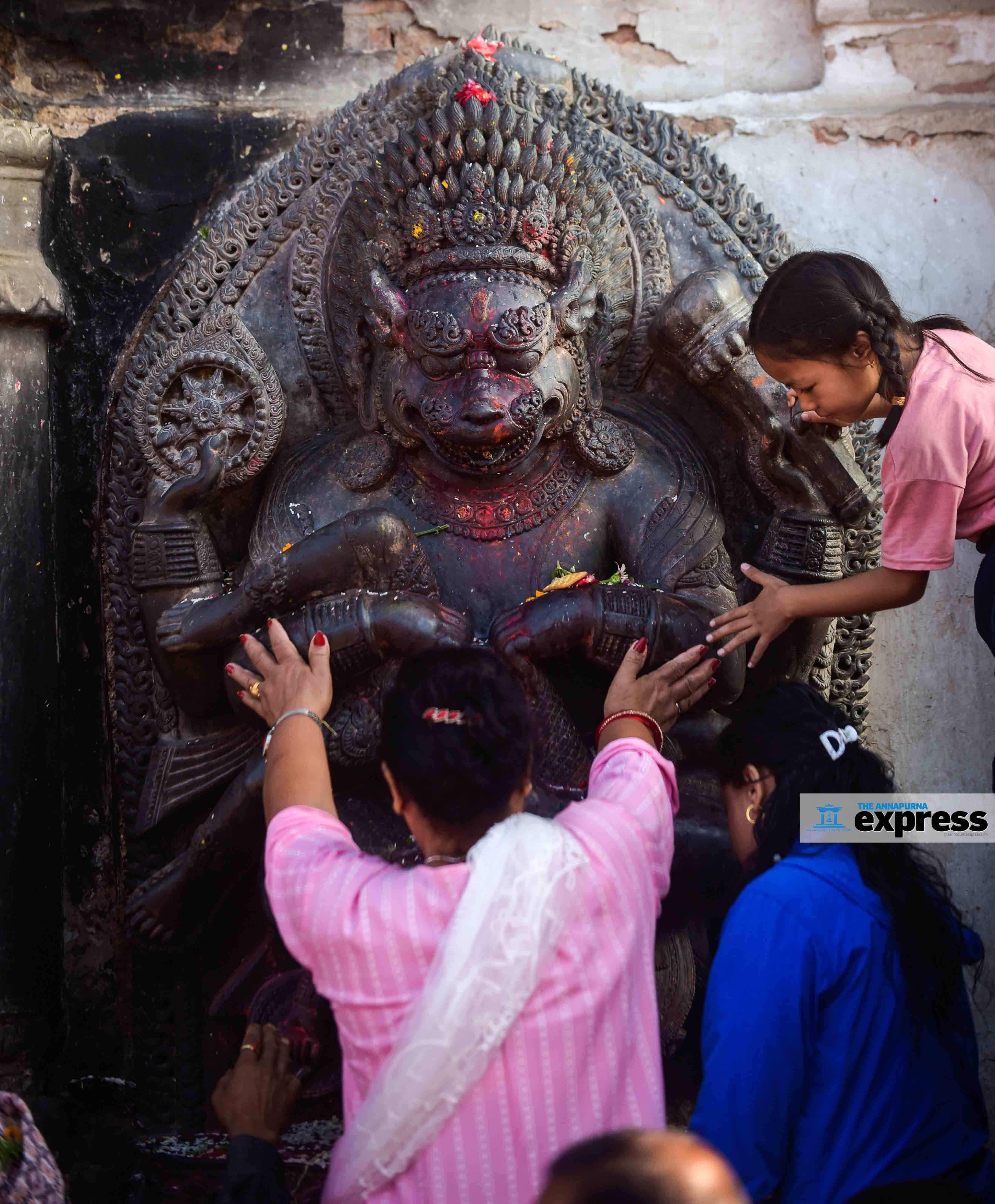
This morning I decided to take a tour around the square. As I walked in, I noticed women dressed in the traditional Newari attire ‘Haku Patasi.’ With their offerings in hand, they were all walking toward a temple. I could also hear men chanting Hindu devotional songs (bhajan) to the beats of their traditional musical instruments.

After I parked my vehicle, I started walking, observing the local vendor market.The place was buzzing with people, many of them shopping for groceries from local vendors. Around the square, there were numerous shops and stalls filled with handicrafts, paintings, statues, and posters of Hindu deities.

The square is still undergoing renovation after being devastated by the 2015 earthquake. With the majority of the temples already restored, this important historical and cultural site has regained its old charm.


What are Dahal’s agenda in New York and Beijing?
Earlier this week, Prime Minister Pushpa Kamal Dahal sought cross-party advice to shape the agenda for the 78th UN General Assembly taking place in New York from Sept 18-26. Dahal’s plans extended beyond the formal assembly proceedings; he wished to gather insights for the high-stakes meetings he is slated to hold with influential world leaders on the assembly’s sidelines. His journey doesn’t end there—he’s also gearing up for a rendezvous with Chinese leaders in Beijing, where he will fly next after attending the UN meeting.
The gravity of Dahal’s presence in New York cannot be overstated. Since 2018, no Nepali prime minister has graced the UN General Assembly with their physical presence. In the intervening years, the world witnessed virtual addresses by the prime minister and the occasional foreign minister attending on Nepal’s behalf. The Covid-19 pandemic only exacerbated the situation, where remote participation was encouraged.
This year, Dahal is set to make history by addressing the general debate of the 78th UN General Assembly. World leaders will convene to deliberate on how best to confront the multifaceted global polycrisis and expedite the realization of the 2030 Agenda for Sustainable Development. The Sustainable Development Goals (SDGs) will take center stage, rallying leaders and communities alike to reaffirm their commitment to these goals at the halfway mark to 2030.
Another marquee event is the Climate Ambition Summit, scheduled for Sept 20. This presents an invaluable opportunity for leaders to collectively demonstrate their resolve to tackle the ever-escalating climate emergency, as emphasized by the UN.
In the United Nations chamber, Dahal is poised to advocate for several crucial issues. He intends to spotlight the devastating impacts of climate change and the intricate challenges posed by Nepal’s transition from a Least Developed Country (LDC) to a Middle-Income Country, particularly in the realms of international trade and a gamut of socioeconomic concerns.
Crucially, Dahal will strive to reassure the international community regarding the culmination of Nepal’s transitional justice process, aligning it with the Supreme Court’s verdict and international norms. He was planning to present the transitional justice bill in Parliament before his departure to New York, but the main opposition, CPN-UML, didn’t cooperate.
But Dahal has to understand that even as he endeavors to advance his vision, the international community remains skeptical of the current bill, challenging his resolve to forge ahead.
Of late, the Dahal government is under immense pressure to expedite the transitional justice process. During a visit by US officials to Nepal, they inquired the Nepali leaders about the transitional justice process, perhaps prompting Dahal to feel the heat.
In New York, the prospect of Dahal holding high-level meetings remains uncertain, with the exception of a photo opportunity with US President Joe Biden. Dahal is at a crossroads, navigating between his pursuit of a blanket amnesty and the resolute international opposition.
The Beijing leg of his journey presents its own set of challenges, particularly concerning the contentious map issue and the broader development agenda. While he may not have broached this topic during his New Delhi visit, mounting pressure from opposition parties and civil society might compel Dahal to address the map issue unequivocally, at least for domestic consumption.
To further complicate matters, Dahal grapples with other pressing priorities. He must finalize the implementation plan of the Belt and Road Initiative (BRI) while navigating the delicate terrain of Nepal’s stance on China’s evolving claims regarding the BRI, Global Security Initiative, and Global Civilization Initiative.
Dahal has long sought to make progress in his dealings with China but exercises caution, especially given security considerations embedded within the proposed plan. His coalition partner, the Nepali Congress, has reservations about embracing the BRI, further complicating matters. With Nepal’s acceptance of the US Millennium Challenge Cooperation fund under the Indo-Pacific Strategy, Beijing is pressuring Dahal to make headway on the BRI.
Last week Dahal also talked about inking a deal on power trade with China, but the chances appear slim. He recognizes the pivotal role played by continuous support from New Delhi and Washington in sustaining his government. Both India and Western powers closely scrutinize Dahal’s China policy. Unfortunately, substantial preparations for his Beijing visit appear lacking, with Foreign Minister NP Saud notably absent from Beijing preparations in favor of the New York leg.
As a prelude to the visit, Nepali Ambassador to Beijing Bishnu Pukar Shrestha engaged with Liu Jinsong, the director-general of the Department of Asian Affairs of the Chinese Foreign Ministry. Their discussions centered on deepening mutual understanding and trust, underscoring Nepal’s unwavering commitment to the One-China policy. Nepal aims to fortify traditional friendship and expand cooperation across diverse domains including the BRI with China. Yet, for China, security remains paramount, and Dahal’s visit presents an opportunity to seek reassurances on this front.
The shadow of the Chinese map issue and the Chinese ambassador's recent comments regarding India cast a pall over Dahal’s visit preparations. Beijing may not harbor high expectations this time around, appearing more amenable to New Delhi. Nevertheless, they favor the continuity of Dahal’s government over the Nepali Congress, recalling their ‘bitter experiences’ with the previous Sher Bahadur Deuba-led administration. Incremental progress and reaffirmations of past agreements may be on the agenda, but transformative breakthroughs seem unlikely. Dahal, now seasoned and matured since 2008, must balance his overtures to Beijing to prevent a change in government—a recurrent theme in Nepali politics dating back to the Panchayat era.


